
Rappel : Si vous voulez limiter les mails, vous pouvez choisir de recevoir seulement les articles en français : Gérer votre inscription
Bonjour chers lecteurs,
Nous vivons une nouvelle aventure cette semaine avec l’arrivée hier du correspondant italien de Titus, Tommaso. Il est venu avec sa classe pour passer une semaine à Aix-en-Provence. Chaque élève italien reste dans le foyer d’un correspondant français, comme Titus, et dans un mois ce sera le tour des français d’aller passer une semaine en Italie. Les autres enfants ont été enthousiastes dans leur accueil (pendant tout le diner, Benjamin répétait inlassablement “Hi Tommaso”), et bien qu’il nous faille nous serrer un peu dans notre petit appartement, nous sommes sûr que ce sera une belle expérience pour nous tous.
L’autre grand événement pour la semaine est une soirée « Pose toutes tes questions sur le christianisme » qui aura lieu à la Faculté Jean Calvin ce soir même. Ce seront Yannick Imbert, professeur d’apologétique, et moi qui répondrons aux questions. Je serais reconnaissant pour vos prières qu’il y ait beaucoup d’étudiants qui viennent et que l’Esprit nous donne de communiquer clairement vérité de Jésus Christ.
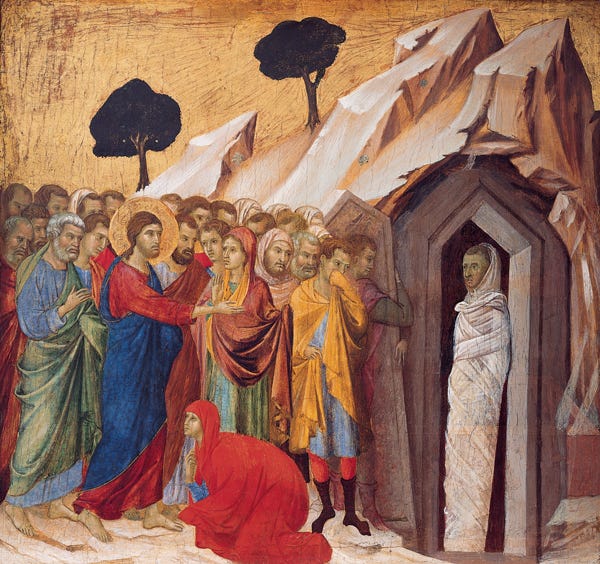
Ne t’ai-je pas dit que, si tu crois, tu verras la gloire de Dieu ?
Il y a, pour cette affirmation, au moins deux façons de comprendre la relation entre la condition (si tu crois) et le résultat (tu verras la gloire) :
(1) Si tu crois, Jésus fera un miracle grâce à ta foi, et tu verras cette manifestation de la gloire de Dieu.
(2) Si tu crois, tu verras la gloire de Dieu dans le miracle que Jésus va faire que tu le croies ou non.
Il y a plusieurs autres passages dans les évangiles qui semblent aller dans le sens de la première option :
Matthieu 9.28-29 – Lorsqu’il fut arrivé à la maison, les aveugles s’approchèrent de lui, et Jésus leur dit : Croyez-vous que je puisse faire cela ? Oui, Seigneur, lui répondirent-ils. Alors il leur toucha les yeux, en disant : Qu’il vous soit fait selon votre foi.
Matthieu 9.2 – Jésus, voyant leur foi, dit au paralytique : Prends courage, mon enfant, tes péchés te sont pardonnés.
Marc 6.5-6 – Il ne put faire là aucun miracle, si ce n’est qu’il imposa les mains à quelques malades et les guérit. Et il s’étonnait de leur incrédulité.
Par contre, il y a d’autres textes où Jésus opère des miracles pour les gens qui n’ont pas de foi :
Marc 4.39-40 – S’étant réveillé, il menaça le vent, et dit à la mer : Silence ! tais-toi ! Et le vent cessa, et il y eut un grand calme. Puis il leur dit : Pourquoi avez-vous ainsi peur ? Comment n’avez-vous point de foi ?
Jean 5.6-8, 13 – Jésus, l’ayant vu couché, et sachant qu’il était malade depuis longtemps, lui dit: Veux-tu être guéri ? Le malade lui répondit : Seigneur, je n’ai personne pour me jeter dans la piscine quand l’eau est agitée, et, pendant que j’y vais, un autre descend avant moi. Lève-toi, lui dit Jésus, prends ton lit, et marche. […] Mais celui qui avait été guéri ne savait pas qui c’était.
En effet la deuxième option est théologiquement satisfaisante en plusieurs égards. Nous savons que Jésus va ressusciter Lazare même si personne ne s’y attendais. Et nous avons plusieurs exemples de personnes qui ont témoigné ses miracles sans y percevoir la gloire de Dieu. Judas les a vu tous sans jamais comprendre qui Jésus était, et les pharisiens préféraient les attribuer à Béelzébul plutôt qu’à Dieu (Lc 11.15). Même la résurrection de Lazare laisse indifférents ceux qui n’ont pas reçu la grâce d’y voir la gloire de Dieu :
Jean 11.45-46 – Plusieurs des Juifs qui étaient venus vers Marie, et qui virent ce que fit Jésus, crurent en lui. Mais quelques-uns d’entre eux allèrent trouver les pharisiens, et leur dirent ce que Jésus avait fait.
Alors, est-ce la deuxième option donc que Jésus entend en Jean 11.40 ? Je ne suis pas sûr, et je me demande si ce n’est pas une combinaison des deux. Marthe objecte à l’ouverture du tombeau en pensant d’une façon purement humaine, et Jésus veut qu’elle lui fasse confiance, et qu’elle s’attende à voir des manifestations de la gloire de Dieu. Elle doit donc (1) ne pas l’empêcher de faire le miracle en refusant d’ouvrir le tombeau, et (2) ne pas limiter ou ignorer la puissance de Dieu dans sa façon de voir les choses. Et sous tous les angles, le problème reste le même, et c’est souvent le nôtre : c’est habitude humain de négliger Dieu dans nos calculs, de présumer qu’il n’est actif dans ce monde ou qu’il n’agira pas pour nous dans nos circonstances. C’est en réponse à cette incrédulité que Jésus dit, « si tu crois, tu verras la gloire de Dieu. »
~
The great feast was repeated on the anniversary of the first one. Tovah directed the ceremony with three-month old Gibbor on her arm. He was big for his age and active, and his mother’s pride in the son she had born to Malakh was immeasurable.
The following week, Tovah’s happy peace was shattered by the passage of a traveller just come from Havilah. He brought the news that a maiden of that city, Tsereh by name, was pregnant by a God who had appeared to her in the form of a blue serpent as she was bathing in a forest stream. Jealous fury consumed Tovah’s entire soul, and the only thought that could bring her the least comfort was that of bringing about the death of Tsereh. In her dreams she killed her rival a hundred different ways, and by day all her thought was bent toward schemes to bring about war between Raamah and Havilah.
Two months later her chance came, and she hired an assassin to murder her father’s chief counselor while he was visiting Havilah. Of course she assured her father that the anger of Malakh burned against Havilah, and that he would surely give success to their army. And so, with satisfaction, Tovah watched the men of Raamah march off to war.
Within three days the report of total victory returned to Raamah. All the men of Havilah had been killed or scattered, the women and children captured, the city burned. However, in the days that followed, despite her many inquiries, Tovah could not find out that Tsereh had either died or been captured. Surely she must have perished, either in the destruction of the city or in wandering in the wilderness. Still, doubt gnawed at her even as there was nothing else to be done about the matter.
~
At fourteen years old, Gibbor was as big as any man in the city, and stronger than any two of them put together. Restlessness drove him often from the city for days at a time where he would hunt and explore, sometimes taking two or three other boys with him. Once he overheard the herdsmen speaking in hushed tones of an enormous tiger that would come into the herd and carry off any animal it chose, even during the day. The next morning Tovah woke to find the tiger’s pelt proudly tacked up to the front wall of the house.
The following year the rumor went out about a gang of vicious brigands way-laying travelers on the Sabteca road. Tovah hurried to find Gibbor to forbid him to leave the city, but he was already gone. For three days, she did not leave the temple, tasting nothing, praying day and night for her son’s safe return. On the fourth day at sunrise, Gibbor entered the city to shouts of astonishment and presented to his grandfather the six heads of the brigands. From then on in Raamah whenever anything needed to be done which wanted courage or strength or cunning, every eye looked to Gibbor.
~
Some years later, the time came for the old king to go the way of all flesh. Gibbor was on a journey at the time, and Nimhor, the eldest of the king’s surviving sons sat on his father’s seat in the king’s hall. A week later when Gibbor returned, he stormed into the hall and demanded the kingship for himself. Tovah too, standing at his side, urged her brother, “My son is the son of our great God Malakh. You have no right to deny him what he seeks.”
“No right, sister? Who is this fellow? He is no son of our father Javan. I am the son of Javan and heir to all that was his. Tell your bastard boy to leave my hall before something bad happens to him.”
Gibbor made an enraged sound in his throat and moved toward Nimhor. Hastily, two guards with spears stepped in front to shield their lord. Gibbor smiled mockingly, and then in a movement that the eye could not follow, he snatched one guard’s spear and slew the other with it. The first guard fled, and Tovah shrieked as Gibbor grabbed Nimhor by the shoulders and savagely head-butted his face. Letting the lifeless body crumple to the ground, he turned to his mother, his face radiating joy, “You warned him, mother, didn’t you.”
~
Gibbor was now king of Raamah, with ambition to be even greater. He set out to bring other cities under his dominion, starting with Pi-Hagihon. This was quickly accomplished, and as the spoils came into Raamah, the people began to think of the abundance of gold and silver and slaves that would soon be theirs thanks to their new king. Flush with confidence, the army soon departed in the direction of Sabteca.
That night, Tovah was trimming lamps in the temple under the watchful stone eyes of Malakh, when she began to hear some distant sound. Was it singing with instruments? The sound grew nearer and turned into a cry of alarm.
“Enemies! Enemies within the gate!”
Rushing to the door of the temple, she looked out into the square. Some few people ran here and there as the clangs and yells slowly worked their way up the hill. Tovah stood frozen in the doorway. What was the use of running? There was nowhere to flee.
Torchlight appeared, flickering in one of the streets, and then the raiders burst into the square. One of them seemed enormous, and for a fleeting moment she almost thought it was Gibbor. They spotted her and the temple, and rushed forward as she sank to her knees. Then they were all around her, and a woman stepped forward, looking down at Tovah with vengeful delight.
“So this is the priestess of Malakh.”
Tovah looked up at her questioningly.
“Your service is finished. Give me your ornaments.”
Tovah clutched at the gold snake pendant she had worn so long, but the woman struck her across the face, and she fell to the ground. The men took the pendant from her and the rings she was wearing, and Tovah looked up again to see the woman placing the pendant around her own neck.
“I am the priestess of Malakh now, and I shall serve him in this house.” Looking down at Tovah she added, “After all, I too have born him a son.”
“Tsereh,” breathed Tovah.
“Yes. We are the survivors of Havilah, and this is the son that I bore to Malakh, Ben-Hanahash. Many years we have longed to exact our revenge on Raamah, and now at last…” She sighed in triumph. Then, considering Tovah for a moment, she gave a command. “Take this one out and tie her to a tree. Let her God decide her fate.”
~
All that night and all the next day Tovah cried out to Malakh, weeping and imploring him to come. They had left her in the very clearing where she had first met the serpent God, and it seemed somehow inevitable that he should reappear exactly where she had seen him before. But no one came, and finally exhaustion overcame her, and she fell asleep.
Tovah woke to find a slave woman working hard to undo the knots that bound her to the tree. The woman looked up briefly and Tovah recognized with a shock the face of her sister.
“Shifhah?”
“Not so loud, yes it’s me.” As Shifhah struggled with the bonds she explained. “The Havilim have taken the city for themselves, and we are all their slaves. I heard what happened to you, and I slipped out here to help you. Told the gate guards I had been sent on an errand… oof, that’s got it.”
The rope ends came loose, and as the coils unwound, Tovah fell to the ground, her limbs completely numb.
“I’ve got some bread here for you. You can hide in the forest. It won’t be long now before your son comes back with my husband and all the men. They’ll send these accursed brigands to a bad end.”
Tovah managed to sit up and take the bread from her sister’s hand.
“I’ve got to get back. It’s probably already a beating for me.”
~
Tovah hid in the forest ten days. One other time Shifhah was able to bring her some more bread. There was a creek for water, and she found a few berries besides. Mostly she sat at the edge of the clearing, twisting and untwisting her hair to the rhythm of the anxious thoughts chasing themselves round and round and round again.
Evening shadows were lengthening on the tenth day when Shifhah reappeared, hurrying through the clearing, looking fearfully over her shoulder.
“Tovah,” she cried, grasping her sister’s shoulders and trying to catch her breath. “The men returned… this morning… oh Tovah…. they were ambushed… in the gate.”
“Gibbor!?”
The pain in Shifhah’s eyes was all too clear. “He is dead my sister, along with my husband and all the men. Their bodies are hanging on the city wall.”
Falling to her knees, Tovah tore her robe and wailed. Her soul was a fountain of agony bursting forth in wretched sobs as she rocked back and forth. Shifhah took her in her arms, holding her head against her chest. Only for a moment, then she spoke urgently into her ear.
“Tovah, you must flee. You must run away from here, Tovah, there is nothing left for you. Go far away and live and carry the memory of our family with you.”
Tovah looked in Shifhah’s eyes. “What did I do wrong? What did I do to displease him? Why is he letting this happen to us?”
“Who knows, Tovah? He is a God. They do not really care for us you know.”
“No but I must have done something. I must have dishonored him. Oh, if only I had known. I would have done anything to appease him. If only I had died and he had lived!” Fresh sobs burst forth and she buried her face in the ground.
“Tovah, it’s no use. Let me have this one comfort, to know that you are alive and safely away from here. I must go back now. Do not delay, my sister, once I am gone. You must flee tonight.”
~
Tovah could not flee that night. She had to see for herself. Silently in the dark, she crept up to the wall. There he hung, his hands suspended, his head limp on his chest. Such a fine, handsome son. Tovah gazed and drank her pain in deep draughts. For hours she stood, looking silently, unable to break her eyes from the horrible corpse, unwilling to leave the child of her womb.
Only when the eastern sky paled did she come to herself. Then panic seized her, and she fled into the woods, running as the antelope before the wolves.
~
When Tovah could run no further, she collapsed and slept where she was. Waking again, she continued her way, neither knowing nor caring where her feet took her. After three days she came out of the forest into a land of grassy rolling hills. For three more days she journeyed, sleeping when too tired to walk, rising and moving when too cold to lie still.
On the third day her drooping eyes failed to notice the gathering clouds before the first drops smote her face. Looking quickly up and clutching her torn robe to her chest she peered anxiously around for any kind of shelter. The empty hills offered her nothing, not so much as a gorse bush. And now the rain poured down in earnest, soaking and chilling her to the marrow of her bones. Grey walls of water closed in around her, and finally giving up the fight, Tovah curled up on the ground and waited for death.
~~~
Qui en a envie ?!
~
Au milieu de la place de la ville et sur les deux bords du fleuve, il y avait un arbre de vie, produisant douze fois des fruits, rendant son fruit chaque mois, et dont les feuilles servaient à la guérison des nations.
Apocalypse 22.2
Aucun post
Comments
Nothing yet. Say the first thing.
Sign in to join the conversation.