
My day began at 430am today. The birds were singing long before I made it to my toothbrush, and the crescent moon hung peacefully with purpose in the sky as I made it to my car for my volunteer job with bird banding. More on that role here.
This Sunday flew by in a whir of miles. All one hundred and eleven of them. There were dirt roads and one-way bridges, tolls and parkways. Shore traffic and all. And I write this now at 545pm on Sunday evening. My car is done for the day, and I am not far behind.
A quick 20 minute drive and I arrive at the field for work, the sun had barely reached above the tree line…and it was was certainly different than the weeks’ before. We have had rain. Lots of it. Green was everywhere…and some places the paths we walk were covered with flopped over ferns and slender mountain mint gracefully doing their job: growing.
The day at my volunteer job usually belongs to an assortment of warblers, flycatchers, Northern cardinals and American robins. It wasn’t much before 715am that my iced coffee soon became an afterthought. There was “a good bird.” That could mean many things. Add in a “really” to that sentence and the coffee immediately becomes less important. There’s always good birds to look forward to, like tanagers, buntings, towhees, common yellowthroats, and even some wood thrushes and brown thrashers. And then, there was a Cooper’s hawk. What a glorious creature to see up close. Keen, stoic, slightly bad ass. A really good bird.
Over eleven years of bird banding research at this location, and we have only seen Accipters twice come to the station. And today was one of them.
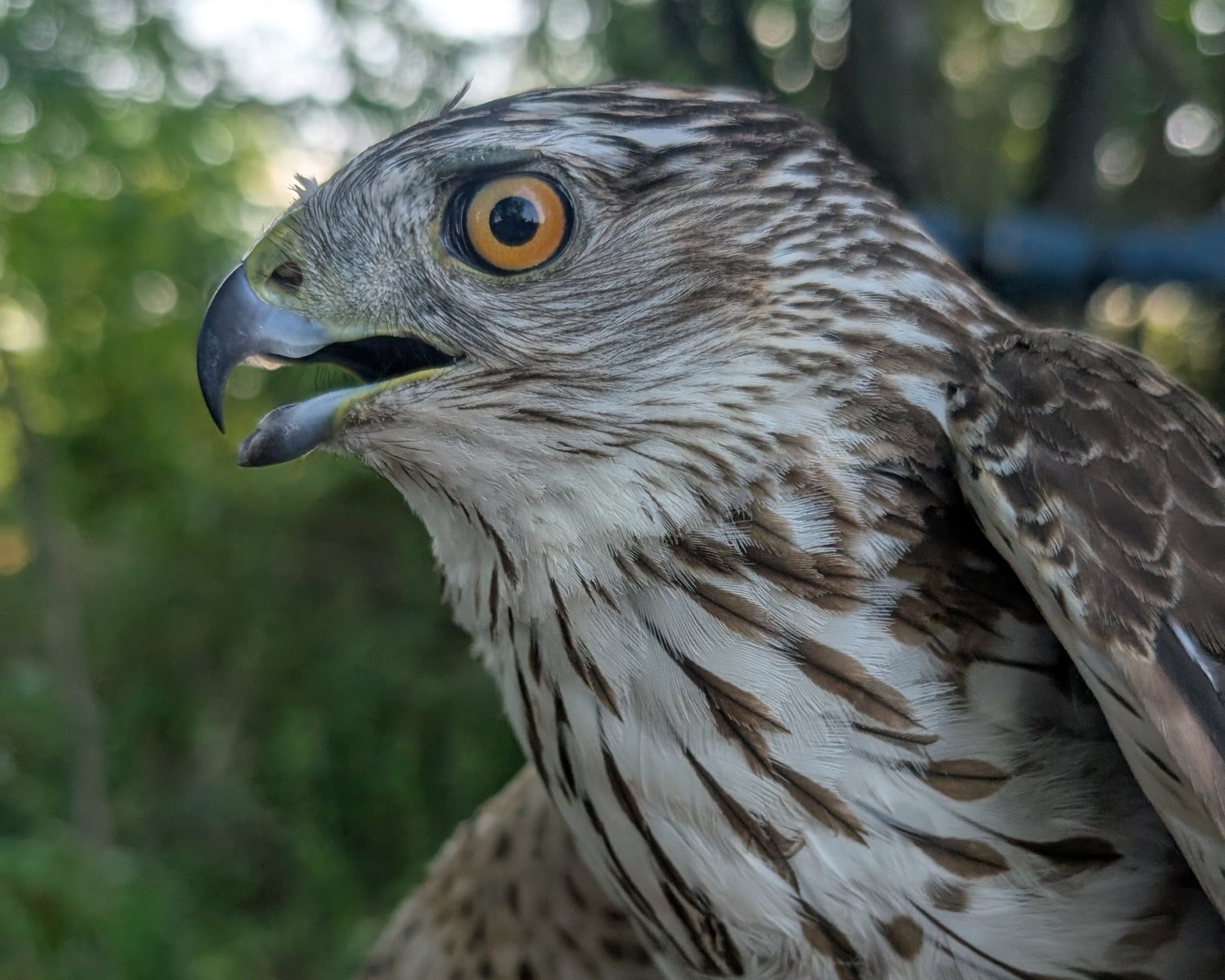
After that moment, and the bird was let go, other “good birds” trickled in. A juvenile Eastern Towhee and some prairie warblers. A few more even beyond those, plus some recaptures. (As the Communications and Data Story Telling Coordinator for this organization, recaptures always have additional props in every story.)
But it soon came time to leave my volunteer hat on a hook until next week, and return to my full-time job. Being a mom.
Whether it's swimming, sleepovers, pool parties or swim meets, my summer has been chock-full of road trips. So I found myself far from birds and well into that occupation for the rest of the day.
And what does bird banding and driving 100 miles with your daughter have in common? Well, when you see these birds up close, you can see the pink stains on their heads from eating berries. You see their crop full of their latest meal. You can see the wear on their tail feathers from surviving in dense undergrowth. You can read their plumage for age. And you can the sharpness of their talons.
It is not unlike being buckled next to a passenger. You get a tiny slice of their 14-year-old life up close through quick stories and briefings that start with “Oh, I can’t believe I forgot to tell you….”
And in over 100 miles today, there was plenty of catching up to do. And lots of music.
*The Wild Bird Research Group (WBRG) conducts conservation and banding science, working extensively in locations like the Fiddler's Creek Preserve in New Jersey. All bird handling is strictly conducted by trained, federally permitted biologists for research purposes—never without proper authorization.
Comments
Nothing yet. Say the first thing.
Sign in to join the conversation.