
Picking the stock is the fun part. Deciding how much to buy is the part that quietly decides how you actually do.
Van Tharp built a career around this idea. He ran a simple exercise at seminars for years. You draw marbles from a bag. Sixty out of a hundred are white and you win whatever you risked. Forty are blue and you lose whatever you risked. The odds are clearly in your favour, better than anything in a casino, and everybody in the room draws the exact same marbles in the exact same order. The only thing each person chooses is how much to bet on each draw.
The results come out wildly apart. Some people finish with a pile of money. A big chunk of the room goes broke. Tharp’s own tally from running it, which is his count from live seminars rather than a controlled study, put the bust rate at somewhere around a third.
Same game. Same odds. Same draws. Different amounts.
That’s the whole point. The size is the steering wheel.
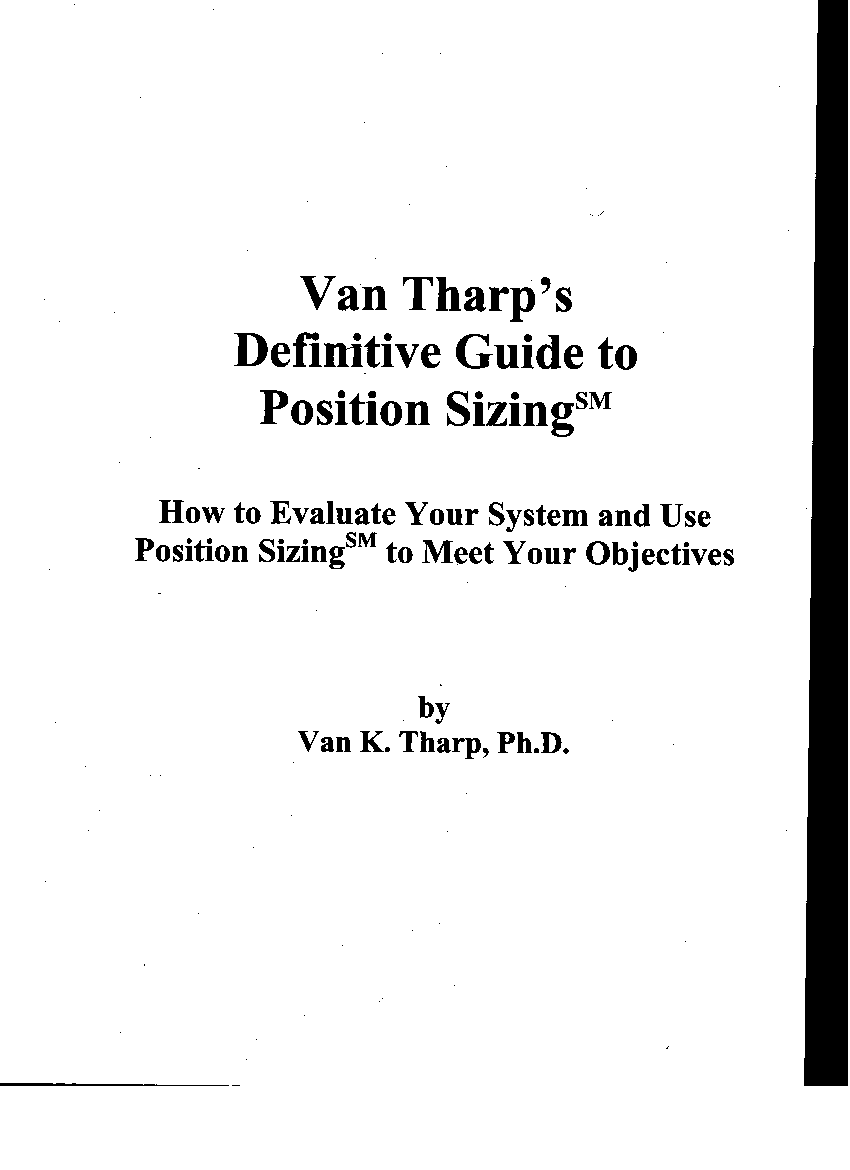
P.S. This topic was suggested by the Fluenteers in the community. Do you want to suggest a topic? Join the chat! I read Van Tharp’s book ‘‘Definitive Guide to Position Sizing’’ to answer this question. Here are my notes summarized and put into a guide for you to enjoy.
Before you can size a single stock, you need to know what you’re sizing it against.
Most of us hold a few different things. Some bonds or cash. A couple of broad ETFs. Then a handful of individual stocks we picked ourselves. That last group is the only place where your judgment is really being tested, so give it a name. Call it your stock sleeve.
Write down one number: what share of your total money lives in that sleeve.
Maybe it’s 30%. Maybe it’s 70%. There’s no correct answer, and it depends on your age, your income, and how much of a drop you can actually sit through without doing something silly. Just pick it on purpose instead of letting it happen by accident.
Here’s the key move. Size every stock as a percentage of the sleeve, not of your whole portfolio.
Why? Two reasons.
The sleeve is the money you’re actively deciding about. Measuring against it keeps your decisions clean.
If you measure against everything, your stock bets silently shrink every time you add cash to your bond bucket. That makes no sense. Nothing about the business changed.
So if your sleeve is €100,000 and you put €6,000 into a name, that’s a 6% position. Doesn’t matter that it’s only 2% of your total. Inside the sleeve, it’s a 6% bet, and that’s the number your decisions should live on.
One nice side effect of this setup. The bigger your bond and ETF ballast, the more concentrated your sleeve can afford to be. A boat with heavy ballast can carry a taller sail.
Here it is. How far can this fall if I turn out to be wrong?
Not how far it could fall in a market crash. Everything falls in a crash. I mean the specific thing: your reason for owning it turns out to be untrue, the market figures that out, and the stock re-rates.
Tharp called this the risk on the trade, and he measured everything in units of it. He called one unit R. Traders get R by setting a stop loss. You probably don’t use stops, and for a business you plan to hold for five years, you shouldn’t. So you need a substitute.
Your substitute is an honest estimate of how much of that position disappears when the story breaks.
Some rough anchors, and I’d stress the word rough:
Steady, profitable, boring compounder on a sensible multiple. If you’re wrong, maybe you lose 25% to 35%. The earnings are real, the balance sheet holds, and the shares find a floor.
Good grower on a full multiple. Call it 40% to 50%. When growth slows, the multiple and the earnings fall together, and that hurts twice.
Fast grower, thin profits, expensive. 55% to 70% is normal. There’s very little underneath the price except belief.
Story stock, no profits, hope in the multiple. Assume 75% or worse, because that’s what these do.
You will not get these exactly right. That’s fine. You need them to be roughly right and honest, and the honest part is harder than the roughly part. If your first instinct is “well, it can’t really drop 60%,” go pull up the chart from 2022. It probably did.
Pick a risk budget first. This is how much of your sleeve you’re willing to lose on one idea going wrong. Two percent is a sensible starting point.
Then:
Position size = risk budget ÷ your downside estimate
That’s the whole calculation. Run it at 2%:
Downside of 30% → 2 ÷ 0.30 = a 6.7% position
Downside of 40% → 2 ÷ 0.40 = a 5.0% position
Downside of 50% → 2 ÷ 0.50 = a 4.0% position
Downside of 65% → 2 ÷ 0.65 = a 3.1% position
Downside of 80% → 2 ÷ 0.80 = a 2.5% position
Look at what that does. The boring compounder gets roughly two and a half times the money the speculative name gets. Nobody had to argue about it. The math just sorted them.
And notice that every one of those positions costs you the same 2% of the sleeve when you’re wrong. Same pain, every time. That’s what makes a portfolio survivable.
If you run the numbers and end up holding more cash than you want, don’t fudge the individual sizes. Raise the risk budget to 2.5% or 3% across the board and run it again. Change the dial, not the readings.
A quick sanity check on why any of this matters. Lose 20% on your sleeve and you need 25% to get back. Lose 50% and you need 100%. Lose 80% and you need 400%. The hole gets deeper much faster than it looks, which is why the size of the hole is the thing you control first.
The formula can hand you a number that’s still a bad idea. So put a ceiling on it.
No more than 12% of the sleeve in one name when you buy it. However good it looks. However well you know it.
No more than 25% in one theme. Three semiconductor names are one bet wearing three hats. Size them like one bet.
The sleep cap. Imagine it opens down 50% tomorrow morning on bad news. If your honest reaction is that you’d sell in a panic, the position is too big. Cut it until the answer is “annoying, and I’d go read the report.”
That third one isn’t soft. Behaviour is a real constraint. A perfectly sized position you abandon at the bottom performs worse than a smaller one you actually hold.
Think about getting into cold water. Some people dive. Most of us walk in.
I’d use two or three tranches for almost everything, and here’s how to do it without turning it into guesswork.
Set the triggers before you buy the first piece. Write them down. A trigger can be a price level, or a piece of evidence, or just a date. Evidence is best. Something like “two more quarters showing the margin holding above 20%.”
A simple pattern that works:
Half now. Enough that you actually pay attention to it.
A quarter when your first trigger hits. Your evidence showed up, or the price came to you.
A quarter when the second one does. Or never, if it doesn’t.
When to just buy the whole thing at once:
You’ve already done the work and you’re confident in the numbers.
The business is stable and the multiple is reasonable.
The full position is small enough that being early doesn’t really hurt.
Be honest about the cost here. Buying in pieces will lose you money on the names that go straight up, and that will sting. What you’re buying with it is information and a calmer head. That’s a fair trade for most people, most of the time.
Only one good reason to add. The business is doing better than you expected.
The reason is evidence. The thing you hoped would happen is showing up in the numbers, quarter after quarter, in a way you can point at. A rising price on its own doesn’t count for much here. A falling price counts for even less.
Before you add, run this test:
Knowing everything I know today, at today’s price, would I open this position at this size from scratch?
If no, don’t add. It’s that simple, and it’s uncomfortable often enough that you know it’s doing real work.
One thing people forget. When a stock doubles, the downside on it usually grew too, because the multiple is higher now. So recalculate. A name that earned a 6.7% slot at €40 might only earn a 4% slot at €90.
Good reasons to trim:
It grew past your ceiling. Set that ceiling at around 20% of the sleeve for a winner that’s run.
Your downside estimate went up. Same business, richer price, more to lose.
You found something clearly better and you have no cash.
You genuinely can’t sleep.
Bad reason to trim: it went up a lot. That’s not information. Great businesses spend most of their lives making you feel like you should take some off.
When you do trim, cut back to the ceiling and stop. Don’t nibble away at a winner every few months because it drifted 1% over target. That’s how you end up with a portfolio of nothing but your mistakes.
Write your exit reasons on the day you buy, while you’re still calm and still capable of thinking clearly about it. Three legitimate ones:
The thesis broke. The specific thing you said had to be true stopped being true.
The price now needs a future you don’t believe in. You’d have to assume something you can’t defend.
Something else is clearly better and you need the cash.
That’s the list. A falling price isn’t on it. Boredom isn’t on it. Somebody on the internet being negative isn’t on it.
For the impatient:
Decide what share of your money is in single stocks. That’s your sleeve.
Size everything as a percentage of the sleeve.
Pick a risk budget, around 2% of the sleeve per idea.
Estimate how far each stock falls if you’re wrong. Be honest, then be a bit more pessimistic.
Position size = risk budget ÷ downside estimate.
Cap any single name at 12% at purchase and 20% after it runs. Cap any theme at 25%.
If a 50% drop would make you panic, it’s too big.
Buy in two or three pieces, with the triggers written down beforehand.
Add when the business surprises you, never when the price does.
Trim to your ceiling. Sell when the thesis breaks.
None of this makes you right more often. That was never the goal. It makes being wrong cheap enough that being right has time to pay you.
—Yorrin
You know someone struggling with position sizing? Share this piece with them. 👇🏻
Comments
Nothing yet. Say the first thing.
Sign in to join the conversation.