
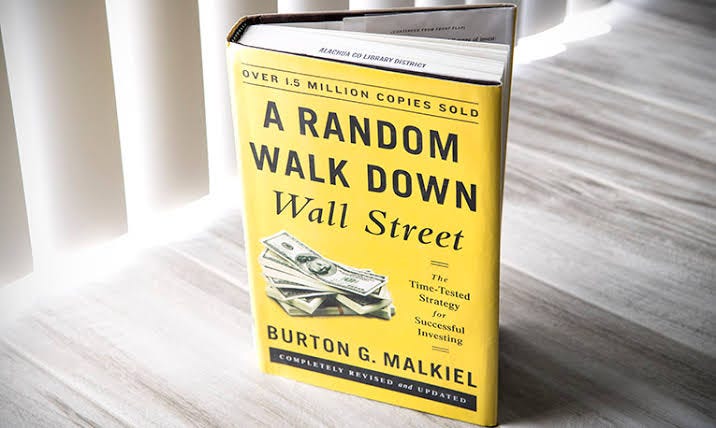
Burton Malkiel published A Random Walk Down Wall Street in 1973.
Fifty-odd years and thirteen editions later, it’s still the single most uncomfortable book on my shelf.
The argument, in one line: a blindfolded monkey throwing darts at the stock listings would beat the average professional.
Not a metaphor. He means it fairly literally.
And look, I run a newsletter built on picking individual companies. So I have every incentive to tell you Malkiel is wrong. Let me walk you through what he actually says first, and then I’ll tell you where I think the argument breaks.
About roughly 90% of Wall Street analysts are fundamentalists, give or take.
They believe in what Malkiel calls the firm foundation theory. That mean that every asset has an intrinsic value, price wanders above and below it, and your job is to buy the gap.
To calculate that intrinsic value, you need four inputs:
Earnings growth rate. The big one. Everything else is rounding.
Expected dividend payout. Higher payout, higher value, all else equal.
Degree of risk. Riskier cash flows need a fatter expected reward.
Future interest rates. The risk-free rate sets your baseline for everything.
Malkiel’s problem is that all four are guesses about the future, and he lists three ways the guessing goes wrong:
Faulty inputs. Reported numbers can be misleading, and they get especially misleading during periods of mass optimism. Every computer scientist knows the rule here. Garbage in, garbage out.
Analytical error. Even with clean data you’re making predictions without divine inspiration. Forecasting is hard, particularly the future bit.
Unexpected events. You can build a flawless model and then the primary plant gets hit by an earthquake, or the founder-CEO has a heart attack on a Tuesday.
The other 10% are technicians, and they run on the castle-in-the-air theory.
Intrinsic value barely matters to them. What matters is crowd behaviour, and whether you can find the assets most likely to attract castle-builders.
Malkiel’s analogy here is a beauty contest. You and a hundred strangers pick the three prettiest people in town, and whoever matches the crowd wins. Your personal taste is irrelevant. You’re guessing what everyone else will guess.
Tulip bulbs in the 1600s, conglomerates in the late 60s, internet stocks in 1999. Same game every time.
The technician’s case for why charts work:
Price increases feed on themselves. Nobody can stand watching other people get rich.
Information reaches insiders first, then their friends and family, then institutions, then you.
Investors underreact to news, which creates sustained momentum.
Malkiel’s rebuttals:
Reversals are sharp. By the time a trend is “signalled,” the move already happened.
Insiders maximise profit. If they know the stock is worth $30 and it’s at $20, they buy all the way up. There’s no polite queue.
The techniques defeat themselves. Once a signal is known, everyone front-runs it and the edge evaporates.
Four biases, and honestly this is the least controversial chapter in the book.
Overconfidence. We overestimate our forecasts and our abilities, then do sloppier work and take bigger risks because of it.
Illusion of control. We feel we’re steering random outcomes. Technicians catch this one badly.
Herd mentality. In Asch’s 1950s experiments, people gave an obviously wrong answer about line lengths after watching planted actors do the same. The follow-up finding is the disturbing part: it wasn’t just social pressure. Their actual perception shifted.
Loss aversion. Heads you lose $100, tails you win $100. Most people refuse. The upside typically has to reach about $250 before they’ll play.
A random walk means future steps can’t be predicted from past ones.
From that, three flavours of EMH:
Weak. Prices already reflect all past price data. Technical analysis is dead on arrival here, though fundamental analysis might still earn its keep.
Semi-strong. Prices reflect everything publicly known. Both approaches fail, and the only remaining edge is insider information.
Strong. Prices reflect everything, including what’s sitting in the CEO’s head. Even insiders get nothing.
There’s an old joke about this. A professor and his student are walking and the student spots a $100 bill on the pavement. The professor stops him. “Don’t bother, if it were real it wouldn’t be lying there.”
Malkiel doesn’t buy the strong version. His answer to the student is closer to: pick it up quickly, because if it’s real it won’t be lying there long.
That distinction matters more than people give it credit for. He’s arguing the market is hard to beat, and that’s a different claim from impossible to beat.
The number that does the heavy lifting: $10,000 into the S&P 500 at the start of 1969 grows to about $736,000 by 2014. The same money in the average actively managed fund gets you around $501,000.
A quarter of a million dollars, handed over in fees.
His prescription is boring on purpose. Long horizon, cheap index funds, spread across asset classes, with allocation shifting as you age.
The five principles underneath it:
1. Risk and reward are linked. Risk here means volatility, measured as how far returns stray from expectations. Higher volatility raises the odds you’re forced to sell at a bad moment.
2. Time reduces risk. Between 1950 and 2013, there was no 15-year holding period for US stocks that produced a negative return. Not one. Time in the market, rather than timing it.
3. Dollar cost averaging works. Fixed amount, fixed interval. You end up buying more shares when things are cheap and fewer when they’re expensive, which drags your average cost below the average price.
4. Know your own risk tolerance. It depends on your age, your finances, and your nerves. JP Morgan’s advice to a friend who couldn’t sleep was to sell down to the sleeping point. Still good advice.
5. Rebalance. Say you target 70% equities and 15% bonds. After a strong run you’re at 80/5, which is riskier than you signed up for. Restoring the target once a year pulls risk back down, and occasionally sells you out of something frothy.
Here’s my honest problem with the book, and I’ve had this argument with myself more than once.
Malkiel proves that the average active manager loses to the index after fees. That’s true. It’s arithmetically guaranteed, actually, because the average manager collectively is the market, minus costs.
What he doesn’t prove is that skill is absent. He proves it’s expensive and rare, which are different things.
A few specific cracks:
The fund data measures an industry, not a method. Career risk, asset bloat, forced diversification, quarterly redemptions. A fund manager running €4bn has constraints I simply don’t have.
His own semi-strong stance leaves the door open. Once you concede $100 bills exist on the pavement, you’ve conceded that somebody gets to pick them up. His argument is about how quickly they disappear, which is a question about small caps and coverage, and that’s precisely where I spend my time.
Efficiency isn’t uniform. A €300m Norwegian industrial with two analysts covering it is not priced by the same machinery as Apple. The theory tends to get tested on the liquid end and then applied everywhere.
None of that makes him wrong for most people. For most people he’s completely right, and the honest version of my job is admitting that.
Three things stuck, and they’ve genuinely changed how I operate:
Fees compound against you exactly as hard as returns compound for you. That $235,000 gap is the whole book in one number.
The bar is the index. If the work I do doesn’t clear a cheap ETF over a full cycle, the work isn’t worth doing. That’s a useful and slightly terrifying thing to keep on the desk.
Rebalancing is free risk management. Costs nothing, requires no forecast, works whether or not markets are efficient.
Read it if you pick stocks. Especially if you pick stocks.
The best books aren’t the ones that agree with you.
Fundamental analysis struggles because its four inputs are all forecasts
Technical analysis struggles because signals get arbitraged away once known
Human psychology makes both harder: overconfidence, illusion of control, herding, loss aversion
Markets behave enough like a random walk that most professionals can’t beat them after costs
The practical answer for almost everyone: cheap index funds, long horizon, annual rebalance
The gap Malkiel leaves open, deliberately, is under-covered corners where the $100 bills sit a little longer
What are you taking with you, or what are you disagreeing with, from Malkiel’s book?
—Yorrin
Comments
Nothing yet. Say the first thing.
Sign in to join the conversation.