
If you enjoy this post, I’d ❤️ it if you’d click the ❤️ at the top or bottom. Thank you!!

This week I continue the work theme of this month’s Flower Child with the topic of remote work. Everyone has an opinion about it, but what’s the reality? My reality may not be the same as your reality — and my reality of today may not be the same as my reality of a few decades ago. There’s more to remote work than meets the eye.

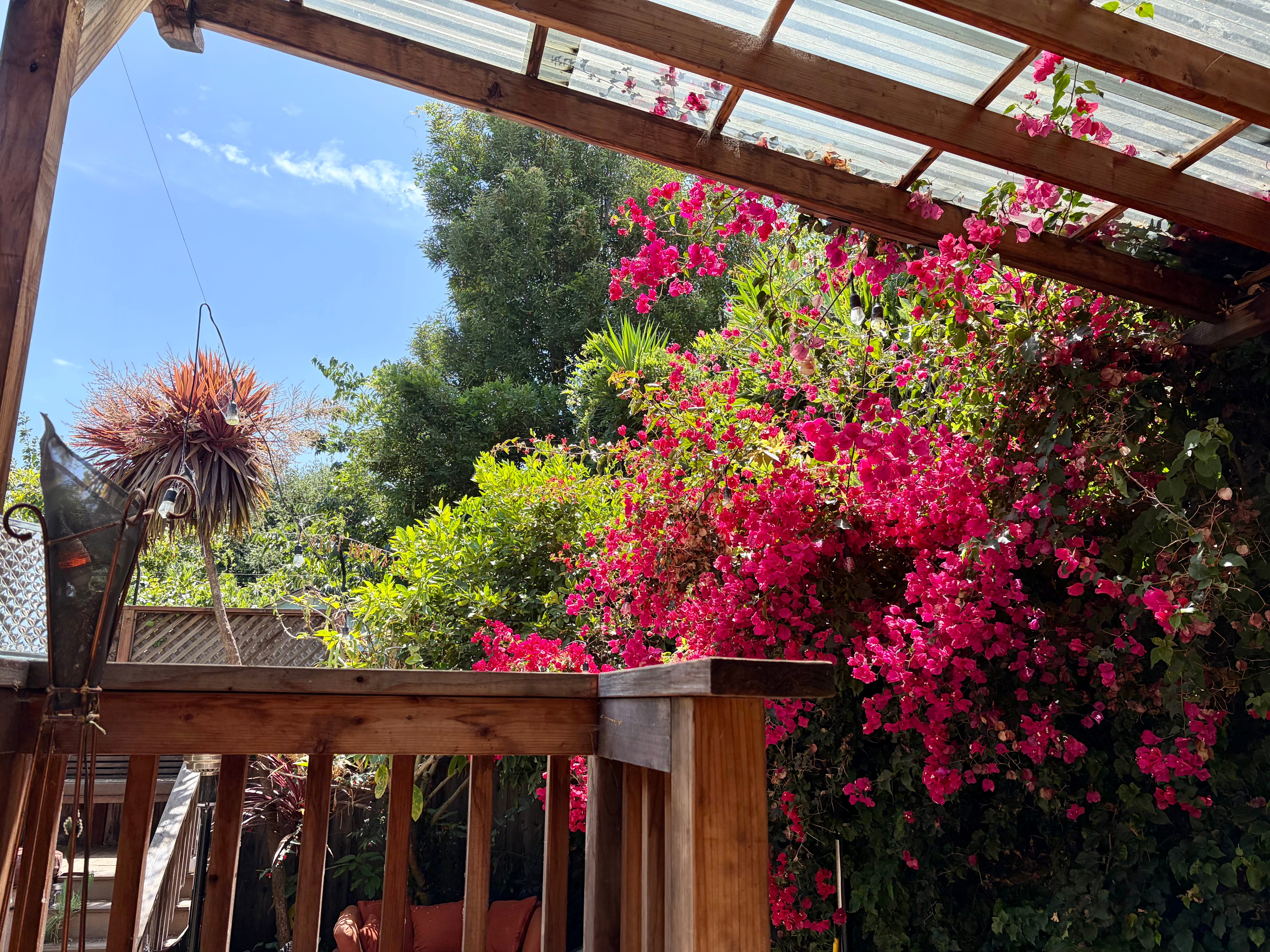
I’ve been working from home since 2017.
When the clean-energy startup that employed me closed and I had to look for a new job, a friend told me about a listing she’d seen for a communications director at a nonprofit.
I looked up the address and saw it was in Menlo Park — a 60- to 90-minute commute by car, longer by public transit. That ruled it out for me. But when I looked on Google Maps, I saw the address was a house. That meant the job would be remote! I got the job, and I haven’t worked in an office since.
Is that a good thing?
It is for me, now. But I’m in my sixties, and our house is set up well for remote work. Rafael and I each have our own office on separate floors — his basement office is known in our house as The Lair — giving us the space and quiet we need to work.
That first year of Covid, when I heard about families crammed into houses where bedrooms doubled as schoolrooms and offices, I was especially grateful for the work-conducive layout of our little bungalow. I was grateful to have a room of my own. I still am.
I also appreciate that I can work all over the house. And in the backyard.
When I want to get some movement in while working, I appreciate that I can use the treadmill desk in my office.
Every day, I appreciate that I can control the temperature, lighting, and noise level (unlike the last office I worked in, where I needed a space heater and a blanket). That I can make my lunch when it’s time to eat instead of having to buy it or pack it ahead of time. That I can do my laundry and start dinner while I work.
These are just a few of the things I appreciate about working from home. Now that I’m consulting part-time, I have the added benefit of flexibility, which allows me to go shopping when stores are less crowded; to hike during the week with retired friends; to visit my mom at her memory care facility.
Right now, this is the life! But that wasn’t always the case.
This isn’t the first time I’ve worked from home. I was a freelance editor for a few years starting in the late 1980s, then again in the late 1990s.
I loved the flexibility of freelancing and the lack of a commute; there was a lot I enjoyed about that way of working. But it could get lonely, even when I was living with someone. Sometimes I’d go for walks or go shopping just to see other people. My work wasn’t portable enough to take to a cafe, and I find cafes too noisy and distracting to work in anyway.
When I was offered a job at HarperSanFrancisco after my first freelance stint of a few years, it took me a while to adjust to the work schedule; luckily, we were having a warm, dry spring and the office was by a pleasant little park, so I napped on the grass at lunch till I got used to regular work hours again.
I also got used to a whole new group of work friends. I’d had some good friends at law book publisher Bancroft-Whitney before I started freelancing; Harper was even more jam-packed with like-minded people. While I sometimes missed being my own boss, that community provided a counterbalance to what I’d lost. Eventually, a significant portion of my socializing revolved around those people.
When I was laid off from that job just as I was getting divorced in 1997, it was tough losing the supportive community I enjoyed five days a week. The sad reality of our modern American culture is that many of us find community primarily in the workplace because it’s lacking elsewhere. I was no exception.
Ever since many more workers went remote at the start of Covid, people have been debating the merits of working from home. Most office workers, especially those with kids, say they prefer remote work. But it does come with some costs, which may not be immediately clear when people start working remotely.
A recent study in Science highlighted that remote work can make people lonely. It’s no surprise that remote workers are less likely to have human contact during their workdays, especially if they live alone. To be precise, they’re 72% more likely to have no human contact all day — 83% more likely if they live alone.
It may also not be surprising that those workers need more mental health care and antidepressants.
Of course, remote work isn’t the only reason Americans are lonely. Before office (and factory) work became prevalent, many people worked from their homes, but they had more regular contact with the rest of their community. Now that many more of us live in urban areas and we’re increasingly isolated, especially in the U.S., the community we get at work has become all the more important.
Like most things, remote work isn’t black and white. Among its many pros and cons:
Senior workers’ productivity often increases when they work remotely; the opposite is true for more junior workers, who also miss out on mentorship opportunities.
Remote work can limit opportunities for collaboration, despite the many tools we have for remote collaboration.
People who work onsite are more likely to be promoted and get other recognition.
Remote work can reduce hiring discrimination and increase workforce participation for women, especially if they have young children.
Similarly, remote work can enable workforce participation for people with disabilities.
For me, the pros are winning at the moment. Now that I have a network of friends from my jobs in publishing and tech, many of whom I’m still close to, some of whom are retired and have more time to get together, I don’t rely on being in an office to make friends or see people. At 64, I’m not concerned about career advancement. Plus, my work — often consisting of things like writing and putting together newsletters — has become more solitary, requiring less collaboration. And since Rafael is also working from home, I see him at breakfast, lunch, and dinner. I’m not lonely, though I’d still like to have more community in my life.
Right now, working from home suits me. But if I were younger, I’d want to go into an office at least some days. During my fourteen and a half years in tech, I worked from home at least one day a week, providing a nice balance.
And that’s what it should be about: balance.
Instead, we have ridiculous situations like the one an Adobe co-worker found himself in when he was forced to drive a long distance to the office only to get on the phone with the people he did most of his work with, who were in Adobe offices in other cities and states; he quit soon after. We have bosses making everyone come back to the office so they can have more control over workers — or perhaps, as some have suggested, to avoid a commercial real estate collapse. We have people who previously worked from home one or two days a week now being forced to go to the office every day.
I’m not saying achieving balance is easy or simple. There’s no perfect balance — for example, if everyone works from home a couple days a week, they might go in on different days, reducing chances for interaction and collaboration.
But we don’t live in a perfect world. For those jobs that can be done remotely, it’s worth giving people some flexibility on where they work. And it’s worth keeping our eyes open about the pros and cons of remote work.
Do you prefer working remotely or in an office? Do you have a choice (or did you have a choice, if you’re retired)? Let me know in the comments!
No posts
Comments
Nothing yet. Say the first thing.
Sign in to join the conversation.