
The line between the chapel and the classroom in Texas just moved. “Bluebonnet Learning” and new mandates for Ten Commandments displays are changing what public education means in the state. This is not a debate about values in the abstract. It is a real shift in what students read, who decides it, and what the courts will allow. Here are five things every educator and parent needs to understand.
1. The $3.3 Million Carrot
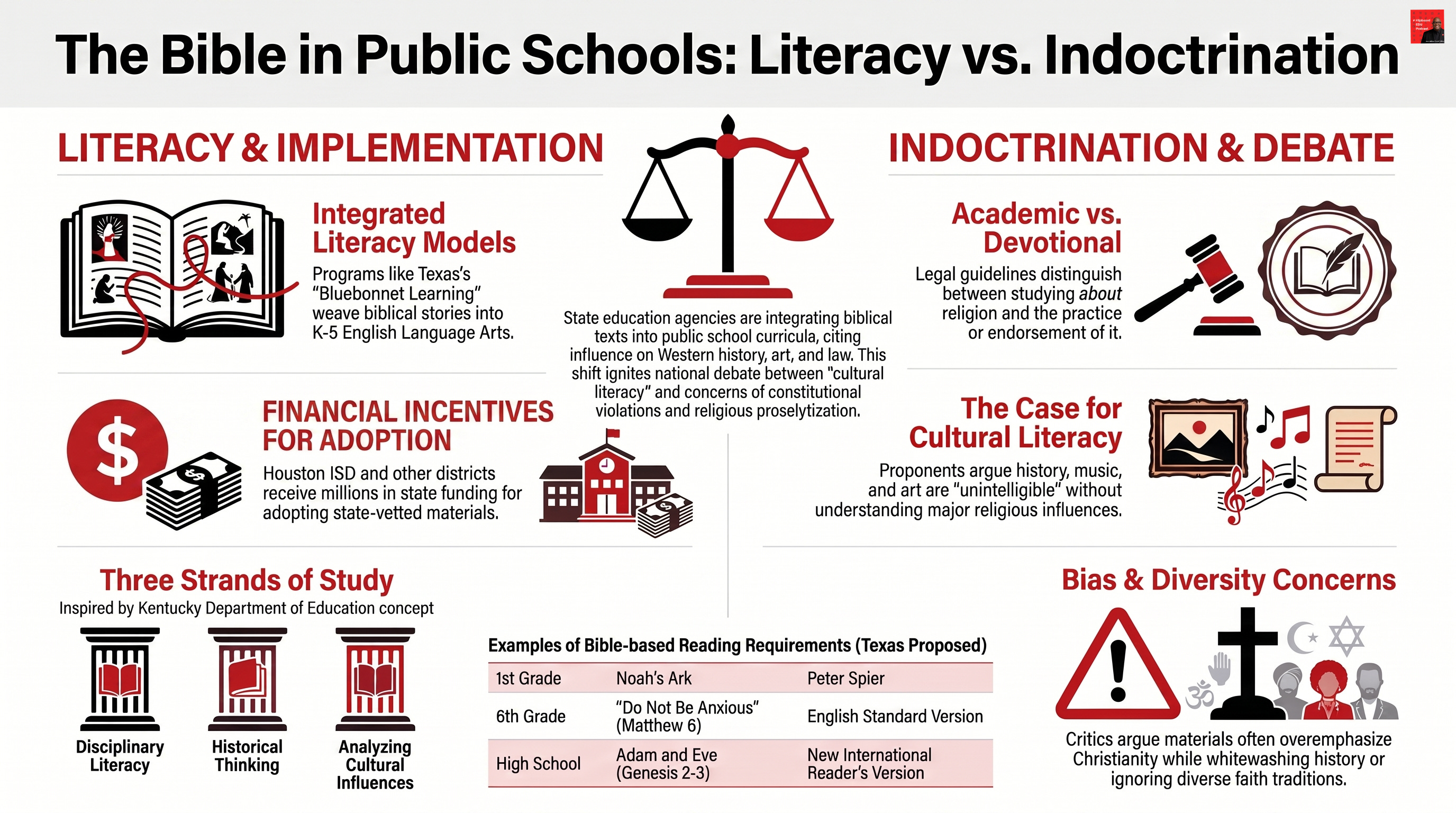
Under House Bill 1605, the Texas Education Agency rolled out “Bluebonnet Learning,” a set of state-built reading materials. The state calls them optional. The money tells a different story.
Houston ISD’s board reversed itself and adopted Bluebonnet. The deciding factor was $3.3 million in added state funding.
The upside: districts get free, vetted materials aligned to state standards, which saves teachers time.
The downside: tying funding to one curriculum pressures local boards to skip the community input they normally require. The advisory board that built this curriculum includes Ben Carson and staffers tied to Project 2025. Only one of ten members is an education specialist from a state university. One Houston parent put it plainly: “Forcing Bluebonnet on the district without transparency, clarity or community involvement is unacceptable. It is too soon and the stakes are too high.”
2. Academic Study vs. Devotional Practice
The First Amendment line is clear in theory: teach about religion, do not practice it. Groups like the Islamic Networks Group recommend teachers frame religious content with phrases like “according to this faith’s teachings,” not as stated fact. The Freedom Forum’s standard is six points: academic not devotional, awareness not acceptance, study not promotion, exposure to all views not one, education about all religions not favoritism, and information not conformity.
Critics say Bluebonnet fails this test. The Texas Freedom Network argues the curriculum presents Christian claims as historical fact rather than belief, crossing from literacy into promotion.
3. The Classical Education Pivot
Bluebonnet blends reading instruction with a classical education model. Kindergartners read David and Goliath next to Chicka Chicka Boom Boom. Fourth graders study detailed New Testament passages. High schoolers use Bible passages as required support material for Pride and Prejudice and Dickens. Middle schoolers analyze the Sermon on the Mount as a model of oratory.
The case for this: students cannot fully understand Western literature without knowing its biblical references. The case against, made by the Texas Freedom Network’s Elva Mendoza: when one faith’s text becomes required reading and others are absent, non-Christian students get treated as outsiders in their own school.
4. Who Should Be Teaching This?
Kentucky’s academic standards already push for “moral character,” listing traits like honesty, citizenship, and self-discipline as goals for students. But character instruction built on biblical text raises a staffing question. The ACLU argues teachers need formal academic training in religious studies, not just personal faith, to keep instruction academic rather than devotional. Kentucky requires Bible elective teachers to hold a high school social studies certification for this reason. Texas has not set the same bar.
5. A Tale of Two Court Rulings
The Fifth Circuit Court of Appeals has ruled both ways on this in the same year. In Louisiana, the court struck down mandatory Ten Commandments displays, citing the 1980 Supreme Court precedent Stone v. Graham. In Texas, the same circuit let a nearly identical law (S.B. 10) stand. Same court, same question, opposite outcomes depending on the state. This is headed to the Supreme Court.
The Question for Texas
Can a public school serve every faith in its classroom while building its core curriculum around one? Texas is the test case the rest of the country will be watching. The answer will be decided in courtrooms, but it is already being decided in classrooms right now.
Works Cited
“Abington School District v. Schempp.” Wikipedia: The Free Encyclopedia, Wikimedia Foundation, 7 June 2026, en.wikipedia.org/wiki/Abington_School_District_v._Schempp.
ACLU Program on Freedom of Religion and Belief. “Statement on The Bible in Public Schools: A First Amendment Guide.” American Civil Liberties Union, 9 May 2007, aclu.org/documents/statement-bible-public-schools-first-amendment-guide.
ACLU of Texas. “Legal Organizations Urge Texas Superintendents to Reject Religious Curriculum.” American Civil Liberties Union of Texas, 30 Jan. 2025, aclutx.org/en/press-releases/legal-organizations-urge-texas-superintendents-reject-religious-curriculum.
American Civil Liberties Union. “Federal Appeals Court Rules Against Louisiana Law Requiring Public Schools to Display Ten Commandments in Every Classroom.” American Civil Liberties Union, 20 June 2025, aclu.org/press-releases/federal-appeals-court-rules-against-louisiana-law.
Ashby, Ellie. “Which Bible passages are in Texas’ proposed student reading list? Here’s what the selections reveal.” The Texas Tribune, 19 June 2026, texastribune.org/2026/06/19/texas-religious-reading-list-sboe-bible-public-schools/.
Associated Press. “Texas board approves adding Bible stories to required reading for public school students.” CBS Texas, 26 June 2026, cbsnews.com/texas/news/texas-school-board-required-reading-list-bible-stories.
Baker Institute for Public Policy. Texas’ ‘Bible-Infused’ Public School Curriculum Raises Church-State Questions. Rice University’s Baker Institute for Public Policy, 2024–2026.
Dunbar, Marina. “Texas makes Bible passages required reading for millions of public school students.” The Guardian, 26 June 2026, theguardian.com/us-news/2026/jun/26/texas-bible-required-reading-public-school.
Haynes, Charles C. A Teacher’s Guide to Religion in the Public Schools. Edited by Natilee Duning, designed by S. Watson, First Amendment Center, 2008 (Reprinted Mar. 2010). Pub. No. 085.10-FAC.
Islamic Networks Group (ING). “Considerations for Teaching About Religion in Schools.” Islamic Networks Group, 2026, ing.org/resources/for-educators/considerations-for-teaching-about-religion.
Johnson, Luke Timothy. “A Bible Curriculum for Public Schools.” The Christian Century, 21 Feb. 2006, pp. 31–37. Prepared for Religion Online by Ted and Winnie Brock, religion-online.org/article/a-bible-curriculum-for-public-schools.
Kentucky Department of Education. Historical and Cultural Influences of the Bible Elective Social Studies Course. Kentucky Academic Standards, Aug. 2018.
Murphy, Sean. “Oklahoma state superintendent orders schools to incorporate Bible instruction.” AP News, Associated Press, 27 June 2024, apnews.com/article/oklahoma-bible-schools-religion-ryan-walters-d15be2f74df2ffbbdfdc549569d06c4e.
Nathan v. Alamo Heights Independent School District. No. 25-50695, United States Court of Appeals for the Fifth Circuit, 21 Apr. 2026.
Schwartz, Sarah. “Why Texas’ Fight Over Social Studies Standards Has National Consequences.” Education Week, 23 June 2026, edweek.org/teaching-learning/why-texas-fight-over-social-studies-standards-has-national-consequences.
Texas Education Agency. Bluebonnet Learning Frequently Asked Questions. Texas Education Agency, Nov. 2024, tea.texas.gov/bluebonnet.
Texas Freedom Network Education Fund. “New Texas Freedom Network Report Exposes How Proposed Texas Reading Curriculum Crosses The Line From Religious Literacy To Proselytizing.” Texas Freedom Network, 15 Aug. 2024, tfn.org/teachthetruth.
Turner, Re’Chelle. “HISD approves Bluebonnet curriculum with Bible references for elementary classrooms.” Click2Houston / KPRC 2, 26 June 2026, click2houston.com/news/local/2026/06/26/hisd-approves-bluebonnet-curriculum-with-bible-references-for-elementary-classrooms.
No posts
Comments
Nothing yet. Say the first thing.
Sign in to join the conversation.