
A few weeks ago, over the Holidays, I stumbled upon a fascinating old scientific paper by a man named Wilson Alwyn Bentley (1865-1931).
The paper, titled Studies among the snow crystals during the winter of 1901-02, features 22 pages of photomicrographic plates showcasing over 250 snow crystal specimens, preceded by 9 pages of detailed descriptions and analysis.
I read it in full, was instantly obsessed, and soon found myself diving into half a day’s research on Bentley’s fascinating discoveries and life story.
Born and raised in Jericho, Vermont, Wilson A. “Snowflake” Bentley was a lifelong dairy farmer, self-taught meteorologist, and pioneer of photomicrography. Famous for having described, classified, and photographed over 5,000 snow crystal specimens over his lifetime (starting in 1885 !), Bentley is also known for his long-term research into the correlation between specific types of snowflakes and the weather patterns that produce them.
To learn more about his life and work, read this article, watch the 8-minute documentary below (featuring a closer look at his ingenious homemade photomicrography setup), or explore the extensive archive available here.
Bentley’s life is interesting to read about. That being said, his unique perspective—which was rooted in his love of his subject, and which he so vividly conveyed to scientists and laymen alike—is more fascinating to me still.

The meticulous care with which Bentley carried out his research and documented his findings over 4 decades, with no regard for compensation or public recognition, was clearly rooted in an unapologetic love of beauty and a remarkable poetic sensibility.
In all of his written works that I’ve seen so far, his vibrant love of snow crystals and related phenomena leaps off the page in any number of ways. Indeed, Bentley’s perspective flits between empirical observation and aesthetic critique with disarming nonchalance, and this quickly reveals itself to be a delightfully strange idiosyncrasy of the 1902 paper linked above. (One wonders if 20th-century scientists would have considered his findings to be, shall we say, abnormally comprehensive; in other words, highly unusual for their author’s dogged insistence on beauty.)
In the excerpts below, Bentley’s empirical descriptions of specific snowflakes featured in the second part of his paper are interwoven with his exuberant running commentary on their unique magnificence. This alternation is consistent throughout the first 9 pages, consistently surprising, and almost jarring at times.
Beyond the beauty of the plates reprinted in this publication, this is the one element that piqued my curiosity about Bentley’s life and work. In many areas, there’s nothing remotely objective about his writing; yet, the quality of his documentation or analysis is unassailable. Read the quotes that follow, and see if you can avoid being charmed right out of your tree.
Excerpts from Studies among the snow crystals during the winter of 1901-02
“We must therefore make a careful study and analysis of the interior portions of the crystals, including the rods, dots, and lines outlining geometrical forms, that add so much to their beauty and interest. These interior details reveal more or less completely the preexisting forms that the crystals assumed during their youth in cloudland. Was ever life history written in more dainty or fairy-like hieroglyphics? How charming the task of trying to decipher them.” (p. 6)
“Considerable modifications of form are frequently due to the aggregation upon the crystals of amorphous or granular material, contributed by relatively coarse cloud spherules, particles of mist, or minute rain drops. Frail light, branching stellar and other forms are often rendered coarse and heavy by such additions […]. Perfect crystals are frequently covered over and lines of beauty obliterated by such granular coatings.” (p. 6)
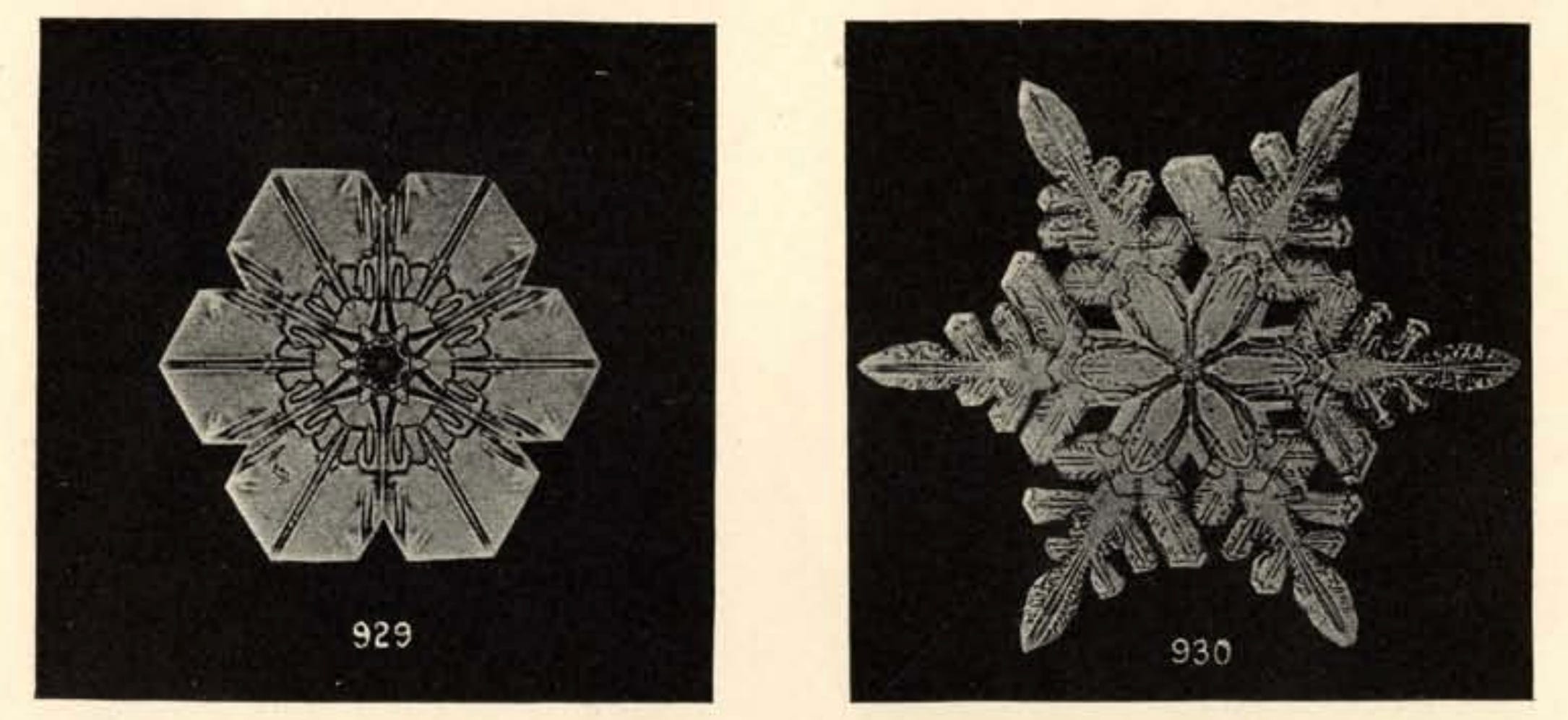
“In the morning the crystals were small granular balls; these were succeeded by small granular somewhat solid tabular crystals; these in turn were followed by tabular forms free from granulation; during the afternoon the tabular forms of closer structure were replaced by crystals of open structure. […] During the forenoon of February 19, [the last belated clouds] contributed a few more choice examples of snow crystal architecture, as souvenirs of the skill of the Divine Artist, and these may be seen in Nos. 923-933. The design within the interior of No. 929 [below, left] is unique and choice.” (p. 10)
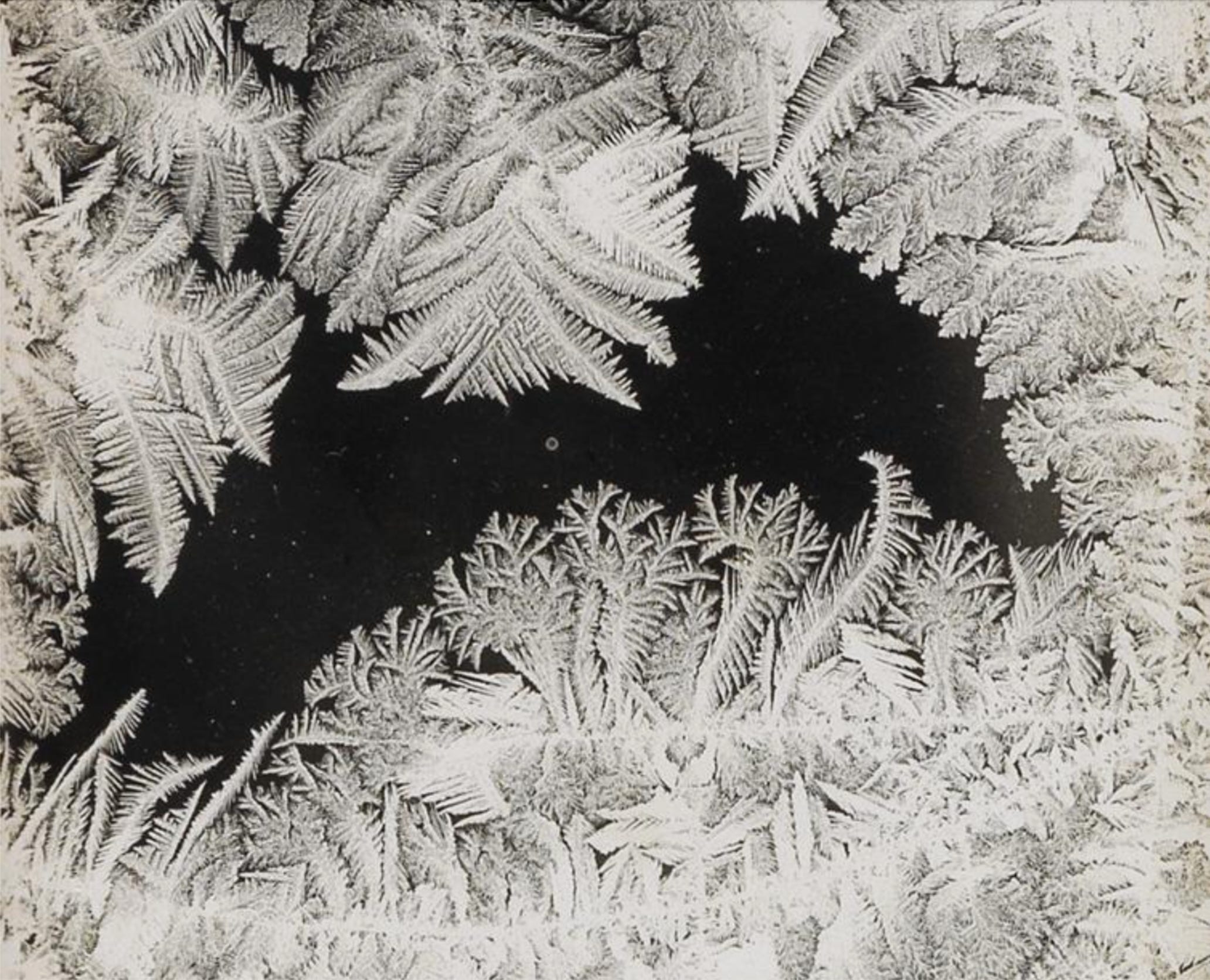
In 1928, Bentley pens an essay for the New York Times entitled Jack Frost Designs Jewels of His Own. The remarkable quality of his attention comes across in this piece as well. Here again, he touches on certain specifics of his scientific approach; here again, his sense of wonder and knack for intricate descriptions are on display. Of course, addressing the layman in the Times gives him much broader license to wax poetic. Happy to oblige, he delivers the shimmering sentences below, replete and radiant with magic and mystery.
If the excerpts above are notable for their unexpected jump cuts, those below are notable as marks of a life well-lived, and well-loved:
“The snow and the ice and the hoar frost furnish brilliants that are incomparably more beautiful than the gems of the Summer dew or those wrought elsewhere in nature’s laboratory. The first revelation that the jewel season is at hand may come after a cold, calm, clear night in late Autumn. We then find that Jack Frost has replaced the dew diamonds adorning the grasses with glittering columnar hoar frost.”
“Over there in another part of the pane may be an imitation of the firmament, full of glittering stars more beautiful than those that spangle the sky at nightfall.”
How unfortunate that the home-schooled, self-taught Bentley would have largely conducted his early research in private, convinced that his findings wouldn’t be of interest to his era’s scientific community.
In hindsight, the entirety of his output presents clear evidence of an exceptional, leave-no-crystal-unturned approach to scientific research, the kind that can only be powered by a visionary’s obsessive curiosity, and the kind that would necessarily have compelled Bentley’s early explorations in the field. A cursory look at his early output (from the turn of the 20th century) reveals the words of a deeply engaged mind—one already alive to all the right questions, if not aware of, nor overly concerned with, the formal strictures of technical writing.
Unsurprisingly, it would be understood and acknowledged, if only much later on, that Bentley had been far, far ahead of his time.
Not only did some of his theories go on to be corroborated by meteorologists several decades after he first presented them, but they’ve since been recognized as important contributions to our scientific understanding of snow crystal formation. (Greatly inspired by Bentley’s earlier findings, influential Japanese physicist Ukichiro Nakaya would go on to create the world’s first artificial snowflakes in a controlled laboratory setting in 1936.)
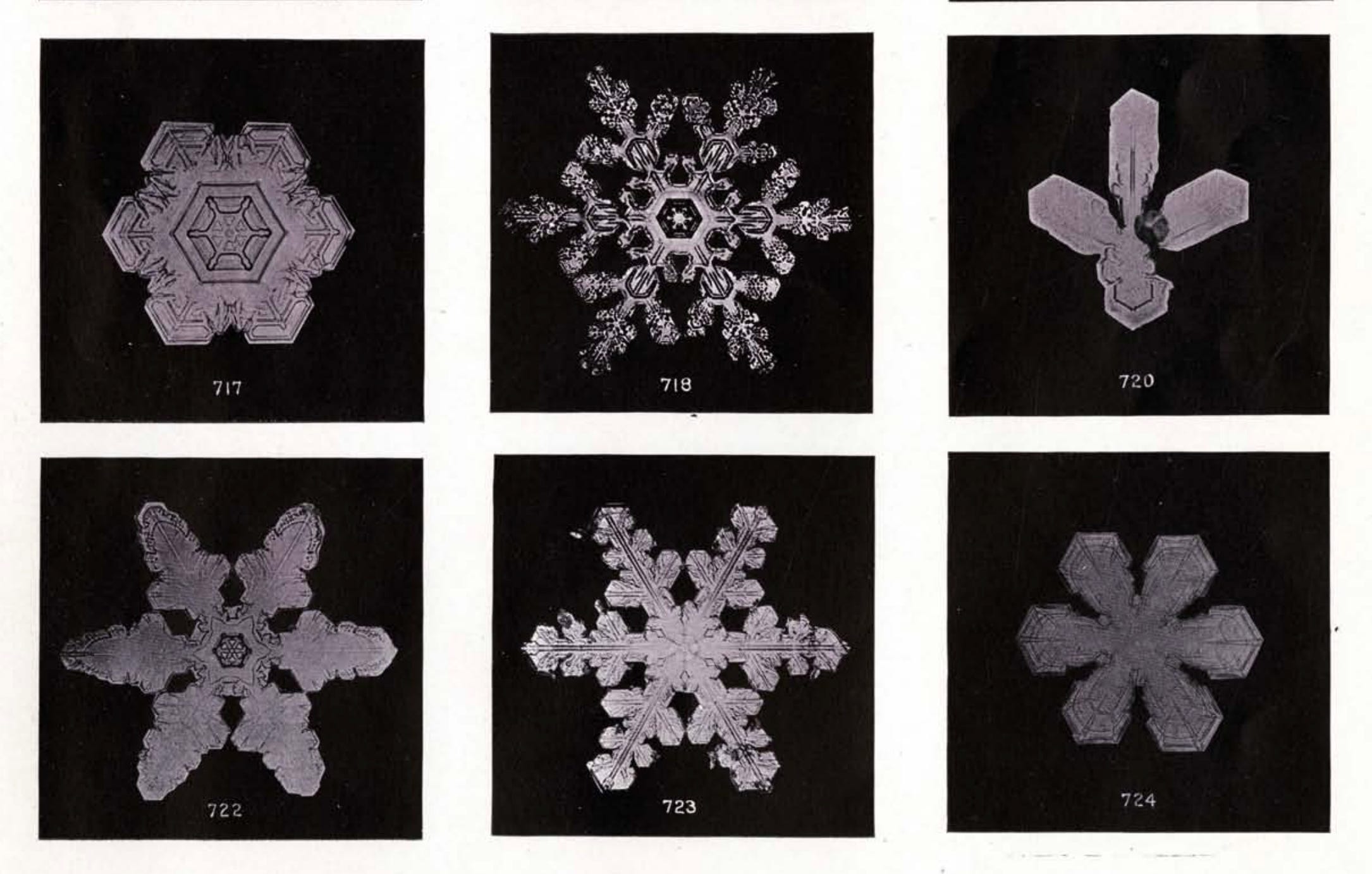
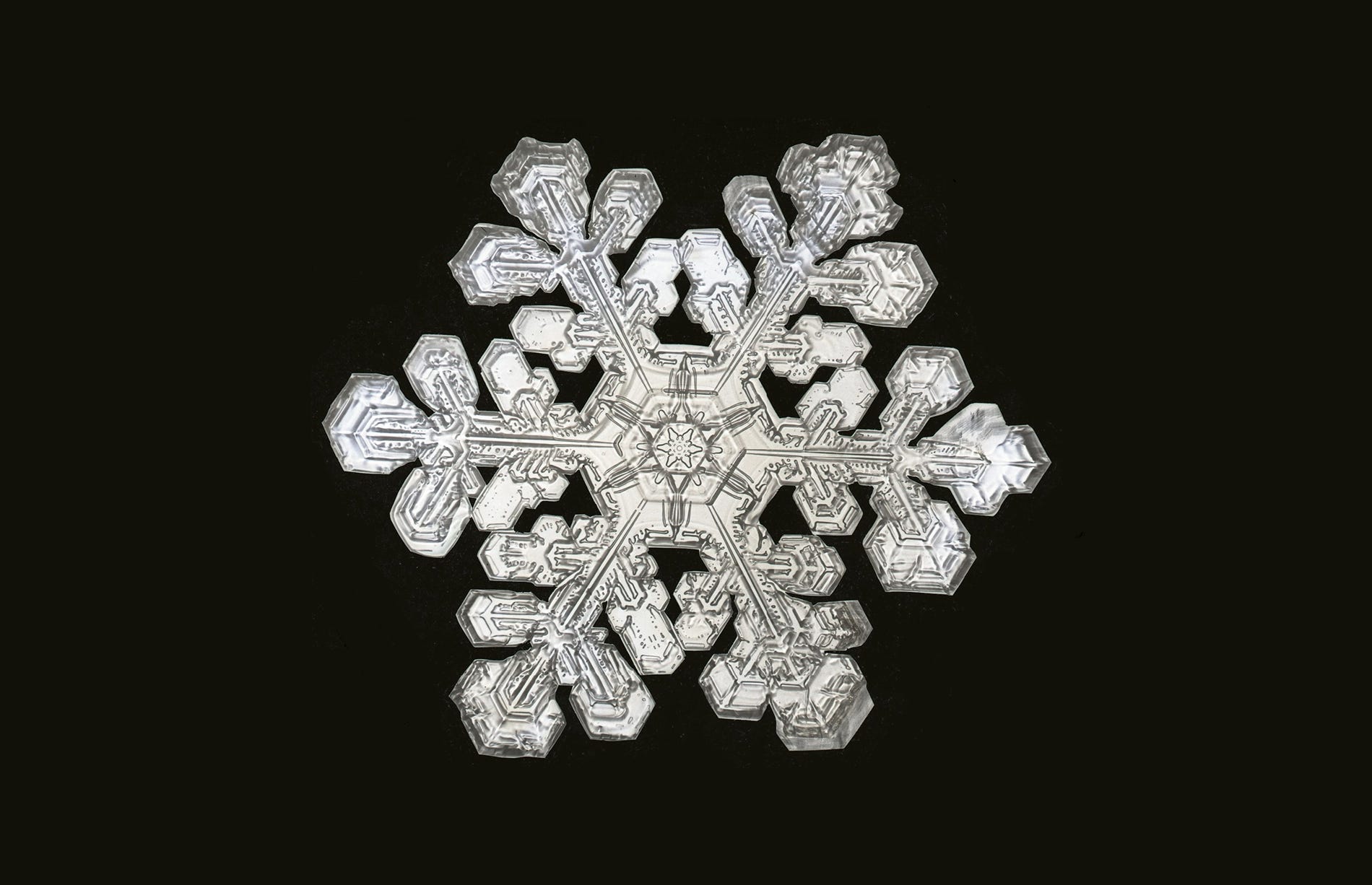
I’ll definitely be spending more time with Bentley’s work, and may consider incorporating some of the divine artistry he’s documented—or the aesthetic principles it exemplifies, at least—into my own artwork.
Over the last century, many artists and designers have noted that these mesmerizing images have much to offer any student of line, composition, and balance.
As I continue my own (artistic) research, it’ll be equally inspiring to meditate on the yet-to-be-disproven idea that no two snowflakes are alike. Incidentally, we also owe this idea to Bentley’s research. On page 10 of his 1902 paper, he wonders aloud:
“In view of this large collection, […] the question now naturally arises: Is there no limit to the number of distinct forms, or may we assume that, if our study be sufficiently prolonged, there will come a time when new patterns will rarely or never be found, most of the designs being merely reproductions or duplicates of those already photographed?”
To my mind, his was the gold-standard approach to doing anything worthwhile. Perhaps this is what inspires me most as I discover his writings.
If a person allows his or her life’s work to be driven by Bentleyesque levels of curiosity and fascination—which tend to generate the devotion, diligence, and care so evident in the quotes above—it seems to me that their odds of achieving little of significance must be virtually nil.
Upon close examination, Wilson A. “Snowflake” Bentley’s writing reads like the strongest sense of purpose known to man.
And that, in itself, is a marvelous thing to behold.
Comments
Nothing yet. Say the first thing.
Sign in to join the conversation.