
Yes, this is a Mother’s Day reflection, and yes, Mother’s Day was a week ago. But that’s nothing: I have been meaning to write this down since March.
It was in March that, with my father’s help, I flew four hours from LAX to STL to visit with my bedridden grandmother and to introduce her to her youngest great-grandchildren, already nearly 18 months old. This was the point of the visit to St. Louis and environs, and it was both delightful and devastating, mundane and fathomless. But the visit was a week long, and a bedridden 97-year-old can only tolerate so many minutes of twin toddler time (and vice-versa). Additional hours would need to be filled.
And so they were. Some hours were filled with tears (both mine and theirs) as the children attempted naps in unfamiliar bedrooms; some were filled with stories from their great aunt, goofy games with their great uncle, or gleeful chaos with their older and wiser 4-year-old cousin. I tried to fill some of the hours with work, ill-advised as that clearly was in hindsight.
One of most memorable hours was spent at the Missouri Botanical Garden’s Butterfly House, where the big event was “Morpho Mania” — the arrival of over 2000 Menelaus blue morpho butterflies.
I cannot overstate the level of motherly exhaustion I was feeling at this point in our visit. It had been the latest last straw when, one infant strapped to my chest, the other in a collapsible travel stroller, I had been told that strollers were not allowed inside the butterfly house. Thankfully there were three other adults with me, and none of them was suffering from my precise brand of frazzlement. Gloria remained strapped to my chest; Graham went forth, as he so often does, squirming in Opa’s arms.
Are you a frazzled parent of infant twins? Or perhaps of a more reasonable number of children, of a more reasonable age? I would like to recommend visiting a butterfly house, especially at the height of a season. It was the stuff of a fairy story, just bright blossoms and flowing water and colorful wings dancing in the periphery at all times. “The periphery” at minimum — one of these majestic creatures actually landed on my shoulder at one point. Another touched down on Gloria’s arm for a fleeting moment.
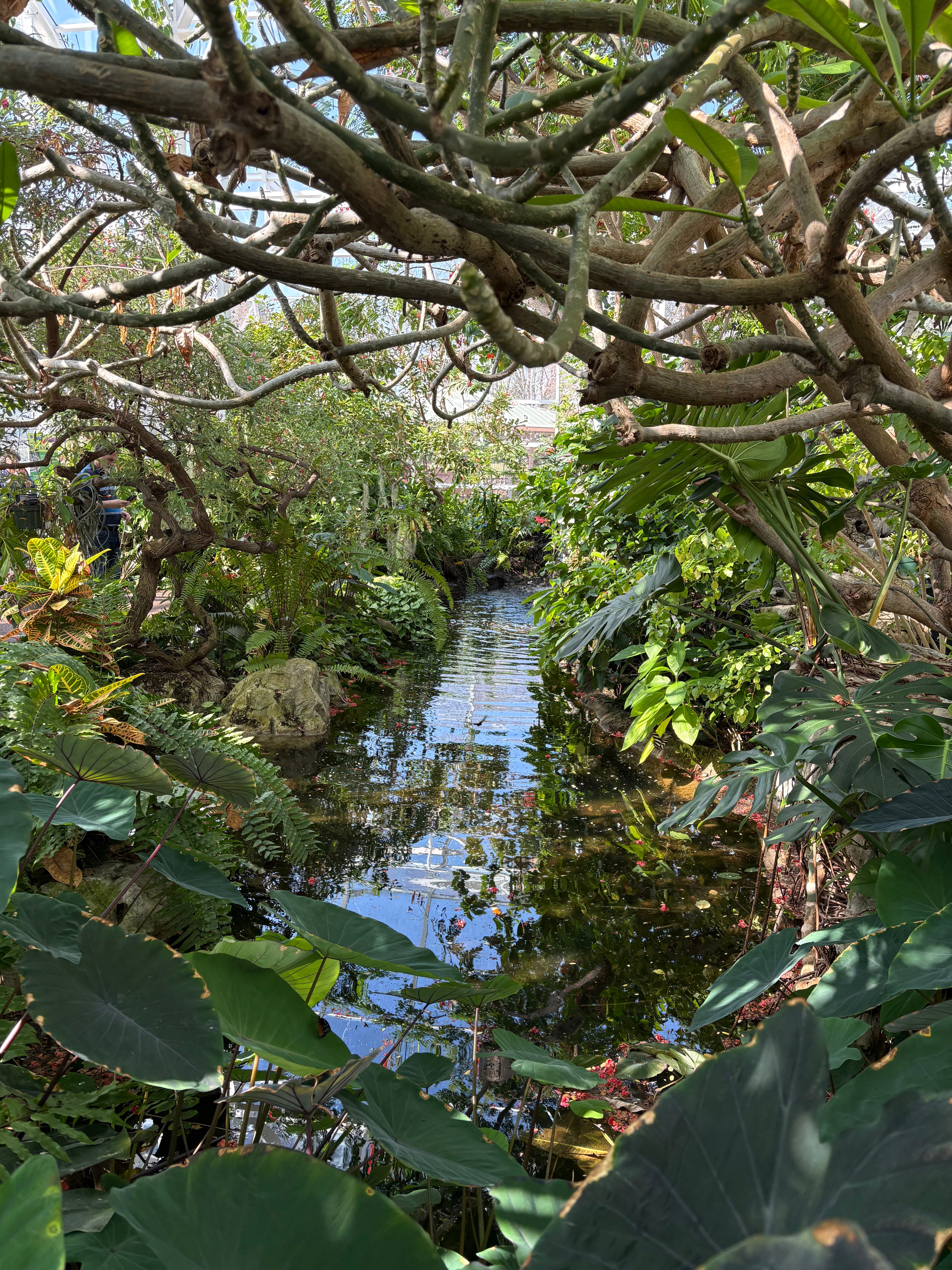
The butterfly is, as a whole, such a jawdropping impossibility. So much so that, unfortunately for my own newsletter purposes, it is absolutely done to death as a metaphor. When we talk about someone emerging from their cocoon, someone in her butterfly era, nothing more needs to be said. Not by me, not by anyone.
Nevertheless, she persisted.
The blue morpho butterfly was new to me, at least as a named species. If you’re familiar with them, you’ll know about their shocking blue color, rare in nature and emphasized by an otherworldly iridescence. Look up a photo of one, and then imagine being in a greenhouse with thousands of them (along with other species which, while less ostentatious, are still *butterflies*).
Not long after entering the garden, I noticed a butterfly sitting with its wings in a closed position. In stillness, the wings displayed a coloring that, at first glance, was unremarkable — a drab combination of matte brown shades. But just an extra moment’s examination revealed something striking in its own right. The pattern on the wings, in beiges, tans, and grays, seemed to mimic an owl’s feathers, or even its beady black eyes. It was intricate and impressive, even if the color didn’t catch one’s eye like that of the flashy blue morphos.
I continued my walk, and it wasn’t until I was most of the way through the garden that I realized: the butterfly with the unassuming-but-dignified outer wings was the blue morpho. The underside of their wings is crazy, sparkling blue. The outside is built, however beautifully to disappear.
Because I was so struck by this experience; because my children were completely mesmerized; because I shared it with beloved family; because my son, who had only a handful of words at that time, came home pointing to every butterfly he saw, on TV, in books, and in real life, and saying “Ba-yiy! Ba-yiy!”; For all these reasons I felt sure this was the story from my trip that I wanted to write about in this space.
The problem was: butterfly garden visit as a metaphor for what? I wasted a fair amount of water attempting to solve this riddle in the shower. As I mentioned, the concept of the emerging butterfly does not need any additional exploration, much less from the likes of me. But what about the double-valenced wings of the blue morpho?
It came to me several weeks later, driving from a Saturday morning outing with the kids. We’d been trying to see the jazz band that plays at the local coffee shop. People love to watch my kids bop and clap to the live music, and they love it too, but they don’t want to be strapped down to their stroller for long these days, and I can’t chase two one-year-olds around a busy cafe alone. We’d arrived just before the band took a break anyway; we made our way conspicuously out through the crowded shop and I’d let the kids scramble around the interior of my minivan (a current favorite pastime) for about 10 minutes — probably about as long as we’d been in the coffee shop. Then I’d wrestled them reluctantly into their car seats (the reluctance being mutual, to put it mildly) and drove home to find some lunch.
And then, my epiphany. The blue morpho. The camouflage and the spectacle. It was motherhood. Duh.
Oh, the endless hymns written to the beauty and majesty of motherhood! It’s the most important job, the ultimate human experience (let alone female ambition); it’s a full time job — but it doesn’t have to be! But it can be, and that’s okay! Whichever way you do it, make sure to put it in your bio, because it defines you now. People really love to see those miraculous mothers on display (as long as it’s not their own mother we’re talking about, she’s just Mom). This flashiness leaves the non-mothers among us somewhere along a bewildering continuum between desperate longing and defensive denial. And once one becomes a mother, yes, the beauty of it is blinding, but the experience bears little resemblance to what you imagined when watching mothers flit by — on the periphery, shall we say.
Of course, the caterpillar-cocoon-emergence thing…that’s also motherhood. Many things in my life have transformed me in one way or another, but none so totally and elementally as this. And I’m not even talking about the part where I grew the children in my body. I’m talking about afterward, when, at my most physically weak, I needed to be the strongest I’d ever been, and somehow I managed to do so. When my brain rewired itself to attempt to address the needs and priorities of two additional people. Two people who, themselves, have not stopped changing for even a day in the entire time they’ve been alive. They wake up from a nap sometimes and I can tell they’ve learned something new in their sleep. And I have no choice but to recalibrate.
As for the camouflage part, look at the way we — even we moms — dismiss this fantastic rewiring of the psyche as “mom brain.” I temporarily forget the name of someone I’ve known for a decade because I’ve replaced that information with the ability to know whether my child is crying because she’s hurt, hungry, or tired. Sounds like some typical, drab, mom stuff — but only if you don’t pause to consider the intricacy.
I thought of the blue morpho again tonight, as I closed my wings on another weekend of solo motherhood. Today we really were on display, a spectacle like we haven’t been since the baby days. After church, we briefly walked through the Beverly Hills Art Fair — them in their double stroller — and I fielded multiple conversations with strangers about how gorgeous they were and (of course) how lucky I was (true). Prying questions, grabbing hands. Then there are the catcalls of twin parenthood — “you’ve really got your hands full!” or “double trouble!” -- which are meant for me, but remain an acknowledgment of the abundance, the resplendence, of being the mother of a pair of cherubs.
The people who fawn over us, over our very existence and its proof of God’s or nature’s whimsical possibility, don’t come home with us. They can’t see me arguing with my son over which one of us gets to hold the broom while I try to clean up the freshly cooked lentils he threw on the floor by the handful. They can’t see me begging my daughter not to reach up and slap her own perfectly rendered baby foot in the oil painting of the three of us that hangs above my bed. They can’t see me in the dark of the nursery, so worn down that I misremember the lyrics to the lullaby I’ve sung to my children nearly every night of their lives, knowing that I have miles to go before I sleep. I have a newsletter to write, and it’s already either a week or six late.
They can’t see it. But if they could, they’d have to admit: it, too, is beautiful.
No posts
Comments
Nothing yet. Say the first thing.
Sign in to join the conversation.