
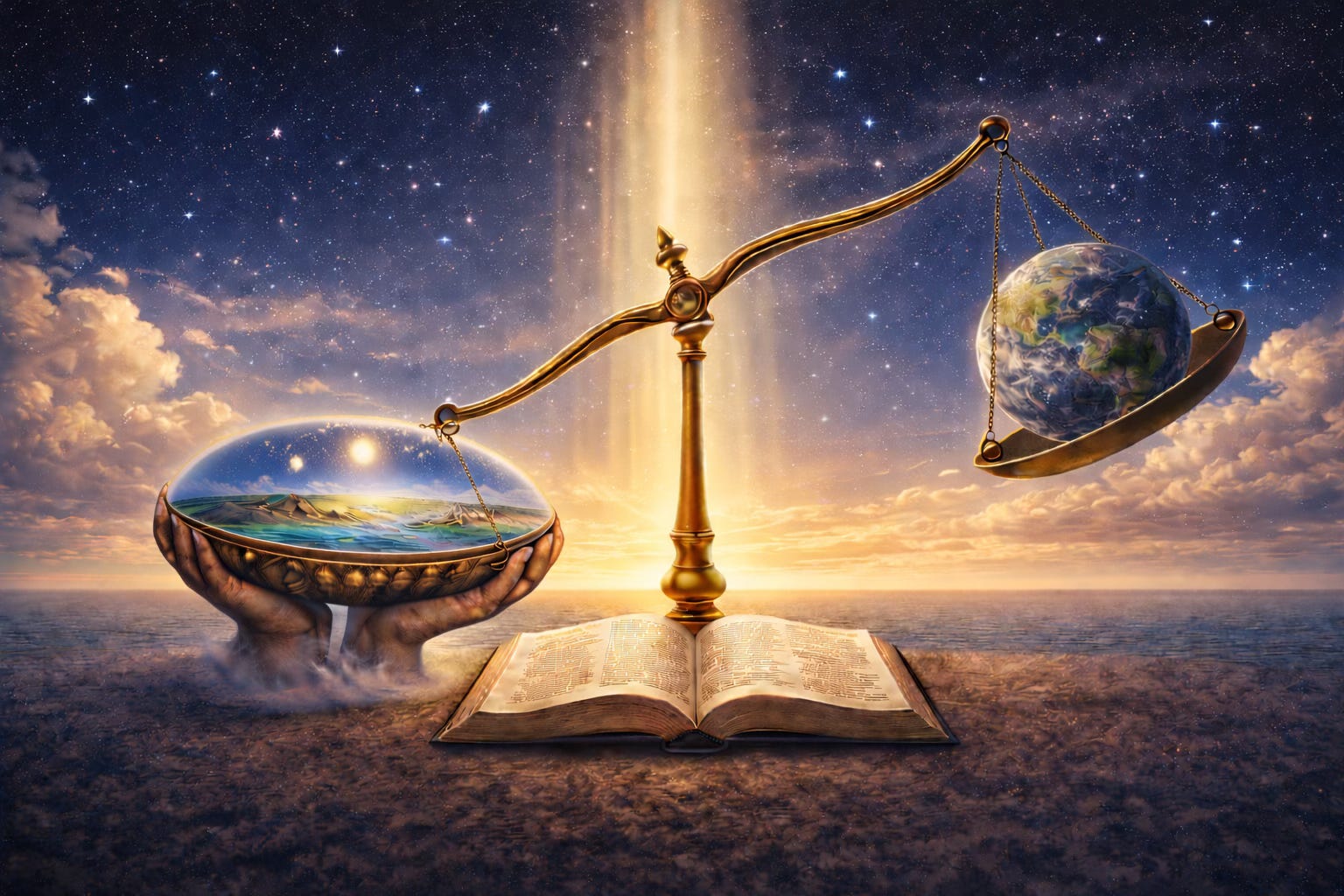
INFALLIBILITY: An Inescapable Concept
“I am the LORD: that is my name: and my glory will I not give to another, neither my praise to graven images. Behold, the former things are come to pass, and new things do I declare: before they spring forth I tell you of them.”(Isa. 42:8-9)
I have been reading Rousas John Rushdoony’s Systematic Theology. And I recommend that you do too. If your pastor or friend has dis-recommended Rushdoony, I suggest you challenge their reasons for dis-recommendation. They might be responding to a straw man argument against Rushdoony and his teaching on Christian Reconstruction. It happened to me twice.
Before I address how infallibility relates to Biblical Cosmology, I want to share my personal experience to help any readers who may have had their well poisoned, as happened to me.
The first time it happened, I had never heard about or read Rushdoony. I had recently graduated from The Master’s University (then College). A young man in my cohort presented all the classmates with some Reformed, Postmil, Reconstruction material. I read through and listened to it all (cassette tapes back in the day), and everything resonated with my spirit.
Later, I met up for lunch with some fellow alumni. I brought up the Reconstruction literature, hoping it would have resonated with them as well. My zeal was shot down when my friends informed me that Christian Reconstruction sought to usher in the Kingdom of God through politics, not the gospel. Sadly, I trusted their testimony and pursued it no further.
Thankfully, God had a plan to bring the topic back into my view with fresh eyes.
Through some rocky times, God led my husband and me away from dispensationalism to a Reformed, Covenantal Church. It felt almost as if we were born again. Finally, we had a framework to understand the Bible from Genesis to Revelation. Everything fit together like a single, unbroken story—no mistakes in God’s purpose for the church, no pitting the Old Testament against the New, and no separate plans for Israel and the church.
We greatly appreciated the pastor at the time and learned much from him.
But God had plans to move us away from that church and across the country. In the process, my husband met a man at a church we visited who introduced him to Rushdoony. That providential encounter led us to examine Postmillennialism and Christian Reconstruction directly.
Years later, I was visiting the wife of our former pastor, who had introduced us to Covenant Theology. I brought up the topic of Biblical Law and Rushdoony. I could tell the pastor was listening to our conversation because as soon as he heard the name Rushdoony, he darted over to the conversation in great concern, warning that Rushdoony sought to usher in the Kingdom of God through politics. Hmm. I had heard that before. This time, I knew the truth.
“Not at all,” I retorted. “Rushdoony seeks to build the Kingdom by preaching the gospel, applying God’s Word to all of life, and fulfilling the Great Commission.”
The pastor was taken aback and tried to correct me. I stood my ground, and he had nothing with which to argue.
Why?
I had read Rushdoony. He had not. Instead, he had taken others’ testimony about him as gospel rather than reading the man. I recommend everyone read Rushdoony and make up their own mind. He most definitely resonates with me at multiple levels, likely because his writing aligns with Scripture and its practical application for all of life.
Before moving on, I’d like to clarify what is meant by Christian Reconstruction, since it is often mischaracterized and dismissed without careful examination.
As alluded to earlier, Christian Reconstruction is about taking over the world for Christ by fulfilling the Great Commission (Matthew 28:18–20).
When regenerated Christians disciple the nations and teach them to observe God’s Law — precisely as Jesus commanded — we can expect the promises given to Abraham’s Seed, who is Christ, to be realized in history. Scripture teaches that all the promises of God in Him are Yes and Amen, and that the whole earth will be filled with the knowledge of the glory of the Lord as the water covers the sea (Genesis 22:18; Galatians 3:16; 2 Corinthians 1:20; Habakkuk 2:14).
The church, also called the Israel of God, is the recipient of these Old Testament Messianic promises, and we should pursue them in faith (Galatians 6:16; Romans 2:28–29; 1 John 5:4; Matthew 6:10; James 2:20).
To be sure, politics will be affected when Christians take God seriously. But we don’t usher in the Kingdom through politics. That charge misunderstands both Rushdoony and Scripture.
The judgments I encountered — first from fellow students and later from a former pastor — did not rest on Rushdoony’s teachings, but on a narrative intentionally propagated and then innocently passed along by those who trusted the source without examination.
So, let me state plainly that I am both a Reconstructionist and a lover of God’s Law when understood and applied correctly.
If you’d like to learn more about Christian Reconstruction, please visit Chalcedon.edu:
Chalcedon is a Christian education organization devoted to research, publishing, and promotion of Christian Reconstruction. We believe that the Christian faith is applicable to every area of life and thought and that all things are to be “reconstructed” according to God’s revealed will in Scripture.
Okay, enough on Rushdoony and Reconstruction. Let’s move on to the topic of infallibility.
I did not get to the first paragraph of Chapter One in Rushdoony’s Systematic Theology before my spirit triggered within me.
I am the LORD: that is my name: and my glory will I not give to another, neither my praise to graven images. Behold, the former things are come to pass, and new things do I declare: before they spring forth I tell you of them.
Isaiah 42:8
Everything in life revolves around the glory of God. For me, this conflict becomes especially visible when a counterfeit cosmology skews God’s glorious creation. Who has the authority to define reality? God or man? The modern cosmological framework doesn’t merely describe creation; it increasingly claims the authority to interpret it apart from God.
What is often presented as neutral science functions instead as a rival authority, seeking to take for itself the glory that solely belongs to the Creator. Before applying this concept more fully to cosmology, I want to explore Rushdoony’s argument for infallibility.
When discussing infallibility, R.J. Rushdoony applies the conflict of authority to evolutionary doctrine and later to other disciplines. He concludes that infallibility is an inescapable topic. I will define terms shortly. For now, I want to mention the foundational issue: when men deny God’s infallible Word, infallibility doesn’t disappear; it transfers to an alternate authority.
Scripture teaches that God alone is self-existent, self-knowing, and self-attesting. He alone has exhaustive knowledge, and therefore He alone can speak an infallible word. By infallible, I mean that which cannot err, cannot mislead, and cannot be corrected by a higher authority. An infallible word does not appeal upward for validation; it stands because of who speaks it. If God speaks infallibly, then He speaks infallibly about everything He addresses, including the nature of creation itself. There is no category of reality — whether moral, historical, or cosmological — that is exempt from His authority once He has spoken.
When God says He will not share His glory, He is not speaking merely of worship in a narrow sense. He is speaking of authority — the right to define reality, order the world, and speak the final word on all things.
I know of more than one student of Rushdoony who has applied his understanding of authority to cosmology. They testify that Rushdoony would reject modern secular science and uphold God’s revealed will. But we don’t need their testimony. We have testimony from Rushdoony himself.
In his exposition of Genesis Chapter One, he identifies the issue of replacing God’s authority with autonomous interpretation. When science places itself over God’s revealed Word, it cannot remain merely descriptive. Rushdoony states that “non-Biblical sciences are closely related to magic,” because they assume that power resides within the natural order and is therefore “amenable to control by man.” At that point, science is no longer operating under God’s authority but claiming an authority of its own. Modern cosmology, therefore, cannot be neutral. When men interpret creation or cosmology apart from God’s infallible revelation, science claims an authority that Scripture reserves for God alone. Furthermore, Rushdoony writes, “If Christianity does not take Genesis 1 very seriously and literally, it is suicidal.”
Please don’t misunderstand. I am not claiming that Rushdoony upheld a specific cosmological model. Rather, I am arguing that his method requires cosmology to submit to the infallible Word of God.
Rushdoony states plainly: “Infallibility is inescapable.”
Man cannot live without a final authority. As mentioned earlier, when God’s Word is not allowed to be infallible, infallibility does not disappear — it transfers to another authority structure. Scripture describes this transfer with precision:
They did not glorify Him as God… [but] exchanged the truth of God for the lie.
Romans 1:21, 25
Just as air pressure fills any available space until equilibrium is reached, so when God’s infallible authority is rejected, another authority necessarily fills that space. There is no neutral vacuum when men deny God’s authoritative word.
It’s worthwhile to note that Adam and Eve first encountered the question of infallibility in the Garden. Who was speaking the truth, God or the Serpent?
Rushdoony explains it like this:
The doctrine of the infallibility of Scripture can be denied, but the concept of infallibility as such cannot be logically denied. Infallibility is an inescapable concept. If men refuse to ascribe infallibility to Scripture, it is because the concept has been transferred to something else. The word infallibility is not normally used in these transfers; the concept is disguised and veiled, but, in a variety of ways, infallibility is ascribed to concepts, things, men, and institutions.
Let’s look at some examples.
Rushdoony provides several examples of how this works in real-world situations. I follow the chapter’s flow here and later hone in on one point.
Evolution: Where the infallible processes of chance and pseudoscience replace the authority of Scripture.
Democracy: Where the voice of the people becomes the voice of God, as is popularized in the Latin motto, vox populi vox dei.
Marxist dogma: Where the infallibility of the dictatorship, dialectical process, and the Party become god, and any perceived error transfers to the people.
Roman Catholicism: Where the voice of the church, tradition, and the Pope have the final authoritative infallible word over and above Scripture.
Existentialism: Where “Whatever is, is right” and becomes the infallible rule of law.
Rushdoony’s point is decisive: every philosophy must have an ultimate standing ground. He writes that every philosophy is authoritarian because it speaks from a position that denies people the right to question it.
He writes:
It is a naive and foolish error to assume that “deliverance” from the doctrine of the infallibility of Scripture “frees” a man’s mind from the concept of infallibility. Rather, it means the adoption of a new infallibility as a rival and supposedly liberating concept.
In reality, when God’s infallible authority is denied, that which appears to liberate man actually puts him in bondage, not just to a faulty system, but to sin and darkness. This devolution is why Rushdoony said to ignore God’s infallible word in Genesis One is suicidal. I will revisit Genesis One in a bit.
Next, Rushdoony defines what is necessary for an entity to claim infallibility.
Who has the right to declare themselves infallible and without error?
Rushdoony writes, “But another necessity ensues. A necessary aspect of the doctrine of infallibility is the total self-consciousness of whatever or whoever is infallible.”
And Rushdoony correctly argues that only one entity possesses total self-consciousness: God alone. He then argues that every system, institution, man, philosophy, or idea not submitted to the infallible Word of God is a false dogma and at war with God.
He then applies this concept to the modern state:
The modern state, as the new god, seeks total control over man in order to speak an infallible word, in order to experiment with man and control him from cradle to grave. Planning is thus increasingly a necessary aspect of the modern state, because the modern state wants to predict, to prophecy, to control. The goal is total planning in order to prophecy, total control for total power.
Infallibility is thus an inescapable concept. What we face today is not an abandonment of the doctrine of infallibility, but its transfer from God to man, from God’s word to man’s word. But, Isaiah warns us, God declares, “I am the LORD: that is my name: and my glory will I not give to another” (Isa. 42:8). Thus speaks the LORD, He Who Is.
We are therefore in a state of war, war between heaven and humanism, war between the Almighty God and the totalitarian state, war between God and the scientific planners, predictors, and controllers, war between God and all those who deny His infallibility. Such a conflict is a very uneven one, and there can be no doubt as to the outcome of this war.
God will not share His glory nor give it to another. Even as the builders of the Tower of Babel were confounded and scattered, even as Pharaoh and his host were destroyed and his troops swallowed up in the Red Sea, even as God declared His judgment on Amalek—and Amalek is gone—even as Assyria and Babylon, and the empires of old, were brought down to dust, so those who today deny His infallible word and ascribe infallibility to the things of man shall be brought low by the Lord of Hosts. “This is the victory that overcometh the world, even our faith” (I John 5:4).
“What shall we then say to these things? If God be for us, who can be against us?”
Notice what Rushdoony is saying here — this doctrine of infallibility is not static; it moves toward historical conflict and resolution, with Christ as the victor. Currently, Christians see the rebellion, but it takes faith to look beyond it and recognize that God’s zeal will see the fulfillment of all His promises in time and history.
Rushdoony’s description of the war between heaven and humanism corresponds to what many today refer to as the New World Order — not as a hidden conspiracy — but as a theological replacement of authority and infallibility. The language differs, but the conflict is the same: rival claims to ultimate authority contending with the sovereignty of God, who will not share His glory with another.
Scripture has anticipated this rebellion of authority and promised the solution long ago.
Why do the nations rage,
And the people plot a vain thing?
The kings of the earth set themselves,
And the rulers take counsel together,
Against the LORD and against His Anointed, saying,
“Let us break Their bonds in pieces
And cast away Their cords from us.”He who sits in the heavens shall laugh;
The LORD shall hold them in derision.
Then He shall speak to them in His wrath,
And distress them in His deep displeasure:
“Yet I have set My King
On My holy hill of Zion.”“I will declare the decree:
The LORD has said to Me,
‘You are My Son,
Today I have begotten You.
Ask of Me, and I will give You
The nations for Your inheritance,
And the ends of the earth for Your possession.
You shall break them with a rod of iron;
You shall dash them to pieces like a potter’s vessel.’ ”Now therefore, be wise, O kings;
Be instructed, you judges of the earth.
Serve the LORD with fear,
And rejoice with trembling.
Kiss the Son, lest He be angry,
And you perish in the way,
When His wrath is kindled but a little.
Blessed are all those who put their trust in Him.Psalm 2
The only hope for kings and nations is to submit to the infallible Word of the Lord alone, not only in civics and other disciplines, but also in cosmology, since God Himself has spoken infallibly to the nature of creation.
The question the church must address is this: when presented with two distinct cosmological models, will it submit to God’s infallible Word or capitulate to another authority?
We know for certain that the infallible God presents an infallible cosmology. Has the church at large embraced its cosmology solely from the Scripture? Or does it rely upon an alternate authority like NASA, space agencies, pseudoscience, science fiction, pagan philosophy, astronauts, secular education, or any other authority that functionally speaks an infallible word about the nature of the earth?
God revealed His infallible cosmology to the Ancients from the beginning of the world, and they faithfully passed it down to later generations until Moses codified it in Genesis One. The remainder of the Bible upholds the Genesis account profusely.
Scripture speaks of a solid firmament, foundations, boundaries, waters above, and heavens stretched out:
He stretches out the heavens like a curtain,
And spreads them out like a tent to dwell in.Isaiah 40:22
God does not present this language as obscure or misleading. He introduces it with a rebuke:
Have you not known? Have you not heard? Has it not been told you from the beginning?
Isaiah 40:21
Scripture speaks infallibly about the nature of creation, and any cosmological model that contradicts that testimony necessarily represents a competing authority. The Bible continually uses language that demands the earth is fixed with foundations and covered by a solid firmament, with the sun, moon, and stars placed inside.
To say otherwise is to defy the Living God, a dangerous position to take.
It is a historical fact that the concept of a spherical earth was rooted in pagan Greek philosophy, not the Bible. To accept a pagan concept that is contrary to Scripture, places pagan thought in a position of higher authority than God’s own testimony. Who are you, oh man, to choose a foreign authority above the infallible Word of God?
Men like Danny Faulkner argue that we ought to look to the pagan Greeks as our starting point for cosmology.
Faulkner writes:
Much of Western science and philosophy traces back to the ancient Greeks. Therefore, if we want to know the history of cosmology, such as beliefs about the earth’s shape, we ought to start with them.
Later, he admits:
Earlier Greek cosmologies were probably flat earth, but we have no knowledge of them.
Even this claim is questionable, as scholars widely acknowledge that early Greek cosmologies were flat earth models. But the larger issue is not what the Greeks believed. The issue is how authority is applied when Scripture is read selectively in matters of cosmology.
Ironically, Faulkner affirms a literal reading of Genesis One with respect to a literal six-day creation, yet does not apply that same literal reading to cosmology.
The problem with Faulkner is not that he sets Scripture aside, but that he does not allow Genesis One to function authoritatively and consistently in cosmology. In doing so, he looks to sources outside of Scripture to resolve what Scripture itself already addresses.
Faulkner is not alone. Many within the Christian world similarly shift authority from Scripture to modern science or pagan thought when it comes to the nature of the cosmos.
The late Ancient Hebrew scholar Michael Heiser may be more accountable than Danny Faulkner, since he taught that the Bible upholds a flat, stationary earth with a solid firmament.
Heiser acknowledged that the writers of the Hebrew texts (Old Testament) believed that the earth was flat, stationary, and enclosed, as reflected in Ancient Near East cosmologies.
In the clip below, Heiser admits that his infallible authoritative source is NOT the Bible. Instead, he says it is Science.
In other words, he says that the modern church knows better than the writers of the Old Testament (i.e., the Holy Spirit) because we have a scientific worldview. His authority is not a biblical worldview, but a scientific one.
Since God is self-conscious and the arbitrator of all truth, He expects His people to understand that His words are infallible. God cannot lie. He would not deceive His people into believing a false cosmology.
God speaks an infallible Word. To insist that Scripture secretly teaches a modern globe cosmology — unknown to God’s people for thousands of years — requires placing an authority over Scripture. Men must restrain, reclassify, or correct God’s infallible Word to preserve the warring model. This denial is nothing short of a denial of the infallibility of Scripture, calling God a liar.
If God merely “accommodated” false cosmological beliefs, then either He knowingly conveyed untruth about His creation (lied) or the cosmological claims in Scripture are not authoritative, which surrenders infallibility to a higher, external standard.
Here is where institutions such as NASA function as replacements. Their claims about the cosmos are treated as unquestionable, not because they are directly verifiable by ordinary people, but because the institution itself is trusted to speak honestly. Astronaut testimony, images, simulations, and models are received as infallible. We can be sure that there has been a transfer of power when the church ridicules men for accepting the Bible’s testimony of the cosmos, and calls its members rebellious for questioning the priests of Science.
I’ve been told by a pastor that I was about to apostatize for believing the Bible on this topic.
Here’s the reality. There is no room for a spherical earth in Scripture, and we are warned sternly for taking such a posture.
Cursed is the man who trusts in man
And makes flesh his strength.Jeremiah 17:5
Rushdoony was right: we are in a state of war. It is not merely intellectual; it is covenantal. Heaven and humanism cannot share authority. God and man cannot both speak the infallible word. When God’s revelation is denied, whatever moves in to fill that void necessarily claims an authority that belongs to God alone — a claim Scripture explicitly forbids.
God will not share His glory with another. He will not yield His authority to ideologies, institutions, experts, planners, or systems — whether Marxist, scientific, or religious in appearance. Infallibility belongs to Him alone.
I am the LORD: that is my name: and my glory will I not give to another, neither my praise to graven images. Behold, the former things are come to pass, and new things do I declare: before they spring forth I tell you of them.
Isaiah 42:8-9
Since God will not share His glory with another, every authority claim that contradicts His Word about creation is already judged and cannot endure.
May You come and judge this idol quickly, Lord Jesus.
Thanks for reading Flat Out Hope! This post is public so feel free to share it.
Comments
Nothing yet. Say the first thing.
Sign in to join the conversation.