
153 desk workers. A three-month workplace sitting intervention. Activity monitors measuring every minute.
Average sitting reduction: 11 minutes per 10-hour workday.
Average lower back pain change: not significant.
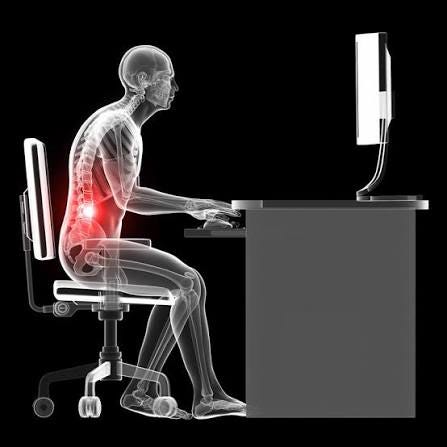
Then the researchers asked a different question — not what happened to the group, but what happened to the individuals who actually reduced their sitting. The ones who reduced sitting by a full hour per workday. What happened to their lower back pain specifically?
It dropped. Significantly. In direct proportion to how much sitting they cut.
The intervention barely worked. The mechanism it was testing worked precisely.
A 41-year-old account manager in Brisbane was part of a workplace sitting intervention in 2014.
She received the health booklet. She attended the presentations. She wore the monitor.
Her sitting time reduced by 8 minutes per workday over three months.
Her lower back pain was unchanged.
A colleague in the same trial who reduced his sitting by 65 minutes per workday reported a significant drop in lower back pain intensity.
Same intervention. Different dose. Completely different outcome.
The programme wasn’t the variable. The behaviour change was.
If your lower back pain hasn’t improved despite general sitting-reduction efforts — the dose may be the problem, not the strategy.
The study found no significant average improvement across the group — because the group barely changed their behaviour. But those who achieved the largest sitting reductions showed the clearest lower back pain improvement.
The evidence points toward a threshold effect: small reductions in sitting produce small or no measurable pain change. Larger reductions — closer to one hour per workday — produce significant ones.
A cluster-randomised trial published in the International Journal of Environmental Research and Public Health enrolled 153 desk-based workers spending an average of 75% of work hours sitting — approximately 7.4 hours per 10-hour workday.
Average sitting reduction across the intervention: 11 minutes total, 6–10 minutes of prolonged sitting per workday. Neither change was statistically significant.
Average pain changes: all small and non-significant across total pain, neck, upper back, upper extremities, and lower extremities.
Lower back pain dose-response: each one-hour reduction in workplace sitting was associated with a pain reduction of −0.84 points on a 0–9 scale (95% CI: −1.44 to −0.25, p = 0.005).
This effect held after adjusting for age, sex, BMI, and other confounders. It was specific to lower back pain. No other body area showed a significant dose-response with sitting reduction.
[Source: Brakenridge CL et al. Evaluating Short-Term Musculoskeletal Pain Changes in Desk-Based Workers Receiving a Workplace Sitting-Reduction Intervention. Int J Environ Res Public Health. 2018;15(9):1975. PMID: 30201930 → https://pubmed.ncbi.nlm.nih.gov/30201930/]
WHAT EVERYONE TRIES:
Occasional standing, brief walking breaks, sit-stand desk use — small reductions in sitting distributed across the day
WHY IT FAILS FOR LOWER BACK PAIN:
The trial confirmed it: 11 minutes of average sitting reduction produced no significant lower back pain change. The dose-response data shows the effect starts becoming measurable approaching one hour of sitting reduction per workday. Below that threshold — the lumbar spine is still spending enough time in sustained static loading that the pain-generating mechanism continues uninterrupted.
WHAT WORKS:
Target a full hour of sitting reduction per workday — not 10–15 minutes — and track it objectively rather than estimating it
Why Lower Back — and Not Neck or Shoulders
The specificity of the finding matters.
Neck pain, upper back pain, upper extremity pain — none showed a significant dose-response with sitting reduction.
Lower back pain did.
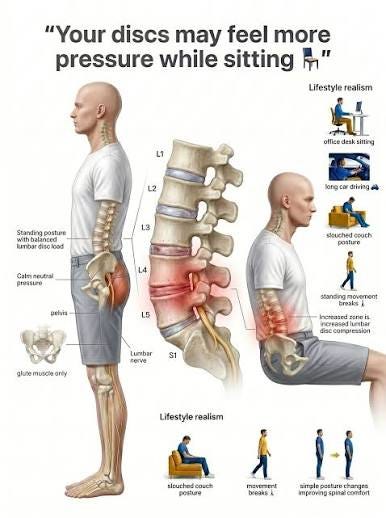
The mechanism the study suggests: prolonged sitting loads the lumbar disc posteriorly, compresses the facet joints, and shortens the hip flexors — pulling the pelvis into anterior tilt that increases lumbar lordosis under load. This is a sustained, static, position-specific loading pattern.
Breaking that loading pattern for a full hour removes the sustained compression that sensitises the lumbar structures. Shorter breaks interrupt the bout but don’t provide enough cumulative relief for the sensitisation to resolve.
The neck and shoulders are driven more by computer use patterns, arm position, and visual demand — different mechanisms that sitting reduction alone doesn’t directly address.
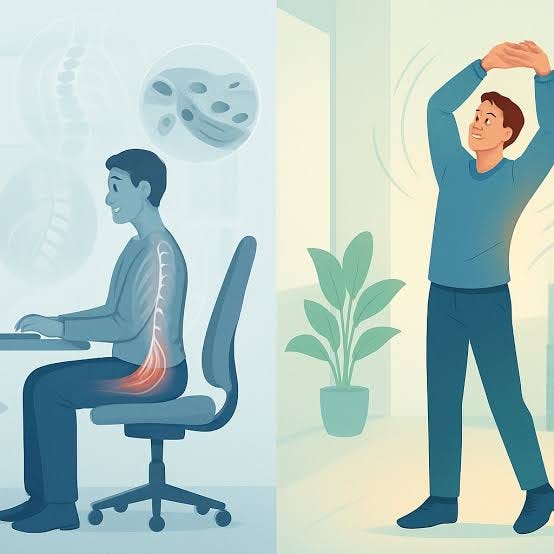
The study measured two types of sitting: total sitting and prolonged sitting in bouts of 30 minutes or more.
Reducing total sitting was significantly associated with lower back pain reduction.
Reducing prolonged sitting showed a borderline association (p = 0.050) that became non-significant after accounting for missing data.
This is counterintuitive. You might expect breaking up prolonged bouts to matter more than total time.
The explanation: the dose-response was driven by total sitting reduction. Workers who cut their total sitting by a meaningful amount also naturally broke up their prolonged bouts. But breaking up bouts without cutting total time — which is what most micro-break strategies produce — doesn’t reach the total reduction threshold where lower back pain responds.
The study raises why sitting loads the lumbar spine — mentioning posterior disc loading and slumped lumbar posture — but doesn’t cover what determines how sensitised those structures are to that loading. Systemic inflammation is part of that picture, and gut microbiome quality may affect baseline inflammatory levels in ways that influence how quickly lumbar structures respond to sustained load. Coach Dylan covers the specific research on how gut bacteria affect systemic inflammation in You’re not fat. Your gut is starving — including a 2021 Stanford trial result that surprised researchers working on exactly this question.
Before the full protocol.
Which of these matches your situation:
→ Lower back pain that builds progressively through the workday
→ Pain that eases on weekends but returns by Tuesday
→ Already trying to sit less — but not tracking how much
→ Tried micro-breaks — still have lower back pain
→ Lower back specific — neck and shoulders are fine
THE CORE PRINCIPLE:
The study found 11 minutes of sitting reduction produced no measurable lower back pain change. One hour produced a significant one.
The protocol is built around reaching and maintaining the one-hour threshold — not through occasional standing, but through consistent daily behaviour change that accumulates to 60 minutes.
The four strategies the Stand Up Lendlease trial found workers used most — standing meetings, walking meetings, standing on the phone, walking to a distant printer — are the basis of the protocol. Each has a measurable daily time value. Combined, they reach the threshold.
(Week 1 — measure before changing anything)
The trial used objective activity monitors. Without one, self-report overestimates standing and underestimates sitting by significant margins.
The proxy measurement method:
For three days — set a timer to alert every 20 minutes. When it goes off: note whether you’re sitting or not. At the end of the day, count sitting periods vs non-sitting periods. Multiply sitting periods by 20.
This gives you an approximate daily sitting total. Most desk workers will find they are sitting for 6–8 hours per workday — consistent with the study’s finding of 75% of work time sitting.
Your target: Reduce this total by 60 minutes per workday. That’s the dose the study confirmed produced significant lower back pain reduction.
(Ranked by daily sitting reduction value)
The Stand Up Lendlease trial tracked which specific strategies workers used most. The four with highest uptake were also the four with the most daily sitting reduction value.
Strategy 1 — Standing meetings (highest yield):
A 30-minute meeting standing rather than sitting removes 30 minutes of sitting in a single event. One standing meeting per day provides half the daily target.
Standing meetings require no equipment, no desk configuration change, and no scheduling change. They require one decision per meeting: to stand rather than sit. The trial found this was the strategy workers adopted most readily.
Strategy 2 — Walking meetings (second highest):
A 20-minute walking meeting removes 20 minutes of sitting and adds light physical activity simultaneously. One walking meeting plus one standing meeting reaches the 60-minute target in two events.
Walking meetings work best for one-on-one discussions, brainstorming, and non-screen dependent conversations. They require no room booking.
Strategy 3 — Standing on the phone:
Every phone call taken standing rather than sitting accumulates 5–15 minutes per call. For workers with regular call schedules — this alone can provide 20–30 minutes of daily sitting reduction.
Place the phone away from the desk. The act of walking to it and standing for the duration becomes the habit. Sitting down to take a call requires a deliberate choice rather than a default.
Strategy 4 — Distant printer / walking tasks:
Choosing the furthest printer, water point, or bathroom on a different floor adds 3–5 minutes of non-sitting per occurrence. Three to four such choices per day add 10–20 minutes.
Combined with strategies 1–3, this closes the remaining gap to the 60-minute threshold on most working days.
(Daily habit — non-negotiable for achieving the dose)
The trial’s failure to produce significant average pain change was directly caused by the failure to produce significant average sitting change — 11 minutes instead of 60.
Tracking the target is what separates 11-minute outcomes from 60-minute ones.
Simple daily tracking:
At the end of each workday — note which of the four strategies you used and for how long. Add them up. Did you reach 60 minutes?
Week 1 target: 30 minutes per day — below threshold but establishing the habit
Week 2 target: 45 minutes per day — approaching threshold
Week 3 onward: 60 minutes per day — the dose the study confirmed
Why tracking matters more than the strategy:
The trial gave everyone the same intervention. The pain outcomes differed based on how much behaviour actually changed. Tracking is the mechanism that converts intention into the dose.
(Weekly — tracks the dose-response in your own body)
The study found a clear dose-response. Your own data will show the same pattern if the dose is reached consistently.
The weekly pain rating:
Every Friday — rate your lower back pain intensity over the past week on a 0–9 scale. Record it.
Plot sitting reduction against pain rating week by week. The relationship the study found at a population level will become visible in your own data over 4–6 weeks.
If pain isn’t reducing after 4 weeks of consistently hitting 60 minutes — the sitting reduction is likely not the primary driver of your specific lower back pain, and a different protocol is needed. The study was explicit that the effect was lower-back specific — not universal across all pain types.
Week 1: Baseline sitting total established — likely 6–8 hours per workday. First two strategies introduced. 30-minute daily target. Some lower back relief possible but below the significant threshold.
Week 2: Three strategies running. 45-minute daily sitting reduction. Approaching the threshold where the dose-response begins. End-of-week pain rating may start to show a trend.
Week 3–4: All four strategies consistent. 60-minute target reached most days. The dose-response confirmed in the study begins to register in the weekly pain ratings. Lower back pain measurably reduced on high-compliance days.
Week 5–6: 60-minute threshold maintained consistently. Lower back pain reduction sustained rather than variable. The behaviour has become habitual rather than deliberate.
Your lower back pain didn’t improve when you tried to sit less because 11 minutes isn’t enough. The study confirmed it.
One hour is the dose where the pain responds. The dose-response is clear, significant, and body-area specific — lower back, not neck, not shoulders.
The four strategies workers used most in the trial — standing meetings, walking meetings, standing on the phone, distant printer — combine to reach that threshold without any equipment or desk reconfiguration.
Track it. Hit 60 minutes. The lower back responds.
I believe most desk workers trying to sit less are making genuine effort.
They stand up occasionally. They take brief walks. They feel like they’re doing something.
Nobody told them 11 minutes doesn’t register. Nobody told them the dose matters more than the strategy. Nobody showed them the dose-response data that makes the target specific.
60 minutes. Four strategies. One tracked number per day. That’s the protocol the evidence supports.
No posts
Comments
Nothing yet. Say the first thing.
Sign in to join the conversation.