
You don’t have back pain yet.
You will.
A 3-arm randomised controlled trial followed 193 healthy high-risk office workers for six months. The control group — who received a placebo seat pad and changed nothing — had a 44% rate of new neck pain onset and a 33% rate of new lower back pain onset.
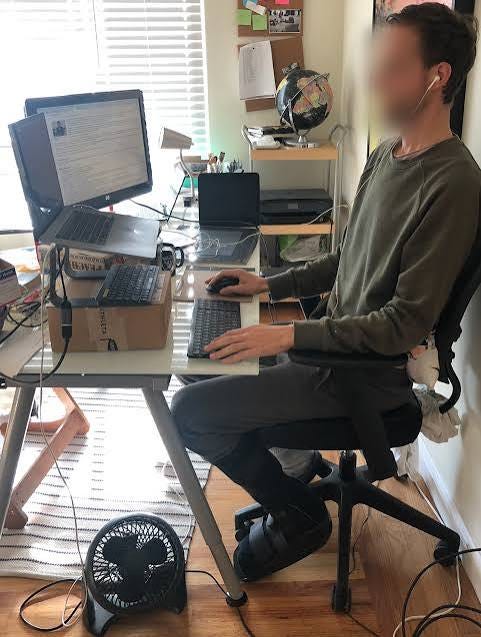
One in three healthy spines developed a new pain problem in six months of normal desk work.
The two groups who made small changes to their daily movement pattern had rates of 17% for neck pain and 7–9% for lower back pain.
Same desk. Same job. Radically different outcome.
Six months into her first office job, a 26-year-old data coordinator in Bangkok had neck pain.
She’d had none when she started.
She was in the control group of the trial — the group that changed nothing. She sat the way she always sat. Took breaks when she felt like it. Moved when she needed to.
Her colleagues in the active break group were doing one thing differently. Specific breaks, at defined intervals, with specific movement.
Their neck pain onset rate: 17%.
Hers: 44%.
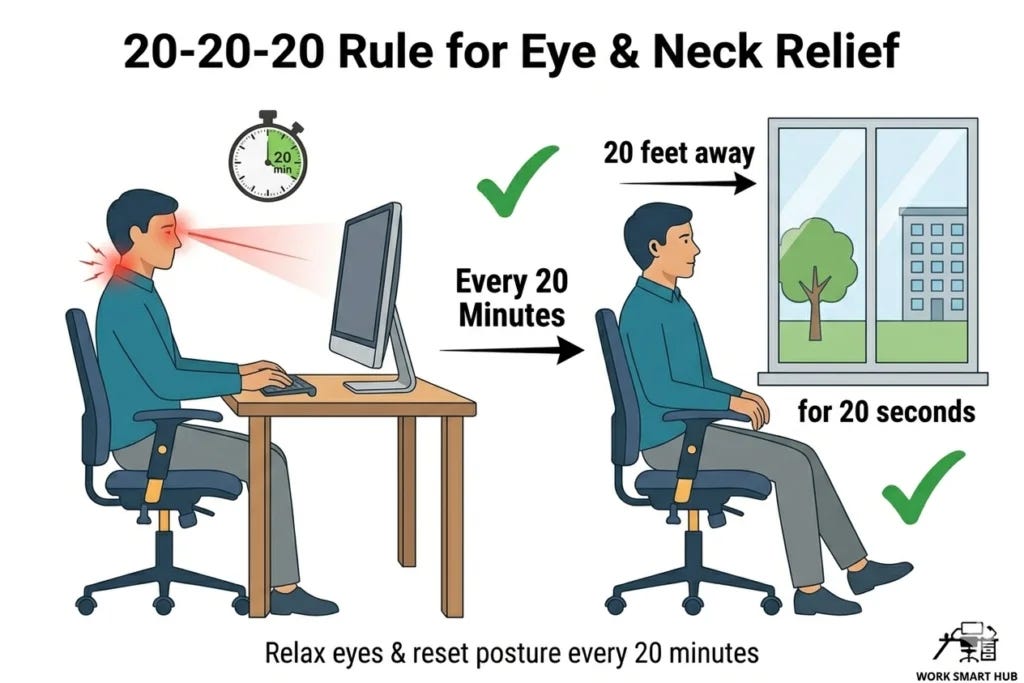
The job was the same. The desk was the same. The movement pattern was the only variable.
If you have no pain now but sit for 6+ hours a day — the trial tells you the probability.
Without structured active breaks or deliberate postural shifts: 44% chance of new neck pain within 6 months. 33% chance of new lower back pain.
These aren’t patients with existing problems. These were healthy, high-risk workers selected because their sedentary work pattern put them at statistical risk.
The risk is the desk. The protection is the movement pattern within it.
A 2021 3-arm cluster-randomised controlled trial published in the Scandinavian Journal of Work, Environment & Health followed 193 healthy high-risk office workers for 6 months.
Control group pain onset:
Neck pain: 44%
Low back pain: 33%
Active break group pain onset:
Neck pain: 17% (HRadj = 0.45, 95% CI 0.20–0.98)
Low back pain: 9% (HRadj = 0.34, 95% CI 0.12–0.98)
Postural shift group pain onset:
Neck pain: 17% (HRadj = 0.41, 95% CI 0.18–0.94)
Low back pain: 7% (HRadj = 0.19, 95% CI 0.06–0.66)
Both interventions reduced neck pain risk by approximately 55–59% and lower back pain risk by 66–81% compared to the control group.
[Source: Waongenngarm P et al. Effects of an active break and postural shift intervention on preventing neck and low-back pain among high-risk office workers: a 3-arm cluster-randomized controlled trial. Scand J Work Environ Health. 2021;47(4):306–317. PMID: 33906239 → https://pubmed.ncbi.nlm.nih.gov/33906239/]
WHAT EVERYONE TRIES:
Waiting until pain appears before making any changes — treating desk discomfort as a future problem
WHY THIS FAILS:
The trial confirmed that 44% of healthy workers develop neck pain and 33% develop lower back pain within 6 months of normal desk work with no intervention. By the time pain appears, the tissue loading pattern has already been running for months. Prevention is measurably more effective than treatment — and in this trial, it required only movement pattern changes, no equipment modification.
WHAT WORKS:
Active breaks at defined intervals and deliberate postural shifts throughout the workday — both produced equivalent protection against neck and lower back pain onset in a 6-month RCT
Why Both Interventions Worked Equally
The trial found something unexpected: active breaks and postural shifts produced almost identical results for neck pain (both 17%) and very similar results for low back pain (9% vs 7%).
Two different mechanisms. Same protection.
Active breaks work by removing the sustained tissue load periodically — giving the compressed spinal structures a window of recovery.
Postural shifts work by varying the load continuously — preventing any single position from accumulating sufficient duration to sensitise the tissue.
The mechanism isn’t “more movement.” It’s preventing any one posture from holding for long enough to become injurious. Both paths achieve that. Both reduce risk by more than half.
The High-Risk Worker Profile
The trial selected “high-risk” workers specifically. This is important for understanding who the findings apply to.
High-risk was defined by prolonged sedentary work patterns — office workers whose job required sustained screen time wi
th minimal movement variation built into the role.
This is the profile of most desk workers today. Remote or office-based. Screen-dependent. Long unbroken sitting blocks.
If you sit for 6+ hours per day with your breaks driven by convenience rather than schedule — the 44%/33% onset rates apply to you. The trial wasn’t studying extreme cases. It was studying the standard modern desk worker.
The gap in this article — why both mechanisms work equally — is fully covered within the article itself. The gut-inflammation piece by Coach Dylan doesn’t map to the movement pattern mechanism this study addresses. No handoff included.
Before the protocol.
Which of these matches your situation:
→ No pain yet — but sitting 6+ hours daily with unstructured breaks
→ Occasional ache that disappears on weekends — nothing consistent yet
→ Already have neck or back pain — want to stop it worsening
→ Take breaks when you feel like it — no fixed schedule
→ Remote worker — fewer natural movement triggers than an office
Reply with whichever one matches.
If your pattern is on that list — I want to build your specific prevention or protection protocol with you. Dylan reviews every reply personally. Roughly 3 in 10 applications are accepted.
Not ready? The full protocol is below.
THE CORE PRINCIPLE:
The trial’s two interventions look different but share one mechanism: preventing any single posture from accumulating long enough to sensitise the tissue.
Active breaks do this by removing load periodically. Postural shifts do it by varying load continuously. Both work.
The protocol combines both — structured breaks at fixed intervals with deliberate postural changes between them. This is more protective than either alone and easier to sustain because neither requires leaving the desk for long periods.
Active Break Protocol
(Every 30 minutes — timed, not felt)
The trial used custom-designed apparatus to trigger active breaks. Without it, a recurring timer is the functional equivalent.
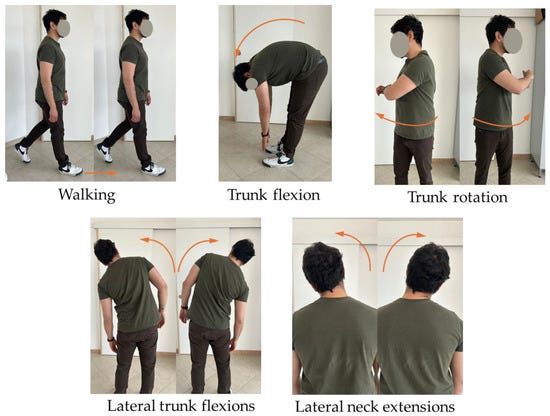
Every 30 minutes — stand up. Move for 2–3 minutes. Return.
The movement during the break matters less than its occurrence. The trial’s active break group moved in defined ways — but the mechanism was the interruption of sustained tissue loading, not the specific exercise.
The 3-minute active break sequence:
Stand — weight even, knees soft. 15 seconds.
Neck rolls — slow, full range each direction. 30 seconds.
Shoulder circles — backward. 30 seconds.
Standing pelvic tilts — 10 reps. 30 seconds.
Walk — to kitchen, window, or simply around the desk. 60–90 seconds.
Total: 3 minutes. Every 30 minutes. This is 18–24 minutes of movement per 6–9 hour workday — distributed in a pattern that prevents tissue sensitisation rather than attempting to reverse it after it’s occurred.
Why 30 minutes not 60:
The trial’s protective effect was strongest in the group using the most frequent interruption. The 30-minute threshold reflects the approximate window before sustained posture produces measurable tissue loading changes. Longer intervals allow the sensitisation process to begin before the break interrupts it.
Postural Shift Protocol
(Continuous — no timer required)
The postural shift intervention produced equivalent results to active breaks for neck pain and slightly better results for lower back pain (7% vs 9%).
Postural shifts vary the load distribution within the sitting position — preventing any single spinal structure from accumulating the majority of compression time.
The four postural positions to rotate through:
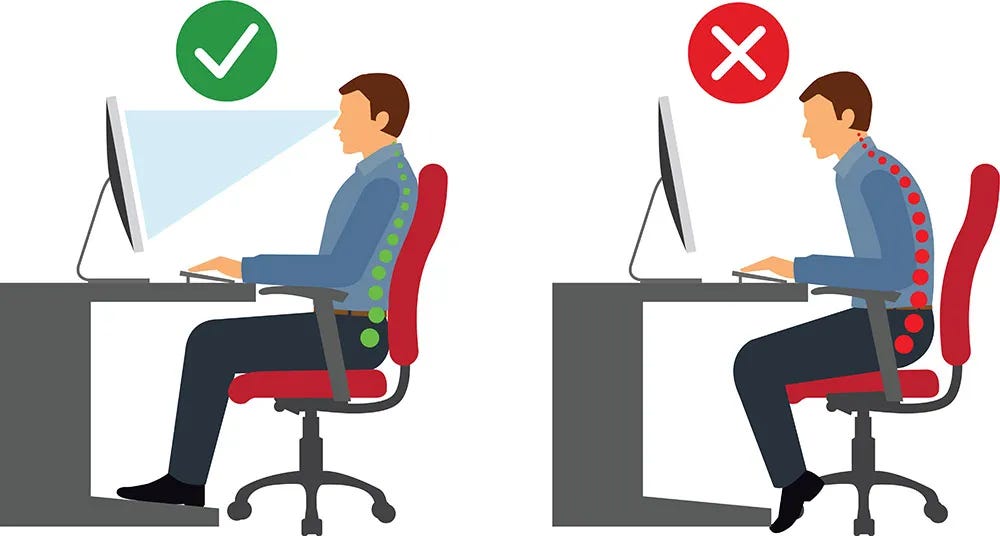
Position 1 — Upright neutral:
Pelvis slightly forward on the chair seat. Natural lumbar curve. Shoulders directly above hips. Monitor at eye level. This is the starting position — not the only position.
Position 2 — Slight recline:
Chair back at 100–110 degrees. Weight shifted backward. Lumbar support engaged. This reduces disc pressure compared to upright — the most pressure-reducing position available in a standard chair.
Position 3 — Forward lean (supported):
Elbows on desk. Forearms supporting torso weight. Trunk slightly forward. This shifts load from the lumbar to the upper extremities — a different distribution from positions 1 and 2.
Position 4 — Lateral shift:
Weight shifted to one hip, then the other. Brief — 30–60 seconds each. Changes the lateral loading on the lumbar discs.
Rotation schedule: Move through all four positions within every 30-minute sitting block. No single position should persist for the entire block. The goal is variety — not finding the perfect position and holding it.
Combined Protocol — The Highest Protection Version
(Active break + postural shifts within each block)
The trial tested each intervention separately. Combining them addresses both mechanisms simultaneously.
Every 30-minute block:
→ Cycle through the 4 postural positions within the block
→ 3-minute active break at the end of the block before the next
This means the spine is never in one position for more than 7–8 minutes AND never in sustained loading for more than 30 minutes without a full break.
The postural shift reduces within-session loading. The active break provides the recovery window. Both mechanisms operate together.
Habit Engineering — Making It Last 6 Months
The trial ran for 6 months. The protective effect required sustained behaviour change — not a week of effort followed by reversion.
The three systems that make it last:
System 1 — Environmental trigger:
Place a small object on your desk that you must move before sitting down. Moving it back after standing becomes the return-to-sit ritual that keeps the break cycle visible.
System 2 — Calendar blocking:
Schedule the 30-minute break as a recurring calendar reminder. Label it. Treat it the same way as a meeting. The trial’s intervention groups had structured apparatus that forced compliance — this is the functional equivalent without equipment.
System 3 — Progress tracking:
Each Friday — note how many days you hit the 30-minute break schedule. Track compliance, not outcome. The outcome (pain prevention) is invisible when it’s working. Compliance is the only visible metric during a prevention protocol.
The trial’s 6-month timeframe matters: the protective effect accumulated over months. Behaviour change that reverts after 3 weeks doesn’t reach the protective threshold the trial confirmed.
Week 1–2: 30-minute timer feels disruptive. Active break sequence takes deliberate effort. Postural shifts require conscious reminders. This is correct — the behaviour is new and requires active attention before it becomes automatic.
Week 3–4: Timer alerts producing automatic stand-up response. Postural shift sequence beginning to feel natural. The physical disruption to workflow reducing as the breaks become predicted rather than surprising.
Month 2: Break cadence established. Postural rotation happening with minimal conscious effort. Some readers with existing mild discomfort may begin noticing it arriving later in the day — the protective mechanism accumulating.
Month 3–6: The trial’s protective window. Readers who maintain the protocol are statistically much less likely to develop new neck or lower back pain than those who returned to unstructured patterns. The prevention is invisible when working — the only evidence is the pain that didn’t arrive.
44% of healthy desk workers developed neck pain in 6 months of normal office work. 33% developed lower back pain.
The groups who added active breaks or postural shifts reduced those numbers to 17% and 7–9%.
The desk creates the loading. The movement pattern determines whether the loading becomes pain. Waiting for pain before changing the pattern means the pattern already won.
Both interventions worked equally for neck pain. The postural shift worked slightly better for lower back pain. Both required nothing more than a timer and a willingness to move before you feel the need to.
The protection is in the pattern. Not the equipment.
I believe most desk workers aren’t ignoring their bodies.
They’re managing pain reactively — taking breaks when it hurts, adjusting position when it aches.
Nobody showed them the 6-month data on healthy workers. Nobody told them the risk was statistical, predictable, and preventable with a 3-minute break every 30 minutes.
Prevention doesn’t feel like anything when it’s working. That’s how you know it is.
No posts
Comments
Nothing yet. Say the first thing.
Sign in to join the conversation.