
Here’s a nice mental model for learning math facts. It’s called the “Instructional Hierarchy.”
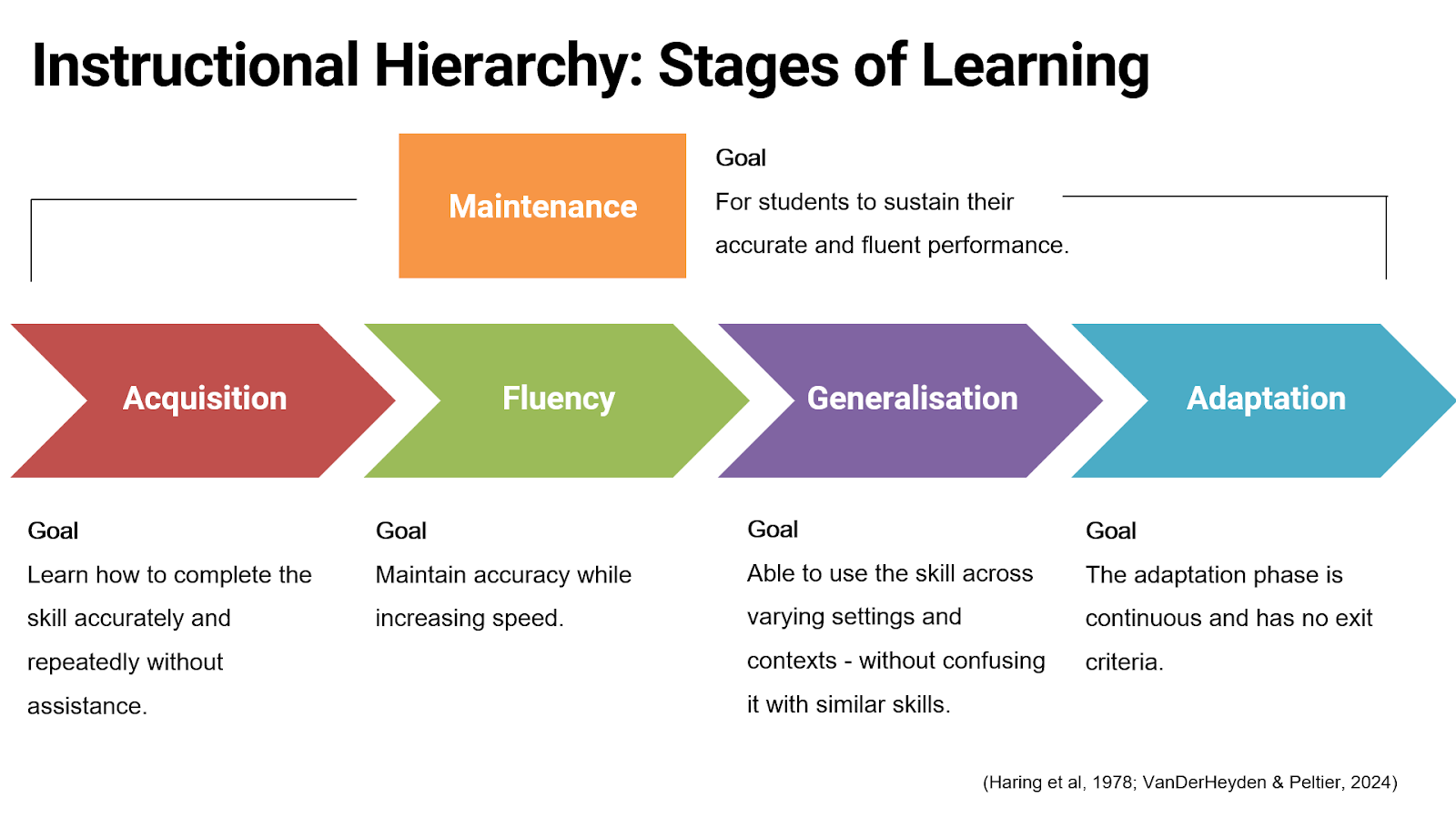
Acquisition: Students learn math facts by connecting new facts to what they already know. The goal is to answer accurately but using a range of strategies, without an emphasis on speed.
Fluency: Students practice, getting more automatic over time. The goal is for math facts to be answered accurately and quickly.
Generalization: Students apply their math fact knowledge in lots of different ways.
Let’s imagine I’m tutoring a student in their multiplication facts. First I would focus on acquisition. We would draw lots of pictures, talk about the commutative property, practice skip-counting, look for patterns in each fact family, and connect the specific math facts to prior knowledge. Then, once students have a solid foundation, we would work on fluency. Here the goal is to get faster. I would tailor the specifics to the student. We might see how many they can answer in one minute or three minutes. I would pay close attention to the student’s confidence and frustration. I would adjust the pace as we go, and figure out what motivates the student to make progress. If acquisition goes smoothly we might introduce more math facts at once. If acquisition is slow we might focus on one fact family at a time. Then, once students have some decent fluency with their math facts, we can focus on the generalization phase. As one example, I’m a big fan of the Beast Academy game All Ten, which is a daily number challenge requiring a lot of flexibility with arithmetic.
Here’s a nice graphic summarizing the Instructional Hierarchy.1
Timed fact practice is a perpetual flashpoint in math education. Some teachers will argue timed fact practice causes math anxiety and is unnecessary. Others are convinced it’s a crucial part of building automaticity.
The Instructional Hierarchy tries to settle this argument. Advocates for this framework would argue that the answer just depends on the stage. In the acquisition stage, timed practice isn’t appropriate. The goal is to get students calculating accurately and connecting what they’re learning to what they already know. In the fluency stage, students need to work on increasing speed to become more automatic and effortless in their calculation. Problem solved!
The issue is that in my class — like most math classes — I have some students who need work on acquisition, some students who need work on fluency, and some students who are in the generalization stage.
This is the core challenge of fact fluency. If I’m working with a student one-on-one, the instructional hierarchy is really useful! In a classroom with a wide range of students, the reality is much more complicated.
One phrase I often hear from math teachers is describing large amounts of practice as “drill and kill.” Drill and kill is excessive practice that undermines motivation and is often seen as inefficient.
I’m a huge fan of practice. That said, I think the instructional hierarchy can help us understand what teachers mean by “drill and kill” and why repetitive practice can be unproductive in some contexts. Repetitive practice is most useful when students are in the fluency stage. Asking students to practice something while they are still in the acquisition stage is going to be inefficent. I’ve seen this over and over again: students are trying to practice something but their working memory is overwhelmed, their work is slow and error-prone, the practice isn’t very productive, and the whole experience is unpleasant for students.
This type of practice often leads to avoidance behaviors. That one student always has to go to the bathroom, or the tip of their pencil breaks, or they hunch over their paper without doing much of anything. Even if the student is trying their best, they may solve problems very slowly and get less practice than their peers. And if the students who need practice the most aren’t getting very much of it, they won’t make much progress.
I have a wide range of students in the room. How can I structure a whole-class activity so that students can make progress on acquisition, fluency, and generalization, all at the same time?
One solution to this challenge is differentiation. You create or adopt resources that try to meet each student where they are. Maybe one student is working on their addition fact fluency, another on multiplication fact fluency, another on long division, and so on. I don’t doubt that, when executed well, this can be a good approach. There are two challenges: first, it’s a ton of work, and second, it takes valuable time. If that system works for you, that’s great! It is just too much for me.
Here’s a simple representation of the Instructional Hierarchy:
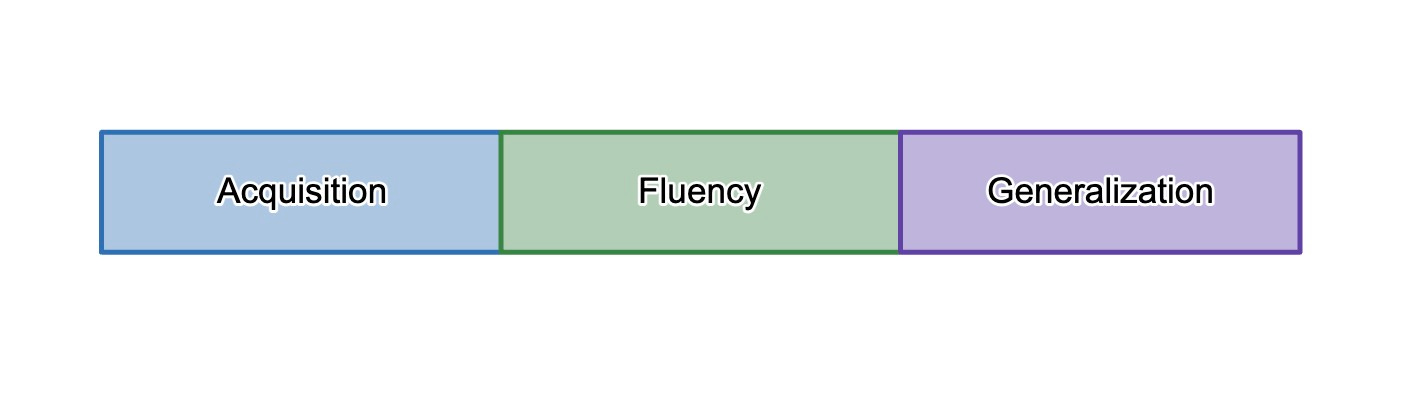
Students are in all different places on that spectrum. Some are at the very beginning of their multiplication fact knowledge, others are ready to generalize.
Here is what I do:
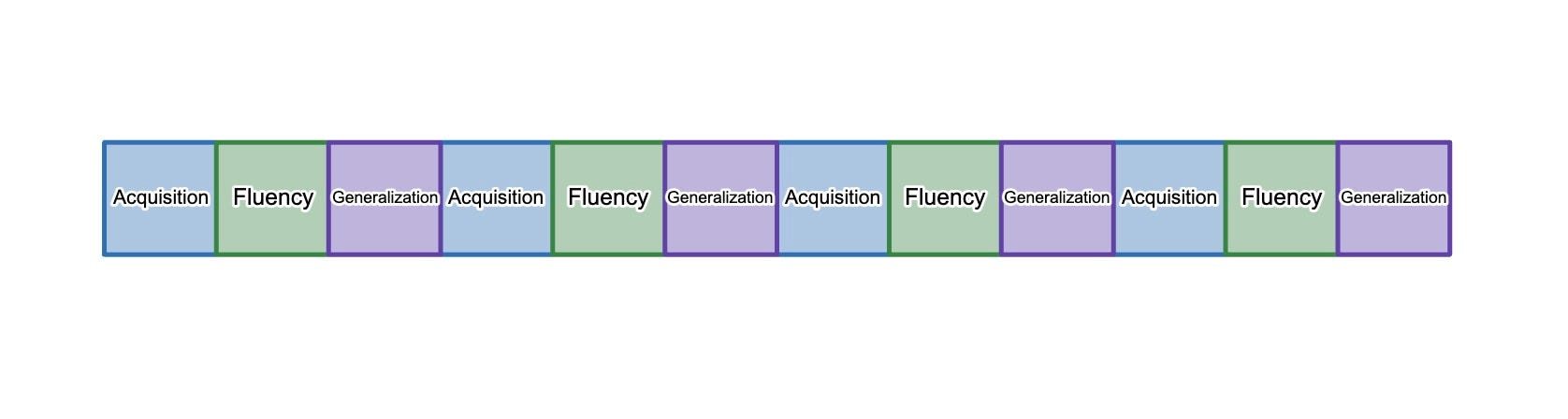
Instead of treating multiplication facts like one big monolith, I break it down into smaller chunks. Practice one fact family at a time. Focus on acquisition first, then move to fluency, while mixing in lots of generalization.
Is this approach perfect? No. But it’s the best solution I’ve found to the core problem.
There’s a naive approach to multiplication facts: students don’t know their facts, so we should have them practice. My experience is that a significant group of students makes very slow progress, and often finds this process incredibly unpleasant. They are in the acquisition stage, and trying to do acquisition for all of their math facts at once is slow and demotivating. Breaking facts into smaller chunks avoids excessive, repetitive practice before students are ready for it.
I’m left with a simple indicator to figure out whether my fact fluency practice is productive. I focus on my students who I know need the practice the most. Are they getting discouraged and avoidant? Are they working slowly and not getting much practice at all? If so, I need to step back and break practice down into smaller chunks. At the same time, I mix in opportunities for generalization like All Ten. Are there some students who don’t need the practice? Sure. But quick chunks of practice won’t hurt, and I’m making sure to include some challenges appropriate to their skills. By focusing on whole-class practice rather than trying to differentiate, the whole process takes less time.
Alright this post is long enough. Next week I’ll be back with more details about my routine.
I’m squishing generalization and adaptation into one category. I’ve seen researchers do this as well. While there are differences they are less distinct from each other than the other stages. For my purposes here, I’m focused primarily on the acquisition and fluency stages anyway.
No posts
Comments
Nothing yet. Say the first thing.
Sign in to join the conversation.