
One of my favorite pieces of teaching advice is to strive for a high success rate. Teachers should ask students lots of questions, and my goal is that students get 80-90% of those questions right.1
The idea isn’t to find contrived ways to engineer an 80% success rate. If that was my only goal, every Do Now would look like this:
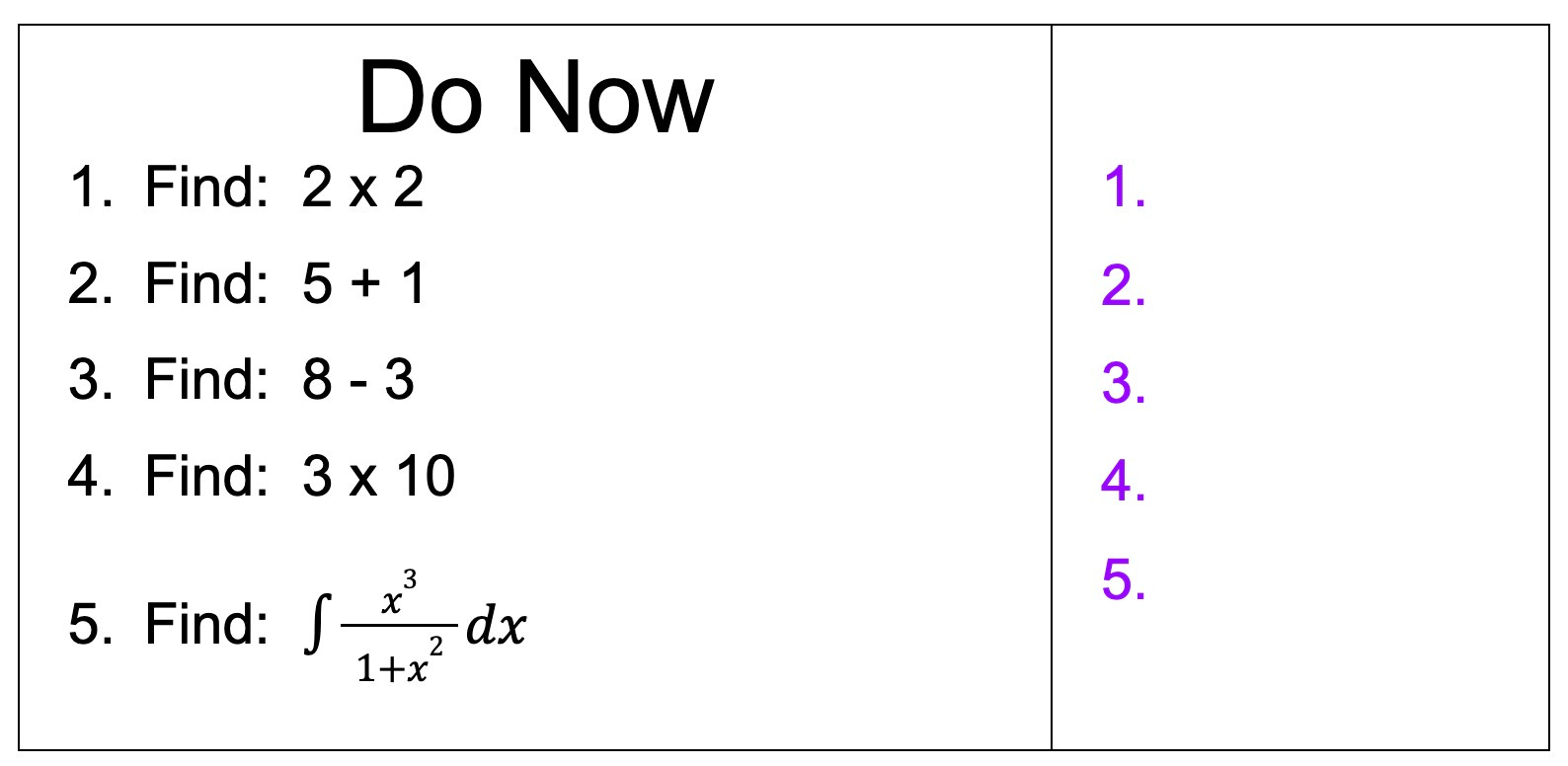
I like this advice because I find it’s connected to many other areas of teaching. 80% isn’t a magic number, but striving for a high success rate pushes me to do all sorts of things in my classroom that are helpful for learning.
I want to start with a non-example: what this is deliberately different from.
It’s common to see posters in classrooms that say things like, “the power of yet: I don’t know this...yet!” or extolling the value of perseverance. And yes, perseverance is a good thing. I don’t have an issue with the signs themselves. But in many cases these posters go along with an approach to teaching: the teacher uses a curriculum, and for many students the curriculum asks them lots of questions they don’t know. So the teacher encourages students with messages about a growth mindset or perseverance in hopes of getting students to persist even though the work is clearly challenging and discouraging for students.
The high-success-rate approach says something different. In that situation, the teacher needs to make a change to increase the success rate. The primary job of a teacher is not to encourage students to persevere when things get hard. The primary job of the teacher is to engineer conditions where students are successful 80-90% of the time, inasmuch as that is possible.
I mentioned that what matters is not the success rate itself but all the other teaching practices that this idea has led to. Here is a rough list of ideas I’ve found helpful that are downstream of striving for a high success rate.
Check responses of all students. Teachers should ask students lots of questions, and they should also check the responses of all students as often as they can. If I’m not seeing or hearing every student’s response, I can’t judge their success rate. Ensuring every student answers is a great way to provide accountability and make sure students aren’t passively following along. There are lots of ways to do this. Some of my everyday strategies are mini whiteboards, turn and talks, choral response, and sets of written problems where I circulate around the room and look at the same 1-2 answers from every student. You might have different strategies. Lots of things work here, as long as every student has to answer and the teacher can gather a bit of data on whether students are successful.
Provide more practice. How much practice do students need? One simple answer is that students should practice until they reach a high success rate. Your curriculum will have a certain number of practice problems. That number might not be right. Providing more practice until students reach a high success rate is a great way to improve long-term retention. This can be inconvenient: practice may extend beyond the boundaries of a single lesson. Teachers have to make time and find resources. But that additional practice is often essential.
Judge a curriculum by the student success rate. Along those lines, something lots of schools wrestle with is the extent to which teachers should follow a curriculum. I’m in favor of high-quality curriculum, but fidelity to a curriculum can become a mindless march without much learning. A high success rate is my benchmark for whether a curriculum needs to be modified or supplemented. If students are not reaching a high success rate, I might need to add more scaffolding, adjust the sequencing, or make other changes. If the success rate is too high, consistently above 90%, then the curriculum is too easy.
Think of every student. Every student is an individual. Here’s one thing that is not a high success rate: give students an exit ticket, 80% of students get it right, and say that’s good enough and move on. The goal is that each individual student has a success rate of 80-90%. Now in real classrooms this is probably impossible, but it’s the goal. The goal isn’t to get 80% of the students across the finish line and ignore the rest. I need to constantly ask myself: what am I doing to support students who have not achieved a high success rate?
There will always be some students who get more questions right. The goal is an 80-90% success rate, so this is a reminder to include some challenge questions so that no student is getting every question right every day.
Similarly, there will always be some students who have a tougher time in school. This is a reminder to ask some simpler questions as an on-ramp to build confidence. I often think I’m asking easier questions early in a lesson and realize that some students are still having a hard time, which is a good moment to recalibrate.
Include lots of review. One way to do that is to include lots of review. I think this is one of the most common mistakes in teaching. Review of what students learned yesterday, last week, last month, last year. New learning always builds on something students have learned before, and those connections are clearest when students get a reminder of that prior learning. Review is good in and of itself, and it’s also a good way to increase students’ success rate.
Motivate students with success. A high success rate also plays a role in motivation. If students are constantly getting questions wrong, they are less likely to want to answer the next question. Motivation is more complicated than that, but it’s not a bad place to start, and trying other motivational strategies while students mostly get questions wrong and feel dumb in class is often futile. It’s not possible to engineer this perfectly for every student in every moment of every class, but a good rule of thumb is to start each class with a bunch of tasks that have a deliberately high success rate to build momentum.
Break complex ideas into small chunks. One piece of advice about teaching is to break complex ideas down into smaller, more manageable chunks. This isn’t bad advice, but it’s not very specific. When do you stop? At what point are the pieces small enough? My metric: if I’m struggling to get students to a high success rate, if we’re practicing and they just aren’t hitting that bar, I’m probably not breaking concepts down into small enough pieces.
If the success rate is low, change something. That last point gets at a larger idea: if I’m teaching something and students aren’t reaching a high success rate, something is wrong. I can’t always say exactly what it is, but striving for a high success rate serves as a check on my teaching. Teaching is an empirical science. Teaching is only effective if students learn something, if they can answer or produce something that they couldn’t before. Striving for a high success rate keeps me connected to that empiricism.
Prioritize. Finally, some teachers will say that all of this stuff sounds nice but they just don’t have time. They have to stay with the pacing guide or they won’t cover everything. I agree! I also do not have enough time. Here’s something I think more schools should do: make the conscious choice that, since there isn’t enough time, they will prioritize a few key skills. That’s where I started. I decided that, in 7th grade math, equation solving was the most important skill, and that I was going to spend more time on equation solving. This meant I had to cut some things, or give them a quick, superficial treatment. That’s fine. One of the lessons for me was realizing that, if I’m not achieving a high success rate with any topic, that’s a ton of wasted teaching. If I pick some things and prioritize them, I can feel much more confident that students have learned the most essential content in my course.
I want to close with another non-example. Someone might read this post and think I want to give students easy work, that I have low expectations and want to avoid challenging students. That’s not it at all. The success rate I am striving for is a ceiling as much as a floor: a success rate of 100% is almost as bad as a success rate of 50%.
This is another reason not to follow the recommendation of a certain success rate blindly, without regard for everything else that goes into teaching. My job is to teach, as best as I can, the standards as they have been set for my students.
I find this advice helpful across content areas: reading, writing, math, social studies. It’s not a magic elixir, it’s broad advice that points me in a helpful direction. Do I need more review? More practice? Break ideas into smaller chunks? Provide more challenge for my strongest students? More scaffolding for strugglers? The exact tools vary by content area, and there isn’t always an obvious solution. But the idea is simple: if the success rate is low, I need to make a change. That broad direction is a helpful one, and I think striving for a high success rate is good teaching advice.
Does research support the idea that teachers should strive for a high success rate? There are a few lines of research that are interesting, but it’s not the case that “research says effective teachers strive for a high success rate” or something like that.
The most common reference to this idea is in Rosenshine’s Principles of Instruction. This research is correlational: Rosenshine observed effective teachers and wrote down what they had in common. Their high success rate could simply have been the result of other effective teaching practices, rather than a standalone recommendation.
Another interesting line of research comes from the Direct Instruction programs. These programs do have a strong research base, though that research is largely limited to early elementary years. In Direct Instruction, success rate is manipulated directly: in the programs it is common to continue practicing a given skill until students reach a high success rate. Elements like student placement in the program and frequent review are specifically oriented around ensuring a high success rate.
Mastery learning is another interesting line of research. This is another type of teaching where students continue practicing until they reach a high success rate, and that has some empirical support. While it has influence in some places, mastery learning research peaked decades ago and is most commonly implemented today in online, personalized learning programs. It’s interesting, but the implications for classroom teaching are not clear to me.
Finally, another interesting data point is a line of research on early reading instruction that suggests too high a success rate is detrimental. Texts where readers know more than about 95% of the words are often classified as being at the student’s “independent” reading level. When primarily reading texts at this level, students tend to make slower progress. For students who are already behind, if they spend most of their time reading at a high success rate they are unlikely to catch up with their peers. It’s not clear what the optimal success rate is, and it probably depends on the quality of instruction and the level of support, but 80-90% is a reasonable guess.
None of this conclusively shows that research supports a high success rate. I find the research interesting and suggestive. Still, I’m recommending this primarily because it has worked for me in my classroom and because it lines up broadly with what I know about learning.
No posts
Comments
Nothing yet. Say the first thing.
Sign in to join the conversation.