
“The science of learning” is a broad term for research into human learning. How do humans learn new things? What is the architecture of the mind? What makes learning easier or harder? The science of learning draws heavily on cognitive science and related fields. It has also spawned a number of popular Substacks and has been getting more and more attention. In some circles, it seems like the science of learning is on the rise.
I feel ambivalent about it.
On one hand, I’m enthusiastic about a lot of what often falls under that broad banner. Cognitive science has had a big influence on my teaching. I’ve learned a lot from that type of research. Cognitive load theory, retrieval practice, and more have all helped me to teach better.
On the other side, I worry that “the science of learning” overpromises. Is there, truly, a science of learning? How much do we know about learning?
One thing I find interesting: in most elementary schools across the US, teachers are aware of “the science of reading.” But “the science of learning” is almost totally unknown across all types of schools. Ask a typical teacher about it, and they won’t know what you’re talking about. Should we — people like me who have learned a lot from research often labeled as the science of learning — be spreading it, and advocating for “the science of learning” to be better-known in schools?
I’ll come back to my hesitations in a minute. First, a story.
I have a stutter. If you’ve spent a lot of time with me you’ve probably noticed it. I have decent coping strategies at this point, but as a kid it would be hard to spend more than two minutes talking to me without hearing a significant stutter.
I went to a lot of speech therapists. Most, unfortunately, didn’t know what they were doing. I have particularly vivid memories from one: a group session where we spent a bunch of time learning definitions and catchphrases. The meaning of fluency, “practice makes permanent, not perfect.” And then we were supposed to practice. It never helped much; I just spent time learning about what speech was supposed to sound like, trying to practice not stuttering, stuttering anyway, and watching the kids around me all do the same thing.
My parents, bless them, were patient, and after a bunch of failures we found someone who helped me develop strategies that worked. The strategies sound pretty counterintuitive to someone who hasn’t experienced this. Here’s one that made a big difference. I mostly stuttered at the start of a word or phrase, and in particular on words that began with consonants. Imagine I’m trying to say “cost,” and it comes out as “c-c-c, c-c-cost.” But if I try to say “accost” I don’t have any trouble at all. So a basic step is, when I start to stutter or anticipate a stutter, I add a vowel at the start of a word. This is a nice way to avoid stuttering. Unfortunately, “cost” and “accost” have different meanings, so it’s not a great long-term solution. Through speech therapy I learned to make the vowel less pronounced. It shifted to something like “(uh)cost,” and then the (uh) became totally silent, just a breath and a slight change in the cadence of my speech.
This is something I’ve found with a lot of effective teaching. It’s not a generic strategy like “break learning into small steps.” Effective teaching is rooted in an understanding of the specific content to be taught. It’s also often a bit counterintuitive, not the first thing one would try, something teachers have figured out after endless trial and error.
Many phenomena in the world seem to roughly follow a bell curve. In terms of speech skills, I fell on the wrong end of the bell curve. I went to speech therapy hoping to make a change, to move to the right. The first few rounds didn’t work. That sucked. Not fun, do not recommend.
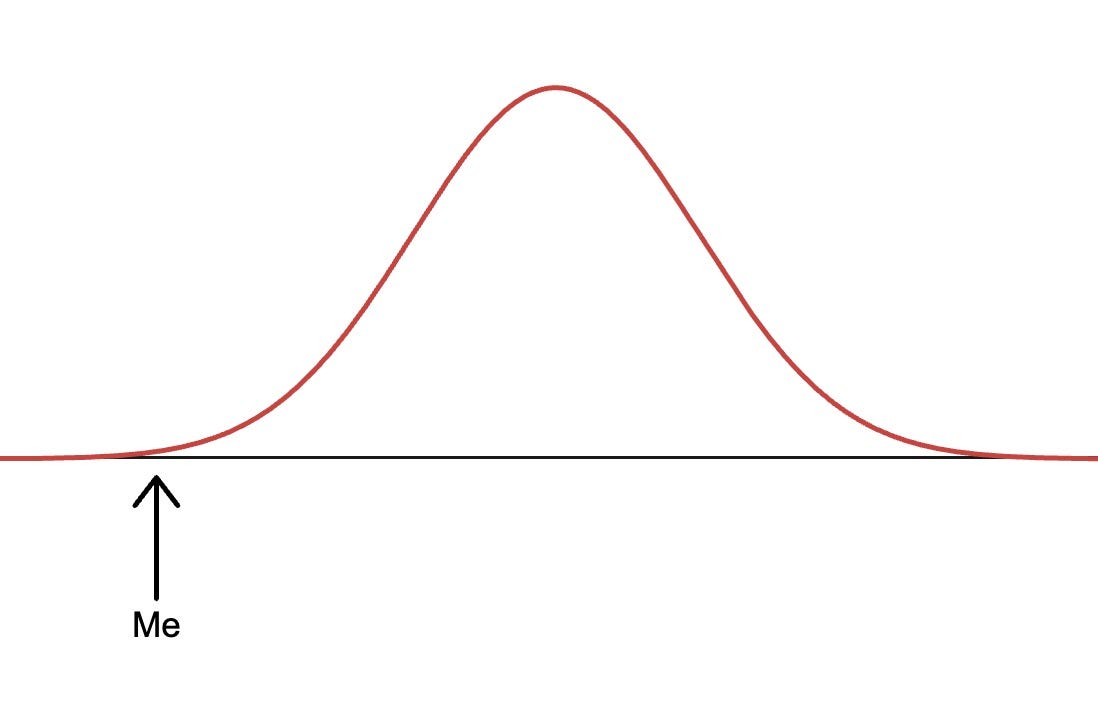
But a bell curve isn’t the inevitable consequence of instruction. Here is Benjamin Bloom:
There is nothing sacred about the normal curve. It is the distribution most appropriate to chance and random activity. Education is a purposeful activity and we seek to have the students learn what we have to teach. If we are effective in our instruction, the distribution of achievement should be very different from the normal curve. In fact, we may even insist that our educational efforts have been unsuccessful to the extent to which our distribution of achievement approximates the normal distribution.
Unsuccessful instruction That’s what I experienced. The end goal isn’t a bell curve. It’s something like this:
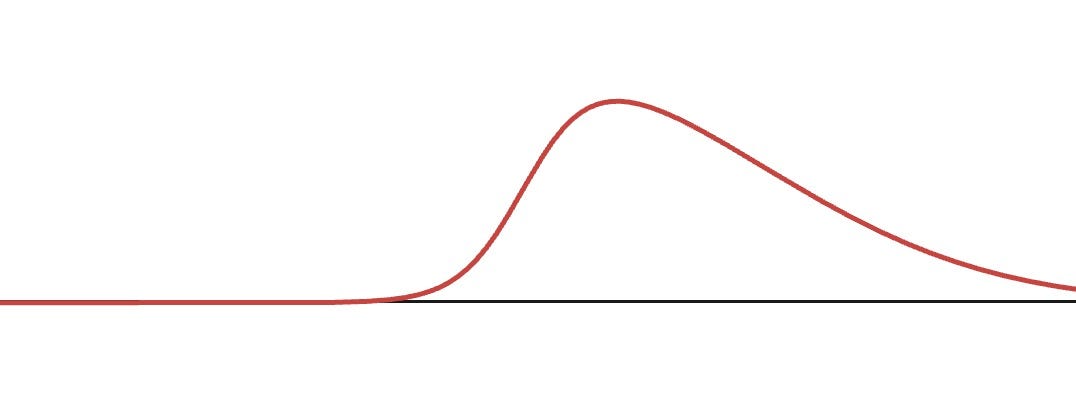
This isn’t some fantasy land where every student is exactly equal. But there should be fewer students in the left tail, and more students shifted to the right.
I think that what Bloom called unsuccessful instruction is the norm. The bell curve is what most outcomes look like in education. This failure doesn’t mean teachers are lazy or students learn nothing. It just means that there’s this bell curve, this random outcome, and that teaching isn’t shifting the distribution. Students arrive with different affinities and aptitudes, and education reinforces them rather than changing a student’s trajectory.
I don’t think unsuccessful instruction is universal. There are some places where the education world has figured some stuff out. Phonics has been in the news in recent years, and I think phonics is a great example of an instructional tool that shifts the bell curve and skews the distribution to the right. But one reason phonics is notable is that it’s an outlier. It’s one of a handful of concrete, specific classroom practices with a strong research base that a typical school can adopt. There are others, though most are buried in the minds of experienced teachers who have figured out a great way to teach this skill or that concept. Islands of success, like the effective speech therapist I finally found. But the bulk of the research suggests that differences in teacher quality and even school quality only explain a modest portion of the variation in student achievement. I think that squares with an environment where unsuccessful instruction is the norm, and for most students school is a place where they fall in a particular spot on the bell curve and stay there.
Here’s an Indian parable:
A group of blind men heard that a strange animal, called an elephant, had been brought to the town, but none of them were aware of its shape and form. Out of curiosity, they said: “We must inspect and know it by touch, of which we are capable.” So, they sought it out, and when they found it they groped about it. The first person, whose hand landed on the trunk, said, “This being is like a thick snake.” For another one whose hand reached its ear, it seemed like a kind of fan. As for another person, whose hand was upon its leg, said, the elephant is a pillar like a tree-trunk. The blind man who placed his hand upon its side said the elephant, “is a wall.” Another who felt its tail, described it as a rope. The last felt its tusk, stating the elephant is that which is hard, smooth and like a spear.
(source: Wikipedia)
In this story, teachers are the blind men and the elephant is the science of learning.
We know some stuff. We can describe a bit about the general shape of the thing that we might call “the science of learning.” But most of the specifics are yet to be filled in.
That’s the thesis of this post. Let’s have some humility. The education world should celebrate our successes, but also be clear-eyed about the goal and how far we have to go. I think Benjamin Bloom’s goal is exactly right: we should strive to shift the bell curve of education outcomes to the right. We should be honest that we don’t have very many well-known, widely used teaching techniques to do that.
My experience with “the science of learning” is that it is absolutely helpful, but also woefully inadequate to the real complexities of teaching. Most of the time when I try something rooted in cognitive science or other learning research, it’s a mess on the first pass. That doesn’t mean it’s bad or useless, just that it’s missing lots of details. We have bits and pieces but the picture is far from complete.
I mentioned phonics earlier, and I think it’s a helpful example in the context of that parable. There’s one part of the elephant we know pretty well. That’s cool! We should teach kids to decode using all of the available research. We should also recognize that phonics teaches students to decode, and decoding is only one part of reading instruction. While there’s plenty of other research on the rest of reading instruction, it’s a lot muddier than phonics — and even in the world of phonics there are plenty of questions left to be answered. Kata Solow had a great recent piece about some evidence that the science of reading has caused an overcorrection toward too much phonics. That seems unsurprising to me: people focus on the part of the elephant they understand, and put less emphasis on the parts they don’t.
Math fact fluency is another interesting case. There’s a lot of correlational research showing that knowing math facts is associated with future math achievement. But there is very little high-quality, causal evidence that additional fact fluency practice leads to broader learning gains. This isn’t to say that math facts aren’t important. We have a sense of the general shape of that elephant. But most of the details are yet to be worked out.1
This leads back to my hesitation with “the science of learning.” I’m back in the classroom right now for the first week of school. I’m thinking a lot about working memory, cognitive load, retrieval practice, and more. All of that stuff plays a big role in my teaching. But the nitty-gritty practical knowledge that helps me put that stuff into practice in my classroom is full of lessons learned from trial and error, one part science and three parts empiricism.
I don’t want to go around overselling this elephant. There’s just so much we don’t know. I’m an optimist: I think there exists a future world where education works much better for many more students. But that future world will rely on a science of learning that looks very different than the one we have today. We are blind men groping around an elephant, and we need to learn about the elephant’s circulatory system, and its mating habits, and its place in the food chain.
I’ve seen both sides as a learner. I experienced unsuccessful instruction in my first few rounds of speech therapy, stuck on the wrong end of the bell curve. Then I found someone who knew what they were doing and understood the specific issue I was having, and now I’m in a totally different place on the bell curve. I’ve also been on both sides as a teacher. I’ve taught plenty of topics where the students who have been strong math students in the past get it, the students who have struggled with math in the past don’t, and I just reinforce the existing hierarchy. I’ve also found ways to teach topics here and there that truly move the needle, where those students who struggle are able to succeed and feel proud of their progress. I want successful instruction for more students. I want it desperately. But that’s not something the science of learning can offer right now.
Is the science of learning a part of that knowledge? Absolutely. But after years of trying to understand the science of learning, it is still no match for the challenges of the classroom. So I’ll share what I’ve learned, but I’m not going to go around telling people that they should adopt the science of learning, or that if only more teachers understood the science of learning we’d have a more effective profession. The science just isn’t there. We have a long way to go, and I want to be honest about that.
I can’t resist opining a bit about the math facts question. Do math facts matter? Absolutely. But let’s look at two tougher topics that math fact learning is supposed to help. To learn about fractions, students absolutely need to know their math facts. This includes subtraction and division, which are often neglected. But to really understand something like equivalent fractions, students also need to have a ton of knowledge of multiples and factors, knowledge that goes beyond simple recall of math facts. Similarly, solving equations is another place where math fact fluency plays a big role. But the key knowledge to solve equations is about the interconnections between math facts. It’s not just that 3 x 4 = 12 and 12 / 4 = 3, it’s seeing 3 and 4 and 12 as part of this bigger family so that students understand the equation 3x = 12 can be solved by dividing both sides by 3.
There’s a lot more to know than committing math facts to memory. Knowing math facts is necessary, but definitely not sufficient. Meanwhile, the vast majority of research focuses on teaching students addition and multiplication facts, rarely even getting to subtraction and division. We’re a long way from truly understanding that elephant.
No posts
Comments
Nothing yet. Say the first thing.
Sign in to join the conversation.