
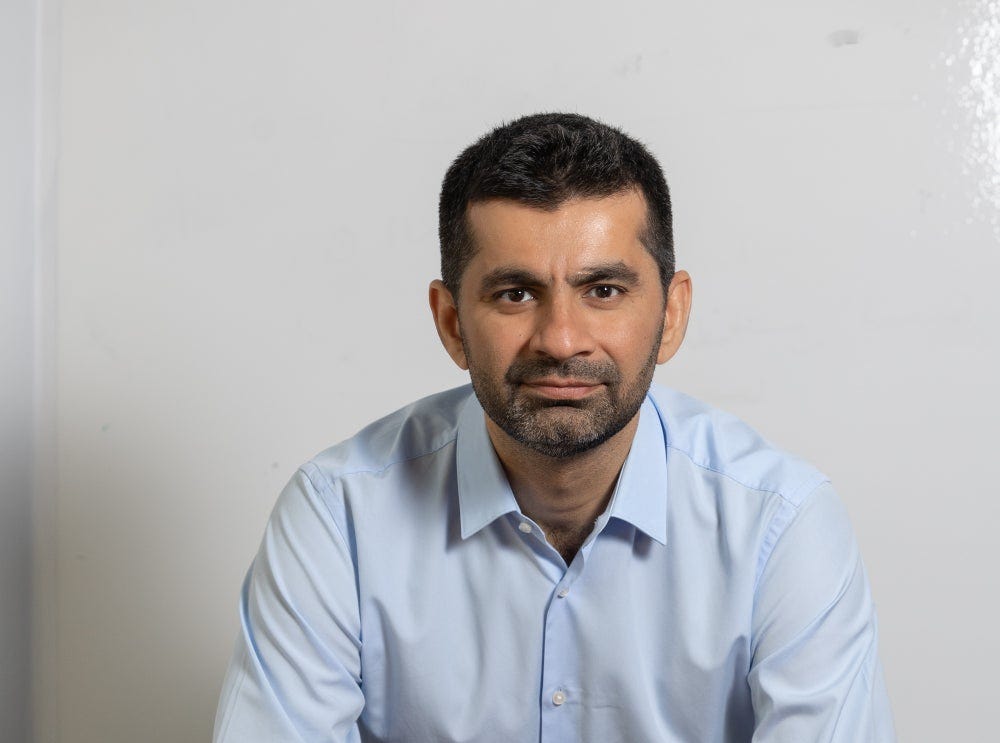
Q1: Take me back to the moment you became the person you are now. What happened, and how did you come to what you do today?
There isn't one thing. I grew up in a humble middle-class family in Pakistan with a mom who was a tiger mom, in today's language. She demanded excellence. Growing up was painful, but in hindsight it was exactly the upbringing you'd hope to get.
Then I got fortunate, a scholarship to California, and graduated right at the height of the dot-com boom. Most startups are spectacular disasters, but they teach you a lot.
The biggest thing was meeting Magnus, my co-founder and partner in crime. He'd had a brush with death, and when someone tells you you're going to die, life becomes very clear. He promised himself that if he survived, he'd build something big and, more importantly, something meaningful.
He's married to a Palestinian, so he'd say, I'm literally married to the region. That's when we decided this region can and should build large, lasting institutions, and paired up to find a big problem to solve.
Q2: What’s the belief you hold that most people around you disagree with, and what did it cost you to keep believing it?
That ambition manifests itself. Magnus used to say it in the early Careem days: if you want something to happen, you have to visualize it happening. So we'd ask, what's the craziest version of this? Put something out there so crazy it feels delusional, then keep repeating it.
Two things happen. When you say you'll build a trillion-dollar platform from this region, the crazy ones say count me in, and once they join, the virtuous cycle starts.
And when you give yourself the liberty to be that ambitious, the noise goes away and you focus only on what moves the needle.
The cost is that it's painful. It's so easy to be reasonable and go with the flow; instead you're always confronting people, always making them believe in something that doesn't seem doable.
Even when you believe it, it's hard to live every single day, because the society around us is designed not to operate that way.
Q3: Why did you start Careem? What was the hardest part of the journey, and what is the ultimate goal now?
We didn’t start Careem because we were deeply passionate about transportation or a specific app idea. We started it out of a burning desire to build something massive and impactful for the region.
When we looked at why large, lasting institutions weren’t being built in our region, we realized it came down to two things:
Life in the region is full of friction. Smart, capable people spend all their mindshare fighting daily struggles: transportation, electricity, water, gas. When your mind is fully consumed by daily friction, you don’t have the space or time to focus on big ideas.
The top talent wasn’t trying to build big things. The brightest minds coming out of regional universities were aiming for comfortable jobs at Western multinationals. But who is going to build our own multinationals if our best people work for others?
So, we converted that into Careem’s core mission: to simplify the lives of people and to build an awesome organization that inspires. We wanted to remove friction so people had the freedom to dream big, and we wanted to build an institution that gave the region self-belief and confidence.
We later expanded into deliveries and payments because our radar was always open to maximize our impact. We were swinging for the fences every single time.
Q4: What’s your advice to Muslims trying to get into a similar space and make an impact?
First, there is a dire need for Muslims to become stronger, independent, and self-reliant. Look at what has happened globally over the last few years; it’s a stark reminder that if we are not economically and institutionally strong, we cannot defend or speak for ourselves effectively. Muslims living in places like Silicon Valley, London, or Dubai have access to the best education and immense resources. We are the privileged few, and the responsibility on us is far greater than on those who don’t have these opportunities. We have to work harder, dream bigger, and build to lift everyone else up with us.
Second, learn from the best. Early in your career, go work in the most demanding, highest-performing environments possible. Places like Google, Anthropic, SpaceX. Building a company is a trade that needs to be mastered. Learn how they hire, how they scale, and how they raise money so you don’t repeat mistakes others have already solved.
Third, start small, but aim incredibly high. Ground yourself in reality initially. I was driving Careem cars myself to assist customers in the early days! Don’t let your massive vision paralyze your day-to-day execution. Start small, but let that silent ambition burn inside you like a fire. If we all do this, the Ummah will be in a completely different place in the next 30 to 50 years.
Q5: What should the Ummah be focused on for the next 10 years?
It’s a highly diverse community, but two clear priorities stand out:
Education: We have an embarrassingly large number of people in our community who are either not getting an education or receiving very poor quality education. We have the collective resources to fix this. We just need the collective will to finally make a permanent dent in this issue.
Excellence and Building Institutional Power: We need to look at successful communities globally and study how they achieved monumental impact over the last century. They prioritized absolute excellence, worked relentlessly hard, and built dominant platforms in finance, media, technology, and science. We must stop just chugging along, content with comfortable paychecks. We need to be unashamedly ambitious, shoot for the moon, and build our own large-scale platforms.
The scale of impact possible today is unprecedented. Look at a company like Google. It started in 1999, and today its valuation is larger than the combined GDPs of multiple major nations in our region. That level of value and impact can be created by a single breakthrough idea. Why shouldn’t one of those big things be built by one of us? It absolutely should be.
About Five by Friday
Five by Friday is a newsletter interviewing successful Muslim founders in the startup space, sharing their experience through five questions.
Friday is a 501(c)(3) that supports Muslim-led businesses through connection to community and capital. We connect founders, investors, operators, and industry experts to unlock expertise, capital, and collaboration.
How you can help power our mission:
Donate: Every dollar counts. Contribute now to help us reach our goal.
Share: Share with friends, family, and on social media. Your advocacy can amplify our impact.
Volunteer: Your time and skills can make an impact too.
You can also find us on LinkedIn, X, Instagram, WhatsApp or join our community directly.
No posts
Comments
Nothing yet. Say the first thing.
Sign in to join the conversation.