
Spicing up the food, an alternate method of shaving, inspirations from the origin of the sun, and Elvis mocks the judge, on this day in music.
Weasels Ripped My Flesh
1970: Legendary avant-garde rockers The Mothers of Invention release their eighth album, “Weasels Ripped My Flesh.” Though Zappa had reformed the Mothers shortly before this release, it does not feature the new lineup. It is Frank Zappa’s tenth LP overall.
The record was the second release by Zappa in 1970, following “Burnt Weeny Sandwich” in February. He put them together with the remaining tracks from the first iteration of The Mothers of Invention, which he had disbanded a year earlier. The music was recorded between December, 1967 and August, 1969, with some outtakes from his second solo album, “Hot Rats,” issued on August 30, 1969. While Sandwich was made-up of structured songs, Weasels is a collection of less-formal and improvisational numbers. Both are a mixture of studio and live recordings.
An excellent example of the chaotic and ad lib nature of the Mothers is evident on the avant-garde track, “The Eric Dolphy Memorial Barbeque,” a tribute to the legendary saxophonist and multi-instrumentalist. Zappa had long noted Dolphy as an influence. The title track, “Weasels Ripped My Flesh,” was recorded live at Town Hall in Birmingham, and features a cacophony of sounds created by the musicians using as much feedback and noisemaking as they could conjure.
The LP also includes more mainstream numbers such as “My Guitar Wants to Kill Your Mama,” which features a rare, and fabulous, acoustic guitar solo by FZ. I always thought it could have been a successful single. Also included is a wonderful cover of Little Richard’s “Directly from My Heart to You,” with vocals and fine violin solo from Don “Sugarcane” Harris. Lowell George, who went on to found Little Feat, appears for the second and final time on a Mothers’ LP, on the opening cut, “Didja Get Any Onya,” playing rhythm guitar and spoken-word vocals. It was recorded in March of 1969 at the Philadelphia Arena, which was indeed in Philadelphia.
Like much of Zappa’s music, there are references and quotes to classical and pop music. Most notably, these include “Prelude to the Afternoon of a Sexually Aroused Gas Mask,” perhaps a far-ahead look at characters he would create for “Joe’s Garage.”
Noah Park designed the cover, which is 1960’s-style pop illustration/comic-book art of a typical businessman shaving with a wired electric razor. However, the razor is actually a small weasel that it is tearing a gash into the businessman’s face.
Not the kind of music that was considered radio-friendly, “Weasels Ripped My Flesh” was known mostly by Zappa’s fans and peaked at No. 189 on the Billboard 200. Critics at the time found it difficult to understand, but modern retrospective reviews reflect a much deeper appreciation. AllMusic rates it 4.5-Stars out of five, a fair assessment, and commented, “…fascinating collection…Zappa’s anything-goes approach and the distance between his extremes are what make Weasels Ripped My Flesh ultimately invigorating.”
I will of course be listening to this today! In fact I’ll probably add “Burnt Weeny Sandwich” and “Hot Rats” for good measure.
The Red Hot Chili Peppers
1984: The Red Hot Chili Peppers release their debut studio album, simply titled “The Red Hot Chili Peppers.” Produced by Andy Gill of Gang of Four fame, and released by EMI America, the LP includes a cover of the Hank Williams song, “Why Don’t You Love Me.”
Though it didn’t chart and was poorly-rated by critics, it earned radio play on college stations and the video for “True Men Don’t Kill Coyotes” had some rotation on MTV, providing a view into the Peppers’ lively stage presence. It’s also a good song.
The group’s second album, “Freaky Styley,” would be produced by George Clinton and see a marked improvement in reviews. Their third album, “The Uplift Mofo Party Plan,” would finally chart and peak at No. 148 on the Billboard 200. They would breakthrough commercially with 1989’s “Mother’s Milk,” reaching No. 52 on the Billboard 200 and featuring an excellent cover of Stevie Wonder’s “Higher Ground.” The Beavis and Butthead movie included the song on its soundtrack, and it hit No. 11 on the Billboard Mainstream Rock Chart. Album No. 5, “Blood, Sugar, Sex, Magic,” from 1991, would go to No. 1 in Canada and No. 3 on the Billboard 200, selling nearly 15 million copies worldwide. The Red Hot Chili Peppers and arrived!
Jazz Impressions of Japan
1964: “Jazz Impressions of Japan,” the 19th album by the classic lineup of the Dave Brubeck Quartet, is released. Produced by legendary Miles Davis collaborator Teo Macero, it was recorded at Columbia 30th St. Studio (now CBS) in New York, and released on Columbia Records. It is Brubeck’s 48th album as a bandleader.
Featuring the best and longest-lasting lineup of the band, Dave Brubeck is of course on piano, Eugene Wright on bass, Joe Morello on drums, and the saxophonist is Paul Desmond. The LP earned a perfect score in The Penguin Guide to Jazz Recordings, 4-Stars.
Some of the highlight tracks include “Koto Song,” which reflects the simplicity and beauty of Japanese kotos, a 13-string zither instrument, with a beautiful melody played by Brubeck. Joe Morello’s rudimentary perfections with brushes on snare alongside Paul Desmond’s soft arpeggios make “The City is Crying” feel like one is actually standing in a Tokyo rain shower. “Fujiyama” fuses the whole-tone scales of Eastern music with the Western semi-tone tradition (i.e. tone-tone-semitone; tone-tone-tone-semitone), to create an almost anthem-like effect with harmonies.
A feature of any Dave Brubeck Quartet album is the Joe Morello drum solo, which appears on the track “Osaka Blues.” Eschewing the use of his lightning speed, Morello opts for a laid-back and structured solo, played as a series of drumset sound vignettes, firstly underneath of Brubeck’s piano, then Joe all by himself. It’s played fully in time rather than open.
It’s no wonder it earned full marks in the Penguin Guide, this is a brilliant album and I shall be listening to it today. Possibly twice, as it’s only 34 minutes long.
The Monday Miles
1989: Miles Davis brings his octet to Italy to perform at the Stadio Comunale Fausto Noce in Olbia, on the Island of Sardinia. A bootleg recording of the concert is somewhere out in the world, but there is no official album.
Joining Miles, who played synthesizer in addition to trumpet, were Rick Margitza (ss; as), Kei Akagi (synth), Adam Holzman (synth), Joe “Foley” McCreary (g), Benny Reitveld (bg), Ricky Wellman (d), and Munyungo Jacksong (perc; v). Miles was clearly deep into his late-1980’s electronica phase.
The setlist was only seven songs, but lasted nearly 70 minutes. The group performed many of Miles’s standard selections for that era, including: “Intruder,” “New Blues,” “Perfect Way,” “Hannibal,” “The Senate - Me and U,” penned by band member Joe McCreary, “Tutu,” and Miles’s jazz version of Michael Jackson’s “Human Nature.”
The Daily Elvis
1956: The notorious “Finger Wiggle” show takes place in Jacksonville, Florida. Threatened and horrified at the mere thought of Elvis performing his famous hip gyrations during his concert, juvenile court judge Marion Gooding, whom one can only assume was a monstrous human being, promised to arrest Elvis if he carried out his signature moves. The King mocked the judge by remaining perfectly still during his performance, but wiggling his pinky-finger fervently. And it still whipped the crown in to a frenzy!
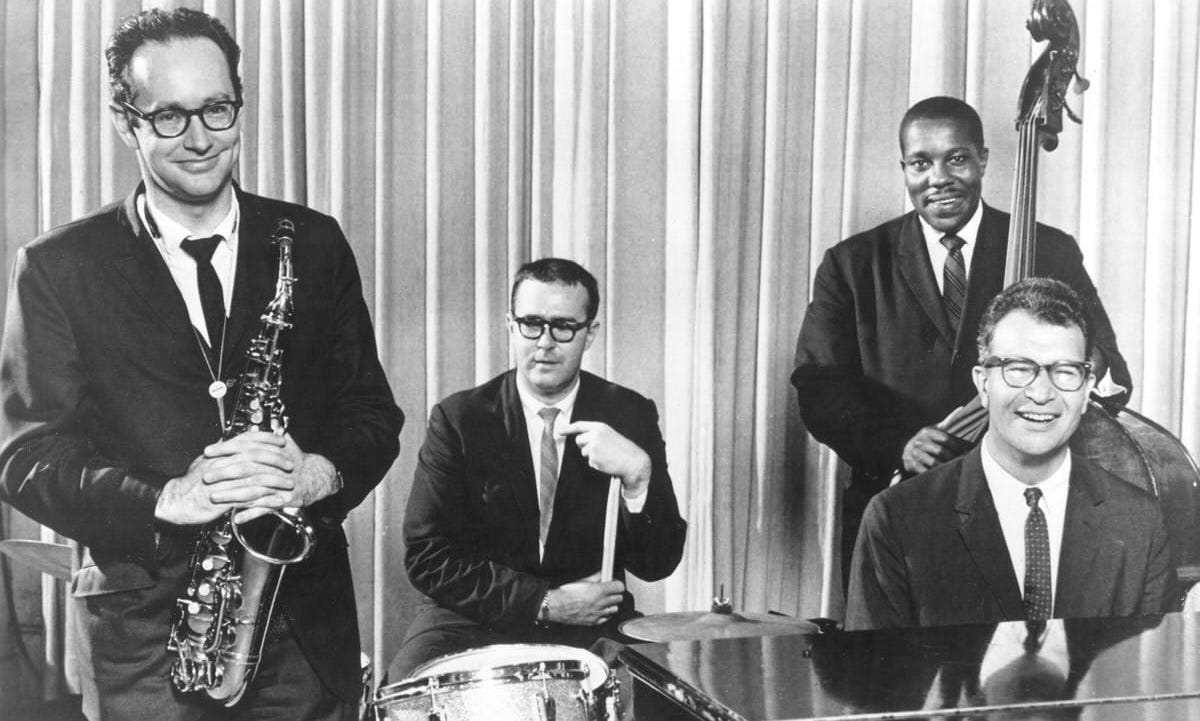
The Dave Brubeck Quartet in 1964. From left to right: Paul Demond (as), Joe Morello (d), Eugene Wright (b), and Dave Brubeck (p).
No posts
Comments
Nothing yet. Say the first thing.
Sign in to join the conversation.