
There’s no foolery on this cob, two eponymous debuts, and Elvis is once again in summer residency in Las Vegas, on this day in music.
Eric Clapton
1970: Legendary English blues-rock guitarist Eric Clapton releases his first solo studio album, “Eric Clapton.” The record is produced by Delaney Bramlett of the bluesy-country outfit Delaney & Bonnie and Friends. Bramlett had become a close friend of Clapton following their meeting on Blind Faith’s U.S. tour, for which Bonnie & Delaney were a supporting act.
By 1970, Clapton had participated in many famous rock and blues groups, including John Mayall & The Bluesbreakers, The Yardbirds, Blind Faith, and of course the most famous of them all, supergroup Cream. It was time for Clapton to branch out on his own, and he began recording his record in December of 1969, completing the project in March of 1970.
He didn’t do it all by himself, choosing to cover some songs and co-write others. The LP features many popular Clapton tracks, such as his cover of J.J. Cale’s “After Midnight” and “Let It Rain,” co-written with Bramlett. In fact, eight of the eleven songs were co-written by Bramlett. Two of those tracks were songs Bramlett co-wrote without Clapton, “Lonesome and A Long Way Home,” which he wrote with Leon Russell, and “Told You for the Last Time,” penned with Steve Cropper of Booker T. & The M.G.’s. “Easy Now” was written solely by Clapton.
The album met with strong commercial success, going to No. 14 on the U.K. Official Album Chart, No. 13 on the Billboard 200, and No. 18 on the Canada RPM 100. The single “After Midnight” was a Top-10 hit in the U.S., but “Let It Rain,” one of Clapton’s better songs, only reached No. 48.
Though Eric Clapton has dozens of certified albums and singles as a solo artist in the U.K., the U.S., and Canada, neither his debut album nor any of its tracks earned a certification.
Motörhead
1977: Motörhead, those speed-metal masters from London, U.K., release their debut studio album, simply titled “Motörhead.” A collection of aggressive and heavy speed metal, it was a refreshing statement for a genre that was already becoming formulaic.
Motörhead was founded by Lemmy Kilmister after he was fired from Hawkwind following his arrest in Ontario for felony drug possession. Canadian border officials mistook Lemmy’s gram of amphetamine powder, a misdemeanour, for cocaine. Once the substance was tested, charges were dropped and the misdemeanour was never pursued.
Rounding out the legendary inaugural lineup were Fast Eddie Clarke on guitar and Philthy Animal Taylor on drums. Lemmy of course played bass and sang lead vocals.
Including the opening track “Motörhead,” this is one of those situations where one can listen to the song “Motörhead” by the band Motörhead from the album “Motörhead.” It doesn't happen that often, but always pleases my simple mind when it does. Plus it’s a great track!
Also debuting with this album was the band’s logo/mascot, Snaggletooth the War Pig. Created by graphic artist Joe Petagno, an alumnus of Storm Thorgerson’s Hipgnosis arthouse who designed Led Zeppelin’s Swan Song label logo, variations of the illustration would appear on most Motörhead album covers. Petagno described Snaggletooth as a combination of the skulls of a bear, wolf, and dog, with tusks.
Including a cover of the old jump-blues song “Train Kept a-Rollin’,” the album was met with some positive critical reviews. It carries a rating of 4.5-Stars in Classic Rock, and 7/10 in both the Collector’s Guide to Heavy Metal and Spin Alternative Record Guide. It peaked at No. 43 on the U.K. Official Albums Chart.
Other popular tracks from the record include “Iron Horse/Born to Lose,” and “White Line Fever.” This is an enjoyable LP. Not pure speed-metal, it could also be described as punk with a little pop-punk on the side, as well as just straight metal.
One Trick Pony
1980: “One Trick Pony,” the fifth solo studio album by Paul Simon, and his first in five years, since 1975’s “Still Crazy After All These Years,” is released. It is his first LP for Warner Bros. Records, which also purchased his back catalogue from Columbia as part of the deal.
The record begins with the exciting and amazing “Late in the Evening,” one of Simon’s all-time bests, which features a great Steve Gadd rhythm based on the afro-cuban “Mozambique” motif. The LP then goes downhill in a hurry.
It’s not that the songs are poor, they’re mostly fair. It’s that especially on Side B, they are all slow ballads and unfortunately, just boring. I’m a big fan of Paul Simon, but I find myself thinking this every time I give the record another try.
The album was released concurrently with an accompanying film also titled One Trick Pony. Featuring the musicians in his band, one would think it was a documentary movie, but no. It’s a scripted drama and the musicians all play characters. Paul Simon plays Jonah Levin, while bass player Tony Levin plays John Dibatista.
However, there are other musicians in the movie who play themselves, including Sam & Dave, The B-52’s, and The Lovin’ Spoonful. Lou Reed is in the movie, but he plays the role of Steve Kunelian. There are also professional actors such as Harry Shearer and Daniel Stern. It was a commercial failure, though it met with some good reviews, including from Roger Ebert.
Although many songs in the movie are the same songs as on the album, they are distinct productions. There are also songs in each medium that don’t appear in the other. For example, “Late in the Evening” on the album is a studio recording, whereas in the movie it was filmed and recorded live at the Agora Theatre and Ballroom in Cleveland. The album features two songs recorded at the Agora, “One Trick Pony” and “Ace in the Hole,” but their movie versions feature alternate mixes.
Critical reviews of the album were mediocre. It has a 3-Star rating (out of five) at AllMusic, a grade of “B-” by Robert Christgau, and simply the word “mixed” in Rolling Stone. On the strength of the lead single, it did will in the charts, going to No. 12 on the Billboard 200 and Top-10 in Scandinavia. However the immediate sales that boosted it in the charts faded and the LP was only certified Gold in the U.S., which is still a good showing, and Silver in the United Kingdom.
The song “Late in the Evening” though was a massive success. It reached No. 6 on the Billboard Hot 100, No. 2 on the Canada RPM Adult Oriented chart, and No. 2 in Israel. It also made the Top-20 on eight other charts. It was nominated for a Grammy, strangely in the Best Pop Vocal Performance - Male category. Simon’s vocals are excellent, but it should have been nominated, and should have won, for Record of the Year. That honour went to Christopher Cross’s “Sailing,” which is the Grammyiest of Grammy things ever.
I will give this album another shot today. I mean, it’s Paul Simon!
The Daily Elvis
1972: Elvis performs two shows, one at dinner and one at midnight, at the newly-renamed Las Vegas Hilton. The famous chain had taken over operation of The International Hotel and of course continued the tradition of an Elvis Summer Festival residency. They’d have been crazy not to. The King delivered his usual all-out performance, including renditions of “Can’t Help Falling in Love” and “You’ve Lost That Lovin’ Feelin’,” to adoration from the audience.
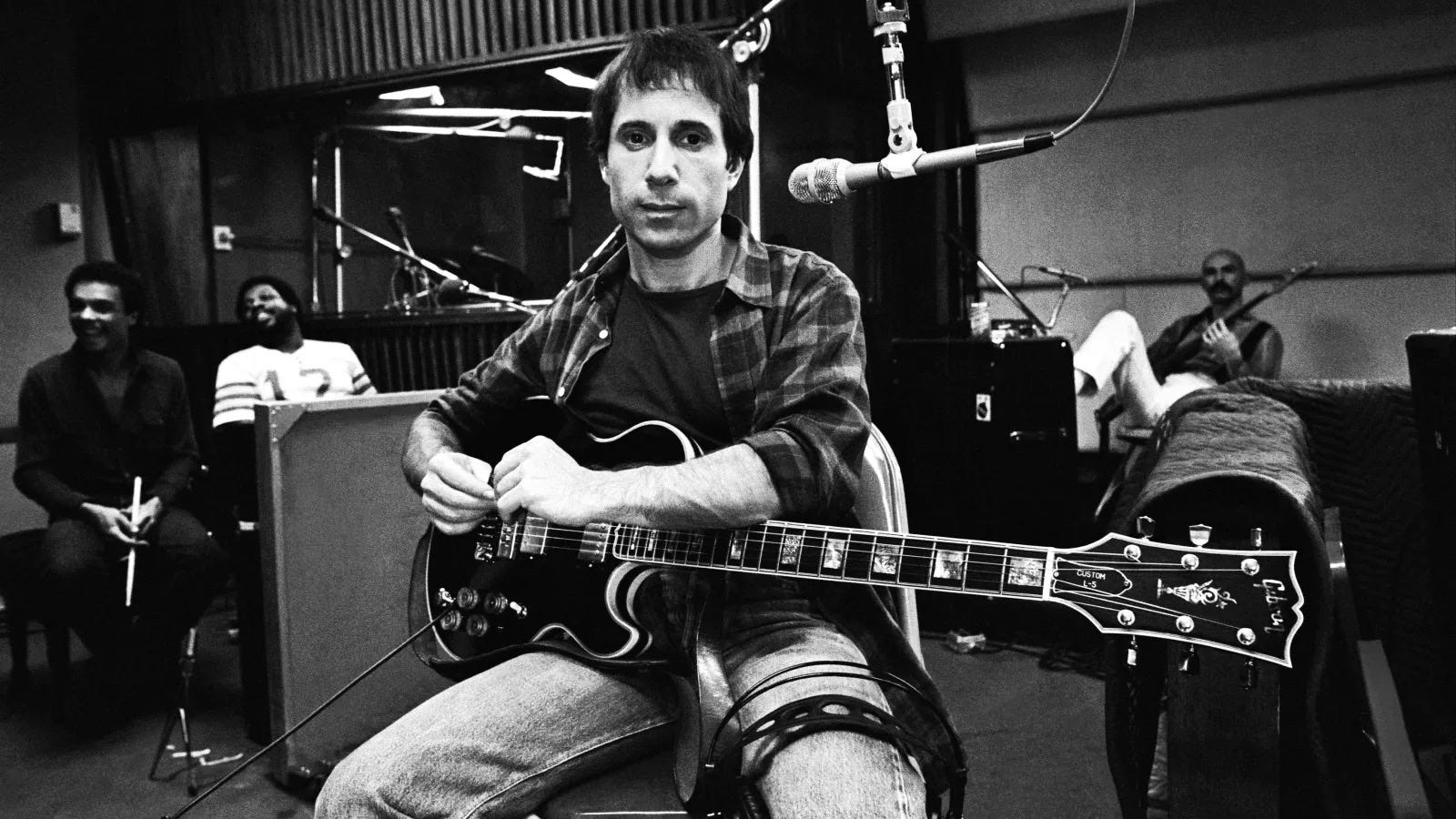
Paul Simon during the recording of One Trick Pony in 1980. In the background to Simon’s left are percussionist Ralph MacDonald and keyboardist Richard Tee. To Simon’s right is legendary bass player Tony Levin.
No posts
Comments
Nothing yet. Say the first thing.
Sign in to join the conversation.