
A betrayal, one incredible vagrant, a band that was ahead of its time, and Elvis enraptures the midnight audience, on this day in music.
Supertramp
1970: Legendary English progressive-pop band Supertramp release their debut studio album, simply titled “Supertramp.” The LP’s first pressing in the U.K. carried the title “And I’m Not Like Other” on the label, but that was quickly corrected.
In Spain, it was named “Now and Then,” and it was known as “Surely” in Singapore. In the United States, the record was not released until 1977, but could be acquired through importers. The eventual U.S. release reached No. 158 on the Billboard 200.
It fell upon band member and guitarist Richard Palmer-James to write all of the lyrics for the album because principal music writers Roger Hodgson and Rick Davies were not willing to do so. Hodgson and Davies had to get used to writing lyrics pretty quickly, however, as Palmer-James left the band after this album.
Palmer-James would also write lyrics for other prog-rock acts including the tracks “Book of Saturday,” “Exiles,” and “Easy Money” for the King Crimson album, “Larks’ Tongues in Aspic.” He additionally wrote the lyrics for four tracks on Crimson’s “Starless and Bible Black” LP, including “The Great Deceiver,” plus “Fallen Angel” and “Starless,” from the album “Red.”
Hearing rumours that both Traffic and Spooky Tooth had made albums overnight, Supertramp chose to record the record between midnight and 6am out of superstition. They used Morgan Studios in London.
Though the album failed commercially, and met with mediocre reviews at best, there was some promise in the work. Judith Simons in the Daily Express wrote, “This debut record album by a group of promising musician-poets is rather more melodic than most discs which pass under the label progressive pop.”
The band’s second album, “Indelibly Stamped,” also failed commercially and critically. Then came “Crime of the Century.” The perfect example of how sometimes a band needs a little time to find its groove. In the “old days,” that time was provided, and resulted in the release of incredible music over the long term. That no longer occurs today.
Back to the “Supertramp” album, it did not earn any sales certifications in the U.S. or the U.K., but in Supertramp-crazy Canada, it is certified Gold. This is actually a pleasant record despite the reviews, though hardly the band’s best, which of course is “Even in the Quietest Moments.”
Betrayal
1985: Michael Jackson outbids Paul McCartney for the ATV Music publishing catalogue, which included the U.S. rights to over 250 songs written by Lennon-McCartney. Jackson paid $47.5 million for the deal. McCartney, who was friends with Jackson, and in fact the person who advised MJ that owning publishing rights was a lucrative investment, felt betrayed and angry by the action.
Through a series of corporate acquisitions and copyright terminations, along with a deal struck with Sony, McCartney re-acquired the author’s 50% of those publishing rights in May of 2026. Paul’s market value share is estimated to be $200 million!
The Friday Frank
1968: The Mothers of Invention perform on the first of two consecutive nights at Chicago’s newly-anointed Kinetic Playground. It had opened four months earlier as the Electric Theater, but forced to change names due to a trademark challenge.
The lineup that night was Frank Zappa (g; v), Ian Underwood (as; p), Bunk Gardner (ts; cl), Euclid James “Motorhead” Sherwood (bar; perc), Roy Estrada (bg; v), Don Preston (elp), Arthur Dyer Tripp III (d), and Jimmy Carl Black (d). Effectively the same lineup as the album “We’re Only In It for the Money,” their most recent at the time, except Billy Mundi was replaced by Tripp III as the lead drummer.
Though a specific setlist is not available, on that tour the group frequently performed what are now classics of the era, including “King Kong,” running anywhere from eight to ten minutes long, “Pound for a Brown,” and “Sleeping in a Jar.” All three numbers would appear on the April 21, 1969 release, “Uncle Meat,” though not these specific performances. Meat is a combination of studio and live recordings, but not presented as a live album.
Other famous songs included “Help I’m a Rock,” from the debut album, “Freak Out,” and a 10:36 version of “The Orange County Lumber Truck,” with extended solos. The basic three-minute version of the song would appear on the 1970 album, “Weasels Ripped My Flesh.”
Frequently performed cover songs included “Wipe Out” by the Surfaris, “Hang On, Sloopy” by The McCoys, and the contemporary avant-garde piece, “Octandre,” by Edgard Varèse.
The Daily Elvis
1970: At The International Hotel, Elvis performs an iconic midnight show, the last of his performances to be filmed by MGM for the documentary Elvis: That’s the Way It Is. The concert is legendary for The King’s light-hearted mood and antics. At one point, he even introduced himself as Johnny Cash, and he altered lyrics to comical effect spontaneously. The audience loved it!
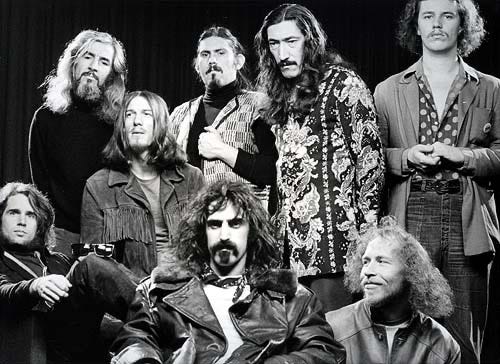
The Mothers of Invention in 1968. From left to right: Ian Underwood, Bunk Gardner, Motorhead Sherwood (fringy jacket), Frank Zappa (bandana kerchief), Roy Estrada (holding vest Napoleon style), Jimmy Carl Black, Don Preston (seated beside FZ), and Arthur Dyer Tripp III. Not Pictured: Ray Collins (v; perc), who also performed early on the 1968 tour.
No posts
Comments
Nothing yet. Say the first thing.
Sign in to join the conversation.