
Powering up a live show while dealing with the realities of touring, and Elvis records a classic, on this day in music.
Flick of the Switch
1983: Legendary Australian hard-rockers AC/DC release their ninth studio album, “Flick of the Switch.” The album was considered a step down from the prior two records, “Back in Black” and “For Those About to Rock We Salute You.” Though it’s disappointing, their streak of multi-Platinum albums was not going to last forever.
Drummer Phil Rudd would be dismissed from the band following the record’s completion. His lingering grief over the death of Bon Scott in 1980 had exasperated his struggles with alcohol, making him unreliable. He was also having personality conflicts with Malcolm Young that boiled over into a fist fight. It took more than a decade, but he reconciled with the group and rejoined in 1995 to record “Ballbreaker.”
Phil would again have to leave the band for all of 2016 and 2017 following a criminal conviction in New Zealand for uttering death threats and drug possession. He was sentenced to eight months of house arrest and could not leave the country to tour with AC/DC. He re-joined after serving his punishment. Rudd would depart the band once more in 2023 to care for his domestic partner, Toni Wilson, who was suffering from terminal Stage 4 breast cancer. Though there hasn’t been any official news, he appears to no longer be with the band. There has also been no word on Toni Wilson’s condition.
Back to “Flick of the Switch,” it was not well-received by critics, with one exception. In the Collector’s Guide to Heavy Metal, Martin Popoff rates the album 10/10 and believes the record to be, “…the blinding furious peak of the Brian Johnson era…recapturing the raw edge lost during the Mutt Lange years...even if the songs were starting to relive past glories…” AllMusic, Blender, and the Encyclopedia of Popular Music however, all rated the album only 2-Stars (out of five.) Rolling Stone was a little kinder, with 3-Stars (out of five).
Though the album went Platinum in the U.S., 3x Platinum in Australia, and Gold in France, Germany, and Britain, it was considered a commercial failure for not selling at the volumes of “Back in Black” and “For Those About to Rock We Salute You.”
It’s a bit unrealistic to consider a million-selling record to be a commercial failure. “Back in Black” sold an estimated 50 million copies to become the second-highest selling album of all time. There’s simply no way the band could ever match it. That said, I agree with the non-Martin Popoff critics’ analysis of this album.
Hard Nose the Highway
August 1973: Van Morrison releases his seventh studio album, “Hard Nose the Highway.” Produced by the legendary singer-songwriter himself for Warner Bros., the LP was recorded at Caledonia Studios in Fairfax, California. The precise date of the August release is unknown.
It’s the first record since Van’s debut, “Blowin’ Your Mind,” that isn’t entirely composed by Morrison. He includes two covers, “Bein’ Green,” written by Joe Raposo and originally performed by Kermit the Frog on Sesame Street and The Muppet Show. The second cover is “Purple Heather,” an Irish/Scottish traditional folk song based upon “The Braes of Balquhither” by Scottish poet Robert Tannahill.
The lead single from the LP is Morrison’s popular song, “Warm Love.” More than enough material had been recorded to produce a double-album, a reputed 30 songs, but Warner Bros. pressured Van to keep it to a single disc. Some of those tracks would appear on his subsequent album, “Veedon Fleece,” with another nine songs making the 1998 outtakes compilation record, “The Philosopher’s Stone.”
The music was sonically rich, with Morrison employing 17 musicians to perform the many horn and string arrangements. In addition, the Oakland Symphony Chamber Chorus sings on the track “Snow in San Anselmo.” Arrangements were handled by Morrison with help from collaborators Jeff Labes for the strings, and Jack Schroer for the horns. The two had contributed arrangements to “Moondance,” with Schroer additionally appearing on all albums in between.
Though the music is quite good, the LP was met with poor reviews. The main complaint of the writers was the lack of emotional conviction, a surprising critique for Sir Van. Robert Christgau graded the album “B-” and wrote, “The relaxed rhythms are just lax most of the time, the vocal surprises mild after ‘Saint Dominic’s Preview,’ the lyrics dumbest when they’re more than mood pieces, and the song construction offhand except on ‘Warm Love.’”
In Rolling Stone, Stephen Holden stated, “‘Hard Nose the Highway’ is psychologically complex, musically somewhat uneven and lyrically excellent. Its surface pleasures are a little less than those of ‘St. Dominic's Preview’ and a great deal less than those of ‘Tupelo Honey…’” I find it interesting to contrast the very different view of the lyrics between Holden and Christgau.
I agree that this album isn’t on par with “St. Dominic’s Preview” and “Tupelo Honey,” but it’s still a good record. Better than what the critics say. Morrison has made 45 studio albums now, and of course some will be better than others.
AllMusic rates “Hard Nose the Highway” at 3.5-Stars (out of five), which is a fair assessment, but Uncut has it at 1-Star (out of five), and The Village Voice graded it a “C+.”
Welcome Back, My Friends, to the Show That Never Ends
August 1974: “Welcome Back, My Friends, to the Show That Never Ends,” the triple-LP second live album by progressive supergroup Emerson, Lake & Palmer, is released. This is the second of today’s releases with month and year known, but not the day.
It is a more traditional live album than their first, “Pictures at an Exhibition,” as it is a collection of songs previously released on studio albums. Pictures however, was all new material that was recorded live. That LP featured the Mussorgsky piano suite by the same name, with lyrics added to “Promenade” and “The Great Gates of Kiev” by Greg Lake, in addition to one band-composed number, “Blues Variation,” and an adaptation of Tchaikovsky’s Nutcracker titled “Nut Rocker.”
Recorded at the Anaheim Convention Center in California on the night of February 10, 1974, Welcome Back… is a nearly-two hour long album that encompasses the entire show. It was produced by Greg Lake for Manticore Records, the band’s own label.
Side 1 features three popular shorter songs, “Hoedown,” “Jerusalem,” and “Toccata.” Side 2 is dedicated entirely to the 28-minute suite “Tarkus,” including “Epitaph,” originally by King Crimson, addended to Part 6, “Battlefield.” The length of the piece required the conclusion to be moved to Side 3. Rounding out that side is the first eleven minutes of “Take a Pebble” that segued in and out of both “Lucky Man” and “Still…You Turn Me On.”
The remaining 15 minutes of the “Take a Pebble” adventure is on Side 4, and includes lengthy piano improvisations by Emerson. “Jeremy Bender / The Sheriff” completes that side. “Karn Evil 9: 1st Impression, Parts I and II” takes up all of Side 5 and runs just over 17 minutes long, including Palmer’s drum solo, with “2nd Impression” and “3rd Impression” bringing the album to a close on Side 6.
It’s the very definition of bombastic and indulgent Seventies progressive rock, which is likely why it didn’t impress music reviewers. I happen to like that bombast myself!
Though they generally praised the performances, with many writers remarking that “Karn Evil 9” is better than the studio version, the criticisms focused on the lack of overdubs. The sound quality was a common complaint, particularly feedback and tunnel-like echo. AllMusic rates it 3-Stars and MusicHound Rock grades it only 2-Stars, both out of five.
Much like Yes’s 3-LP live set, “Yessongs,” it’s a comprehensive retrospective of the band’s career to that point with excellent performances, but the sound quality makes it difficult to listen to.
The album was nonetheless a commercial success, going to No. 4 on the Billboard 200, No. 6 on the Canada RMP 100, and No. 6 on the U.K. Official Albums chart. It is certified Gold in the U.K. and in the United States.
The Daily Elvis
1954: Scotty Moore and Bill Black join Elvis at Sun Studio where they work for hours in the evening on a new recording of “Blue Moon.” A slow and haunting version, with percussive tones provided by Black’s bass, and slap-back echo effect on Elvis’s microphone, producer and label owner Sam Phillips wasn’t quite sure about it. He didn’t release it right away, but it was eventually included on Elvis’s debut album after being picked-up by RCA Victor. For my money, it’s one of The King’s best recordings.
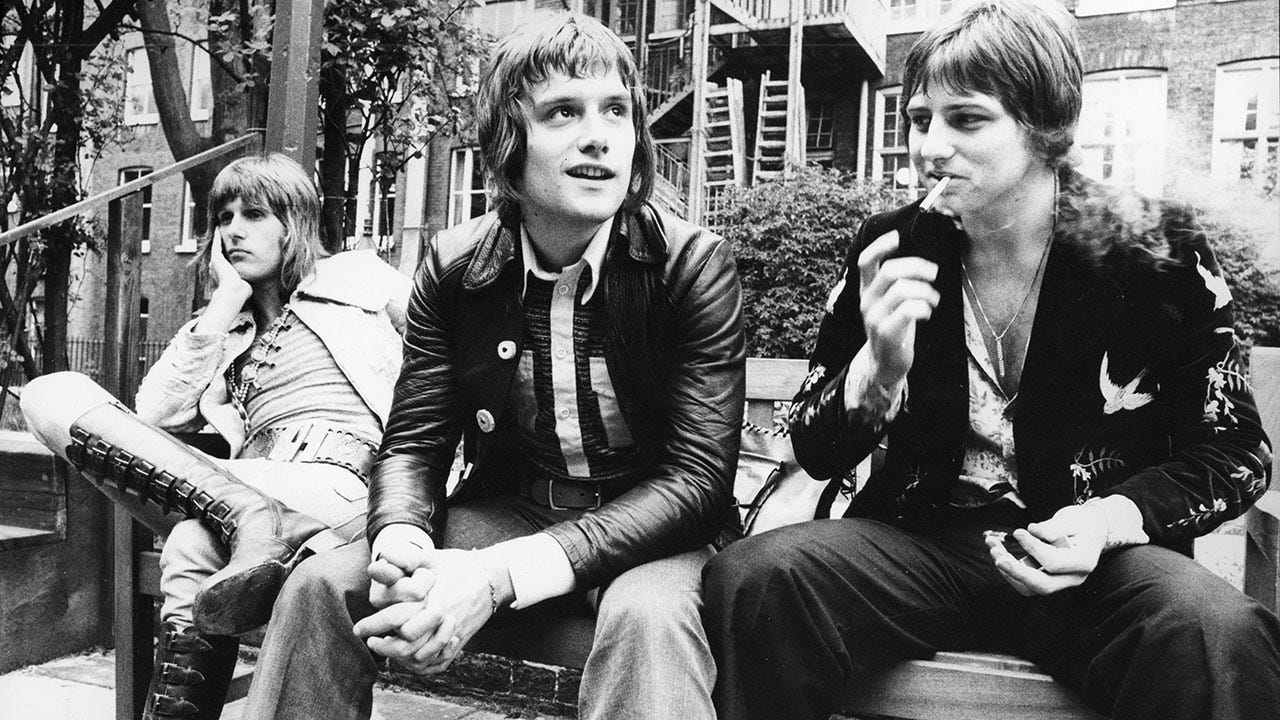
Keith Emerson, Carl Palmer, and Greg Lake of Emerson, Lake & Palmer in 1973.
No posts
Comments
Nothing yet. Say the first thing.
Sign in to join the conversation.