
The door swings on drama, but a nice win, and Elvis is in the second year of his comeback, on this day in music.
Nice
1969: English prog-rock group The Nice release their third studio album, simply titled “Nice.” It would be the final LP to feature pianist-organist Keith Emerson. In the U.S., the album was titled “As Nice As Mother Makes It.”
By 1969, The Nice had scored a hit with their cover of “America” from West Side Story, had two critically-acclaimed albums to their credit, and made Melody Maker’s 1968 year-end poll as the ninth-best band in the United Kingdom. They were seemingly on the rise, but Emerson felt they had reached their creative peak, and departed the band following the release of the LP.
“Nice” was a popular record in the U.K., where it reached No. 3 on the Official Albums Chart. However, it remained obscure in North America, despite much touring in the U.S. that saw the band perform in major venues like the Fillmore and the Fillmore East.
The record was the third in a row to meet with widespread critical praise. Writing for east coast American magazine Fusion, Lloyd Grossman stated that the band, “…use jazz and classical elements with an ease and brilliance that few bands can equal.” In the U.K., New Musical Express published that, “…no group had done more to advance the musical side of pop in recent years.” However, Village Voice writer Robert Christgau naturally hated it, writing, “…the most overrated group this side of The Moody Blues..,” harshly criticizing what he determined to be Emerson’s lack of taste while acknowledging his immense talents.
The album did not chart in the U.S. though Keith Emerson, Lee Jackson (bg), and Brian Davison (d) nonetheless delivered an excellent work. It features versions of Dave Brubeck’s “Rondo” and Bob Dylan’s “She Belongs to Me,” and the great original composition, “Azrael Revisited,” among its six tracks.
I’ll be listening to this LP today!
Win, Lose or Draw
1975: The Allman Brothers Band, the Macon-based legendary blues-rock group, release their sixth album, “Win, Lose or Draw.” It’s the final studio LP to feature Chuck Leavell and Lamar Williams, who were not invited back when the ABB regrouped for 1979’s “Enlightened Rogues.”
Critical reviews of the album were generally poor, but not unanimously so. Though it was graded “C” in the Village Voice, 1-Star (out of five) in The Rolling Stone Record Guide, and 1.5-Stars at AllMusic, it also received “Favourable” designations from newspapers The Calgary Herald, Detroit Free Press, and The Los Angeles Times.
It was a difficult time for The Allman Brothers Band, who were too enamoured by the rockstar lifestyle and not fully focused on the music. Gregg Allman agreed with the harsher criticisms in a retrospective discussion, stating, “‘Win, Lose or Draw’ was a perfect reflection of our situation in 1975. It was basically all over with the Allman Brothers Band.” The ABB broke up in July of 1976, with Gregg’s testimony against road manager John Scooter Herring in his drug trial exacerbating existing riffs.
Another factor detracting from producing a great album was Gregg’s struggles with alcohol. He composed only two tracks on the record, “Nevertheless” and “Win, Lose or Draw.” Dickey Betts handled three songs, including the obligatory instrumental epic that appears on most ABB records, in this case “High Falls,” which is actually quite good. The remaining two tracks were covers of classic blues and country songs.
I don’t find this album to be as bad as some of the critics and Gregg Allman himself find it to be. It’s a listenable album, though clearly not spectacular. Unfortunately, the group would release a couple of albums that were far worse.
In Through the Out Door
1979: “In Through the Out Door,” the eighth studio album by legendary hard-blues rockers Led Zeppelin, is released. Much of the album was composed by John Paul Jones and Robert Plant. As always, it was produced by Jimmy Page.
Unbeknownst at the time, it would be the last studio album for the band, due to the unexpected death of irreplaceable drummer John Bonham only a year later. They decided there could be no Led Zeppelin without Bonham, and following the release of “Coda” in 1982, a collection of odds and ends from studio and stage, the band was finished.
An under-appreciated work in the Led Zeppelin canon, it has more recently entered the conversation of favourite Zeppelin releases. The eight studios albums, while varied in styles and presentations, are notable for their consistency, and consistently high sales figures.
The LP features the great tracks “Fool in the Rain,” “Carouselambra,” (two of my favourites from the group) “In the Evening,” and “All My Love,” which rivalled “Stairway to Heaven” for high school dance closing number frequency back in my day. However, the remaining three songs are also excellent, with “Hot Dog” maybe lagging a little behind.
It did not receive much critical praise at the time of its release, further evidence of its under-appreciation. That’s not to say it was poorly rated as it earned mainly average reviews. The Rolling Stone Album Guide and the Encyclopedia of Popular Music both ranked it 3-Stars out of five, plus it earned higher marks in MusicHound Rock at 4-Stars, and Smash Hits graded it 7/10.
As with all Led Zeppelin records, it had a huge audience. It went to No. 1 on the Billboard 200, No. 1 on the U.K. Official Albums Chart, and No. 1 on the Canada RPM 100. It was certified 6x Platinum in the U.S., 2x Platinum in each of Australia and New Zealand, Platinum in the U.K, and Gold in Argentina. It estimated to have sold as many as 11.5 million copies worldwide.
I do enjoy this LP, and I will certainly be listening to it today.
Drama
1980: English prog-rock masters Yes release their tenth studio album, “Drama.” With the whole band producing, assisted by long-time engineer and producer Eddie Offord, it is the only Yes album to feature Trevor Horn on lead vocals. Jon Anderson was not part of the group at the time.
Infamous for the sheer multitude of lineup changes, the Yes personnel on “Drama” were Trevor Horn (v; g), Steve Howe (g), Chris Squire (bg), Geoff Downes (key), and Alan White (d).
Though neither of the two singles, “Into the Lens” and “Run Through the Light,” broke the Top-100 in the charts, and the songs aren’t necessarily famous Yes tracks, they’re all quite good. The album therefore earned strong critical reviews, though is certainly not the group’s best. The epic-length “Machine Messiah” is a standout cut.
It is rated 4-Stars (out of five) in The Rolling Stone Album Guide and 3.5-Stars (out of five) by Classic Rock magazine. On the charts, it peaked at No. 18 on the Billboard 200 but went to No. 2 on the U.K. Official Albums Chart. It earned Silver certification in the U.K, but no certification in the United States.
I enjoy this album, but I enjoy most Yes albums!
The Daily Elvis
1970: Elvis is in his second season at The International Hotel in Las Vegas, knocking-out audiences with his entertaining concerts at dinner and midnight. After selling-out the 2,200-seat for both shows, The King met with fans backstage.
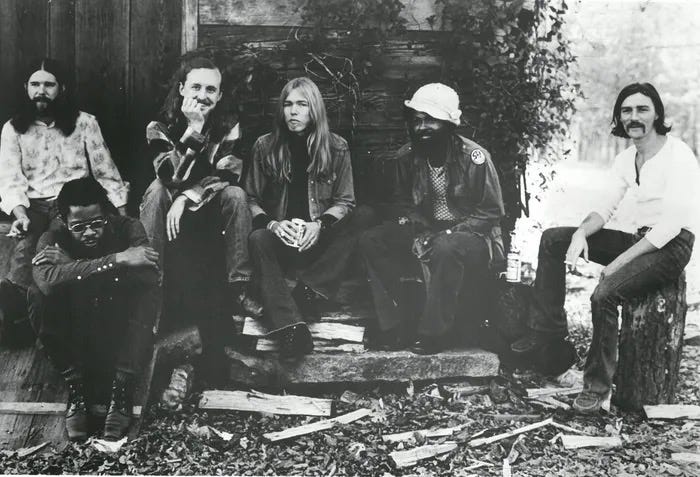
The Allman Brothers Band in 1975. From left to right: Chuck Leavall (p; key), John Lee Johnson aka Jaimoe (d; perc), Claude Trucks aka Butch (d; perc), Gregg Allman (v; or; guitar), Lamar Williams (bg), and Richard Betts aka Dickey (g; v).
No posts
Comments
Nothing yet. Say the first thing.
Sign in to join the conversation.