
“Listen, you own your medical records.” Dr. Oz declares in a promotional video put out by the Centers for Medicare & Medicaid Services (CMS).
“Listen, you own your medical records,” says Centers for Medicare & Medicaid Services Administrator Dr. Mehmet Oz in a promotional video.
Oz, the CMS Administrator, is joined in the video by then FDA Commissioner Dr. Marty Makary, who chimes in with his concurring second opinion at the end: “Those records belong to the American patient. They belong to you.”
In case you’re not convinced by their authority or the invigorating background music, Dr. Oz explains: “You paid for them one way or another.” Of course! You paid for them, so they belong to you, right?
Well, no.
But I get it: Dr. Oz is running Medicare, not the Fed. He may be unfamiliar with financial concepts like renting, leasing, and licensing. Those are the kinds of transactions our money is increasingly likely to go toward when we pay for things, and most of us ordinary Americans are aware that simply paying money for something doesn’t necessarily mean we own it.
“Americans own their healthcare records,” says Health and Human Services Secretary Robert F. Kennedy, Jr. at a December 2025 White House event (at 1:45:39 in the video).
The fact is that our medical records don’t belong to us in any sense of legal ownership. When clinical notes, lab and imaging results, and all sorts of other data are added to our records by healthcare professionals, that information does not become our property by law.
That’s why we have rules and regulations, in HIPAA and elsewhere, granting us access to the health information collected about us and some degree of control over how it is shared and used.
If we owned our own medical records, we wouldn’t need those regulations. We could store all our own medical records on our own devices, delete the part that shows we’ve been eating way too many Snickers bars, and tell our doctors to get rid of any copies they have in their systems. We could tell them to cease and desist from keeping the records if they put up a fuss. If you think I’m wrong about medical record property rights, please give that a try and let me know how it goes.
“But what about New Hampshire?” savvy readers might ask. Yes, you’re right: New Hampshire is the only state in the nation that actually does have a law granting individuals ownership of the “medical information contained in [their] medical records.”
However, the records themselves belong to the provider who created them, and state regulations require providers to retain records for seven years after last contact with a patient—just like in other states. In practice, the New Hampshire law gives people about the same level of control over their records as HIPAA. That is to say, it gives them the ability to access their medical records.
Nowhere in the United States do individuals have property rights to their medical records that grant full legal ownership—in the way that copyright and trademark laws do, for example.
Here is former Assistant Secretary for Technology Policy and National Coordinator for Health Information Technology at the U.S. Department of Health and Human Services Dr. Micky Tripathi on a 2024 podcast, explaining the fact that laws and regulations give us the right to access our complete medical records, but do not grant us ownership of them (beginning at 17:21):
And yet, “You own your medical records” and “Your medical records belong to you” have become mantras for Health and Human Services officials. President Trump himself has been using this language since his first term. At a 2020 event announcing his “America First Healthcare Plan,” he said (27:31):
The America First Healthcare Plan will deliver another long awaited reform: We will put you in control of your own medical records . . . We’ll require doctors to make your records available electronically, and you’ll own them, and you’ll control them, and they will be portable, and you’ll be able to work seamlessly with all of your medical providers. [emphasis mine]
“We’ll require doctors to make your records available electronically, and you’ll own them,” says President Trump at a 2020 event (at 27:48 in the video).
That healthcare plan never materialized, but in 2021 under the Biden administration, the ONC Cures Act Final Rule did indeed introduce requirements for health care providers to make patients’ complete electronic medical records available to them upon request (with some exceptions). Before that, they were only obliged to hand over a subset of basic information in a record, as defined by the U.S. Core Data for Interoperability (USCDI).
But the Final Rule did not in any way give patients ownership of their records, and neither did any other regulatory changes that came after it.
The language about medical record ownership is only used in political speeches and at events where HHS officials are promoting their latest health IT program. You won’t find it in any legal or regulatory documents.
Even the outline for the America First Healthcare Plan proposed giving patients “control” and “access,” to their records, carefully avoiding any reference to ownership. Trump’s new “Great Healthcare Plan” proposal doesn’t mention medical records at all.
So why do Dr. Oz and other HHS officials keep saying our medical records belong to us, that we own them? Here’s my take:
It’s because they’re building a health data infrastructure that will collect and store an extensive profile of every individual, and make it accessible to authorized users anywhere in the world, and many people are uncomfortable with that.
Many of the medical freedom voters in the MAHA faction of Trump’s coalition are strongly opposed to it. They’re opposed to everything it’s built on, from digital ID and biometric data collection to wearables and AI medical tech.
The HHS crew keeps talking about how we own our medical records to assuage fears about technocracy and medical authoritarianism, and gain public support for the system they’re building. They decided that the benefits of building a data dragnet outweigh the civil liberties risks, and they’re trying to keep MAHA on board.
“It’s OK!,” they’re saying. “We’re building the personal surveillance system you have feared and fought against, but you’ll be in charge of it. It will belong to you!” Because you paid for it, or something.
The new health data infrastructure that is rapidly coming into place will truly be, as Trump might put it, something no one has ever seen before.
The amount, granularity, and scope of information it will be able to gather and store on every individual; the coding systems that transform the information into structured, actionable data; and its networked accessibility have the potential to make the health data system at least as powerful a resource for personal data as any existing commercial or government data system.
I haven’t been calling it the “health data leviathan” for nothing.
Everyone who has their hair on fire about Palantir merging databases full of personal information should take a moment to look at just how comprehensive the data sets collected in the already unified system of “medical records” are shaping up to be.
As I’ve pointed out before, “medical records” can contain much more information than what most people think of as having to do with medicine. All kinds of information related to mental health, relationships, and personal habits can be collected and assigned medical codes.
More significantly, the addition of “social determinants of health” (SDOH) data to medical coding created a catch-all way to record details about every aspect of a person’s life.
Social determinants of health are typically described as “the conditions in the environments where people are born, live, learn, work, play, worship, and age.” New SDOH codes that describe non-medical details about an individual’s life are being generated continuously and added to the code sets used in medical records.
Methods of collecting information have expanded as well. Wearables, apps, and medical devices collect biometric data; ambient listening AI scribes used in doctors’ offices and telemedicine can note every detail in a conversation; and new technologies the Trump administration is funding will transmit information from inside people’s bodies. All of that data can be coded and entered into your medical records.
There are no limits to the amount of information that can be stored about an individual in a modern digital system, and the difficulty of managing large collections of personal data and making them useful is easily addressed by the scoring systems in current use and the AI agents being put in place.
The MAHA HHS takes every opportunity to emphasize to the public that this growing trove of data will catapult us into a future of deep health insights and groundbreaking cures. Storing oodles of personal information on networked servers is what we must do to put the power of health information in your very own hands, they tell us—and there’s nothing to worry about, because it belongs to you. Except it doesn’t.
So if you don’t own your health records and have full property rights to them, what kind of control over how they’re used do you have?
HIPAA, the ONC Final Rule, and state regulations lay down the fundamental rules about who can access individuals’ health information and under what circumstances. First, as I’ve described, individuals have the right to access all of their own health records that fall under HIPAA—in other words, information collected by health care providers, health plans, and healthcare clearinghouses—which together are known as “covered entities”—and their business associates.
HIPAA lays out clear rules prohibiting covered entities from selling individuals’ health records, and its privacy rule requires individuals to consent before their providers can share their records with other parties whom they have no relationship with.
But those consent rules don’t apply to sharing health information with the government.
The HIPAA privacy rule makes exceptions to the consent rules for public health authorities. They can access data in your health records if they present a reason why doing so is needed to conduct “public health activities.”
Those activities are very broadly defined, including conducting “public health surveillance, public health investigations, and public health interventions,” or lessening “a serious and imminent threat to the health or safety of a person or the public.”
Essentially, the law allows public health authorities themselves to define what valid public health activities are and therefore which information in individuals’ medical records they have the authority to access without the individuals’ knowledge or consent.
With the SDOH expansion of public health authorities’ purview to cover all areas of life, almost no category of personal information stored in individuals’ electronic health records is off limits. (There is a notable exception. More on that later.)
During the eras of paper medical records and non-networked electronic medical records, the barrier to federal, state, and local health departments having direct, up-to-the-minute access to everyone’s health records was technical, not legal. That barrier is rapidly coming down.
As state health information exchange (HIE) networks are put in place and both state and private-sector record holders connect to TEFCA, the national “network of networks,” the technical ability for government authorities to tap into every individual’s health records increases.
As networks expand and connect, moving toward a data infrastructure with full interoperability, regulatory bodies are putting HIPAA-compliant bureaucratic systems in place to give public health authorities access to the information they want.
In New York, for example, state health department authorities access information from patients’ medical records through the Statewide Health Information Network for New York (SHIN-NY).
Every general hospital in the state is connected to the SHIN-NY, along with many clinics, HMOs, home care agencies, nursing homes, and hospices. You can find a list of organizations that are required to connect as “regulated participants” as well as those that can do so voluntarily on page 47 of the SHIN-NY’s Statewide Common Participation Agreement. Voluntary SHIN-NY participation extends the SHIN-NY’s reach beyond the realm of medical facilities by including community-based social service organizations.
State and local health departments can access data elements from every individual who receives medical or social services from one of those providers in the following approved categories:
[June 2026 update: The following data set has been submitted for approval:
What that means for you if you live in New York is that if you have ever received care from a provider connected to the SHIN-NY (any hospital, for example), your records are available through the SHIN-NY. Those records may include not only information from the SHIN-NY-connected provider you saw, but also information from other providers that could be matched to your identity.
Authorized health department staff have direct access to records through dedicated online portals for public health users of the SHIN-NY. They won’t be able to see your full record, but they will be able to view the elements in the core USCDI data set and other data sets that have been approved for public health use.
Once your medical records have been connected to the SHIN-NY through a participating provider, there is no way for you to remove them or deny access to them by public health authorities.
You can control which providers have access to your medical records by granting or denying consent to share them on a form provided by one of the SHIN-NY’s six regional subnetworks (a single statewide consent form is in the works). You can give consent for emergency access only. If you deny consent for providers to access your records, they’ll be able to find your name in the system, but they won’t be able to see your information.
You can even sign a special Universal Denial of Consent Form that will stop providers and health plans from seeing any results at all when they search for your name or other identifying information in their online portal to the SHIN-NY.
On those forms, you will see text like this:
Public Health agencies will remain eligible to access my clinical data in accordance with applicable NYS public health laws.
Public health workers use a different SHIN-NY portal to access your medical records than providers, and what they can see is determined by what authorities have decided to grant access to, not by your knowledge or consent.
The USCDI is continually being updated to new versions, and public health authorities can request approval for use of new categories of data from the SHIN-NY Statewide Data Use Committee. The information public health authorities have access to will change over time, according to the priorities of the people in charge.
I have focused on New York’s health data infrastructure to give you a detailed look at how government access to medical records works. Other states have or are developing similar systems.
Dr. Oz, RFK Jr., and President Trump himself can get together with a banjo and sing “Your records belong to yooooo!” in a three-part harmony all day long, and it will do nothing to change the access public health authorities have to your personal health information.
You might be thinking,“So what?” Public health authorities have been collecting information from medical records in the United States since the 19th century. It has mostly been a process running in the background of daily life—something people might only notice if they got a contact-tracing call from the health department.
Over most of the past 150 years or so, public health authorities have required health care professionals to give them just a tiny amount of information from the medical records they kept on paper. They used it to detect outbreaks, monitor diseases, allocate resources, and try to figure out if their public health efforts were working.
Switching from a paper record system to a networked electronic one makes public health surveillance a whole new ballgame. With the new system coming into place, there’s no technical limit to how much information a medical record can hold or how much of it authorities can access.
The question for them now is not what they can do with a very limited amount of health data but what they should do with a constant, up-to-the-minute, unlimited supply of it.
One answer to that question has been: “Make America Healthy Again.” Despite the anti-technocratic bent of the movement that swept them to power, RFK Jr. and his MAHA crew have put the pedal to the metal on health data infrastructure modernization.
They have also embraced data-driven value-based payment as a means of promoting better health outcomes. They are rapidly replacing the old fee-for-service systems with financial incentive structures that reward doctors for improvements in their patients’ health instead of just paying them for procedures and appointments.
New programs like Medicare ACCESS reward providers for collaborating with patients in using health-monitoring technology to prevent and manage chronic illnesses. The ACCESS plan explains: “Participating organizations will receive recurring payments for managing patients’ qualifying conditions, with full payment tied to achieving measurable health outcomes.”
If the MAHA HHS has departed from its grassroots base by accelerating the rollout of health data technology, it has stayed true to them by focusing on empowering individuals to improve their own health.
The technology it’s promoting most is geared toward helping individuals collect their own personal data in collaboration with their doctors to gain a holistic understanding of their health and use diet, exercise, and lifestyle changes to improve it.
Even its efforts to advance technology for developing personalized pharmaceutical products, which has been off-putting to some MAHA supporters, are based on an individualized view of health.
The MAHA movement’s ethos values individual agency and autonomy, treating physical health as something intertwined with other personal and spiritual aspects of an individual. MAHA supporters tend to view pharmaceutical solutions and institutional approaches to managing health with suspicion.
That is not the prevailing view in the vast public health establishment. In fact, it’s quite the opposite. The social determinants of health framework is the zeitgeist there. Instead of seeing health as something individuals can control and improve through their own efforts, the SDOH worldview sees people as largely powerless against societal factors that determine the state of their health.
SDOH adherents frequently cite the obviously unprovable claim that 80 to 90 percent of a person’s health status is determined by social determinants of health. Those determinants, they insist, are beyond the control of individuals and can only be addressed by transforming society.
SDOH determinism is of a piece with the vein of left-wing political philosophy that has risen to electoral prominence and institutional power during this century. It describes improving the health of marginalized and oppressed people by changing the conditions in which they live as the task of public health authorities.
The SDOH determinists don’t just blur the line between medical issues (and records) and every other socioeconomic factor—they erase it completely, viewing every aspect of life as a matter of health and therefore within the purview of public health policy. In this context, health data becomes a socioeconomic engineering tool for public health authorities.
The guiding light of the SDOH determinists is “health equity.” Here’s how New York State’s Health Equity Plan defines it:
Health equity means everyone has a fair and just opportunity to be healthy, where no one is limited in achieving optimal health because of who they are or where they live. This means that to work towards health equity, everyone must be able to access and experience the conditions in life that contribute to optimal health: safe and secure housing, steady and livable income, quality education, social support networks, quality health care, nutritious food, safe transportation, green spaces, clean air and water, and freedom from discrimination based on race, gender, sexual orientation, disability status, or any other part of one’s identity.
The SDOH determinists judge whether health equity has been achieved by group outcomes: We will reach health equity when all racial, ethnic, and socioeconomic subpopulations have the same health outcomes. Until then, public health authorities must reach into every sector of society to engineer “conditions in life that contribute to optimal health.”
If you’re looking for the MAHA HHS’s arch-nemesis, New York is a good place to start. Since RFK Jr. took the helm as Secretary of Health and Human Services, the state’s political and public health establishment has been working assiduously to counter his efforts.
Governor Kathy Hochul has signed legislation allowing the state to substitute guidance from various U.S. and international organizations for HHS guidance on vaccinations, New York City’s city council passed resolutions in support of that, and both the state and NYC health commissioners have made their general opposition to RFK Jr.’s HHS administration clear.
Both the state and NYC are at the forefront of the health equity movement in public health. They have spent the past several years expanding Medicaid to address social determinants of health, producing health equity studies and policy plans, and assembling new committees and working groups to advance the health equity agenda.
When New York City’s new socialist mayor, Zohran Mamdani, chose a health commissioner, he opted for Dr. Alister Martin. Martin is the founder of A Healthier Democracy, a nonprofit that advocates for healthcare workers and institutions “to leverage political organizing tactics to create positive social change.”
Through its initiatives, A Healthier Democracy seeks to engage patients in civic activities and connect them to government resources—and also to influence policymaking affecting social determinants of health. One of its goals is to address what SDOH adherents call the “political determinants of health” (PDOH). The term was coined by public health scholar Daniel Dawes, who wrote the 2020 book with that title.
In The Political Determinants of Health, Dawes argues that health disparities between groups are largely due to social determinants, which are produced by political determinants. The political determinants, in turn, are underpinned by societal structures that have developed over the course of history, most notably structural racism.
Dawes describes the political determinants of health as falling into three core categories: voting, government, and policy. The task for public health advocates set forth by the PDOH framework is to change the political landscape by addressing those categories. Improvements to social determinants are expected to follow from that, bringing populations closer to health equity.
The website for A Healthier Democracy presents its mission as tackling the PDOH “root issues,” explaining:
80% of a patient’s health outcomes are due to issues outside of clinical care setting including housing insecurity, food insecurity, and upstream issues influenced by the political determinants of health.
The organization is addressing those PDOH through initiatives like Vot-ER, which brings voter registration into the doctor’s office. Doctors working with Vot-ER ask patients whether they’re registered to vote and help them get registered if they aren’t.
As a nonprofit organization, A Healthier Democracy and its Vot-ER program maintain a nonpartisan position. Participating doctors are not encouraged to recommend candidates or political parties. Dr. Martin explained this in a 2020 conversation with the Editor in Chief of the AMA Journal of Ethics, Dr. Audiey Kao: “As your doctor, I cannot tell you who to vote for,” he said.
But Martin goes on to describe how he uses his voter registration conversations with patients to promote the SDOH/PDOH worldview and recommend policies to vote for, telling them:
Eighty percent of your health is due to what we call the social determinants of health, and only 20 percent is actually sort of what’s happening in this room . . . so in order for us to make you healthier we need to be doing all we can to vote for the policies and for the positions that make the social determinants of health and your environment, your lived experience, healthier for you.
New York City Health Commissioner Dr. Alister Martin explains how he responds to questions from patients about whom to vote for in a 2020 conversation with Dr. Audiey Kao from the AMA Journal of Ethics (at 14:00 in the video)..
As New York City’s health commissioner, Martin is in a prime position for addressing political and social determinants of health. It remains to be seen how exactly he will do that. As an advocate, he has focused on connecting people with government resources through initiatives like Link-Health and promoting access to preventive medicine interventions like vaccination through public outreach campaigns.
Martin doesn’t seem to have a record of supporting authoritarian policies and mandates, or using individuals’ health information to craft and enforce them. Thus far, his approach has seemed more practical than ideological.
But he’s just getting started. At a recent Board of Health meeting, he presided over a presentation recommending the City make “anti-racism, health-related” revisions to the city charter and establish a “Data for Equity” working group to “apply an intersectional, anti-racism equity lens to public health data.”
The next year will show whether he maintains his pragmatic approach and sticks to providing guidance and access to services, or takes a more heavy-handed ideological turn.
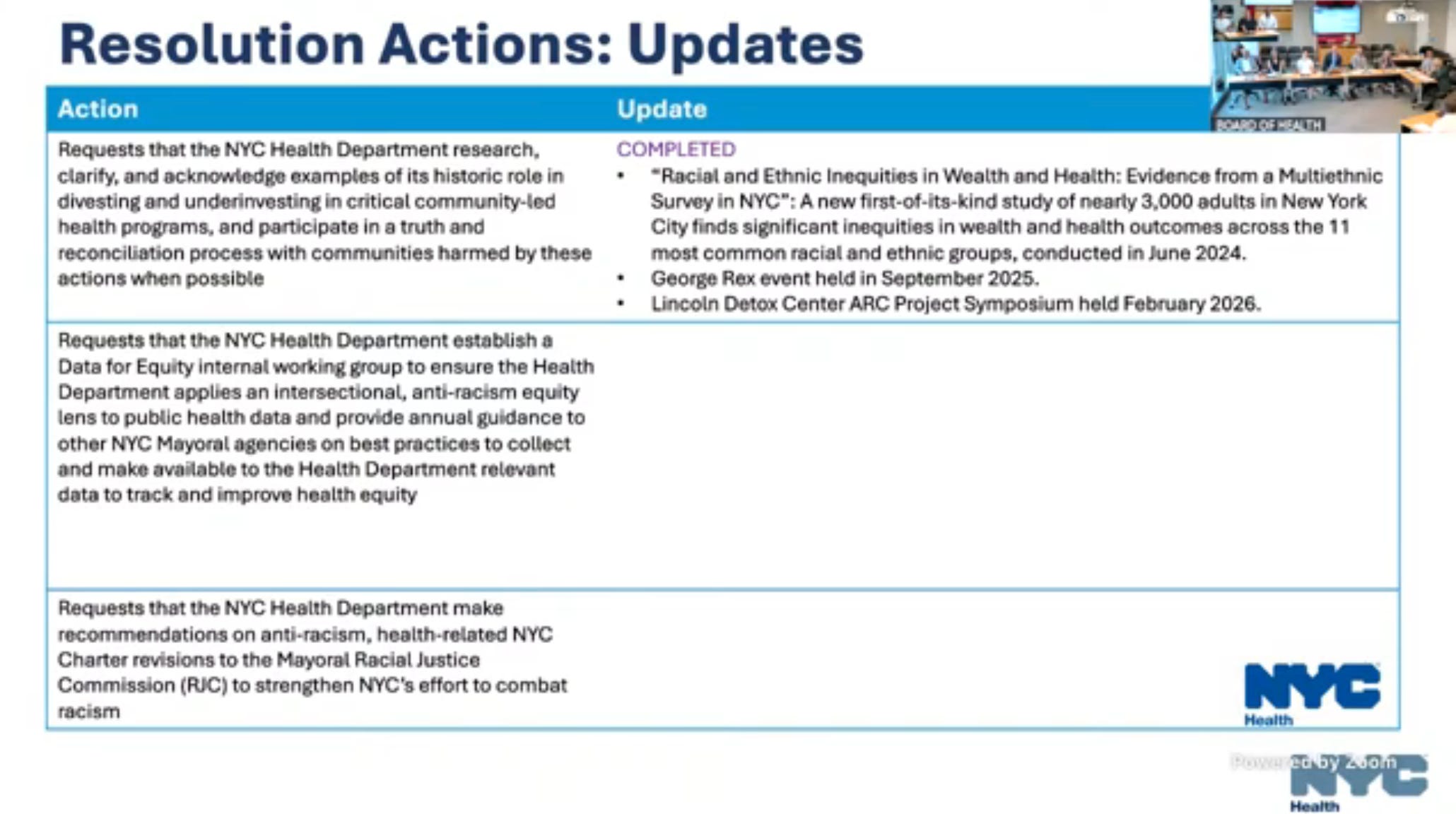
Screenshot from the May 19, 2026, New York City Board of Health meeting.
Martin’s predecessor, former Acting Health Commissioner Dr. Michelle Morse, offers a good example of a public health official who combines a heavily ideological approach with a preference for heavy-handed governance. Morse did not leave New York City government when Martin became commissioner, but has stayed on in her role as the health department’s Chief Medical Officer.
A founder of EqualHealth, an organization devoted to “building critical consciousness and collective global action in pursuit of health equity for all,” Morse is a proponent of social medicine. The EqualHealth website defines social medicine as:
an approach to health that recognizes the centrality of the social and structural determination of health, integrates social theory to understand social forces that marginalize and harm communities, and builds collective power to challenge oppression and support the struggle for social justice
This ideological approach to public health and healthcare doesn’t just draw connections between societal factors and health. It seamlessly blends the social, economic, political, personal, and medical. For example, Morse has advocated using reparations for slavery to improve COVID-19 outcomes and collecting household wealth information as health data.
The term critical consciousness, used by EqualHealth, was coined by the Brazilian Marxist educational theorist Paulo Freire, as conscientização in the original Portuguese. It’s an expansion of the anti-colonial Marxist Frantz Fanon’s French term conscientiser, which Fanon used to name the process of becoming aware of oppressive structures. Freire expanded the concept to describe it as the first step toward revolutionary action.
Dr. Morse’s social medicine approach brings the revolutionary politics of Freire and Fanon into the realm of public health. She recently co-authored a paper advocating for an approach to academic global public health that combines “settler colonialism and racial capitalism” frameworks to challenge “widespread epistemic and material injustice.”
In addition to her ideological position, Dr. Morse has a record of supporting authoritarian public health policy. When the firefighters’ union sued to try to block New York City’s COVID-19 vaccine mandate on municipal workers in the fall of 2021, Morse submitted an affirmation to the court in support of it. The City’s workplace vaccine mandates led to firings and other job losses of thousands of New Yorkers.
I’m not singling Dr. Morse out as an exception. On the contrary, many, if not most, public health officials share her views.
In a February 2023 talk at the Federal Reserve Bank of New York, Morse joined former New York State Health Commissioner Dr. Mary Bassett on a panel to talk about “Reimagining Public Health for NYC: A Discussion on the Racial Wealth Gap and Health Equity.”
Like Morse, Bassett is a health equity advocate and SDOH/PDOH determinist. Also like Morse, she actively upheld the workplace COVID-19 vaccine mandates put in place by her predecessor, Dr. Howard Zucker. Those mandates, in the healthcare sector, court system, and state agencies, put an estimated 34,000 people out of work.
Bassett also created a system of racial preference for the distribution of monoclonal antibodies and antiviral medications to treat COVID-19 in 2021. As acting state health commissioner, she designated “non-white race or Hispanic/Latino ethnicity” as a medical risk factor, which meant that in the event of a shortage, non-white individuals would have received the treatments before white individuals, all other medical risk factors being equal.
During the panel discussion, the two former health commissioners pointed to slavery, structural racism, and racial wealth gaps as drivers of health inequities. They advocated “race-conscious solutions,” redistributive economic policies, and personal data collection to address health disparities between groups.
Morse attributed black New Yorkers having a relatively low rate of COVID-19 vaccination to “inequity and exclusion,” disregarding the fact that many simply didn’t want to take the shot.
In fact, many of the middle- and working-class New Yorkers who lost their jobs, and sometimes their homes, under the mandates these two Harvard-educated women supported were African-American and Caribbean-American. Numerous people I’ve spoken with have compared the mandates to the slavery their ancestors were subjected to.
Apparently Drs. Morse and Bassett didn’t think the paychecks and health insurance they lost would be as effective at mitigating COVID-19 symptoms as reparation payments. They and much of the public health establishment are focused on using the power of government to achieve the societal changes they want to see, rather than putting more decision-making power in individuals’ hands.
My point here is not to wade into arguments about structural racism or reparations or any of the particular concerns of today’s SDOH/PDOH determinists. Tomorrow’s might have other preoccupations. It is to shed light on the deterministic, ideologically driven, and often revolutionary worldview that leads so many in the public health sector to see their mission as nothing less than transforming all of society.
The MAHA HHS administrators may be aiming to empower individuals to improve their own lives with the help of health data, but the infrastructure they’re constructing to gather that data and make it easily accessible will exist long after they’re gone.
They are building a vehicle that will hurtle us into a future of pervasive and expansive health data gathering and ubiquitous health record accessibility, but they will not always be behind the wheel.
There is a very strong chance that Drs. Martin and Morse and the thousands of other SDOH/PDOH determinists who make up the public health bureaucracy at every level of government and in the nonprofit sector will be sliding back into the national health data driver’s seat over the next few election cycles.
The health data infrastructure and value-based payment systems that the MAHA HHS is putting in place now will be ideal mechanisms for enforcing compliance with public health mandates and incentivizing adherence to policies designed to drive not just individual outcomes but population-level ones.
The systems the Trump administration is building to put the power of health information into patients’ hands will also be powerful tools for public health socioeconomic engineers.
I want to emphasize that the question of health record ownership and control is not technical. It is a legal issue. There are technologists inventing systems for storing medical records on your own devices, having full control of access, and ensuring accuracy and security. One doctor recently patented a blockchain-based system.
But unless you’re creating your own medical records, you won’t own them and you won’t be able to control the access authorities have to them. Your health records will belong to the organizations that generated them and be stored in their networked EHR systems, and access to them will be governed by existing laws and regulations.
I can imagine a future in which you can do all your own labs and scanning with gadgets at home and consult with your own personal, private AI doctor. When you need something fixed, you’ll just snap the optional surgery arm onto the Optimus robot you bought to mow your lawn and set it to medical mode.
Like one of the hive-mind post-humans in Pluribus, your robot will become whatever kind of medical professional you need. You’ll sync your private medical records with its brain and won’t need to share them anywhere. But we’re not there yet.
And while you’re fantasizing about that scenario of technology-enabled medical autonomy, you should keep in mind that your robot could also come with a government-activated prison guard mode. Whether it does will be determined once again by the laws we decide to put in place.
No matter how advanced technology gets, its uses will depend on the rules we decide to create as a society.
A small army of bureaucrats has been working for years to create new consent systems that will allow patients to control which healthcare providers and other third parties have access to their medical records.
At the state level, they sit on committees like the SHIN-NY’s Policy Committee, trying to create a workable statewide consent form for sharing medical records. At the Sequoia Project, they sort through the tangle of state and federal laws to craft a digital consent system that will work nationwide with TEFCA.
These bureaucrats have been trying to create systems that will allow information in health records to be tagged and categorized so that patients can have more granular control over how information is shared and with whom. With a more detailed digital consent system, new legal protections could be added to certain categories of data or offered as options for patients to select when signing consent forms.
But the public never sees this group of people deciding what kind of control they will have over how their own health information is shared. They’re not in the headlines, like Dr. Oz.
Their priorities tend to be the priorities of the public health establishment. They’re not concerned about protecting information from public health mandates or overreach by SDOH socioeconomic engineers.
They want to add extra protections for information about medical services related to reproduction and “gender-affirming care.” They’ve been worried that officials on the political right will use individuals’ health records in those categories for criminal prosecutions.
They aren’t wrong. The Trump administration is doing that right now. The U.S. Attorney’s Office for the Northern District of Texas recently sent grand jury subpoenas to several healthcare institutions across the United States, including NYU Langone, demanding they hand over detailed medical records for patients under the age of 18 who have received “sex-rejecting procedures.”
In the wake of the 2022 Dobbs decision overturning Roe v. Wade and legal efforts to ban “gender-affirming care,” Democrats moved quickly to put extra protections for related medical procedures and records in place. In New York, they created the Shield Law, which is actually a set of state laws. It’s unlikely to block a federal grand jury subpoena, and Langone will probably have to hand over the records.
Many conservatives are pleased to see the government going after “gender-affirming care” practitioners, because they consider it to be medical malpractice. The records being requested will be used to penalize institutions and medical professionals, not patients.
But they should keep in mind that the subpoenas demonstrate the fact that even the most protected medical records can become accessible to authorities. Another administration with different priorities could access other kinds of information.
Some of the efforts to protect certain categories of information have been through changes to existing regulations. In 2024, the Biden administration issued a HIPAA Privacy Rule to Support Reproductive Health Care Privacy. It added special protections for medical records related to reproductive health care. In 2025, the U.S. District Court for the Northern District of Texas vacated it.
But HHS also issued a new privacy rule for medical records related to substance use disorders in 2024, requiring data shared with public health authorities without consent to have the patient’s identity removed. That rule stuck. It’s a rare exception to authorities’ ability to access medical records for “public health activities” without patient knowledge or consent and with patient identity intact.
That rare exception shows that exceptions can be made. Protections can be strengthened, and patient information can be shielded from government access and overreach. It’s a question of political will.
The HIPAA Privacy Rule is due for an update. Proposed modifications were floated back in 2021, but nothing moved forward. That might change this year. In January, health sector press picked up on the fact that HHS was talking about updating the HIPAA Privacy Rule with American Indian Tribal authorities. That led them to speculate that a Privacy Rule update is on the horizon. I’m keeping an eye out for that.
Meanwhile, in legal news, medical freedom advocate Leslie Manookian has announced that the U.S. Supreme Court declined to review a lower court decision against Los Angeles United School District workers who were fired for refusing to comply with a COVID-19 vaccine mandate.
That decision, Manookian writes, essentially ruled that:
even if a “vaccine” like the Covid-19 injection is well-known to fail to stop transmission or infection, it can still be mandated if an administrator has a reason to think it might work to help protect public health or the vague promise of “safety.”
The court’s logic, she explains, could be applied not only to vaccines but to other medical interventions. SCOTUS endorsed that logic by declining to hear the case, Health Freedom Defense Fund et al. v. Alberto Carvalho.
With SDOH determinists expanding the purview of public health to include every area of life, strictly medical interventions might not be the only thing administrators might think should be mandated to protect public health.
Manookian and the organization she founded, Health Freedom Defense Fund, have been working to put in place legal protections for informed consent and bodily autonomy, most notably in the Idaho Medical Freedom Act.
Those kinds of protections will be all the more important when we have a fully interoperable, government-accessible Internet of health records that stores a mountain of information about every one of us.
What we need as we finish construction on our health data infrastructure is not glib assurances that our medical records belong to us, but an acknowledgment that they don’t and a serious review of the laws and regulations that govern what can be done with them.
A vast bureaucracy that stretches across the public and private sectors is waiting in the wings with grand plans for reshaping not just our healthcare but all of society. Our current system gives it extraordinary powers to access our information and issue rules and mandates that are enforced like laws.
The laws and rules we put in place now about how our health information can be used by authorities will shape our future freedoms, and not just the medical ones.
Comments
Nothing yet. Say the first thing.
Sign in to join the conversation.