
Over the past nine months the conversation about EdTech has changed dramatically. Those of us who have been fighting the onslaught of EdTech products into classrooms have witnessed a true about-face in how the media covers the issue (much better), the willingness of lawmakers to engage on the topic (increasing!), and the number of concerned parents joining the cause (so many more!). The EdTech industry is concerned by this growing backlash and they should be. In response, they are working hard to reframe how they talk about technology use in schools.1
Call it a “rebrand,” if you will.
But what it means is that the meaning and intention behind my trademarked phrase— “tech-intentional”— is being routinely massaged into a softer, gentler marketing rebrand of EdTech companies who want to appease increasingly concerned superintendents and administrators, as reflected in language like “purposeful” technology, “intentional” technology, “educational” vs. “entertainment” technology, etc.
I will not participate in, nor will I accept, the co-opting of our ideas (and my trademark), by those who seek to profit from children while dismantling education.
So I want to take a moment to explain the origin of my phrase and the timeline of my trademarking process, and remind my readers of the true meaning of the term as I intended it— not as it may appear in a co-opted form in the new marketing materials in school leaders’ inboxes this summer, but as the simple and (if I may so myself) radical idea that it truly is.
In 2018, I started using the phrase “tech-intentional” when I spoke about screentime. Usually it would appear in this context when I spoke to audiences: “I am not anti-tech; I am tech-intentional.” Someone wisely recommended I trademark the phrase, and I began that process in 2019. I hired a trademark lawyer, filed paperwork, and paid a few fees. Then I waited. And waited. And waited.
But finally, as of January 2024, “tech-intentional” became a federally registered trademark.2
When I first started using the phrase, I didn’t see many references to or misuses of it, but over the past year or two, I’ve had to spend time and money to protect the mark from EdTech companies who attempting to redefine the phrase for their own purposes. It’s not just the use of the phrase “tech-intentional”— which I keep close tabs on and follow up with immediately when I see use of it cropping up, and which I can fight— but harder to protect is my intended philosophy when similar-sounding versions of it (like “intentional tech,” for example) show up in marketing copy.
Of course, these companies can afford good lawyers, so they know to be careful not to use the trademarked phrase directly, and I will fight actual misuse of the trademark. But it is less straightforward to push back on their attempt to redefine what “tech-intentional” (or in their case, “intentional tech”) actually means.
Here is how I define tech-intentional:
Being tech-intentional means only using screen-based technology that enhances, nurtures, and supports ourselves, our child, or our family in a way that aligns with our values, and resisting, delaying, or limiting screen use that interferes with healthy mental, physical, cognitive, and emotional development.
The simpler version of tech-intentional can be summarized like this:
When it comes to screentime, being tech-intentional™ means:
Less is more.
Later is better.
Relationships and skills before screens.
I am sometimes accused of being “anti-tech.” These critics assert that the opposite of thoughtless technology overuse must be technology abstinence.
This couldn’t be further from the truth.
The problem is that tech-intentionality can look a little bit different from person to person, family to family, or school to school. Tech-intentionality, unlike EdTech, is not an app or platform designed to be scalable and standardizable, because children, families, and teachers are not scalable and standardizable.
Of course I use technology as a tool. I know how to do this thanks to having a fully-formed pre-frontal cortex, decades of analog classroom learning (including technology education), and the ability to discern when to use technology and when it’s using me, but I do understand the tendency towards this black and white, either/or thinking. As our movement gains traction, I have become a more visible and appealing target for opposition.3
But the irony is that while the very building blocks of code may be binary, teaching and learning and parenting are anything but. This is why I developed the concept of tech-intentionality— because we need a clear path forward for navigating technology, childhood, and education in a world where digital technology does and will continue to exist. Of course technology is “here to stay” (as we so often hear), but that doesn’t mean four-year-olds need AI chatbots or second graders need iPads or middle schoolers should have access to GenAI.
Can our modern technology make our lives better, easier, more convenient, safer? Sure. But it does the opposite, too. And of course, too much time on social media or scrolling or gaming mutes our curiosity, critical thinking skills, and ability to be discerning, rendering us less thoughtful users of the products or tools that might also help us. (See: Today’s school children who are learning to read on an app or via a chatbot vs. today’s Big Tech executives who are highly successful in part because they had time in childhood to develop these skills.)
Technology isn’t in and of itself the issue; the problem is that the business model of technology companies and social media platforms threatens our very humanness (like creativity, critical thinking, and problem solving) which in turn threatens families and civic institutions. Unlike previous forms of technology (the fork, for example), in today’s world, we are engaging with curated and specifically built products designed to manipulate our attention, hijack our focus, and blur fact and fiction, all for someone else’s profit, while at the same time eroding the very skills we would need to defend ourselves from it.
And when it comes to children, I take issue with that.
The business model of EdTech companies and social media platforms threatens our very humanness, which in turn threatens families and civic institutions. Today, we are engaging with curated and specifically built products designed to manipulate our attention, hijack our focus, and blur fact and fiction, all for someone else’s profit, while at the same time eroding the very skills we would need to defend ourselves from it.
Just like family screen use, school-based screen use must also be tech-intentional. The good news is that the tech-intentionality is easily applicable in both home and school environments. I’ve delivered keynotes on this very topic and written extensively about why the future of education will be tech-intentional. I even offer schools the opportunity to become “Tech-Intentional Certified,” with Manhattan Day School in New York City serving as the first school to receive this designation in May of 2026.4
Here is my definition for a tech-intentional school:
Being a tech-intentional school means only using screen-based technology that enhances, nurtures, and supports your school community, your students, or your educators and staff in a way that aligns with your mission and values; and resisting, delaying, and limiting screen use that interferes with healthy mental, physical, cognitive, social, spiritual, and emotional development.
A tech-intentional school is not anti-technology.
A tech-intentional school recognizes that the best preparation for a digital future is an analog childhood.
As schools face a growing reckoning about their reliance on EdTech products, it is my hope they will move towards a tech-intentional school framework, where technology use in a classroom meets the above requirements, as well as answers Four Key Questions below.
While there are many parts of this process that need attention, the two my work has focused on the most are: screen use in the home and screen use for and at school. While the challenges may differ slightly, the solution is the same: tech-intentionality.
Being tech-intentional doesn’t mean “no tech”; it means technology use that aligns with our values. It means technology that enhances our relationships, not detracts from them. It means prioritizing skills and healthy development before introducing screens. Being tech-intentional means making purposeful choices about our use of technology. Being tech-intentional means using technology, not letting technology use us.
Rebranded EdTech company marketing today might echo some of these sentiments, but it is here that their definition falls short and fails to meet what I consider the most important criteria for determining tech-intentionality: the four questions.
When it comes to technology use in the home or at school, especially for use by children, being tech-intentional means we can answer each of the following four questions with a resounding “Yes”:
Is it effective?
Is it safe?
Is it legal?
Is it better than a human?
The first three of these questions are not of my own creation— they have been circulating in our activism groups for years. They are excellent questions, and leaders like Jared Cooney Horvath, Jon Haidt, and Andrew and Julie Liddell of the EdTech Law Center have been providing us with concrete, independent evidence that the answers to these three questions are three fiercely disappointing “No’s.”
Not long ago, when I sensed a potential industry rebrand was coming, I added the fourth question. I had a feeling that in response to growing concerns, the EdTech industry might seek to reposition themselves as misunderstood “helpers” whose purpose is to “support teaching and learning” and then possibly even get to a place where they could start to answer “Yes” to the first three questions.5
But when it comes to how I define “tech-intentionality,” that’s not enough.
Because even if a mission-driven company one day decides to put people before profits and drastically change their business model and makes their product safe and legal and promises (ha) it’s used only for very specific and narrow purposes that actually support learning and learners (because those are two separate things), at the end of the day, we still must ask: Even if the first three criteria are met, is use of the product still superior to a human teacher?
I truly believe the answer is No, because learning happens in the context of caring and trusted human relationships. I can think of no instance where the displacement of a human teacher will ever be better than the product.
And that, unfortunately, is where I part ways with the EdTech companies trying to do good-er.6
As awareness of the problems with Big Tech and EdTech products grow, so too has the resistance to its onslaught, and thus we see the softened marketing language— “We’re the “good” kind of screentime, guys!” and the reactionary appropriation of terms, ideas, and language that historically meant one thing but now must serve a redefined purpose (because #profits and #shareholders).
As a result, I am having to more frequently defend my intellectual property because I am adamant that my original concept of tech-intentionality not get co-opted by for-profit companies who manipulate other people’s ideas for their benefit.7
I won’t name which EdTech company recently advertised their Middle School ELA curricula using my trademarked phrase, but, as is my strategy, when I first politely reached out and asked them to please remove it as it was a violation of the trademark, the CEO informed me that he “couldn’t identify the overlap” in his misuse of the mark (!?), but would I like to “hop on a call” to “discuss “ my “concerns”?
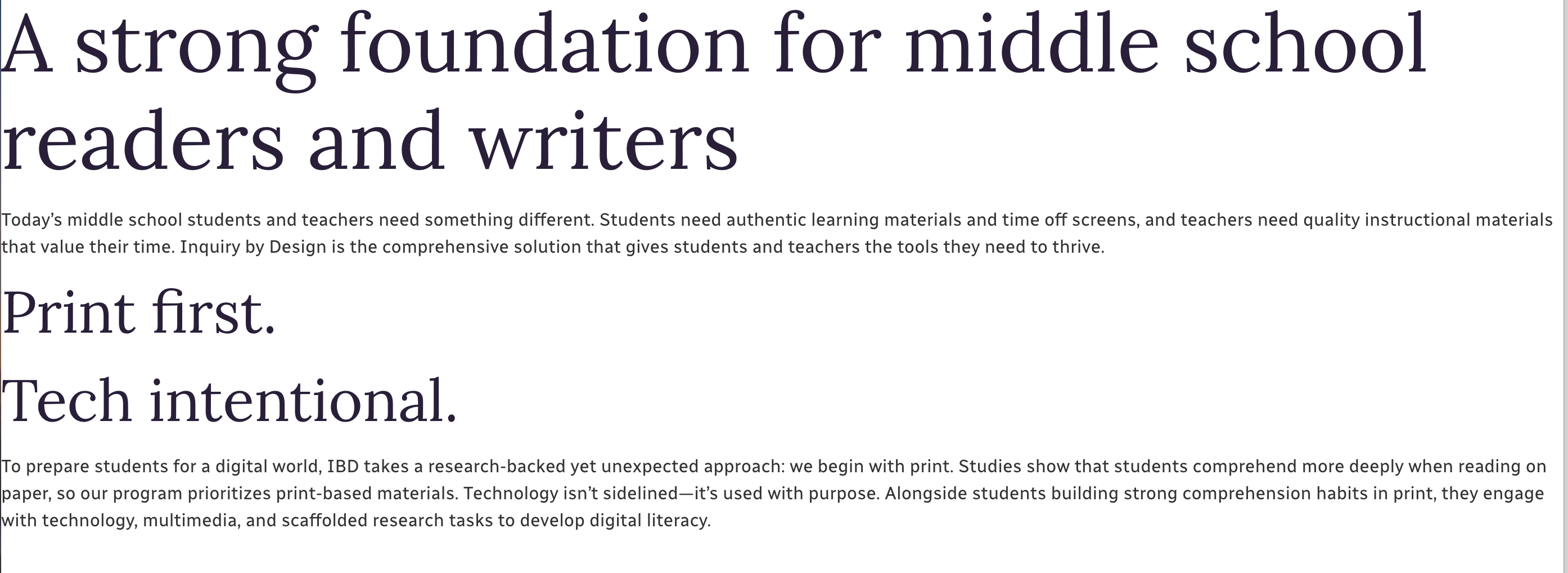
Reader, I did not hop on a call to “discuss” my “concerns,” but I did have my lawyers send a Cease and Desist letter.
Incredibly, once that email landed in his inbox, my trademarked phrase disappeared from the website.
Keep up the good fight, friends.
It’s working.
Note: Parts of this essay originally appeared on my blog in January 2025.
A much longer essay on this is coming soon.
The trademarking process is not speedy.
Including my first death threat! Good times.
I’ve been accused of “profiting” off this resistance movement. That’s hilarious, if you look at my tax returns. I really only charge for two things: speaking engagements and the school certification, though I am always open to work within a budget and often do. The majority of my work I offer free of charge. One way you can support me is to become a paying member of this Substack.
Though stories like this raise so many other questions. Definitely worth clicking on this link if you pay attention to footnotes.
Because I know there will be push back on this— “Does that mean you say no technology in the classroom”? Absolutely not— here’s a reminder of what I say over and over and over again: EdTech is not Tech Ed. We need Tech Ed; we’ve got EdTech.
We haven’t even touched on what AI companies are doing with so many people’s intellectual property.
Comments
Nothing yet. Say the first thing.
Sign in to join the conversation.