
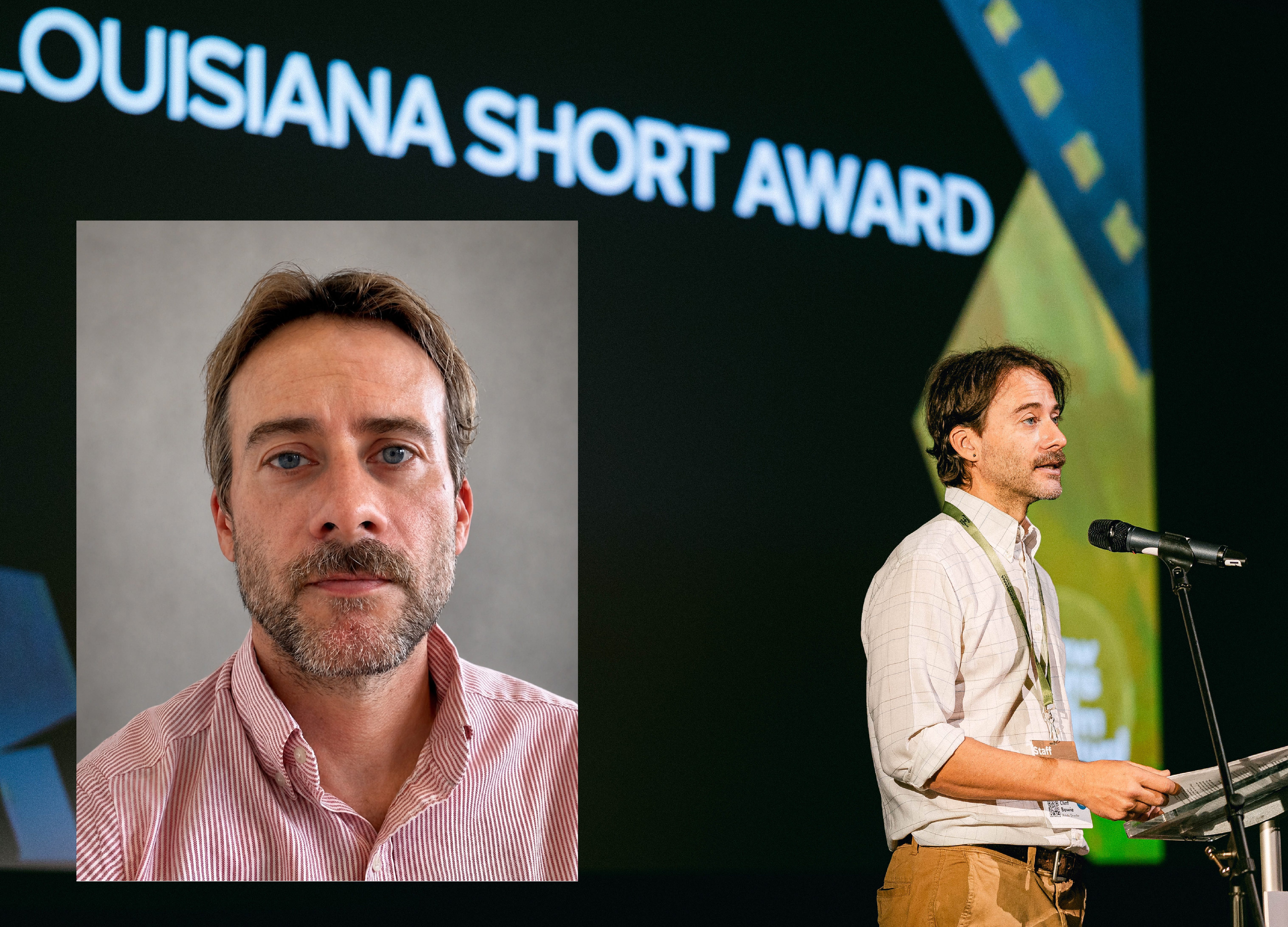
Who’s Watching? is a recurring series on For Immediate Release. We spend so much time wondering what film programmers are looking for — this is where I turn the camera around.
I emailed the New Orleans Film Festival in the summer of 2016, before I even lived there — I was visiting the city for the first time and wanted to meet the people behind it. Clint wrote back. A year later, after I moved to New Orleans, he offered me a job. We worked together for four and a half years. He is one of the most thoughtful people I have worked alongside — a Southern gentleman in the truest sense, not the performative kind, the real deal. Genuine, measured, deeply invested in doing this work right. I have watched him agonize over programming decisions with more care than most people bring to anything. So when he says rejection isn’t personal, I promise you — he means it.
The film that made me want to work in festivals was…
There was a string of films that I saw in my early 20s that really cemented my love for cinema and piqued my interest in pursuing it as a career. I was working as a journalist when I came across documentaries like Sherman’s March, Hands on a Hardbody, and the 7Up Series that made me fall in love with nonfiction filmmaking. I found myself documenting stories myself and pushing my editor to include more video components to our reporting (I mean, how can you write an article about a skateboarding bulldog, which I did, and NOT have accompanying video footage?). At the same time, I was spending more and more time volunteering at film festivals and at the nonprofit cinema in my community. When the opportunity for a full-time job in film presented itself, I left journalism and never looked back.
If I could only program one genre for the rest of my life… I’m partial to Narrative Shorts, maybe because I love a challenge, and this category is the most grueling due to the sheer volume of shorts that are submitted each year. But despite the work—or maybe because of it—I find it to be the most rewarding. In the past 16 years, I’ve watched over 10,000 narrative shorts for NOFF, and I’m still not over the joy of coming across a short that really moves me or surprises me.
The filmmaker I'd most want to have a drink with after their Q&A (dead or alive) is… I’m actually not into meeting celebrities or big-time directors. As wild as it might be to have tea with Hitchcock, I’d honestly rather spend the time catching up with a filmmaker friend I don’t get to see enough anyway. Someone like Angela Tucker or Zandashé Brown — I don’t see them enough as it is, and I never tire of conversations with them.
Deep in selection season, the film that makes it all worth it is the one that… is not afraid to be vulnerable.
The best audience reaction I've ever witnessed at a screening was… when people clap when they see their friend’s name in the credits. It’s always heartwarming to see community support for a film, and not just for above-the-line talent but for the costumers, line producers, gaffers, and all the talent that goes into a film behind the scenes.
What do filmmakers misunderstand most about how festival programming works? There’s a prevailing assumption out there that if your film gets selected, it means that the programmers love it, and if it gets rejected, it means they hate it — and the reality is (obviously) so much more nuanced than that. As programmers, we fall in love with so many films each year, and our team spends countless hours in meetings fighting over which ones to give a slot to. Cutting films we love is painful, and I wish there was a way to communicate, in a way that would be honestly received, how we can love a film but also not be able to invite it in. Even personalized rejection notices fail to do this properly, and it’s one of the downsides of this binary in/out gatekeeping structure that seems inherent to this process. Not getting selected doesn’t mean your film isn’t good or that it didn’t make an impact on the programmers; just that there were more compelling reasons that other films were selected-- and oftentimes, those reasons can have more to do with the festival itself and their priorities than whether the programmers “like” the film, something that is often irrelevant in the programming process.
Is there a film you rejected that still haunts you?
Oh gosh, that list is impossibly long—and it grows every year. There are no right or wrong choices in programming. It’s entirely subjective, which makes it doubly hard to assess whether you’ve made the right decision about something. Early in my career, I often deferred to others to make final decisions, and I still carry lots of regret about not standing up for films I believed in at the time. Confidence in this field (at least for me) took a long time to build, and I still constantly doubt myself and my decisions. But I don’t make decisions in a vacuum, and I surround myself with a team of people who help make programming decisions collectively. Still, we all walk away from every programming meeting upset about a film we’re advocating for that doesn’t make the cut. I’m constantly strategizing about how best to craft an argument for a programming meeting to convince my team, but on the flip side, they regularly remind me of my own blind spots and biases. It’s not easy, and you have to trust the process you’ve built to make good programming choices that you can stand by and be proud of. Before the pandemic, I lost a friendship over a programming decision I made, and I’ve struggled with how to reconcile that for years. I supported the decision that we made about the film, but those kinds of difficult decisions and complicated repercussions come with the territory of programming.
I knew I was in the right job when… lol I still question whether I’m the right person for this job! After 17 years, I do still enjoy it, and I’ve been so rewarded by the relationships I’ve made — with both filmmakers and programming colleagues— and I think that I’ve become very adept at managing this kind of process and a team of 15 programmers. But... as a white man in film programming, I recognize that my perspective is one that is already too dominant in this space, and I’m doing what I can to ensure that a more diverse pool of programmers will take over and eventually supplant my voice in the landscape.
Anything you’d like to add for filmmakers to know?
There’s a lot wrong with film festivals today, from the way filmmakers are compensated to how films are selected, but the one thing I’d encourage filmmakers to do if they want to see changes is to speak up and make their voices heard. Email festival organizers, comment on social media threads — the landscape will only change if there are requests (and pressures) for it to do so. And festivals need to be reminded of what’s working and what’s not for the communities they serve.
Clint Bowie is the Artistic Director of the New Orleans Film Society, where he manages the curation of the organization’s year-round programming, including the Academy Award–qualifying New Orleans Film Festival, the New Orleans French Film Festival, and the organization’s artist development programs. He has served on review committees for ITVS, Creative Capital, the National Endowment for the Arts, United States Artists, FilmNorth, and Latino Public Broadcasting, and has spoken on panels organized by Sundance Institute, Firelight Media, and the Center for Asian American Media. He is currently on the Advisory Board for the Overlook Film Festival and was previously a board member for Film Festival Alliance.
For more about the New Orleans Film Festival, visit neworleansfilmsociety.org
If you want to go deeper on how to navigate the festival world — strategy, submissions, programming decisions, all of it — I’m writing a guide. Pre-order it here.
No posts
Comments
Nothing yet. Say the first thing.
Sign in to join the conversation.