
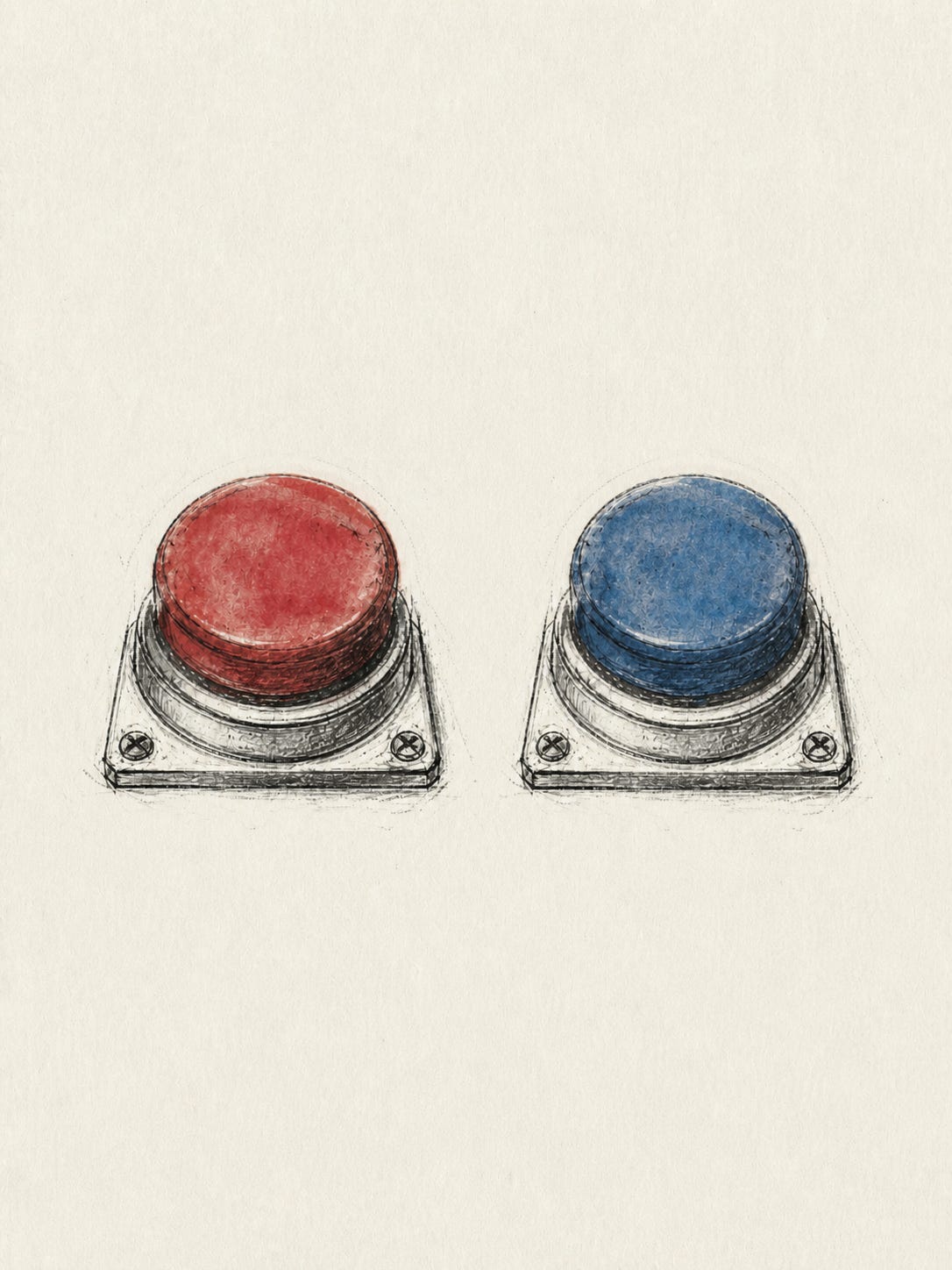
By now, I’m sure you’ve heard of the “Red Button or Blue Button” problem.
Red Button or Blue Button: Everyone in the world has to take a private vote by pressing a red or blue button. If more than 50% of people press the blue button, everyone survives. If less than or equal to 50% of people press the blue button, only people who pressed the red button survive. Which button would you press?
This problem uncovers some surprisingly deep issues about decision theory, collective action, and your ethical obligations to others.
I think you should push blue. Here is a modest case for why.
Let’s start easy. Suppose you only care about your own life. You can visualize all the possible outcomes using this payoff matrix:
\(\begin{array}{c|c|c} & \text{You: Blue Button} & \text{You: Red Button} \\ \hline \text{> 50%: Blue Button} & \text{You }{\color{#228B22}\text{live}} & \text{You }{\color{#228B22}\text{live}} \\ \hline \text{$\leq$ 50%: Blue Button} & \text{You }{\color{#B22222}\text{die}} & \text{You }{\color{#228B22}\text{live}} \\ \end{array}\)
If you push the red button, you’re guaranteed to live, and if you push the blue button, you might die. So, if you only care about your own life, you should push the red button, because doing so weakly dominates pushing the blue button.
Takeaway: If you only care about your own life, push the red button.
But do you only care about your own life?
Think about all the other people’s lives that are at stake. Your friends, your family, and all your other loved ones are also playing this game. Random strangers are too. And although you probably don’t care as much about random strangers as you do about your loved ones, you probably care at least a little bit about random strangers.
Further, here’s a fact that you can be almost certain of: of the 8 billion people on Earth, at least one person will press the blue button. I’m not claiming lots of people will, just that, almost certainly, at least one person will. Maybe they’re scared. Maybe they’re confused about the situation. Maybe they think they’re taking the moral high ground. Maybe they’re creating a problem when one doesn’t need to exist. Whatever their reasons, you can be almost certain that at least one person will press the blue button.
And further, however bad their reasons, they don’t deserve to die for it. (Let’s set aside the issue of the risk to yourself for a moment.) I’ve seen comments that say, “The only reason to press blue is to save the other idiots that also pressed blue.” But surely, if someone does something stupid or negligent, I’m willing to bet you wouldn’t suddenly stop caring about their life.
Consider this case:
Beach: You’re relaxing on a beach. Nearby, someone who can’t swim is playing on a pier that extends into the water. They know they can’t swim. They climb onto the rail, fall in, and start drowning. You could easily save them. There is a life jacket next to you, and all you have to do is throw it to them.
This person is certainly an idiot for playing on top of a pier, knowing that they can’t swim. They created a problem when one didn’t need to exist. But, I think, you would still throw them the lifejacket.
Takeaway: You (probably) care about other people’s lives, including the lives of people who make stupid or negligent choices. (And if you’re not convinced, think about your loved ones.)
But Blue Button or Red Button is not like tossing someone a life jacket! There is a risk to your own life if you push the red button. You might care about other people’s lives in general, but you wouldn’t be willing to pay a real cost, like risking your life, to save them.
Notice that we have changed the problem. The problem now is: what should you do in cases in which you must contribute to a public good (saving as many lives as possible, including your own) by incurring a cost to yourself (risking your life)? In other words, the problem is starting to look like a collective action problem.
Here is an example of a collective action problem.
Littering: There is a beautiful public park that you and lots of other people love. There are no garbage cans in the park. You are carrying litter with you. It would be very easy and convenient for you to throw the litter as you pass through the park. Most people would barely even notice it. On the other hand, you could carry your litter with you and throw it away at home, but this would be somewhat annoying and inconvenient.
What should you do? Here is one way to think about this problem. You might reason that it would be better to litter since your tiny piece of trash would make almost no difference to the beauty of the park. But remember, everyone is in the same situation as you are! And if everyone litters, the park would be ruined.
You can again visualize all the possible outcomes using a payoff matrix:
\(\begin{array}{c|c|c} & \text{You: Don't Litter} & \text{You: Litter} \\ \hline \text{Everyone else: Don't Litter} & {\color{olive}\begin{array}{c}\text{Clean Park +} \\ \text{Inconvenience}\end{array}} & {\color{darkgreen}\begin{array}{c}\text{Clean Park +} \\ \text{Convenience}\end{array}} \\ \hline \text{Everyone else: Litter} & {\color{red}\begin{array}{c}\text{Dirty Park +} \\ \text{Inconvenience}\end{array}} & {\color{darkorange}\begin{array}{c}\text{Dirty Park +} \\ \text{Convenience}\end{array}} \\ \end{array}\)
The worst outcome is when you don’t litter, but everyone else does (bottom left). You have the inconvenience of carrying your litter home, but still end up with a dirty park. A slightly better outcome, but still bad, is when you litter and everyone else does (bottom right). There’s no more inconvenience, but your beloved park is still ruined. A good outcome is when you don’t litter, and neither does anyone else (top left). You have a beautiful park, at a small cost to yourself. The best outcome is when you litter, and no one else does (top right). You still have a clean park and the convenience of not carrying your trash home.
The problem is that no matter what everyone else does, it’s better for you to litter. If everyone else doesn’t litter (that is, if we’re in the top row), then you should litter, since you get a clean park either way and a bit of convenience if you litter. If everyone else does litter (that is, if we’re in the bottom row), then you should also litter, since you get a dirty park either way, and a bit of convenience if you litter. Littering strictly dominates not littering.
But since everyone else is in the same situation you are, they will also litter! And you will end up in the bottom right cell, with a dirty park and only a bit of convenience, instead of a much better outcome, with a clean park and only a small amount of inconvenience. Yet intuitively, the best outcome for everyone is the top left cell, where everyone carries their litter home and enjoys a beautiful park.
This is a collective action problem. Each individual must pay a small cost to preserve a public good, the good would be preserved even if any individual refused to pay, but if everyone refused to pay, the public good would be destroyed. A lot of real-life cases are like this. Cases of companies polluting, citizens voting, and even concert attendees putting up their phones to record the show can be thought of as collective action problems.
Given that you care about other people’s lives, Blue Button or Red Button is a lot like Littering. You might reason that it would be better to push red since the probability of your vote making a difference is vanishingly small.1 But remember, everyone else is in the same situation as you are! And if a majority pushes red, then those unlucky people who pushed blue, whom you (probably) care about, will die.
\(\begin{array}{c|c|c} & \text{You: Blue Button} & \text{You: Red Button} \\ \hline \text{> 50%: Blue Button} & {\color{olive}\begin{array}{c}\text{Everyone lives +} \\ \text{You risk your life}\end{array}} & {\color{darkgreen}\begin{array}{c}\text{Everyone lives +} \\ \text{You don't risk your life}\end{array}} \\ \hline \text{$\leq$ 50%: Blue Button} & {\color{red}\begin{array}{c}\text{Blue-pushers die +} \\ \text{You risk your life (and die)}\end{array}} & {\color{darkorange}\begin{array}{c}\text{Blue-pushers die +} \\ \text{You don't risk your life}\end{array}} \\ \end{array}\)
Here again, the worst outcome is when you push blue but the majority doesn’t (bottom left). You end up risking your life and dying, and lots of people end up dying as well. Since we are assuming you care about other people’s lives too (especially your loved ones’ lives), this is the worst outcome. A better outcome, but still bad, is when you push red, but the majority pushes blue (bottom right). You do survive, but lots of people end up dying. Again, since we are assuming you care about other people’s lives too, this is still a bad outcome. A good outcome is when you push blue and the majority does too (top left). Everyone survives, but you had to risk your life. The very best outcome is when you push red but the majority pushes blue (top right). You didn’t have to risk your life, and everyone still survives.
The problem is that, just as before, no matter what everyone else does, it’s almost always better for you to push red (since the probability of your vote being decisive is vanishingly small). If you are confident the majority will push blue, there’s no need to risk your life and push blue - just push red! If you’re confident the majority won’t push blue, then you should push red to save yourself - there’s no need to throw your life away for nothing! Just as in Literring (if we ignore the vanishingly unlikely situation in which your vote is the deciding vote), pushing red strictly dominates pushing blue.
But lots of people are in the same situation as you are. So, we will all end up in the bottom right cell, with a majority pushing red, and a few poor, confused people pushing blue and dying. Intuitively, the best outcome is again the top left cell, where most people push blue, and no one dies.
Takeaway: If you care about other people’s lives, Blue Button or Red Button has a similar structure to a collective action problem, like the problem of littering, voting, or polluting.
What should you do if you are in a collective action problem? Based on the reasoning I gave above, it seems that you should refuse to pay the cost, and so end up in a less-than-ideal situation.
But a hidden assumption crept into the discussion. An assumption about the right theory you should use to make decisions. To see what that assumption is, consider this last case.
Twin Littering: Just like Littering above, except with a twist. This time, you and all the other people who in the park are psychological twins. Because of your genetic makeup, personality, and background, there is a 99% probability that you will all make the same decisions when placed in the same situation.2
What should you do now?
Suppose you think, “I should litter, since no matter what anyone else does, I’m better off if I litter.” But this time, remember that everyone else is your psychological twin, so you can be confident they are thinking the exact same thing. So, if you choose to litter, then you have a 99% confidence that everyone else will make that same decision to litter. On the other hand, if you choose not to litter, you can be very confident that everyone else will also not litter. So, you might reason, it would be better not to litter, since your very decision not to litter will make you confident that no one else will litter either.
If you agree with this reasoning, then you might like Evidential Decision Theory (EDT). Roughly, EDTists think that you should choose the action that you expect will maximize value, conditional on your choosing that action. More formally, EDTists calculate an action’s value by:
\(EU(A) = \sum_i P(S_i \mid A) \, U(A \,\&\, S_i)\)
where
\(P(S_i \mid A)\)
refers to the probability that you’ll end up in some state S, conditional on taking some action A, and
\(U(A \,\&\, S_i)\)
refers to your utility function U, which spits out a number that represents how much you value a certain action A and a state S.
Essentially, you should take the fact that you chose to litter as evidence for the fact that other people will litter, even though your choosing to litter doesn’t cause them to do so. EDTists will therefore choose not to litter in Twin Littering, because they know that their psychological twins will act just as they do, with a high probability.
However, you might not like this kind of reasoning. You might reason, your choice to litter won’t cause anyone to litter! It just so happens that your actions and everyone else’s are correlated, because you and everyone else in Twin Littering are psychological twins. You should still litter, you might think, because again, no matter what anyone else does, you are better off littering. This is what we learned, you might insist, from looking at those payoff matrices, and finding out that littering strictly dominates not littering.
If you like this kind of reasoning, you might like Causal Decision Theory (CDT). Roughly, CDTists think that you should choose the action that you expect will cause the state with the highest value. More formally, CDTists calculate an action’s value by:
\(\quad EU(A) = \sum_i P(A > S_i) \, U(A \,\&\, S_i)\)
where
\(P(A > S_i)\)
refers to the probability that a certain action A will cause a certain state Si.
Essentially, since your choice to litter is not causally connected to anyone else’s choice, CDTists think you should litter in Twin Littering. By payoff matrix-style reasoning, no matter what anyone else does, you are better off littering.
Takeaway: An EDTist will not litter in Twin Littering, and a CDTist will.
So, EDTists will choose not to litter in Twin Littering, while CDTists will choose to litter. What does this have to do with real-life collective action problems, like Littering?
The answer is that although in real-life cases, you do not have a bunch of psychological twins running around, you can still reasonably assume you are very similar to many other people out there. In real life, there are lots of people who have similar personalities, preferences, and backgrounds to you, who reason in the same way that you do, and therefore, who make similar decisions to you when placed in the same situations.
Take Littering. You cannot be 99% confident that everyone will make the same choice that you do, but you can be reasonably confident that lots of people, with similar personalities, preferences, and backgrounds to you, will make the same decision as you do. In other words, if you choose to litter, you can reasonably expect all the other people who are similar enough to you to litter as well. Maybe it’s not 99%. Maybe it’s closer to 50%. But whatever it is, you can be reasonably confident that lots of people will act like you.
So, if you are an EDTist, you will reason that, since many other people will make the same choice as you do, you should choose not to litter, since your choice not to litter will be evidence that lots of other people will not litter as well. (On the other hand, a CDTist will still litter in Littering.)
Takeaway: If you are an EDTist, and there are enough people out there who think as you do, you will (probably) not litter in Littering.
That, finally, brings us back to what you should do in Red Button or Blue Button. First, note that although you don’t have a bunch of psychological twins out there, you can be reasonably confident that there are lots of people with similar personalities, preferences, and backgrounds to you. When given the choice between pushing red and pushing blue, they will deliberate in the same way that you do, reach the same conclusion that you do, and then make the same choice that you do.
So, if you like EDT, you should (probably) push the blue button, because you will take your choice to push blue as evidence for what a chunk of similar people will choose to do. If there are enough people who will deliberate like you and make the same choice as you, then this will result in a blue victory, and no one will die.
However, if you like CDT, then you should just push the red button. You will reason that pushing the blue button won’t cause anyone else to push the blue button too (at best, it will just be correlated) and pushing the red button, as we figured out above, strictly dominates pushing the blue button.
But how many people in the world will deliberate as you do? If, say, only 10% of the population deliberates as you do, this may not be enough evidential lift for it to be worth pushing blue. In other words, it may turn out that pushing blue increases your expectation of a blue victory, but not by much. So, maybe even if you are an EDTist, you should be wary of pushing blue, since you still have a high expectation of all the blue-pushers dying, including yourself.
Takeaway: If you are an EDTist, and there are enough people out there who think as you do, you will (probably) push blue.
So far, we have been thinking about what the right decision is, assuming that you are only trying to maximize what you value. (We assumed that you wanted to save the lives of other people.)
But you might think that this leaves something out. You might think that in a collective action problem like Littering, you shouldn’t just do what is best for yourself or what you value. You might think that decision theory can tell you what to do if you want to get the most value for yourself, but this ignores the ethics of your decision. You might think you have an ethical obligation to not litter, to vote, to not pollute, and in general, to cooperate in collective action problems. If you are sympathetic to this idea, you might think we need to go beyond decision theory… to ethics.
There are many ethical theories that can make sense of collective action problems. One is Kantian Ethics, according to which there are certain ethical constraints on action that go beyond maximizing what you value. Roughly, Kantian Ethics says, before you take an action, think about what rule (maxim) you are acting on. Then, imagine a world in which this is a rule that everyone follows (universal law). Finally, ask yourself, in this world, are you still able to pursue the goals you are committed to pursuing (will)?
For example, in Littering, if you choose to litter, the rule you would be acting on is something like, “It is OK for people to litter to avoid the inconvenience of carrying litter home.” Now, you imagine that everyone else could act on this rule. In such a world, the park would be ruined. And finally, a goal you are committed to pursuing is having a clean park, because you love the park. So, you shouldn’t litter.
So, similarly, in Red Button or Blue Button, if we assume that some poor, confused individuals will press blue, Kantian Ethics would recommend pushing blue as well. If you push red, then the rule you would be acting on is something like, “It is OK not to take on small risks to your life, despite the fact (because of our assumption) that this will result in some people dying.” Now, you imagine everyone else could act on this rule. In such a world, you might find yourself in a situation in which other people need to take on small risks to protect your life, but don’t. And obviously, a goal you are committed to pursuing is not dying. So, you shouldn’t push red.
Takeaway: If you think that you have an ethical obligation to cooperate in collective action problems, you will also think you have an ethical obligation to press blue.
That’s my modest case for blue. Here is the final takeaway.
Final takeaway: If you can be confident at least one other person will press blue, and if you care about other people’s lives, including the life of this one person who might press blue, not just your own, and if you are an EDTist, and if there are enough people in the world like you, who will deliberate just as you do, then you should push blue. If you aren’t an EDTist or if you think there aren’t enough people in the world like you, then you might still think you have an ethical obligation to cooperate in collective action problems, and so you will think you have an ethical obligation to press blue.
Out of a population of 8 billion, if each individual has exactly a .50 probability of pressing blue or red, then the probability that the population will be exactly evenly split is approximately
\(\frac{1}{224{,}000}\)
If the probability is even slightly off, if say, it’s 0.501 or .499, then the probability that the population will be exactly evenly split is approximately
\(\frac{1}{10^{6948}}\)
which is virtually zero.
No posts
Comments
Nothing yet. Say the first thing.
Sign in to join the conversation.