
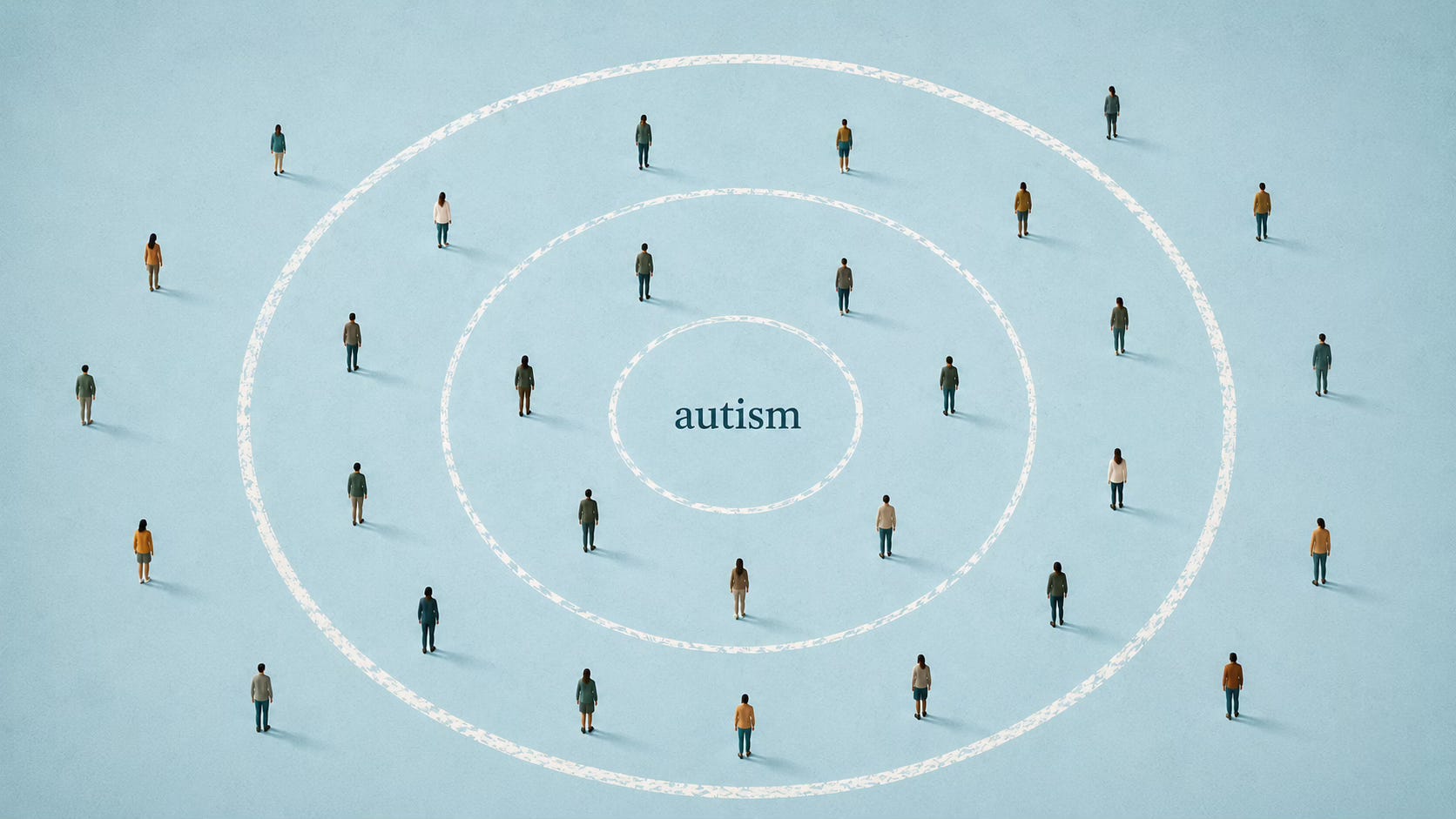
This article discusses the changes to the construct of ‘Autism’ - sometimes described as ‘Autism Spectrum Conditions’ - that occurred in 2013. It explores how the DSM-5 fundamentally altered the autism construct in ways that were not anticipated in the original field testing, and were subsequently interpreted through a particular explanatory lens.
In trying to answer the question that first brought me to Substack—How did everything become neurodevelopmental?—I found myself returning to the DSM-5.
Diagnostic criteria are more than lists of symptoms. They define the population that clinicians diagnose, researchers investigate, prevalence studies describe, and genetic or brain imaging analyses attempt to explain. They also shape how people come to understand their own experience. When those criteria change substantially, an important scientific question follows: has the underlying condition remained constant, or has the composition of the diagnosed population also changed?
Construct change
In 2013, DSM-5 introduced one of the most substantial revisions in the history of autism diagnosis, a new diagnostic construct known as Autism Spectrum Disorder (ASD).
ASD was created by integrating a number of conditions, including Autistic Disorder and Asperger Syndrome.
Within the Autistic Disorder diagnosis, developmental delay, issues with language production, learning disabilities and intellectual impairment had been associated with the condition, along with social and communication concerns and restricted behaviours. Autistic Disorder had, for the preceding 3 decades, been defined by onset beginning before the age of 3.
Asperger Syndrome, introduced in 1994 in the DSM-4, did not specify an age before which diagnosis could occur. Although considered a developmental disorder, it was possible for Asperger’s to be diagnosed in adulthood, and DSM-4 criteria included guidelines for adult ascertainment. Individuals with Asperger syndrome were often verbally fluent, with average to high intelligence, and some psychological comorbidity, along with social difficulties including not being able to read verbal cues, and difficulties in reciprocal conversation.
Changes in the DSM-5 included the following:
A: Age of Onset
Combining different diagnostic constructs into a spectrum presented a challenge regarding how age of onset would be considered. The DSM-5 Work Group described Criterion C, which suggested symptoms should begin in childhood, but may arise when social demand exceeded capacity, as recognition that a neurodevelopmental disorder may manifest only as children’s social environments become more complex (Coudry et al, 2014).
Criterion C fundamentally altered the logic of autism diagnosis. By explicitly allowing autism to be recognised “later in development” (rather than, for instance, ‘during adolescence’) it created the possibility of retrospective diagnosis across the lifespan.
B: Changes in symptom profiles
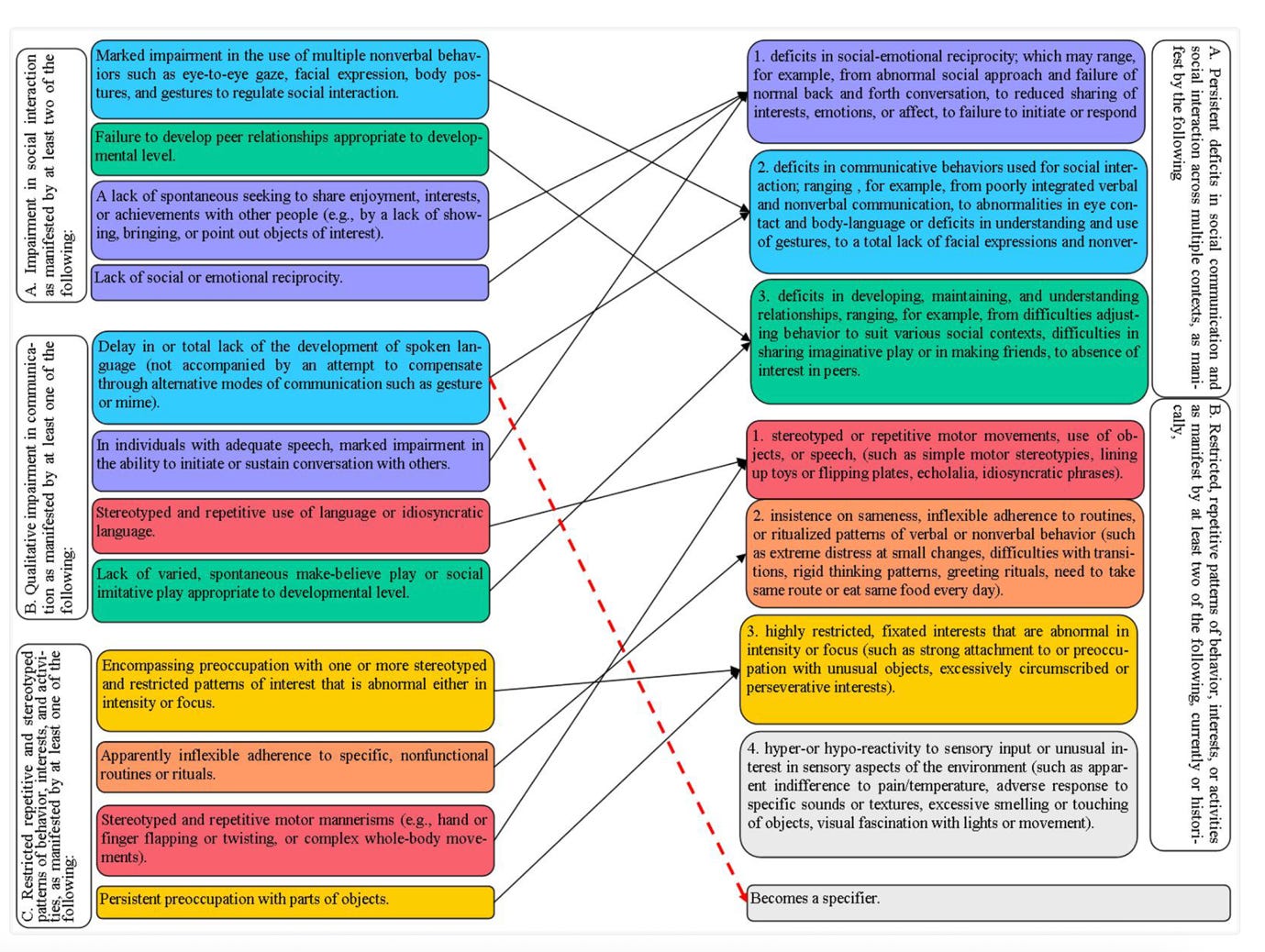
Significant changes occurred in the symptom profile, which moved from 3 domains and 7 symptoms, to 2 domains and 5 symptoms.
Perhaps the most consequential change was the removal of the Communication Axis, which until 2013 had captured language delay or language production issues, and the distinctive communication difficulties that were specific to Autistic Disorder or Asperger Syndrome (for example echolalia, issues with prosody or pedantic speech).
This detail, which anchored some of the developmental issues experienced those with Autistic Disorder, was removed.
In its place, a re-worked Criterion A provided a far broader conceptualisation of social and communication difficulties - including difficulties getting along with your peers, engaging in reciprocal conversation, and the capacity to share emotions or interests.
As Awais Aftab later observed in “Autism’s Confusing Cousin’s”, this re-conceptualisation increasingly overlapped with features common to many other psychiatric conditions.
Sensory sensitivities were introduced for the first time, located within Criteron B, along with remnants of the former communication axis, regulatory behaviour, and restricted interests. Regulatory behaviour was no longer confined to the stereotyped movements seen in Autistic Disorder, and now included behaviours common across the general population (hair twirling, foot tapping).
The table below (from Coudry et al 2014 “Treating the whole person with autism: the proceedings of the Autism Speaks National Autism Conference”) provides a visual description of the changes between the DSM-4-TR and the DSM-5.
C: Masking
Criterion C introduced the possibility that although symptoms must be present in early childhood, they may not emerge until social demands exceeded capacity, or may have been masked by learned strategies. As discussed elsewhere, masking was not previously part of the Autism diagnostic criteria, and the construct had not been defined or operationalised prior to its introduction.
D. Dimensional Framing
The move to dimensional framing was based on the idea that Autistic traits reflected a single underlying condition varying only in degree.
F. Co-Occurrence with ADHD
DSM-5 simultaneously broadened ADHD criteria such that retrospective adult diagnosis of that condition was also possible. Concurrent diagnosis was now permitted between the two conditions, creating a substantially different clinical landscape from earlier diagnostic systems.
The proposed DSM-5 criteria for ASD were operationalised during field testing using childhood onset before 36 months and did not evaluate the later-life application of Criterion C, including masking (McPartland et al, 2012)
The DSM-5 provided little guidance regarding how clinicians should apply the three social communication domains in practice, leaving room for different clinicians to apply different thresholds when deciding whether someone met the criteria (Frances, 2013). Kamp-Becker (2024) argued that the ICD-11 broadened this flexibility even further, with more than 300 different combinations of social communication and restricted behaviour features potentially meeting criteria for Autism Spectrum Disorder. She suggested that such flexibility would increase diagnostic heterogeneity and make autism more difficult to distinguish from other psychiatric conditions.
The wording of the DSM, the operationalisation used during validation, and the subsequent clinical interpretation of the criteria should not be assumed to be identical, particularly as constructs such as masking were not defined until several years after publication of the new ASD criteria, and remain contested. The criteria may thus be interpreted differently by different clinicians, and that interpretation may be evolving over time.
Construct Migration
A consequence of collapsing different presentations into a single spectrum was construct migration: findings from Autistic Disorder increasingly came to be generalised to today’s much broader ASD construct.
For instance, prevalence data evaluating changes in the male to female rate of diagnosis (MFR) over time compare Autistic Disorder with ASD.
Likewise, findings from the Female Protective Effect (FPE) literature are now discussed in relation to later-diagnosed girls and women (Lai et al, 2015). However, the FPE research tells us nothing about women diagnosed later in life with average to high intelligence.
Evidence that a higher mutational burden may be required for a girl to develop austim was derived from a specific subgroup. Although the oft-cited seminal study included almost 15,000 children, the critical analysis was based on just 324 children with classic DSM-IV Autistic Disorder and co-occurring intellectual disability (Jaquemont et al, 2014). Other influential studies supporting the FPE also focussed upon this subgroup.
This distinction is important: evidence that arose within one diagnostic group does not automatically generalise to another, particularly if the diagnosed population has changed.
Retrospective diagnosis
Criterion C enabled a fundamental shift in diagnostic reasoning. Rather than relying primarily on prospectively observed developmental differences, clinicians were increasingly asked to infer the presence of an underlying neurodevelopmental condition from an adult’s developmental history, current presentation and retrospective interpretation of earlier life experiences.
When DSM-5 was introduced, clinicians considered how autism might become apparent as social demands increased during later childhood or adolescence (Coury et al., 2014). In practice however, Criterion C opened the possibility of retrospective diagnosis across the lifespan.
Autism could therefore be diagnosed in adulthood - even in the absence of documented neurodevelopmental concerns ocuring during childhood or adolescence - if those earlier difficulties were considered to have been masked, unrecognised or obscured by co-occurring mental health conditions.
In effect, evidence that had previously argued against a childhood diagnosis no longer necessarily argued against an adult diagnosis.
The architecture of autism had changed.
An Evolving Autism Construct
The DSM-5 criteria have remained unchanged since 2013. However, the practical interpretation of those criteria should not be assumed to have remained static. The wording of the published criteria, the operationalisation used during field testing and validation, and their subsequent application in clinical practice may differ substantially.
Following publication, the criteria entered a broader social context in which clinicians, researchers, advocacy organisations and an established online autism community continued to interpret, elaborate and apply their meaning. Through this process of social transmission, concepts such as masking, the female autism phenotype and retrospective recognition became increasingly associated with the ASD construct, influencing both clinical practice and self-identification.
The criteria may therefore be interpreted differently by different clinicians, and that interpretation may itself continue to evolve over time, particularly within the later-diagnosed population.
Implications
The implications of DSM-5 for autism research were recognised from the outset. McPartland, Volkmar and Reichow (2012), who undertook specificity analysis for the new criteria write:-
“The proposed DSM-5 criteria will significantly alter the composition of individuals meeting criteria for an ASD.“
They cautioned that interpretation of the extensive DSM-IV literature would therefore become more complicated.
“Significant changes in the type of individuals meeting or failing to meet criteria render comparisons of current or historical samples with DSM-5-based samples unreliable.”
The specificity analysis predicted that only 75% of those with Autistic Disorder and 25% with Asperger disorder would meet criteria for the new ASD construct, and only 46% of people with an IQ greater than 70 would be included (McPartland, 2012). In the 13 years since that time, clinical practice appears to have produced a spectrum of autism that is markedly different from what had been predicted. Later diagnoses increasingly included verbally fluent, cognitively able individuals, many of whom were recognised during late adolescence or adulthood, frequently following previous psychiatric diagnoses.
At the time of the DSM-5 revision, King and colleagues (2013) explicitly cautioned that altering diagnostic criteria that had remained largely stable for nearly two decades would require ongoing empirical evaluation. They noted that changes of this magnitude were likely to affect prevalence estimates, case composition, and downstream service systems, and therefore warranted systematic post hoc assessment. What is evident in the subsequent literature however, is that one explanatory narrative has been favoured: that ASD criteria allowed increased recognition of the same underlying construct. This proposition was built into the merger, which had assumed that Autistic Disorder and Asperger Syndrome were the same condition operating at different levels of severity.
Earlier work by Tsai and Ghaziuddin (2013) had challenged that assumption. They argued that autistic disorder and Asperger’s represented qualitatively distinct clinical constructs rather than points along a single continuum, and warned that collapsing these categories into a unified Autism Spectrum Disorder risked compromising both epidemiological clarity and etiological research.
Tsai went further - predicting that Asperger’s would re-emerge.
What now?
One of the central explanations for increasing autism prevalence has been that improved diagnostic criteria are identifying individuals who would always have met criteria but were previously overlooked.
This is an empirical hypothesis rather than a settled fact.
An alternative hypothesis, recognised by McPartland et al. (2012), Tsai and Ghaziuddin (2013), and King (2013), is that changes to the diagnostic construct itself would alter the composition of the diagnosed population.
Distinguishing between these competing explanations has become increasingly feasible with recent genomic studies, yet findings are often interpreted within a continuity framework - that autism has always been broadly heterogeneous - rather than explicitly evaluating whether construct change may also account for the observed patterns.
These two hypotheses generate specific predictions.
Hypothesis 1: Better recognition of the same underlying condition
If the increase largely reflects recognition of people who were always autistic under essentially the same construct, then we might predict:
similar underlying genetic architecture across cohorts diagnosed in different eras;
similar developmental trajectories, once ascertainment is accounted for;
later-diagnosed individuals representing previously overlooked members of the same biological population.
Hypothesis 2: Construct change
If DSM-5 altered the construct and expanded its boundaries, then we might predict:
systematic changes in the genetic composition of diagnosed cohorts over time;
declining enrichment for autism-specific genetic signals in later cohorts;
increasing overlap with ADHD, anxiety, depression or other psychiatric liabilities;
changing phenotypic structure of diagnosed populations.
From an epidemiological perspective, the changes in the construct of ‘autism’ complicate a straightforward comparison of prevalence trends: rising diagnosis rates can reflect better recognition of people who would previously have been missed, changes in who now meets the diagnostic criteria, or both.
From the perspective of philosophy of science, competing explanations should remain open to empirical evaluation, particularly when they generate different predictions that can now be evaluated using datasets that were not available at the time these deliberations took place.
_________________________________
Coury DL, Swedo SE, Thurm AE, Miller DT, Veenstra-VanderWeele JM, Carbone PS, Lounds Taylor J. (2014) Treating the whole person with autism: the proceedings of the Autism Speaks National Autism Conference. Curr Probl Pediatr Adolesc Health Care. Feb;44(2):26-47.
Frances AJ. (2013) Two Fatal Technical Flaws In The DSM 5 Definition Of Autism. Psychology Today. May 25.
Jacquemont S, Coe BP, Hersch M, Duyzend MH, Krumm N, Bergmann S, Beckmann JS, Rosenfeld JA, Eichler EE. (2014) A higher mutational burden in females supports a “female protective model” in neurodevelopmental disorders. Am J Hum Genet. Mar 6;94(3):415-25.
Kamp-Becker I (2024) Autism spectrum disorder in ICD-11-a critical reflection of its possible impact on clinical practice and research. Mol Psychiatry. Mar;29(3):633-638.
King BH, Veenstra-Vanderweele J, Lord C. (2013) DSM-5 and autism: kicking the tires and making the grade. J Am Acad Child Adolesc Psychiatry; 52:454–457.
Lai MC, Lombardo MV, Auyeung B, Chakrabarti B, Baron-Cohen S. (2015) Sex/gender differences and autism: setting the scene for future research J Am Acad Child Adolesc Psychiatry. Jan;54(1):11-24.
McPartland JC, Reichow B, Volkmar FR. (2012) Sensitivity and specificity of proposed DSM-5 diagnostic criteria for autism spectrum disorder. J Am Acad Child Adolesc Psychiatry. Apr;51(4):368-83.
Tsai LY, Ghaziuddin M. DSM-5 (2013) ASD moves forward into the past. J Autism Dev Disord. doi: 10.1007/s10803-013-1870-3.
Tsai LY. Asperger’s disorder will be back. (2013) J Autism Dev Disord. 2013 doi: 10.1007/s10803-013-1839-2.
No posts
Comments
Nothing yet. Say the first thing.
Sign in to join the conversation.