
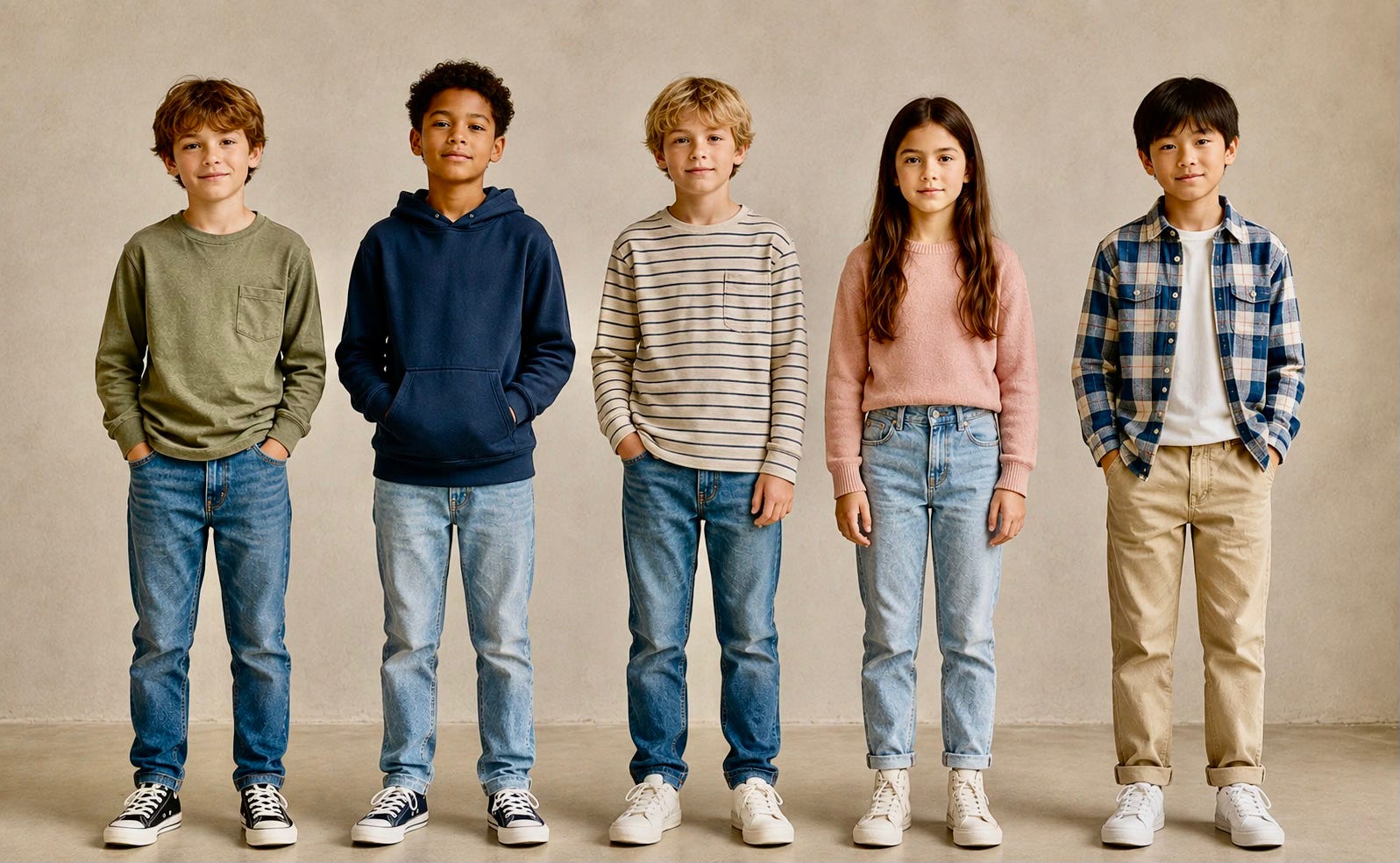
“Historically, autism research focused predominantly on males.”
This statement has become ubiquitous in discussions of autism, particularly in research that focuses on girls and women. However the claim is problematic because this is not what the historical evidence establishes.
That evidence indicates only that early autism research contained predominantly male participants.
It does not necessarily follow from the composition of those diagnosed with autism that the research “focused predominantly on males”, with the corresponding assumption that females were not included or were neglected.
This is a critical distinction.
Until the introduction of Asperger Syndrome in 1994, children diagnosed with Autistic Disorder were predominantly boys. Today, children diagnosed with ASD in early childhood remain predominantly boys, at a ratio of approximately 3.5:1.
Importantly, the girls diagnosed in this early group tend to have a similar genetic presentation to the boys (Zhang et al., 2025). A systematic review found no significant sex differences between autistic boys and girls below age six. In fact, at this age there appear to be significantly more similarities than differences (Gundeslioglu et al., 2026). Later on however, some differences begin to emerge - particularly for those diagnosed later in adolescence or adulthood, something I have discussed previously and will return to shortly.
So if the clinical population of young children diagnosed with autism contained approximately four boys for every girl - an observation largely consistent across decades and diagnostic classifications - research samples containing substantially more boys are not, in themselves, evidence that researchers neglected girls.
A more straightforward statement is: autism research largely reflected the diagnosed population.
We know some conditions occur more frequently in one sex than the other, so where is the justification in assuming that asymmetric autism diagnosis is a matter of a gender-equity failure? That girls were systematically excluded from research?
Where is the justification for turning male preponderance into male bias?
There is another problem with continuing to assume an historical absence of females in the research. For over a decade, autism research has been intensely interested in girls and women. Extensive literature now exists specifically examining female presentation, female experience, diagnostic bias, female socialisation, masking, camouflaging, restricted interests, internalising symptoms, late diagnosis and the proposed female autism phenotype.
From what we know now, it is no longer credible to suggest autism research simply neglected females. Multiple studies and meta-analytic evidence find little support for current or previous autism diagnostic criteria or assessment instruments being systematically biased against females (Stroth et al. 2022; Kaat et al., 2021).
The girls were always there. There were simply fewer of them.
So why do researchers and influencers keep repeating the phrase?
I think it’s because “focused on boys” is doing a lot of rhetorical work. It does more than describe history. It invites the reader toward a moral interpretation: Why were researchers focusing on boys? What happened to the girls?
And from there, a chain of propositions becomes remarkably easy to accept:
Research samples contained predominantly boys
becomes
Research focused predominantly on boys.
Which becomes
Autism research was biased toward boys.
Which becomes
Autism was defined according to a male phenotype.
Which becomes
Girls were systematically underdiagnosed.
Each proposition may be testable. Some may turn out to be true. But none is established simply because the one above it is true.
And this is how an inference morphs into a ‘fact’.
Much of what is presented as established knowledge in contemporary autism research rests on an inference added to an observation. The observation may be sound. The inference might be plausible. But it still requires evidence. This is particularly the case when most studies are cross sectional.
Inference is unavoidable in science. The problem arises when we stop recognising that we are making one.
When observation and interpretation are habitually presented together, we eventually stop noticing where the evidence ends and the explanation begins.
Perhaps it is time to stop repeating the historical observation with a foregone conclusion attached to it - and start reassessing those inferences directly, one by one.
________________________________
Gundeslioglu, H., Gray, K.M., Hewitt, O.M. et al. Are There Sex or Gender Differences in Autistic Characteristics? An Umbrella Systematic Review. J Autism Dev Disord 2026
Kaat AJ, Shui AM, Ghods SS, Farmer CA, Esler AN, Thurm A, Georgiades S, Kanne SM, Lord C, Kim YS, Bishop SL. Sex differences in scores on standardized measures of autism symptoms: a multisite integrative data analysis. J Child Psychol Psychiatry. 2021 Jan;62(1):97-106
Stroth S, Tauscher J, Wolff N, Küpper C, Poustka L, Roepke S, Roessner V, Heider D, Kamp-Becker I. Phenotypic differences between female and male individuals with suspicion of autism spectrum disorder. Mol Autism. 2022 Mar 7;13(1)
Zhang, X., Grove, J., Gu, Y. et al. Polygenic and developmental profiles of autism differ by age at diagnosis. Nature 2025 646, 1146–1155.
No posts
Comments
Nothing yet. Say the first thing.
Sign in to join the conversation.