
Hey all, Jason here.
It’s hard to believe it is mid-August already (happy birthday, dad!) — though, with my reduced speaking/conference/travel schedule this year, I don’t have any set travel plans until October. Apart from the pandemic, surely the longest I’ve gone without being on an airplane, and, I have to say, I’m kind of enjoying it!
Subscribe or Support by Upgrading
Partner content: MoonPay’s unified fiat-to-crypto payments platform is trusted by over 30 million people to move money between traditional payment rails and blockchains. So when MoonPay first rolled out AI enterprise-wide, it implemented browser-level controls to maintain security.
Their AI usage soon outgrew those controls.
Employees were connecting AI agents to internal systems through MCP, where they could send messages, edit documents, and change records, invisible to any browser tool. The Speakeasy AI Control Plane surfaced shadow AI and made every agentic action authenticated, auditable, and security-compliant. After just a 30-day proof of concept, Speakeasy now governs MoonPay’s 200+ internal MCP servers and has secured 60,000+ agent sessions across the company.
Read how MoonPay governs its AI
A minor programming note: I’m testing moving this section to the start of the newsletter. It historically has been at the end, but now that there is consistently a paywalled portion of each week’s newsletter, I’ve moved it here, so both paid and non-paying subscribers can benefit from an overview of other important and interesting news items I haven’t had time to cover in a given week.
Revised Procedures for Processing Federal Deposit Insurance Applications (FDIC)
FinCEN Permanently Ends Beneficial Ownership Reporting Requirements for Millions of Small Business Owners (FinCEN)
FTC Stops Sprawling Credit Repair Scheme that Scammed Consumers Out of Nearly $200 Million (FTC)
FTC Ditches ‘Disparate Impact’ (FTC)
Trump Family’s World Liberty Financial Gets Preliminary Approval to Launch a Bank (Wall Street Journal)
Trump Crypto Took $100 Million From a Businessman With Red Flags (New York Times)
Start-up bank backed by Palmer Luckey set to raise $1.5bn (FT)
Revolut Secures French Banking License to Expand European Operations (Wall Street Journal)
White House renews its attempt to remove Fed Governor Lisa Cook (CNN)
The West’s Demographic Math No Longer Adds Up (Politico Magazine)
A Deep Dive into OG Bank Swag (Fintech Takes Banking)
Voluntary, Non-Binding, and Full of (Contradictory) Promises (Fintech Takes)
Zaria Seeks Trust Bank Charter for Crypto-Backed Loans (PYMNTS)
Behind the buy: building Rain’s stored value layer with Ansa (Rain)
Knot and Venmo Team Up to Make Venmo the Effortless Way to Pay (Business Insider)
When Coastal Community Bank, a prominent bank partner to fintechs like Dave, OnePay, and Robinhood, announced its quarterly earnings at the end of July, it reveal a sharp swing, from posting $12 million of net income in the first quarter, to a loss of just over $42 million in the second.
The loss was driven by accounting charges Coastal recognized as of the end of the second quarter related to an unnamed lending partner.
Fintech Business Weekly has confirmed through multiple sources that the partner in question is LendingPoint, which offers unsecured personal loans from $1,000 to $36,500. LendingPoint’s loans range from 24 to 72 months, with APRs from 7.99% to 35.99%, serving primarily near-prime borrowers.
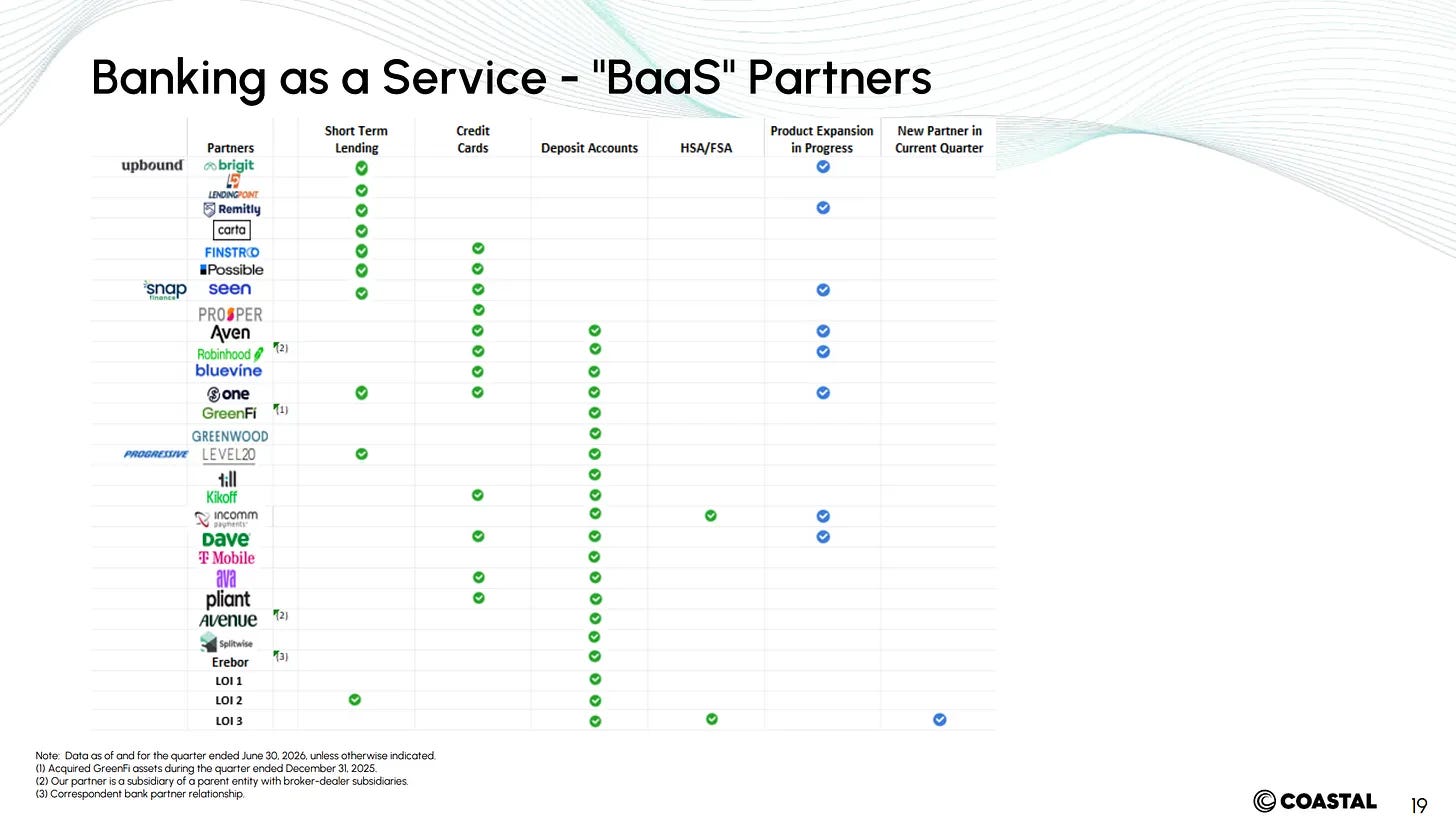
Coastal first announced its partnership with LendingPoint in December 2021. At that point, per the announcement, LendingPoint, which Coastal described as “the leading AI CreditTech platform designed to improve access to affordable credit for consumers and small businesses while reducing the risk and costs of lending,” had originated over $4.5 billion in loans. LendingPoint’s “predictive underwriting models and lower fraud rates” would allow Coastal to “provide a more inclusive experience and be able to offer a broader range of lending solutions for our customers,” Board Chair Chris Adams said at the time. Adams was elevated from non-executive to executive chair concurrently with the release of Q2’s disappointing financial performance. (Bloomberg also independently reported that LendingPoint was behind Coastal’s earnings miss here.)
In addition to partnering with Coastal, LendingPoint also works with FinWise, another popular partner bank, as well as originating loans under its own licenses in certain states. LendingPoint previously partnered with Midland States Bank, though Midland wound down that relationship, ultimately selling $87.1 million of LendingPoint-originated loans in December 2024, realizing net charge offs and provisions for credit losses of $17.3 million on the sale, equating to nearly ~20% of the face value of the outstanding receivables.
Coastal’s $42.1 million loss in Q2 “is primarily attributable to a $68.8 million credit expense related to a single, isolated CCBX partner relationship,” according to the company’s earnings release. The expense is comprised of a $46 million valuation adjustment to a credit enhancement asset and a $22.8 million provision for credit losses, which, the release said, are “not expected to be fully collected under its indemnification arrangement.” As a point of comparison, Coastal’s net income for 2023, 2024, and 2025 ranged between $44.5 million and $47 million each year.
Coastal’s CEO Eric Sprink added context, commenting in the earnings release, “Based on our assessment, we recorded the potential impact fully and in accordance with our credit protection framework. We believe this is an isolated issue pertaining to one partner and does not reflect a change in our view of our broader partner portfolio or BaaS model.”
Sprink further clarified on the company’s earnings call, saying, “The partner remains responsible for losses covered by the indemnification, and recording a valuation adjustment does not change or waive those rights. It reflects our current assessment and provisioning based on the facts available at quarter end. What changed is our assessment, which prompted us to recognize the economic losses today.”
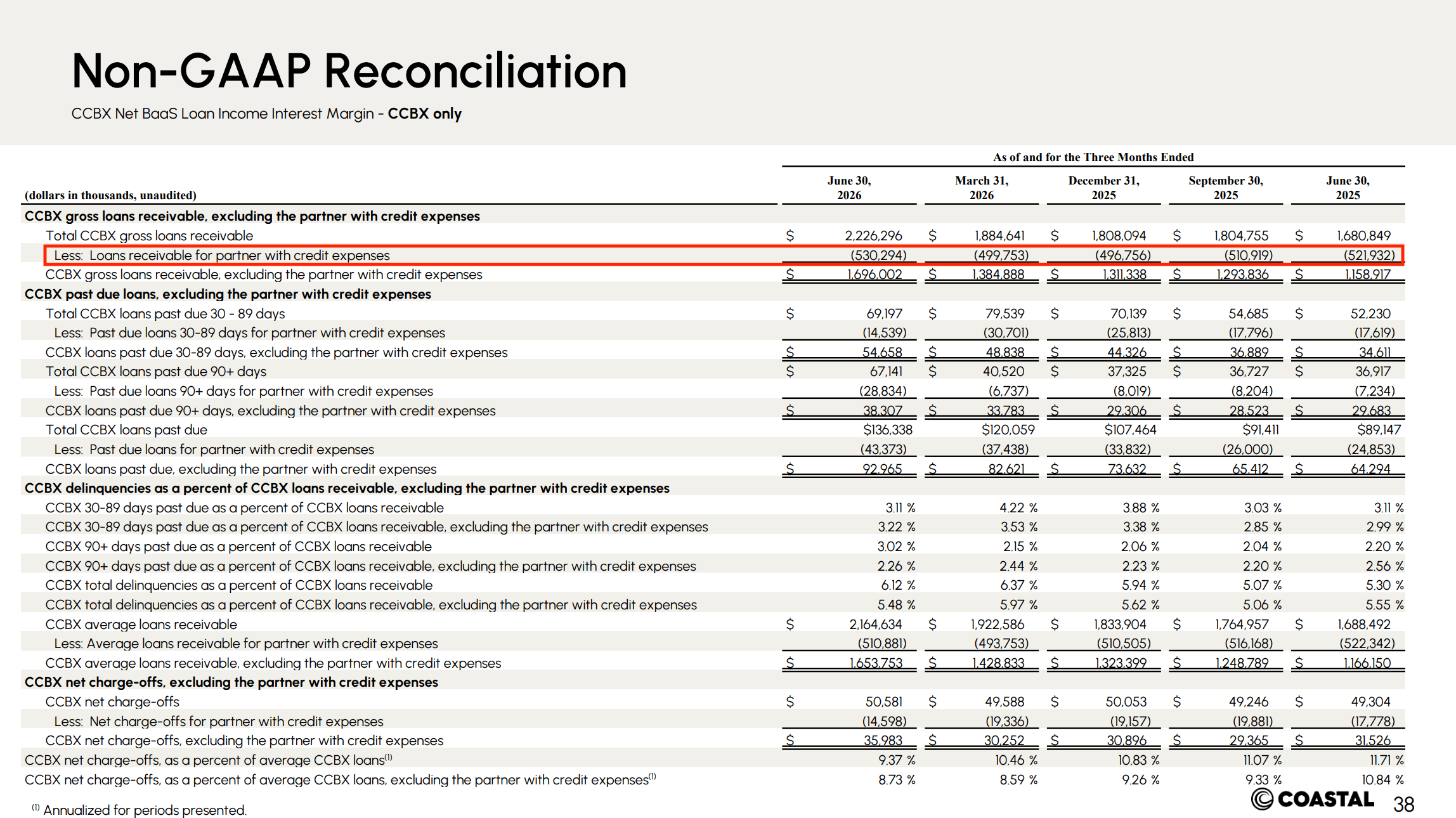
The $68.6 million credit expense is tied to a pool of about $530 million in outstanding loans, according to Coastal’s Q2 earnings presentation.
With a total of $1.68 billion of consumer loans outstanding in its partner banking business unit, which Coastal refers to as CCBX, that $530 million book — which Fintech Business Weekly confirmed was originated by LendingPoint — represents approximately 31.5% of CCBX’s consumer loan book, or 23.8% of its overall CCBX book of about $2.23 billion.
While many banks that partner with fintech lenders opt to hold no or minimal exposure to partner-originated loans on their balance sheet, working with their partner to sell or securitize such loans, Coastal does hold such loans on its own balance sheet. Coastal’s agreements with lending partners theoretically mitigate this risk by having the lenders indemnify Coastal for fraud and credit losses and holding a cash reserve at the bank.
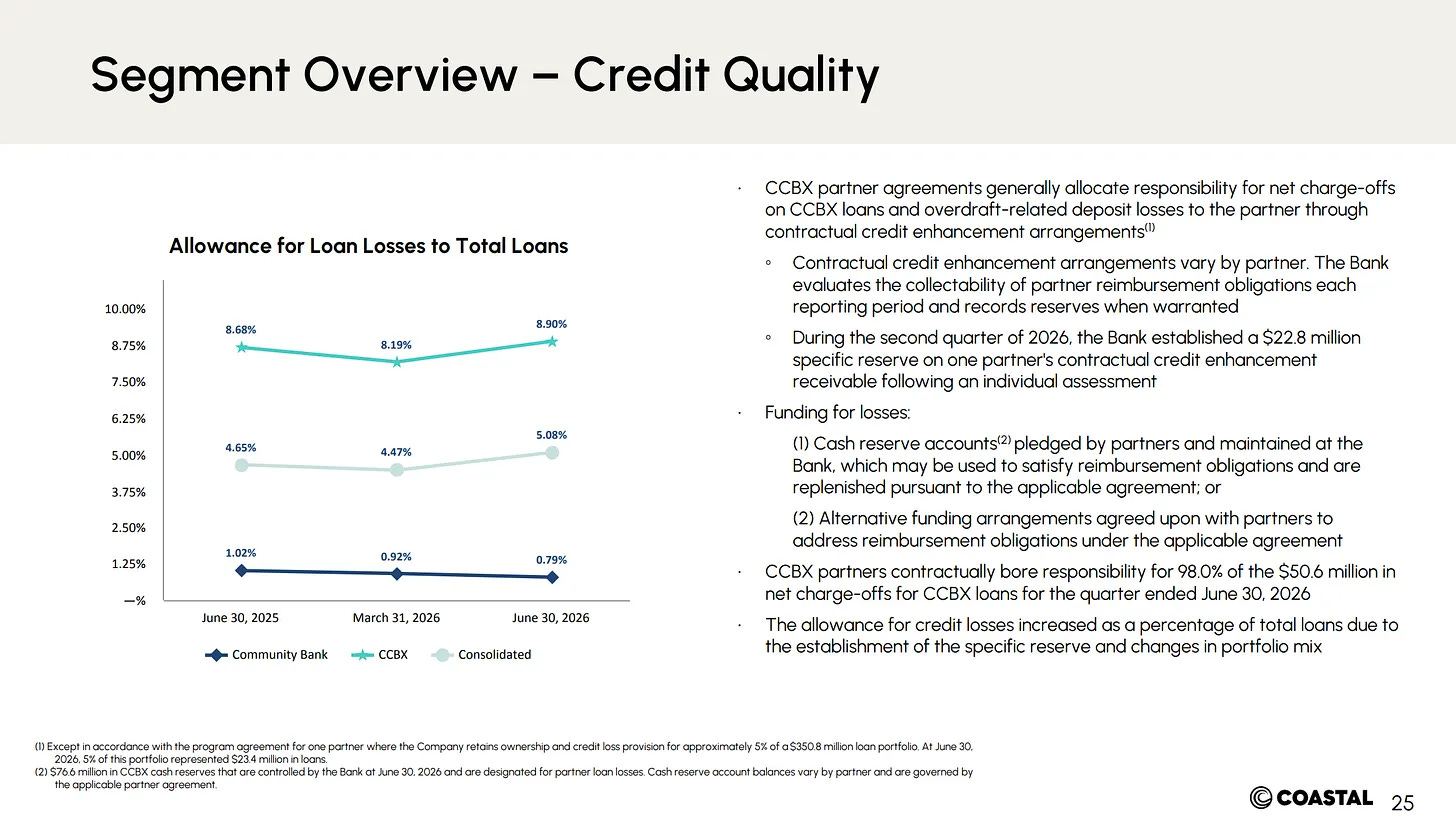
In this operating model, Coastal records a provision for losses (liability) on its balance sheet and a corresponding credit enhancement (asset), representing the value of the indemnification.
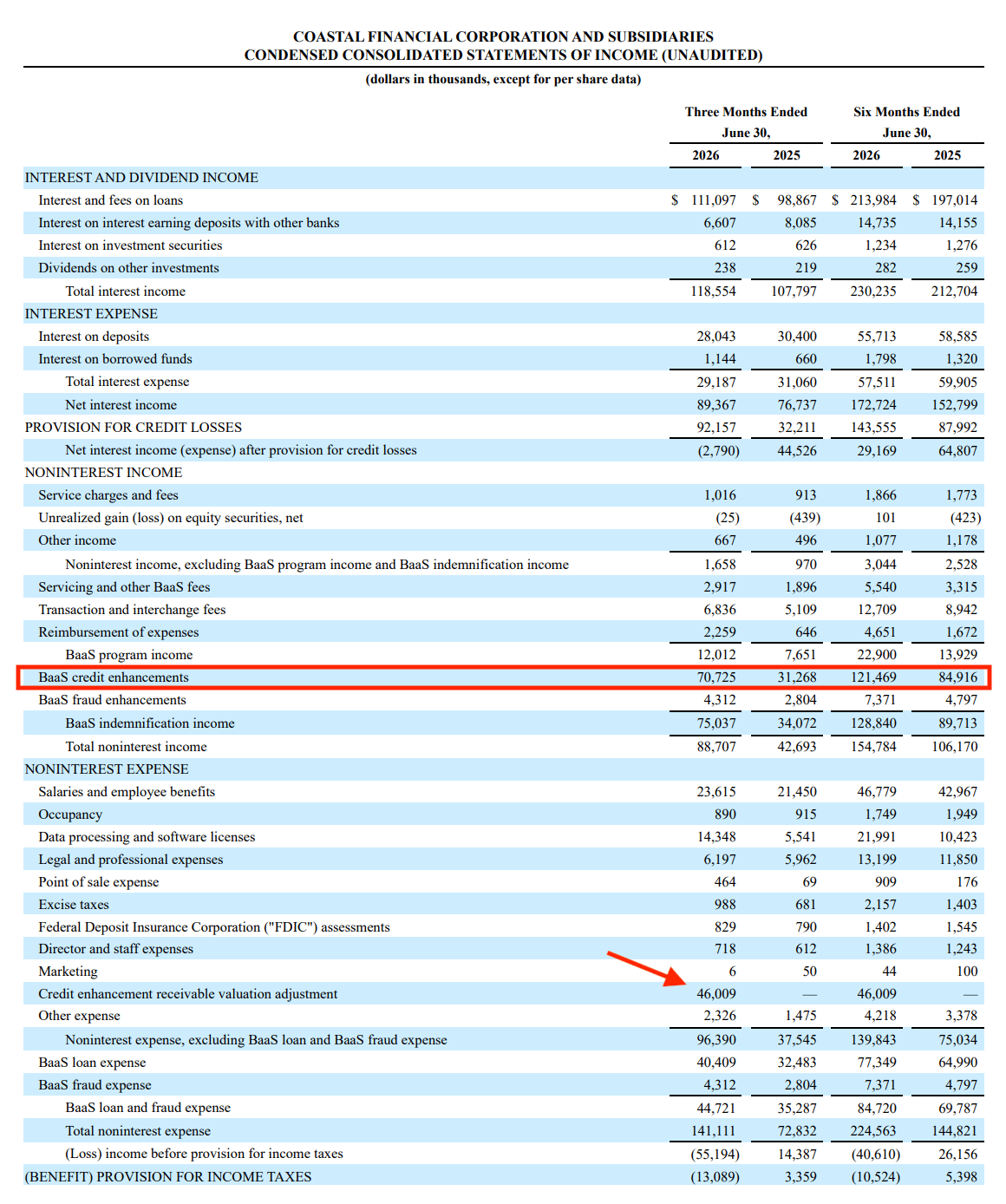
Coastal’s 10-Q explains this structure by saying, “Agreements with our CCBX partners provide a credit enhancement under which the partner indemnifies or reimburses the Bank for covered credit losses on loans, unfunded commitments and negative deposit accounts. In accordance with U.S. GAAP, we estimate expected credit losses on these exposures and record the related provision for credit losses and reserve for unfunded commitments. Concurrently, a credit enhancement asset is recognized through noninterest income (BaaS credit enhancements) representing the expected reimbursement from the partner.”
But, such indemnification agreements implicitly come with counterparty risk, as they’re contingent on a given partner having the financial strength to fulfill them.
It appears that, as of the end of the second quarter, Coastal assessed that LendingPoint wouldn’t be able to fulfill its indemnification obligations, suggesting the financial condition of that unnamed partner — LendingPoint — has materially deteriorated.
Fintech Business Weekly is made possible by the generous support of paying subscribers — bringing you independent analysis of banking, fintech, and crypto without fear or favor.
You can support my work by becoming a paying subscriber if you aren’t already. Paying subscribers enjoy:
access to the entire archive of nearly six years of newsletters
extended versions of the weekly newsletter, with additional content and analysis
and (for founding member tier) quarterly personal 1:1 fintech Q&A / strategy calls with me, tapping into my unparalleled knowledge of the intersection of banking and fintech and experience working in the sector, including helping to launch Goldman Sachs’ retail bank Marcus
Support Fintech Business Weekly
You can also support Fintech Business Weekly by sponsoring a newsletter or podcast, putting you in front of 93,000+ of the most influential decision makers in banking, fintech, and crypto. Learn more about sponsor opportunities or request a media kit by dropping me an email.
The situation with LendingPoint appears to have been brewing for some time.
LendingPoint was on the verge of failure when it took a $125 million preferred equity investment from Warburg Pincus, announced in January 2021, according to sources familiar with the situation. Warburg gained a seat on the board in the investment and ultimately took majority control of LendingPoint.
LendingPoint’s Q3 2023 “system conversion” Midland States Bank blamed for “significant credit deterioration and servicing-related deficiencies” was a “disaster,” one person with knowledge of the transition said. LendingPoint moved to a home-grown system for loan origination and servicing, but the new system wasn’t fit for purpose, resulting in LendingPoint being unable to process loan repayments or send statements for a couple weeks, the person said.
Borrowers’ inability to make payments helps explain the “servicing-related deficiencies” that Midland blamed for the “significant credit deterioration” it saw in its LendingPoint-originated portfolio.
In addition to the credit losses, Midland was unable to file its Q1 2025 in a timely manner and had to restate prior earnings filings owing to its accounting treatment of partner-originated loans.
Midland explained in a May 2025 SEC filing, saying (spacing adjusted and emphasis added):
The errors relate to the Company’s accounting for loans originated pursuant to third-party loan origination programs. These programs go back as far as 2012. As part of these programs, the third-party provider offered various credit enhancements with respect to loans originated under the programs, including contributions to reserve accounts, yield maintenance and certain other payments.
Historically, the Company accounted for all borrower payments and credit enhancement payments under these programs on a single unit or net basis, with all such payments presented as interest income representing the Company’s effective yield on the portfolios.
The Company has determined that these payments should instead be accounted for on a separate unit of account or gross basis, with loan yields and interest income recorded at the gross borrower loan rate, and credit losses and associated provisions for credit losses recorded on a gross basis over the life of the loans, and with all credit enhancement payments recorded separately as a credit indemnification derivative.
The recording of the provision for loan losses and corresponding corresponding credit indemnification asset, which is not the approach Midland had originally taken, is comparable to the accounting treatment Coastal describes in its 10-Q and earnings presentation.
Shortly after LendingPoint’s botched system conversion, cofounder Tom Burnside stepped down as CEO. Then-chief business and legal affairs officer Mark Lorimer replace him as interim CEO until August 2024, when Shawn Stone was appointed as CEO. Stone last only a year in the role, leaving in August 2025, replaced on an interim and then permanent basis by Mark Freeman, who had previously served as LendingPoint’s CFO. Freeman presently serves as LendingPoint’s CEO. The executive churn, unsurprisingly, hasn’t been limited to the CEO role, with turnover in the CFO, CRO, CTO, and general counsel roles as well.
In addition to the system conversion and C-suite drama, LendingPoint’s loans haven’t performed as expected.
In May 2025, Kroll Bond Rating Agency (KBRA) affirmed prior ratings on nine classes of notes back by LendingPoint loans, but downgraded its ratings on five classes of notes. KBRA wrote at the time:
Five of the nine affirmations reflect credit support that is adequate to support the outstanding ratings. Two of the affirmations were previously lowered to CCC (sf) as they are susceptible to loss over the remaining term of the transaction, and two were previously lowered to C (sf) as they continue to miss interest payments and remain at an increased risk of principal loss. The remaining five actions are downgrades, which are reflective of continued credit support erosion and the performance of the underlying collateral.
And, in May 2026, KBRA again downgraded ratings on six classes of LendingPoint-backed notes, noting that the ratings changes were “reflective of continued credit support erosion and the performance of the underlying collateral.”
LendingPoint doesn’t appear to have issued any agency-rated asset-backed securitizations since the downgrades on its 2022 and 2023 vintages.
Instead, in 2025, it turned to a forward flow arrangement, noting at the time that “[t]he loan flow program marks the first loan sales since LendingPoint revitalized their loan marketplace offerings with a new management team and credit tiers.” Such arrangements typically carry a higher cost of funds than rated ABS transactions.
LendingPoint’s inability to issue rated term asset-backed securitizations would likely make it more dependent on forward flow buyers, warehouse facilities, and the willingness of bank partners to hold loans on their balance sheets — as Coastal did for LendingPoint.
While LendingPoint’s own financial condition isn’t entirely clear, there are data points beyond Coastal’s action that suggest the company may be in distress.
LendingPoint has borrowed money from a public business development corporation, Midcap Financial Investment Corporation. According to Midcap’s SEC filings, it began treating that debt as impaired in its Q3 2025 quarterly earnings. As of the end of Q2 2026, Midcap valued one loan to LendingPoint LLC that has a cost basis of nearly $38.9 million at just $20.2 million, reflecting its expectation that it will not be repaid in full.
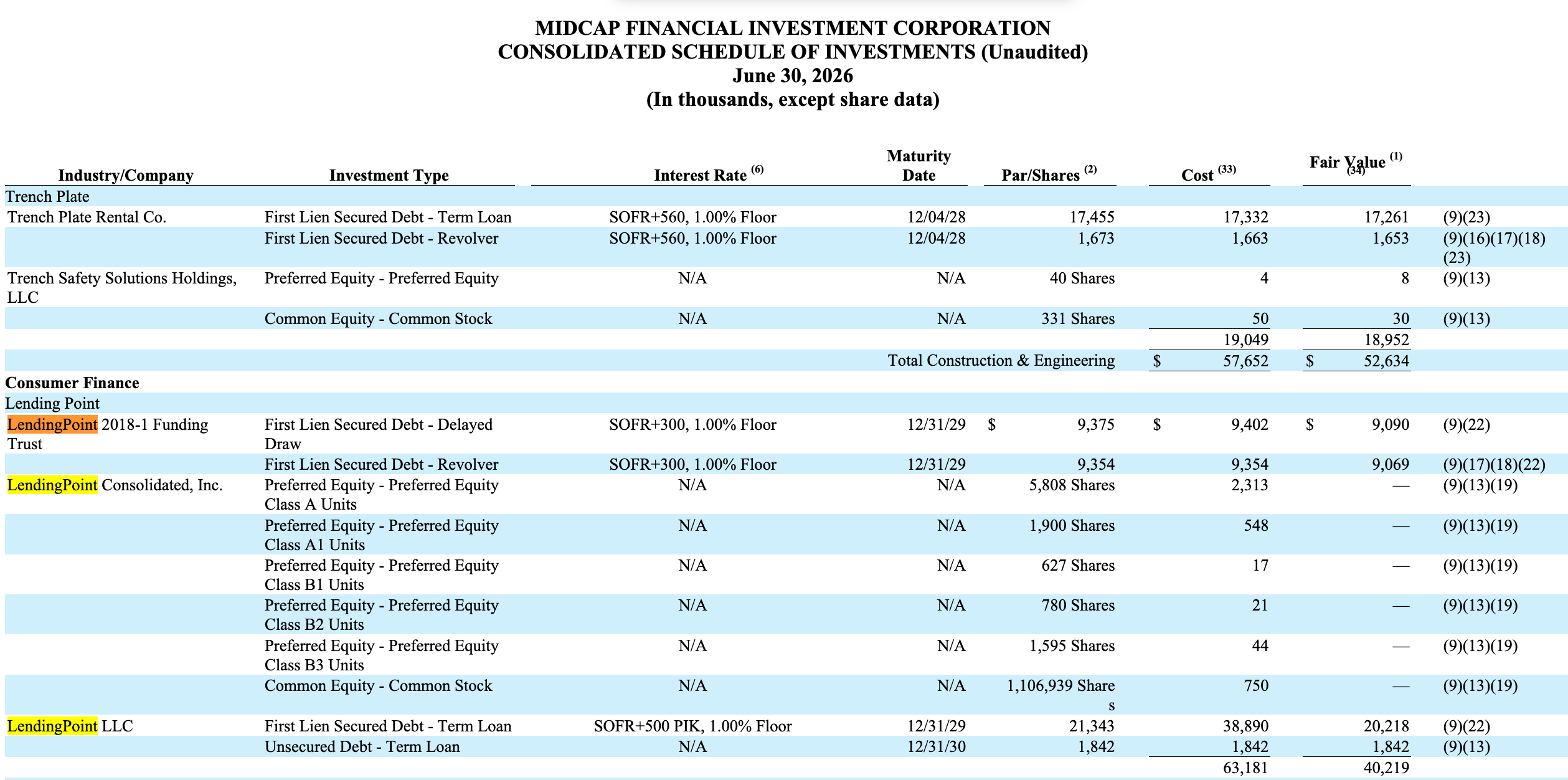
Equity in LendingPoint that Midcap assigned a combined fair value of approximately $2 million as of the end of 2025 appears to be marked to $0 in its most recent quarterly earnings.
Midcap recorded an almost $20 million write down on its overall exposure to LendingPoint in 2025 and a $3.3 million write down year to date in 2026, per its SEC filings.
Midcap’s write downs at the end of 2025, Q1 2026, and Q2 2026 are somewhat hard to reconcile with LendingPoint’s November 2025 announcement that it had raised a new round of capital financing, which, the company claimed at the time, would “position[] the company for significant expansion and market acceleration in 2026.”
That announcement didn’t name the investors, apart from specifying the round included “participation from current and new investors,” nor did it specify the amount of capital raised.
LendingPoint is hardly the first fintech program to cause headaches or financial losses for its bank partner.
Small business charge card and banking startup Parker’s recent bankruptcy, after a potential acquisition fell through at the last minute, left bank partner Patriot and debt provider Silicon Valley Bank feuding over some $21 million of outstanding card receivables.
When consumer budgeting and spending app Qube Money failed to secure a new bank partner, its existing bank partner at the time, Choice Bank, unilaterally emailed users, informing them their accounts would be closed.
Also-ran middleware provider Solid, plagued by allegations it misled its investors by faking its revenue numbers, it onboarded questionable programs, and it breached its fiduciary duties by facilitating fraud, ultimately filed for bankruptcy protection, causing headaches for bank partners Lewis & Clark and Evolve Bank & Trust.
And, of course, the Synapse mess, in which as much as $95 million of customer deposits remain unaccounted for, caused endless headaches and financial losses for its partner banks, with Evolve and Lineage most heavily impacted.
By comparison, Coastal’s LendingPoint situation appears to be relatively contained.
Yes, it took a $68.6 million charge, though, based on the bank’s statements, that appears to be the maximum potential loss, and, depending on the underlying credit performance and LendingPoint’s financial condition, there is a chance some or all of the expense is reversed in the future.
And according to Coastal’s earnings announcement, as of the end of Q2, taking into account the charge and its net loss for the quarter, it has a company common equity Tier 1 ratio of 10.86%, a Tier 1 leverage ratio of 9.11%, and a total risk-based capital ratio 13.30%, all of which are above the thresholds to be considered well capitalized.
Importantly, unlike in the Synapse, Solid, Qube, or Parker examples, there doesn’t appear to have been any negative end user implications. Even if LendingPoint were to fail, there is a backup servicer in place that should be capable of quickly taking over servicing the portfolio.
Coastal’s LendingPoint situation illustrates the often bespoke nature of bank-fintech partnerships, even when they may appear, on the surface, to be functionally similar.
Different operating models — in Coastal’s case, holding partner-originated loans on its balance sheet and relying on the partner to indemnify losses — carry distinct risks and different problems when things do go awry.
In Coastal’s case, it had concentration risk, in that more than 30% of its BaaS lending is tied to LendingPoint, and counterparty risk, in the form of LendingPoint’s seeming inability to be relied upon to meet its indemnification requirements.
Now, Coastal is facing a shareholder suit, after its stock price dropped more than 40% on news of its Q2 loss (as Matt Levine would say, everything is securities fraud!).
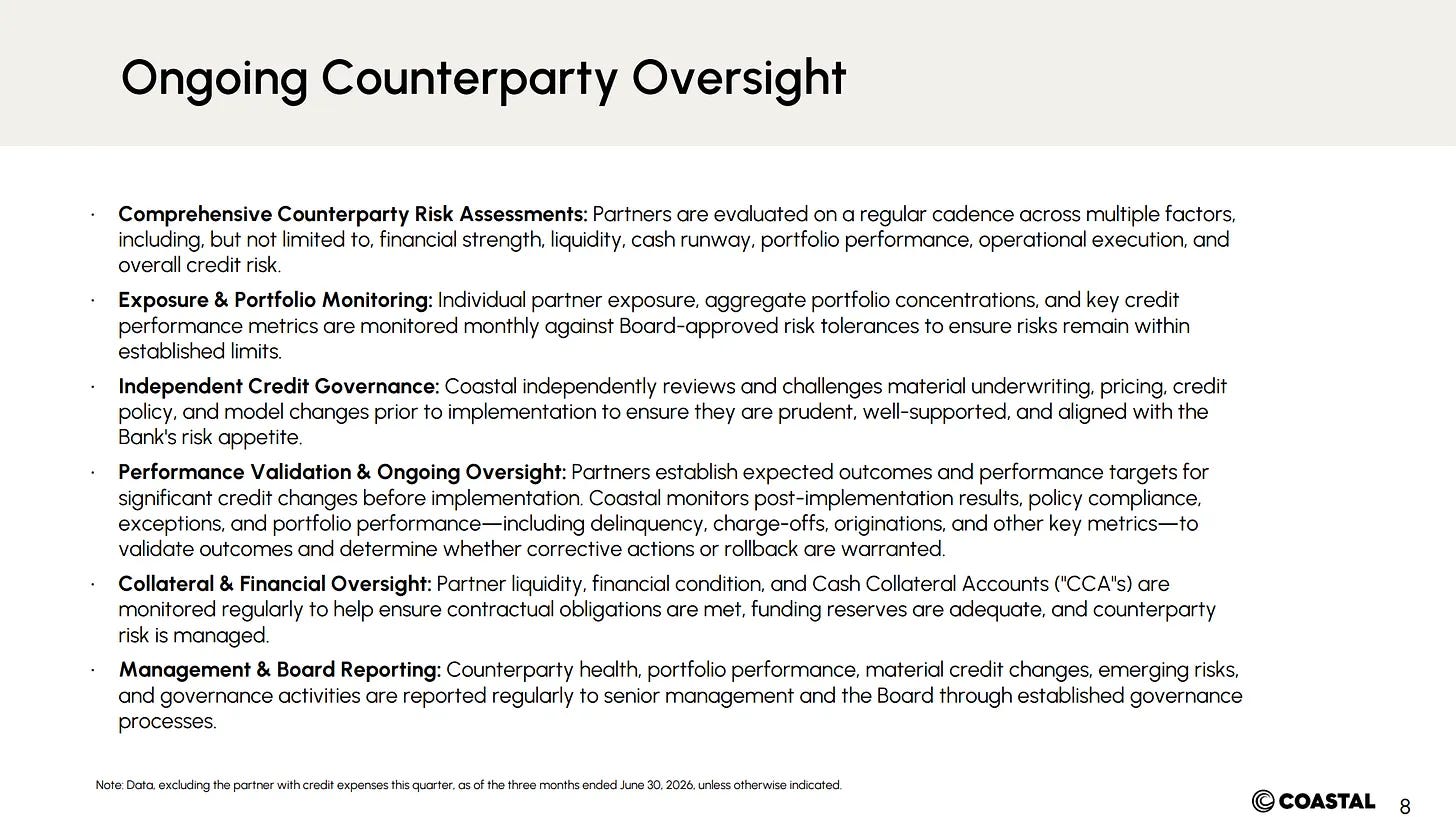
As part of its quarterly earnings presentation and call, Coastal explained that it thoroughly reviewed other CCBX partners and views this as a one-off situation. Coastal also reinforced that it conducts ongoing counterparty oversight, including of counterparty risk, credit governance, financial condition, and management and board reporting.
With the recently reported news that the FDIC is working with banking and fintech trade associations on a potential independent standard-setting organization, the Coastal-LendingPoint situation provides an interesting opportunity for a thought experiment: is this a scenario that standards should attempt to address? And if so, how?
As of yet, it is Coastal’s shareholders who are primarily bearing the losses; the company and bank remain well-capitalized and consumers don’t appear to have incurred any negative effects. While surely not a pleasant exercise for Coastal and its board, management, and employees, based on known facts, is this a scenario to be avoided, through more robust partner oversight and, potentially, an independent organization monitoring for adherence to certain standards?
Or, is it an example of current governance and guardrails working, more or less, as intended?
Representatives for Coastal Community Bank and for LendingPoint both declined to provide any official comment for publication.
The Office of the Comptroller of the Currency has rebuffed Dutch digital-only bank bunq’s third attempt to charter a de novo bank in the United States (my LinkedIn post on this last week got quite a bit of attention, so I’m expanding on it a bit here.)
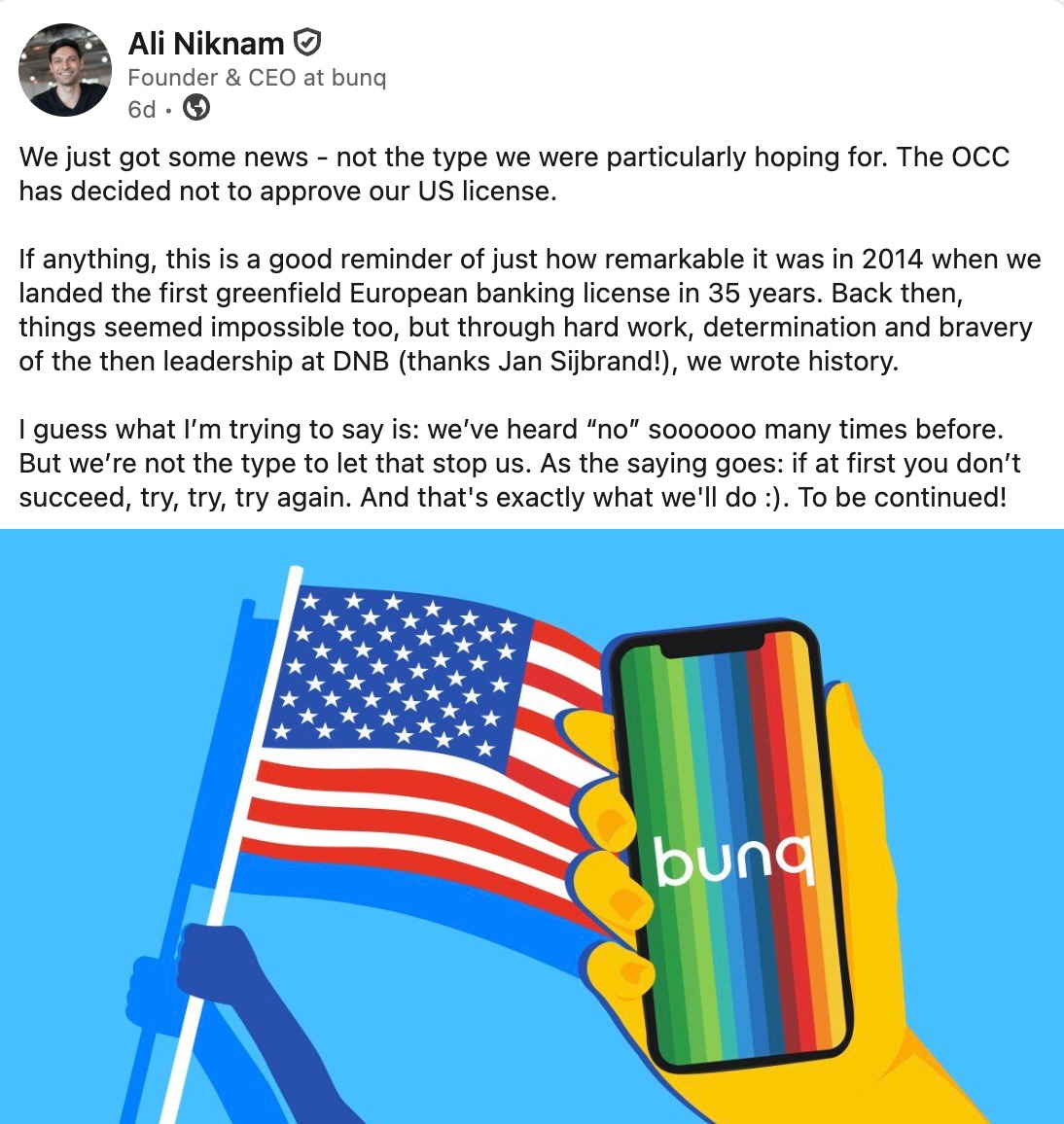
First, credit where it is due. Historically, the OCC has allowed charter applicants to “withdraw” their applications, rather than face the embarrassment of having them publicly denied.
Comptroller Jonathan Gould has expressed a goal of the OCC being more transparent and accountable, including in chartering, and he is making good on that.
While perhaps not a good look for the entity whose application is denied, this transparency offers other potential applicants the opportunity to better understand how the current OCC is evaluating charter applications.
Comments
Nothing yet. Say the first thing.
Sign in to join the conversation.