
Hey all, Jason here.
Big congrats to Cordant on emerging from stealth and announcing it has raised an $8 million seed round. I’m proud to have made an angel investment in the round, which was co-led by Oak HC/FT and Motive partners.
Cordant, founded by veterans of Rapyd, offers a “command center” for modern financial infrastructure: a single operational picture across all of your systems that money moves through. Congrats again to founding team Eric Rosenthal, Lior Levitt, Sagi Ittah and Juan Jose Huezo, I look forward to supporting you all on this journey!
Subscribe or Support by Upgrading
Partner content: 30+ new speakers just unlocked.
Founders and operators from Chime, Mercury, Figure, Gusto, Plaid, Navan, Valon, Alloy, OnePay, and more are joining us in San Diego.
We’re going deep on AI, banking, payments, lending, fraud, infrastructure and stablecoins. Join the people who built the thing, explaining what worked and what broke.
Bonus unlocked: Fintech Business Weekly readers save 20% with code FBW20.

Last week, the FTC ordered the cofounders of crypto service Celsius Network to pay a combined $16.1 million in penalties, stemming from the spectacular 2022 collapse of the company that operated as something between an unlicensed bank and an outright Ponzi scheme.
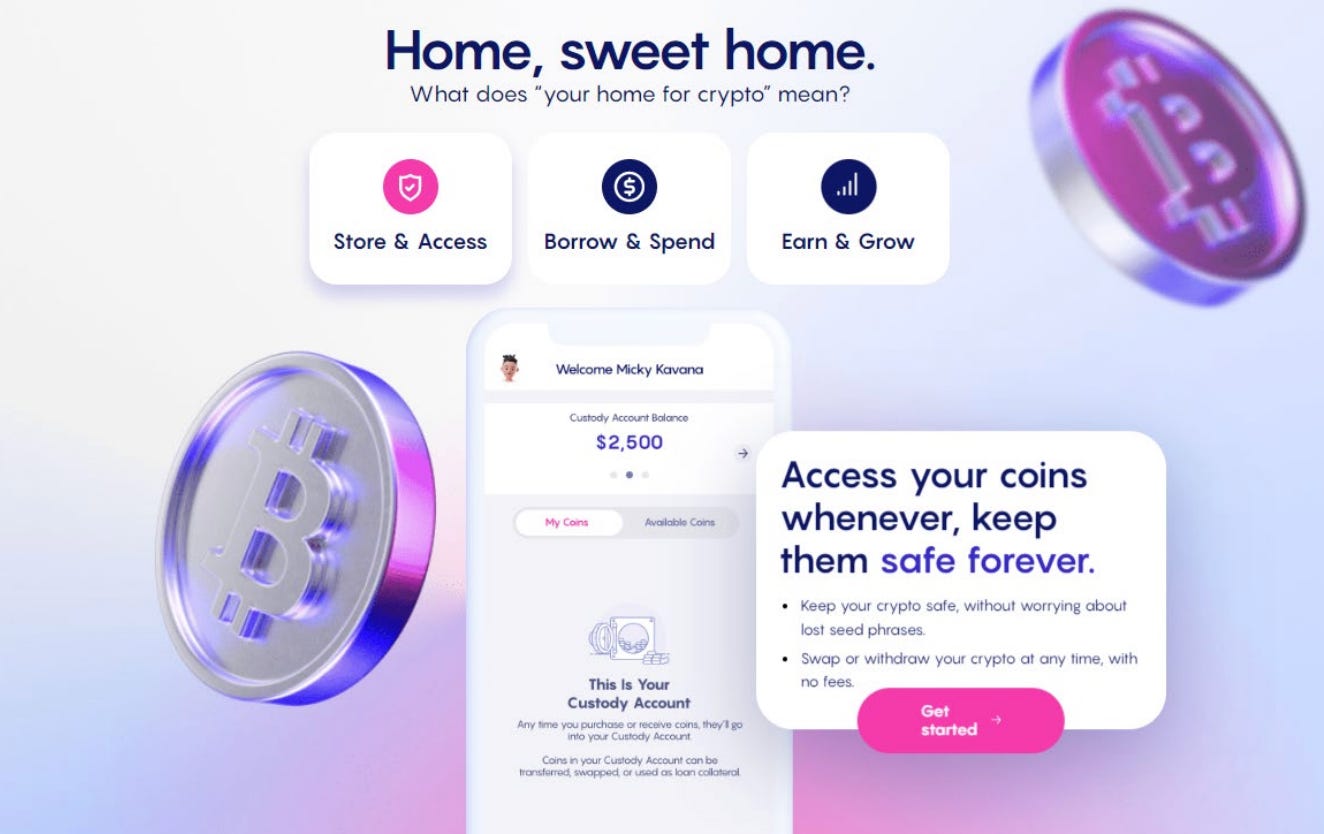
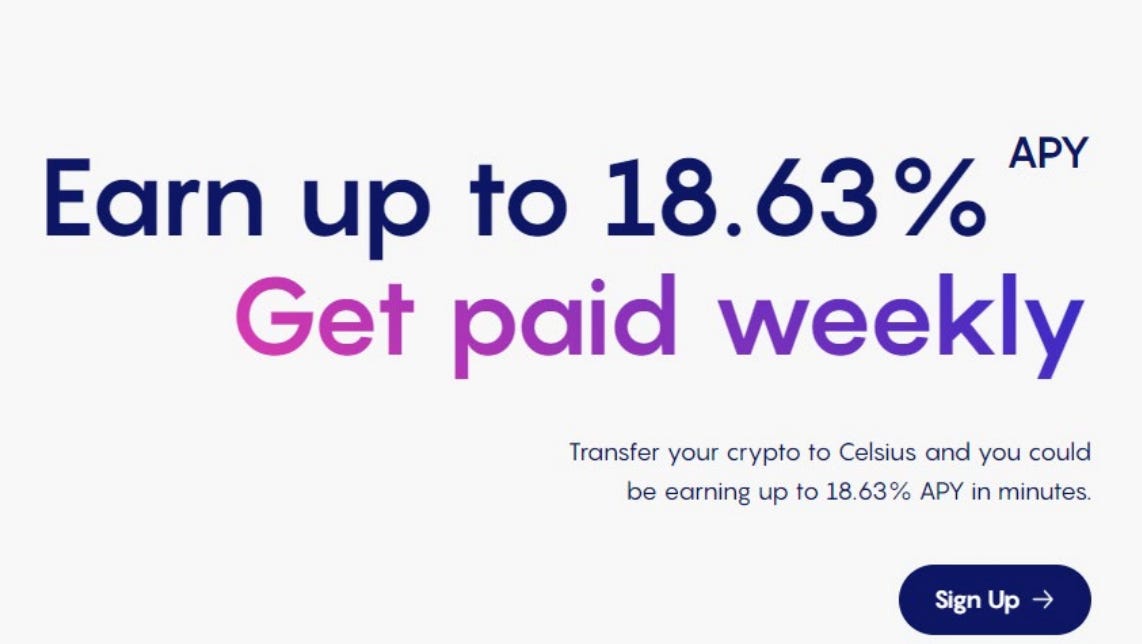
The company was valued at $3.25 billion when it raised $750 million in a round led by WestCap and CDPQ, Canda’s second largest pension fund, in November 2021. Like other popular crypto platforms of the era, Celsius let users buy and hold crypto, and advertised that consumers could earn as much 18.63% APY on assets held on the platform — essentially risk free.
In the latest FTC action, announced publicly last week, former CEO Alex Mashinsky agreed to pay $10 million, with former chief strategy officer Shlomi Leon agreeing to pay $4.1 million, and former chief technology officer Hanoch “Nuke” Goldstein agreeing to pay just over $2 million.
The FTC orders permanently ban Mashinsky and Leon “from advertising, marketing, promoting, offering, or distributing, or assisting in the advertising, marketing, promoting, offering, or distributing of any product or service that can be used to deposit, exchange, invest, or withdraw assets, whether directly or through an intermediary.” Goldstein’s order more narrowly bans him from such activities as they relate to cryptocurrencies.
Mashinsky and Celsius chief revenue officer Roni Cohen-Pavon both also faced criminal charges related to the company’s collapse. Cohen-Pavon plead guilty to conspiracy to commit price manipulation, securities fraud, manipulation of securities prices, and wire fraud and agreed to cooperate with prosecutors’ case against Mashinksy. Cohen-Pavon was sentenced to time served.
Mashinksy himself ultimately plead guilty to one count of securities fraud and one count of commodities fraud. In May 2025, Mashinsky was sentenced to 12 years in prison.
At the time of Mashinsky’s sentencing, U.S. Attorney for the Southern District of New York Jay Clayton, who oversaw the case, said, (emphasis added) “The case for tokenization and the use of digital assets is strong but it is not a license to deceive. The rules against fraud still apply, and the SDNY will hold those who flout them accountable for their crimes.”
While the collapse of the TerraUSD “algorithmic” stablecoin and wider TerraLuna crypto ecosystem was the primary trigger leading to Celsius’ failure and ultimate bankruptcy, what Celsius was promising users — up to 18% return on a seemingly risk-free basis, at a time when the Federal funds rate was 0% — was always unsustainable.
Numerous other crypto firms tied to the same wider lending, speculation, and yield generation ecosystem failed in 2022, including BlockFi and, most notoriously, FTX.
While crypto went through an extended “winter” in the wake of the numerous firms that failed in 2022, it ultimately recovered.
As crypto and stablecoins continue to work to become more firmly embedded in the traditional financial services ecosystem — including via last year’s passage of the GENIUS Act, regulating stablecoins, and the CLARITY Act, which is currently being actively debate in the Senate — it is worth revisiting some of the more egregious allegations from the FTC’s 2023 complaint against Celsius and its cofounders:
Since 2019, Celsius explicitly positioned itself as a “safer” alternative to banks, saying that it always acted in the “best interests” of its “depositors,” using marketing copy that included “Banks are not your friends” and “Unbank Yourself”
Celsius, through its website, marketing channels, and directly in “Ask Machinsky Anything” (AMA) videos, repeatedly told users that it did not make unsecured loans, it maintained sufficient liquid crypto assets to satisfy all consumer obligations, consumers could withdraw their crypto at any time, and that Celsius maintained a $750 million insurance policy for consumer deposits
Celsius told users it had “much less risk” than banks and that “a run on the bank cannot happen at Celsius”
Celsius told users it had “over two billion dollars on its balance sheet… there is no safer place to give your coins to loan” and that it had “enough liquidity on the sidelines… enough liquidity on hand” to satisfy consumer obligations
Celsius told users they could earn yield “without taking any risk… or taking minimal risk”
Celsius told users loans Celsius made to third parties were low- or no-risk because they were secured by cryptoassets held by Celsius that the company could liquidate if the borrower defaulted; Celsius told users that their deposits would only be lent with “100% collateral” and that it did not engage in unsecured lending
Celsius treated business and individuals seeking to borrow from it identically, meaning both were required to post collateral
And that Celsius promised users they could withdraw their funds “at any time”
Consumers believed the claims Celsius was making. According to the FTC complaint:
As one consumer put it, “[Mr. Mashinsky] reiterated time and time again on Twitter and on these AMAs that the company was over collateralized and that should anything go wrong they have more than enough money to make all depositors whole.”
Another consumer spent “100+ hours listening to Mr. Mashinsky and the communication of the company… every week for over a year: The worst thing that can happen is that everyone gets their coins back,’ ‘we have 2 billion dollars on our balance sheet so there is zero risk in depositing your crypto on Celsius…”
And a third consumer, whose funds were in Celsius when it froze withdrawals and ultimately declared bankruptcy, told the bankruptcy court, “I initially signed up with Celsius due to the advertised fact that you could earn interest in crypto with minimal risk through over-collateralized loans… The advertising campaigns, weekly AMAs, website, and interviews all are adamant that our funds are used in over-collateralized loans to generate yield for the depositors.”
But, in reality, according to the FTC complaint:
Celsius lent to institutional borrowers on an unsecured basis
Despite marketing returns as high as 18% APY, the median return users earned was just 4.9% APY; users could only earn higher yields on so-called “alt” coins, rather than more popular bitcoin and ether, and had to enroll in Celsius’s CEL Loyalty Program — and buy a certain amount of Celsius’s own CEL token — to earn the higher rates
In July 2020, Celsius had approximately $160 million of unsecured loans
In August 2021, nearly half of Celsius lending portfolio, over $700 million, was unsecured
In April 2022, Celsius had over $1.2 billion in uncollateralized loans outstanding
By June 2022, Celsius had lost more than $60 million from its under- and uncollateralized loans
That Celsius was misleading consumers doesn’t appear to have been a secret within the company. Per the FTC complaint, “Internally, Celsius employees acknowledged that the promises that Celsius made only collateralized loans were false, and that Mr. Mashinsky was a ‘liar’ for claiming that ‘we do not do unsecured lending.’”
While Celsius described itself as having over $2 billion on its balance sheet and ample liquidity to meet withdrawal requests, in reality, “[m]uch of Defendants’ assets, like Bitcoin mining equipment and stock in Bitcoin mining companies, could not quickly be converted into cryptocurrency for withdrawals. Other assets, like Celsius’s proprietary CEL token, were highly volatile and illiquid, without a guaranteed market for sale,” the FTC complaint says.
In fact, per the FTC complaint, Celsius “did not even know what Celsius owned and what it owed,” as the company “did not track [its] available assets or its consumer liabilities.” The complaint explains (emphasis added):
Until 2021, Celsius did not use any system for monitoring movement of cryptocurrency assets to and from its platform. Nor did Celsius have any policy or procedure for ensuring that Celsius had assets available to satisfy consumer demands. In mid-2021, Celsius began using spreadsheets to track its assets and liabilities (most of which were consumer deposits).
Celsius employees updated the spreadsheets manually. There was no standard process for updating the spreadsheets at regular intervals and no system for ensuring their accuracy. As a result, the spreadsheets were often inaccurate and frequently overstated Celsius’s assets.
Internally, Celsius employees acknowledged that its own internal financial statements were inadequate and could not be trusted, yet Defendants continued to assert that Celsius could satisfy consumer withdrawals.
In the spring of 2022, amid the wider crypto market turmoil, Celsius faced increasing difficulty in meeting customer withdrawal requests, and, by May, the FTC complaint says, the company was insolvent.
Per the complaint, “Mr. Mashinsky, Mr. Leon, and Mr. Goldstein, were aware that Celsius’s ‘capital sits near zero’ and that Celsius was having trouble satisfying customer withdrawal requests.”
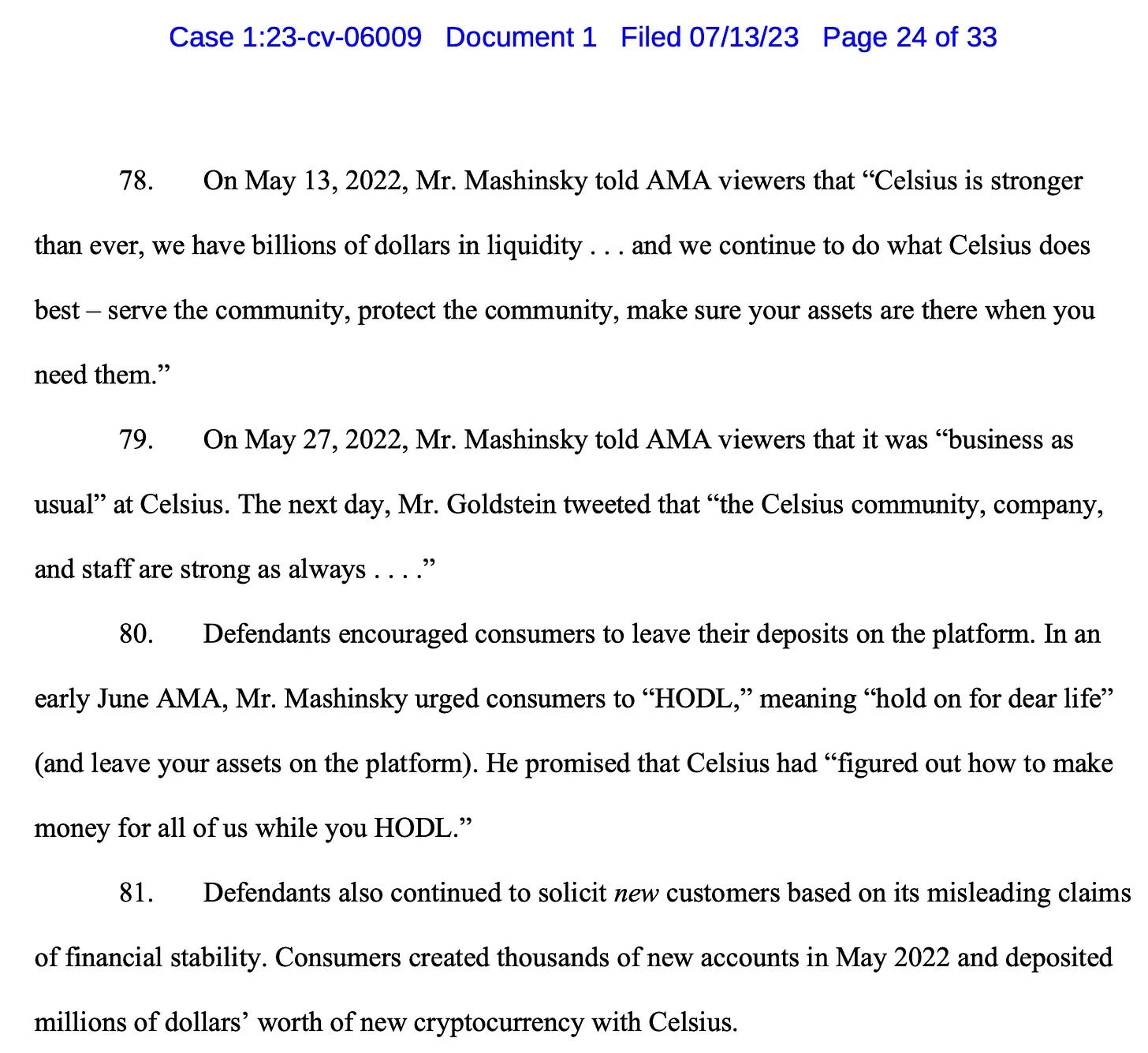
But, despite being insolvent and unable to return assets to its depositors, Celsius and its executives continued to insist it “was stronger than ever, and doubled down on their promises that deposited assets were ‘safe’ and consumers could withdraw cryptocurrency deposits on demand,” the FTC’s complaint says.
And despite the brewing crisis and users’ inability to withdraw their funds, Celsius cofounders Mashinsky and Leon withdrew significant personal assets from the platform before it collapsed:
On April 4th, Leon withdrew $2.2 million of USDC and 8 million CEL tokens, subsequently pledging about 7.3 million CEL tokens to borrow $4 million in cash from Celsius
And Mashinsky withdrew bitcoin, ether, and USDC worth just over $1 million on May 15th, and additional assets worth over $5.1 million on May 31st
On July 13, 2022, when Celsius filed for bankruptcy, it owed users more than $4.7 billion.
Celsius was founded in 2017 and claimed to raise $50 million through its “initial coin offering” — arguably an illegal sale of unregistered securities — and used it to build the foundation of what was, functionally, an unlicensed crypto-based banking business that took customer crypto “deposits,” charged interest to lend them out, and passed a portion of that interest back to “depositors.”
But, as is now clear, much of Celsius was little more than smoke and mirrors.
Even the “$50 million” it raised in its ICO was a deception: the company actually raised just $32 million and elected not to disclose the shortfall out of fear of “upsetting” investors.
Celsius told users they could earn more than 18% APY, that their crypto was safe and continued to legally belong to them, and that all loans Celsius made were collateralized — none of which was true.
Numerous state regulators pursued investigations or actions against Celsius, including New York, New Jersey, Texas, Alabama, Kentucky, Arkansas, Oklahoma, Pennsylvania, Massachusetts, and Washington. But these state regulatory actions, in retrospect, were clearly insufficient to protect consumers from harm.
It took approximately five years from the time Celsius was founded until it collapsed. The bankruptcy process began in July 2022 and litigation related to the matter is still ongoing today, four years later.
With federal financial regulators shrinking their workforces and swinging sharply to a more permissive stance while simultaneously approving numerous new bank charter applications — including those for seemingly novel uses of national trust banks — one wonders, how many Celsius-style disasters are brewing in the background right now? The reality, as is too often the case, is that we likely won’t know until it’s too late.
There is no federal interest rate cap*.
In fact, when Dodd-Frank was passed it the wake of the 2008 global financial crisis, the provision creating the Consumer Financial Protection Bureau explicitly barred the new agency from establishing a usury limit, unless specifically authorized by law.
(*except for the federal Military Lending Act, which prohibits charging more than 36% APR, where the APR calculation includes a broader set of fees and charges than under the Truth in Lending Act applicable to typical consumers. The MLA applies to active-duty members of the armed forces, their spouses, and, sometimes, their dependents.)
Instead, consumer interest rate caps and associated regulations are set by individual states. Permissible rates vary significantly state to state; for example, New York has a 16% APR cap on consumer credit, while Utah has, functionally, no usury limit. Rate and fee limits can even vary in the same state, based on loan size and product structure (eg single-payment loan, close-ended installment loan, revolving line of credit).
Banks, both nationally chartered and state chartered, generally enjoy the right of preemption, enabling them to “export” the rate of their home state to borrowers across the country, regardless of any rate cap in the borrower’s state*. Non-bank lenders, however, generally must obtain a lending license (and possibly other types of licenses) in each state they operate in and adhere to each state’s rate and fee limits and other relevant regulations.
(*The ability of banks — both OCC-chartered and state-chartered — to “export” their home state rates to borrowers in other states where the rate exceeds the borrower’s state’s rate cap has faced numerous challenges over the years, particularly as part of bank-fintech partnerships, including “true lender” challenges and, more recently, DIDMCA.)
Historically, the result of this fairly incoherent patchwork of federal and state-by-state regulation has been that banks lend to “good” borrowers at a “reasonable” rate and non-bank finance companies lend to “bad” borrowers at “high” rates.
The definitions of these terms are highly contingent on who you ask, with general agreement that the admittedly somewhat arbitrary line between good/reasonable and bad/high is 36% APR. This segmentation actually further penalizes those who choose or are forced to borrow from non-bank lenders, as such lenders have a higher cost of capital vs. bank deposits, which gets baked into the higher interest rate borrowers pay.
“Fintechs” hardly invented the model of a non-bank consumer lender working with a chartered bank to lend nationally without the need to obtain state licenses or adhere to state rate caps. Store front payday lenders used this model as far back as the late 1990s. Federal regulators, led by the OCC, cracked down on the practice, citing credit concentration risk, third-party oversight, consumer compliance, and operational failures (not the actual interest rates.)
Since the regulatory crackdown in the early 2000s until the birth of fintech in the mid-2010s, the bank vs. finance company segmentation remained largely intact. First wave fintech lenders, like “peer to peer” lenders Prosper and LendingClub, helped return the issue to the foreground.
As they matured (and particularly after some tightening in capital markets around 2016) fintech lenders came to appreciate the appeal of the bank charter, and the cheap and sticky source of deposit funding having one enables. But those lending at or above 36% APR were consistently stymied by consumer advocacy groups like the Center for Responsible Lending and the National Community Reinvestment Coalition, with regulators demurring from their attempts to form or acquire banks.
Current federal regulators have, clearly, taken a different view of higher-APR lenders seeking to acquire existing banks or to charter de novos, including Enova and OppFi (disclosure: I ran marketing for Enova’s payday loan product, CashNetUSA, from 2011-2013.)
Democratic Senators and consumer advocacy groups have pushed back on these types of acquisitions and, last week, 20 state attorneys general sent a letter to Comptroller Gould, Fed Chair Kevin Warsh, and FDIC Chair Travis Hill, raising “serious concerns about the possibility of granting bank privileges to high-cost lenders and other nontraditional entities without adequate safeguards to protect consumers, investors, and the financial system.” The letter specifically flagged the applications from Enova and OppFi.
The effort, led by Illinois attorney general Kwame Raoul, argues that “[a]pproval of these charters would mark an undeniable shift in the types of entities that enter our national banking system” and warns that “it should be cause for alarm.”
The attorneys general argue that “[a]llowing such companies into the national banking system without guardrails empowers and incentivizes predatory lending and needlessly leaves consumers vulnerable to harm.”
State interest rate caps “unequivocally demonstrate[] the will of the people — regardless of political party — to prevent unaffordable lending,” the letter argues.
Enabling high APR lenders to preempt state rate caps through bank partnerships (or by becoming/buying a bank, as Enova an OppFi seek to do) allows them to “extract profit from those that are in desperate need of money,” the attorneys general say.
The letter argues that the acquisitions are incompatible with the safety and soundness principles regulators are tasked with enforcing, writing, “Enova and OppFi’s history of high-cost lending and flagrant efforts to evade applicable laws render such applications inconsistent with the standard for approval under the law and approving them would undermine the integrity of the national banking system.”
The group asks federal banking regulators to allow “ample opportunity” for public comment, to hold public hearings prior to making a decision on the applications, and, ultimately, urges regulators to decline Enova’s and OppFi’s respective applications.
In an unusual move, the Office of the Comptroller of the Currency rejected Wise’s application to charter a national trust bank last week.
Comments
Nothing yet. Say the first thing.
Sign in to join the conversation.