
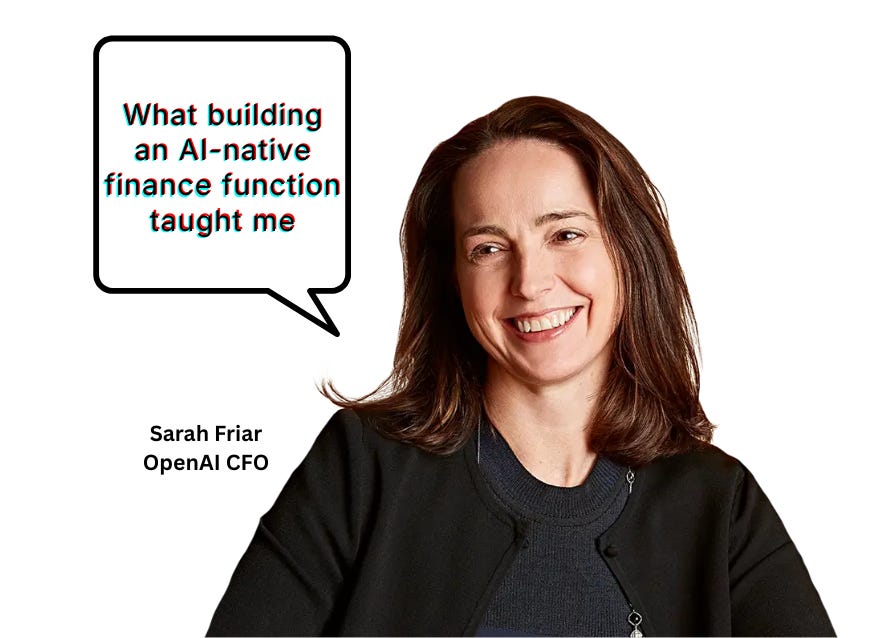
Sarah Friar is the CFO of OpenAI.
Her team has access to the most advanced AI tools on the planet. They build them. They ship them. They sit in the same building as the engineers who make ChatGPT, Codex, and every model the rest of us pay to use.
And her finance team still closes the books manually.
Actuals in one system. Purchase orders in another. Accruals in a spreadsheet. The explanation for a variance buried in a message thread.
Manual, recurring work every single month.
If the CFO of OpenAI hits that wall, your team is not behind.
Your team is normal.
Friar is now rebuilding her entire finance function around AI.
Not just add AI to the edges.
She wants to redesign how the work gets done from the ground up.
She calls it an AI-native finance function.
She wants a zero-day close and continuously updated forecasting.
She is not there yet. But the lessons from the journey are the clearest playbook you’ll ever see from any sitting CFO on how to add AI in finance.
Five lessons. Here is what she teaches, where we push further, and what you do with each one Monday morning.
Friar runs a finance hackathon.
Procurement.
Sales engineers.
Tax, investor relations.
Real work. Real problems.
One output: IR-GPT. A custom GPT grounded in approved IR materials. Answers diligence questions that used to take hours. Now produces a strong first draft in seconds.
Access without a use case produces tourism.
Access paired with a real problem produces adoption.
The hackathon forces both into the same room on the same day.
The use cases that survive the hackathon need to become repeatable skills by Friday. Otherwise the insight evaporates and next month someone rebuilds it from scratch. Discovery is expensive. Doing it twice is inexcusable.
Pick one task your team dreads.
Variance commentary. Intercompany recon. Board question prep.
Give one person two hours and permission to build something.
See what comes back.
Friar describes what every CFO recognizes.
Actuals in one system. Purchase orders in another. Accruals in a spreadsheet. The explanation for a variance buried in a message thread.
Then she describes the target: a continuously reconciled view where each variance traces to underlying activity, AI prepares initial explanations and flags exceptions, and finance validates, applies judgment, and owns the sign-off.
“The close does not disappear. What begins to disappear is the scramble to reconstruct the business after the period ends.”
Best sentence written about AI in finance this year.
The unit of work in finance is not the spreadsheet, the slide, or the report. It is the decision. Everything upstream is assembly. AI handles assembly. Humans handle judgment.
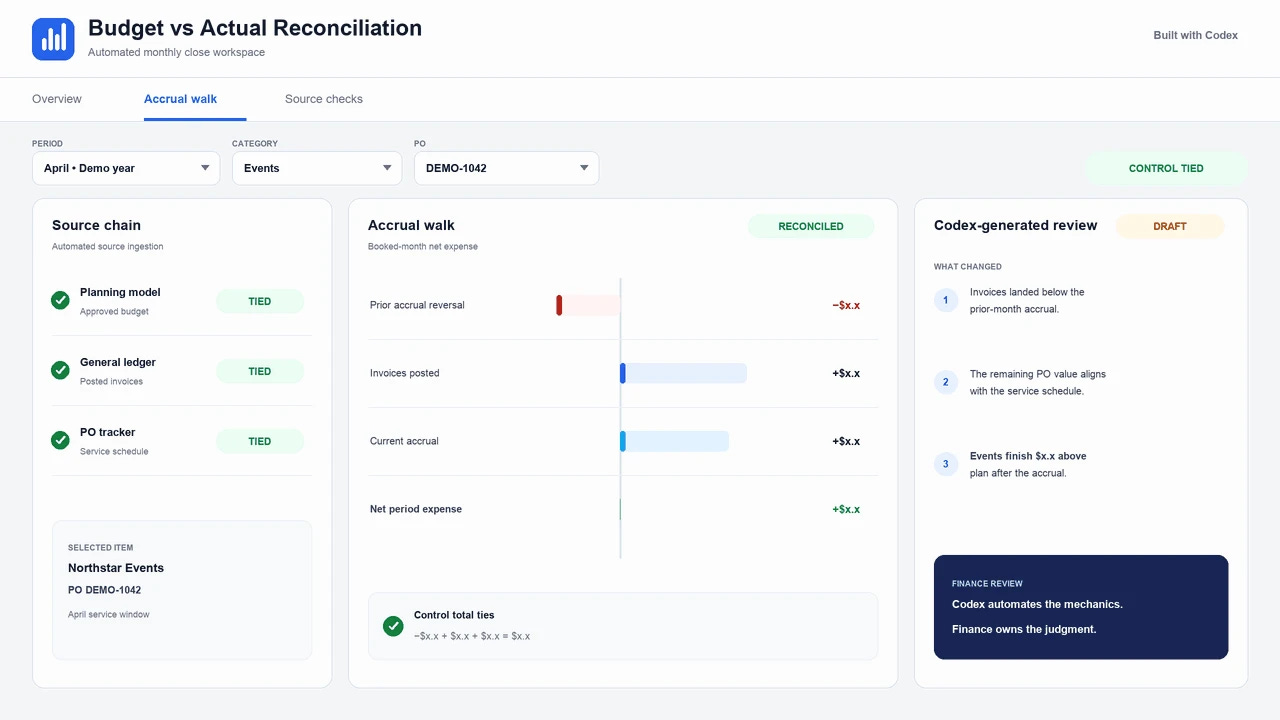
A continuously reconciled view requires governed data, not pasted data. It requires a semantic layer that understands your chart of accounts, your dimensions, your planning rules. Claude in a chat window cannot do this.
Claude on top of a governed financial data layer can.
That is what we build at finstory.ai and it is what makes continuous close actually possible, not just aspirational.
Friar cites OpenAI research:
40% of finance professionals’ specialized AI use involves work outside traditional finance. 22% involves engineering-related tasks.
One teammate who never coded builds a tool that turns the monthly advertising forecast into weekly and daily plans. Accounts for weekdays, holidays, forecast comparisons. Every number ties to the approved model.

“The people who understand the problem can now shape the solution.”
The best finance tools will not come from software companies guessing what finance needs. They come from finance people who know exactly what they need and now have the ability to build it.
This is already happening.
Every week we see CFOs, Controllers, and FP&A leads building skills, dashboards, and investigation workflows in Claude. The Born2Cycle experiment we published last week is exactly this: a finance-grade workflow built by finance people, not engineers.
But speed needs a safety net.
A finance professional who builds a tool needs governance around that tool. Who reviews the logic. How errors get caught. Where the numbers come from. Build-fast culture needs validate-fast culture right next to it.
The IR-GPT example is the case study.
AI produces a draft in seconds. The IR team reads it, adds judgment, checks consistency, owns the result.
“AI accelerates the work. People own the result.”
Then Friar makes a point most articles skip: set usage limits, budget controls, role-based access, model-routing rules, approval thresholds. Manage AI the same way you manage any variable expense.
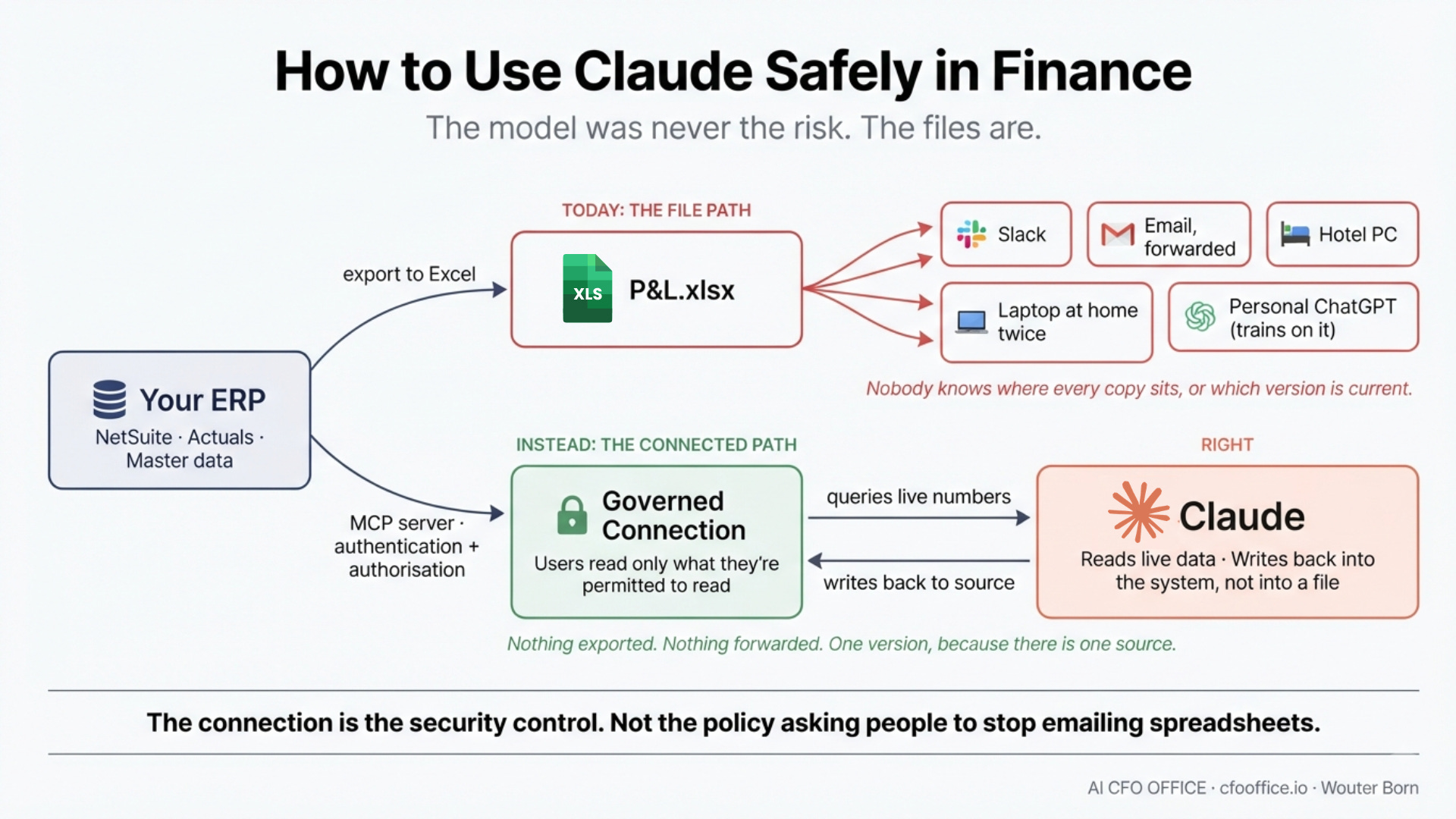
The governance question is not whether to use AI. It is who accesses what data, what actions the system takes, when approval kicks in, when issues escalate. Standard financial controls language applied to a new tool.
The most underrated section.
Friar proposes four questions for every AI workflow:
Does AI complete work that matters?
What does it cost including employee time, review, and rework?
Is the result good enough to use?
Does it help move faster or make a better decision?
Then she drops a line most CFOs miss on the first read.
“The cheapest model is not always the most economical. If a better model gets to a reliable answer with fewer attempts and less review, it may cost less overall.”
Token cost is not the metric.
The metric: does the workflow produce a reliable result, and what is the all-in cost to get there including human time to review and correct.
Sarah Friar runs finance at the company that builds the AI everyone else is trying to figure out. Her team hits the same walls yours does. The difference is she is systematically tearing those walls down.
Her destination is a zero-day close.
Not closing the books in one day. Closing them in zero days. The books are always closed because the data is continuously reconciled, every variance traces to its source, and there is nothing left to scramble for when the period ends.
You can’t be what you cannot see.
If we want our finance teams to embrace what is possible with AI, we have to show them what it looks like. And as CFOs, that starts with us, says Sarah.
If the CFO of OpenAI is still figuring this out, you have permission to be figuring it out too.
What you do not have is permission to wait.
Read Sarah Friar’s full article
And that is all for today.
Real reports from real data, for the first group of beta customers who want in.
If you have ever spotted a contradiction in a board document after it shipped, you are exactly who we built this for.
AI-native platform that turns financial data into board-ready stories.
Find us on LinkedIn | finstory.ai

No posts
Comments
Nothing yet. Say the first thing.
Sign in to join the conversation.