
Matt Clifford and Ian Hogarth believe Europe is roughly a decade behind the United States in building the technology companies that will define the next era. But they also believe that the gap can be closed, and that the UK and Europe could even leapfrog America, if political leaders and the public make fundamentally different choices.
I sat down with Matt and Ian to talk about what Europe needs to do to save itself from stagnation. We get into why Europe’s risk aversion is a bigger threat than American superiority, why career politicians won’t survive in the new multipolar world, and why the pro-growth movement is losing the culture war — and how to win it back.
Watch the full conversation here:
Technology Ecosystems Compound, and Europe Lost a Decade
Technology ecosystems compound over time, and the compounding effect takes decades to manifest.
When you look at the current dominance of American AI companies, you’re not just seeing the result of recent investments. You’re seeing the payoff from decisions made 20, 30, even 40 years ago. Microsoft, Amazon, Google, Apple, NVIDIA were already scaling up rapidly when Tony Blair was Prime Minister and the UK’s economic growth was on a par with America’s.
The balance sheets of those companies are what enabled the AI boom. Google bought DeepMind. Microsoft invested in OpenAI. Amazon, Meta, and Google have collectively spent hundreds of billions building data centers. As Ian put it: “So much of the US’s current outperformance in AI has been enabled by the balance sheets of those companies.”
Europe, by contrast, is roughly a decade behind. There have never been any trillion dollar companies in the continent.
The brain drain to the United States the past couple of decades has also been significant, and as distasteful as Trump is to European expats, they aren’t headed back home in droves.
America is the NFL of AI. No other country is even playing the same sport.
But it won’t always be this way.
The entire postwar European project is designed to reduce risk.
As Matt puts it: “It’s really hard to overstate the degree to which the whole European project is in reaction to the horrors of the 20th century, and it is deliberately a variance-dampening device. That’s a feature, not a bug, in the elite culture of Europe.”
For 50 years, that made sense. The goal was to prevent another European War from ever taking place. Institutions like the EU were designed to smooth out the extremes, to create predictability, and to ensure that no single country could pursue a radically different path from its neighbors.
But we live in a very different world today than we did just 10 years ago. As many people in the UK and elsewhere have felt their relative status decline over a generational period, social unrest has destabilized the EU and led to things like Brexit, as shortsighted as that particular referendum may have been.
And the United States is no longer willing to prop up NATO to protect Europeans from the Russians. China & Iran are stretching America thin, and more than 60% of Americans do not support the War in Iran on both sides of the aisle.
The era of Pax Americana is over, and every country needs to fend for itself. If Europe doesn’t create the conditions for trillion dollar companies to emerge within the next decade, the continent risks becoming a vassal of the Chinese.
And that will only happen if the public decides to embrace growth.
Europe in general, and the UK in particular, has a cultural problem called degrowth.
People have become convinced that economic growth is bad because the growth that has occurred just hasn’t benefited that many people.
In Matt’s words, “the idea of growth is just not very appealing to people.” What’s missing is a cultural movement that makes tangible what the country could become. “It isn’t about rich people getting richer. It’s got to be about people’s lives.”
Right now, people are upset that economic growth benefits, say, big pharma doing gain-of-function research on viruses in China, or the destruction of the environment à la Greta Thunberg. Whereas incomes have remained stagnant, so much so that the National Institute of Economic and Social Research declared that the UK is no longer a rich country:

National Institute of Economic and Social Research@NIESRorg
Compared to the rest of Europe, would you say that the UK is a rich country? 💭 🎬 Don't miss our NEW must-watch video 🎬 We explain key findings from our latest report, unpacking the drivers behind the decline in UK living standards 📉👇 @econfilm niesr.ac.uk/publications/u…
10:03 AM · Mar 13, 2025 · 10.1K Views
10 Reposts · 12 Likes
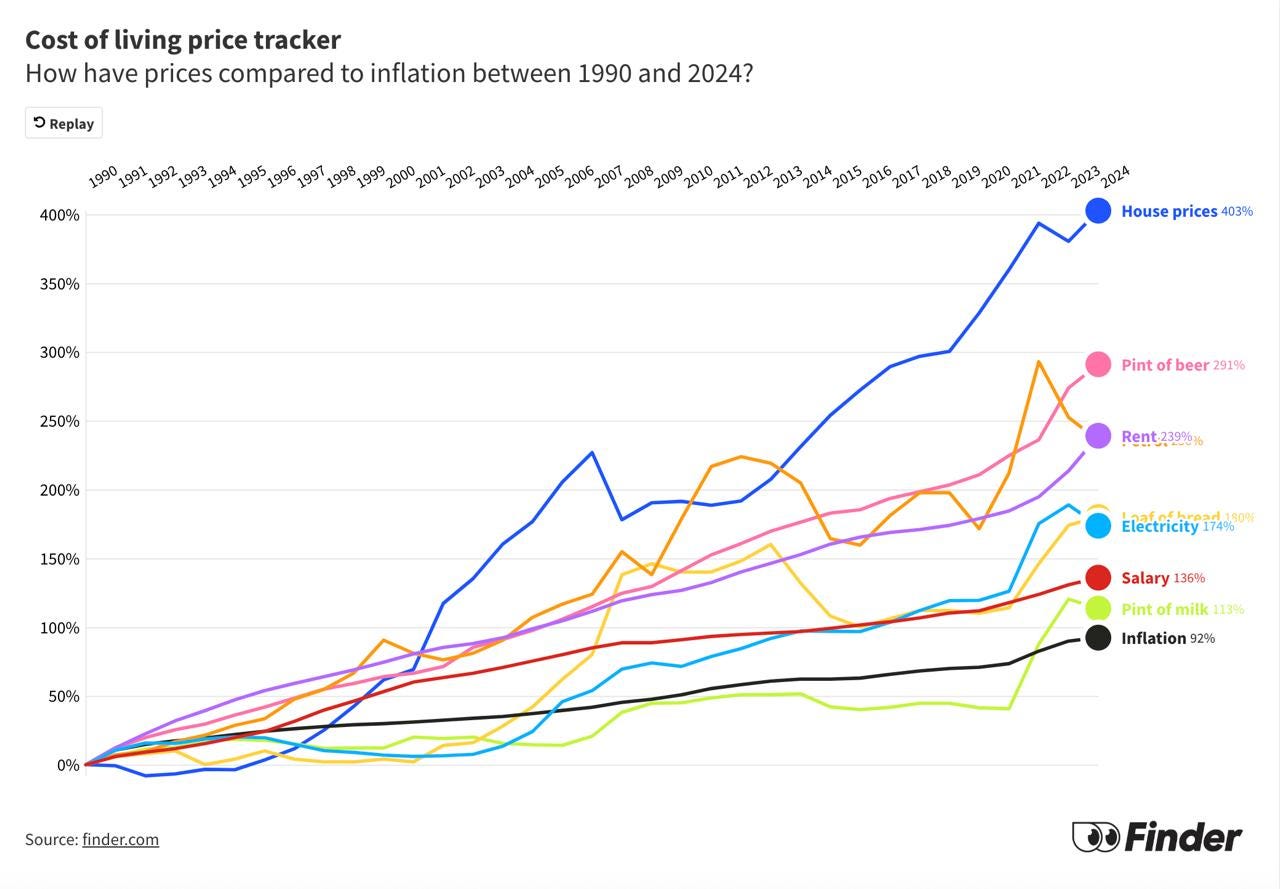
The way Big Tech has sold Andreessen’s techno-optimist agenda has persuaded people in Europe to hate growth. People do not appreciate being told AI is going to wipe out their jobs and threaten their way of life, and they start to believe it when their wages haven’t kept pace with the cost of living:
Part of the solution, Matt & Ian argue, is to start being honest about the negative externalities of new technologies. If our kids are watching AI slop online and melting their brains, we need a way of accounting for that so we stop implicitly praising all new growth as good.
But the other half of the solution is just to foster venture-scale growth in the UK that benefits everyone. Why not make the UK the best place to invest in fusion?
When the British public starts seeing lower energy bills, tech executives will be taken more seriously in the UK.
Technologists will finally be seen as belonging to British society rather than evil overlords obsessed with control.
Matt and Ian’s Hopes for 2050
The UK is at an inflection point for the next 25 years.
The talent density exists to incubate the next trillion dollar business. Universities like Oxbridge and Imperial are educating world-class people. Demis successfully built DeepMind in London. And the UK is already the third-largest AI market in the world.
Like Ian said in the conversation: “I’m not really sure there is any important new branch of the tech tree where the winning company can’t come from the UK.”
But the compounding will only accelerate if Europe makes fundamentally different choices about taking risks and welcomes risk-seeking capital.
Pension funds need to invest in deep tech. Universities need to adopt liberal policies on spinouts. Leaders need to tell stories about why creating new industries, including the failure that inevitably comes with that, is necessary in the new, post-Trump multipolar world in which we now find ourselves.
The public must accept the possibility of failure in order to succeed. The greatest risk isn’t picking the wrong technology or backing the wrong company, but rather refusing to make a choice at all.
To not try at all is to fail.
The world is not heading toward smoother hills and geopolitics will only get more chaotic. This presents a huge opportunity for all of Europe for the next 25 years.
Europeans need to decide whether they want to continue on the path of dependence to superpowers like the U.S. and China, or carve out their own path and sovereignty.
The UK can go back to being the richest country in the world. It can incubate trillion-dollar companies and win the power law races in fusion, photonics, and robotics. And who knows what other new technology the future will bring?
The UK has all the ingredients you need as a country to become rich again. It’s just a question of political will, and if Matt & Ian have anything to do with it, I have high hopes for Britain’s success.
No posts
Comments
Nothing yet. Say the first thing.
Sign in to join the conversation.