

With huge growth in awareness—in the media, with consumers and among regulators—2025 will go down in the books as a pivotal year in financial influence. Here are a few of the big stories we were following:
For auld compliance officer anxiety: Half a dozen financial regulators around the world got together in the summer for a coordinated “Global Week of Action Against Unlawful Finfluencers” and United Arab Emirates even launched a new finfluencer licensing scheme. The initiatives highlighted a general growth in awareness of finfluence on the regulatory front.
While US regulators didn’t get on board with the Global Week of Action, there were some notable enforcement actions, including a $350,000 fine levied by FINRA against New York-based online brokerage Open to the Public Investing for not making sure that paid finfluencer posts about the firm were fair and balanced.
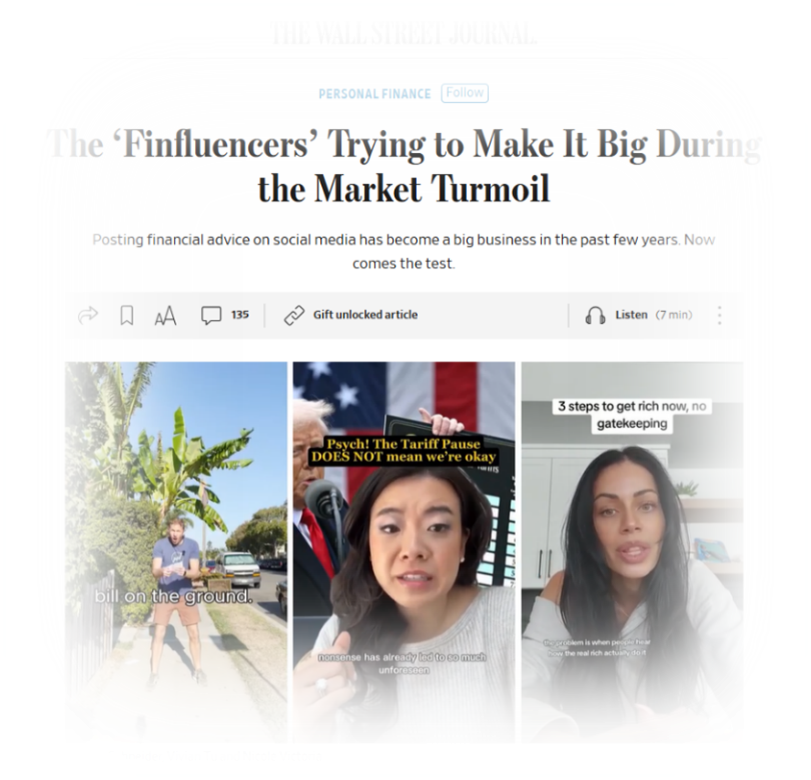
The venerable, 136-year-old Wall Street Journal acknowledged the growing clout of finfluencers and highlighted the work of several Instagram, YouTube and TikTok rockstars in helping investors—particularly younger ones—navigate the volatile financial markets.
On Dec. 4, FINRA released research on shifting investor influence highlighting that younger investors, including 61% of those under 35 and 57% of those with less than two years of investing experience, are turning to finfluencers. The regulator noted the need for investor education remains critical. “They still struggle with gaps in investing knowledge and risk assessment, which can leave them vulnerable to costly missteps.”
Old McMarketer had a platform, AI-E-O: If there is one question on the mind of financial communications pros who cut their teeth learning SEO, it’s: ‘What do I need to be doing to optimize for the new world of AI search?’ Funny you should ask. In 2025, it emerged that if you want to make the LLM bots take notice, you’d do well to build a presence on that scary, lightly moderated user-generated content platform Reddit.
After a two-year hiatus, Michael Burry returned to active social media posting. On Halloween, he posted on X under the handle @michaeljburry (display name: Cassandra Unchained), with cryptic warnings about an AI-driven market bubble, overinvestment in tech, and potential crashes. Burry—played by Christian Bale in The Big Short—also announced he was deregistering his firm, Scion Asset Management and operating it as a family office. He subsequently posted the 1969 letter from Warren Buffett announcing the wind down of Buffett Partnership, Ltd. The S&P 500 Index fell 30% the next year and was still down a decade later.
Long taco truck/short hotel banquet room may be the winning pairs trade in 2026 after FutureProof founder Matt Middleton and fintech conference pioneer Anil Aggarwal acquired publisher ETF.com. The new editorial direction is still taking shape under Dave Nadig, who returned to his former stomping ground as president & director of research, but a big FutureProof-style ETF conference—complete with Gen-X music acts—seems inevitable. Hootie, if you’re reading this, gather the Blowfish and call your agent.
The ETF conference roadshow is going global too: TMX VettaFi bought UK-based ETF Stream, a strategic expansion into UK/EU ETF media by ownership whose primary business is data analytics and (surprise!) large-scale conferences.
Not since Beyoncé’s 2013 Beyoncé has a surprise content drop created such a stir among hardcore fanboys & girls: After a six-year hiatus, technology whisperer Mary Meeker emerged to serve up one of her famous reports on the digital zeitgeist. Trends – Artificial Intelligence is 340 slides of PowerPoint gold on the impact of deep learning on companies, markets and society. Here’s hoping we don’t have to wait another half decade for Meeker’s next release.
Bloomberg’s Odd Lots went from insider-y podcast with a following on Wall Street to required listening for investors worldwide. By ramping up episode frequency and focusing on decoding the market implications of Trump tariffs, the duo of Joe Weisenthal and Tracy Alloway grew monthly downloads to 2.5 million in the second quarter, a 50% increase over Q1. A New York Times photographer even captured a big crowd lined up outside a hip Manhattan club for a live taping of an episode devoted to ... the bond market

Financial advice popping off on social media: In June, the Philadelphia Fed published research showing that social media is the third most preferred source for financial advice. The report found that YouTube and Facebook were the top choices for financial advice and that the most common actions taken based on finfluencers was: budgeting (43 percent), strategies to improve credit scores (33 percent), purchasing or selling stocks or other investment products (28.1 percent), purchasing or selling crypto (27.3 percent), and saving for retirement (26.1 percent).
2025 saw the maturation of the digital asset class, notably the spectacular rise and fall of personality-driven crypto projects like ‘Hawk Tua’, ‘TRUMP’, ‘MELANIA’ and ‘LIBRA’ (from Argentinean President Javier Milei). These four coins garnered significant coverage (and debate) in financial media that exposed the volatility and risks of celebrity-backed projects.
It’s a major award! InvestmentNews just dropped the categories for the 2026 InvestmentNews Awards and added a new category for Finfluencer of the Year to “recognize a financial content creator (“finfluencer”) who has made a significant, positive impact on financial literacy and consumer understanding of personal finance, investing, or wealth management over the past 12 months.”
If 2026 is half as interesting as 2025 in the world of financial influence, it’s going to be a wild ride. Buckle up, finfluencianados …
No posts
Comments
Nothing yet. Say the first thing.
Sign in to join the conversation.