

Greetings friends!
For years, criminals have been stealing $100,000 a year from my family.1
Not just us, but all my well-earning friends are losing similar amounts. If you had asked us, most of us would have said we had no idea we were losing such huge sums to theft. But we were, and we still are.
The ugly scandal is finally being exposed. The question is, will we put up with it, or will we demand changes? I’m heartily sick of it. Whether you consider it a problem probably turns on where you live. More on this below.
Almost everything about paying taxes creates negative emotions. The current revelations of widespread theft might be the tipping point. Consider:
It is irksome to see our tax burden only go up, and maddening to have almost no ability to direct what programs our tax dollars fund.
It is intolerable to hear that thieves steal great swathes of our taxes every year, while elected leaders are indifferent to this theft or, worse, complicit.
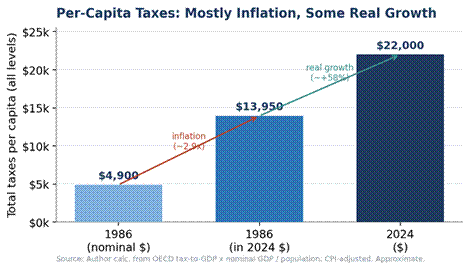
Over the last 40 years,2 the individual tax burden has stayed in a fairly narrow band between 25% and 28% of GDP. Because our GDP has grown massively, and thanks to inflation, the amount of taxes we each pay has increased.
As a percentage of salary, the average household pays 25% to 30% of its paycheck in taxes, all-in.3
Using the latest IRS data from 2024, Americans filed 153 million returns reporting $15.2 trillion in adjusted gross income. Income tax is steeply progressive, with people reporting higher income paying much higher taxes and at much higher average rates.
The bottom 50% of returns paid just 3.3% of the total income tax, at an average rate of 3.7%.
The top 10% of returns account for 70.5% of all taxes, at an average rate of 20%.4
In dollar terms, the top 10% pay $1.5 trillion in income taxes, out of the total $2.1 trillion. That is about $99,000 per filer each year, which I’ve rounded to $100,000 because it’s a nice, round number.
Oh, and our tax system has grown more progressive over time. In 1980, the top 1% paid 19.3% of federal income taxes. Today, they pay double that, or 38%. Keep this in mind whenever you hear someone argue that the rich don’t pay taxes.
And before you sharpen your knives and pitchforks for “the rich,” consider that an income of $188,000 or more puts a household in the top 10% of all taxpayers. That’s a lot, for sure, but it’s we regular families, and not a handful of oligarchs, who pay the bulk of all taxes.
In All-American Fraudsters, I estimated that thieves steal $1 to $2 trillion in taxes every year. This figure struck some readers as fantastical because it implies millions of fraudsters pilfer 10-20% of our total government budget.5
A careful look at today’s data reveals that $1 trillion is a conservative estimate, while $1.5 trillion is entirely plausible when we include taxes wasted, lost, or stolen.6 Every week reveals new scams resulting in billions of dollars lost. While $2 trillion is certainly possible, I’ve used the $1.5 trillion figure here.
What this means is that, effectively, all the taxes paid by the top 10% ($1.5 trillion) are squandered to mismanagement and theft. Every year. Every hard-working, decent household has virtually all its taxes stolen from it. $100,000 a year per top 10% household, on average.7
I find this absolutely mind-boggling. And infuriating.

Looking at the scale of the fraud, it is almost certain that our elected leaders have been complicit. Here’s an easy way to apportion responsibility and evaluate guilt.
Our elected leaders have a fiduciary duty to represent our interests. That is, we elect them to look out for us. Did they behave faithfully, or have they breached their duty to us?
For accountants, doctors, and lawyers, the law has long evaluated whether fiduciaries have acted negligently. The standard is whether the individual knew or should have known that they were acting improperly.
I suspect that many politicians were in on the game. That is, encouraging rampant fraud in government programs because they received kickbacks, either directly or indirectly via campaign contributions. We don’t have direct proof of this yet, however, so consider my suspicion speculative.
Legally, however, even the ones who merely “turned a blind eye” are responsible because they should have known fraud was rampant. Today, no politician can credibly claim they are unaware of widespread fraud in government programs.
So what are they doing about it? If Minnesota and California are any indication, we can expect delay and denial.8
Students of psychology, economics, or tax policy will know the ironic result of publicizing dishonesty can be that more people are likely to behave dishonestly. At least initially and in certain circumstances that may apply here.
When people see that others have violated a social norm or rule by failing to declare some income, taking benefits they haven’t earned, or committing petty theft, they become more likely to violate these norms and other norms. When we see visible signs that rules are not enforced, people are more likely to behave inappropriately themselves.9
Specific to paying taxes, research shows that people comply in part because they believe others comply and that the system is fair and the money is not wasted. When either belief erodes (i.e, “everyone cheats,” or “they just waste it anyway”), tax compliance falls.10
If we don’t want more people feeling inclined to cheat, we need to see widespread condemnation (i.e., confirming that the behavior is unacceptable) and punishment (authorities coming down hard on fraudsters).

I don’t know, but I’m concerned. The reaction in states heavily impacted by fraud, such as Minnesota, California, and New York, is not encouraging. Perhaps because politicians there are incompetent or implicated, they have been unable to condemn or stop the fraud.
The federal government is sending a different message, with both strong talk and muscular enforcement. Many people view the government’s actions as overtly political, however, because they’ve focused first on Democrat-run states. This undermines the corrective effect of both the moral condemnation and the enforcement.
As such, I predict we’ll see worsening fraud in the short term in states and cities that consider themselves opposed to the current administration.
At the same time, the publicized federal enforcement will greatly anger taxpayers across the nation who realize their hard-earned money is being knowingly seized from them and then wasted.
We’ve fought revolutions for lesser provocations. If we don’t get this corruption epidemic fixed quickly enough, we might find ourselves in another one.
Be well.
I’ve done thorough research to derive the figures here, with the help of Claude Cowork. The key sources include the OECD (revenue statistics), the IRS (income and tax statistics), the US GAO (fraud report GAO-24-105833, April 2024), and the Tax Foundation (taxes and spending).
I focused on the last 40 years because that covers two generations of taxpayers. It also gives us some historical comparisons to put the current situation in perspective.
The average federal income tax burden across all filers is 14.1%. Payroll taxes adds 7.65%. Stale and local taxes (income, sales, and property taxes) add between 8% and 12%. Taken together, the average household thus pays between 25% and 30% of its income in taxes.
If you are curious, the top 1% of returns pay 38.4% of all income taxes, and they pay the highest average rate, fully 26.3%.
Total government spending in 2024 was $11.7 trillion, of which $6.75 was federal, $3.16 state, and $2.9 local. When we net out federal money re-spent by states, we arrive at a consolidated total government spend of $10 trillion per year. I’ve used the $10 trillion figure throughout.
The most comprehensive fraud analysis came from the GAO in 2024 (i.e., before the recent uncovering of hundreds of billions in additional fraud). The GAO estimated annual fraud in federal government programs of up to $521 billion, and cautioned that their analysis was incomplete. They reviewed only a subset of federal programs and excluded state and local fraud entirely. Expanding to include total federal fraud and adding in demonstrated state and local fraud easily gets us over $1 trillion. Moreover, the GAO did not include an estimated $600 billion a year in taxes owed that are never collected by the IRS due to willful tax evasion.
Stolen taxes represent about $10,000 per return across all returns filed, and almost $5,000 per citizen. These are epic amounts.
Comments
Nothing yet. Say the first thing.
Sign in to join the conversation.