
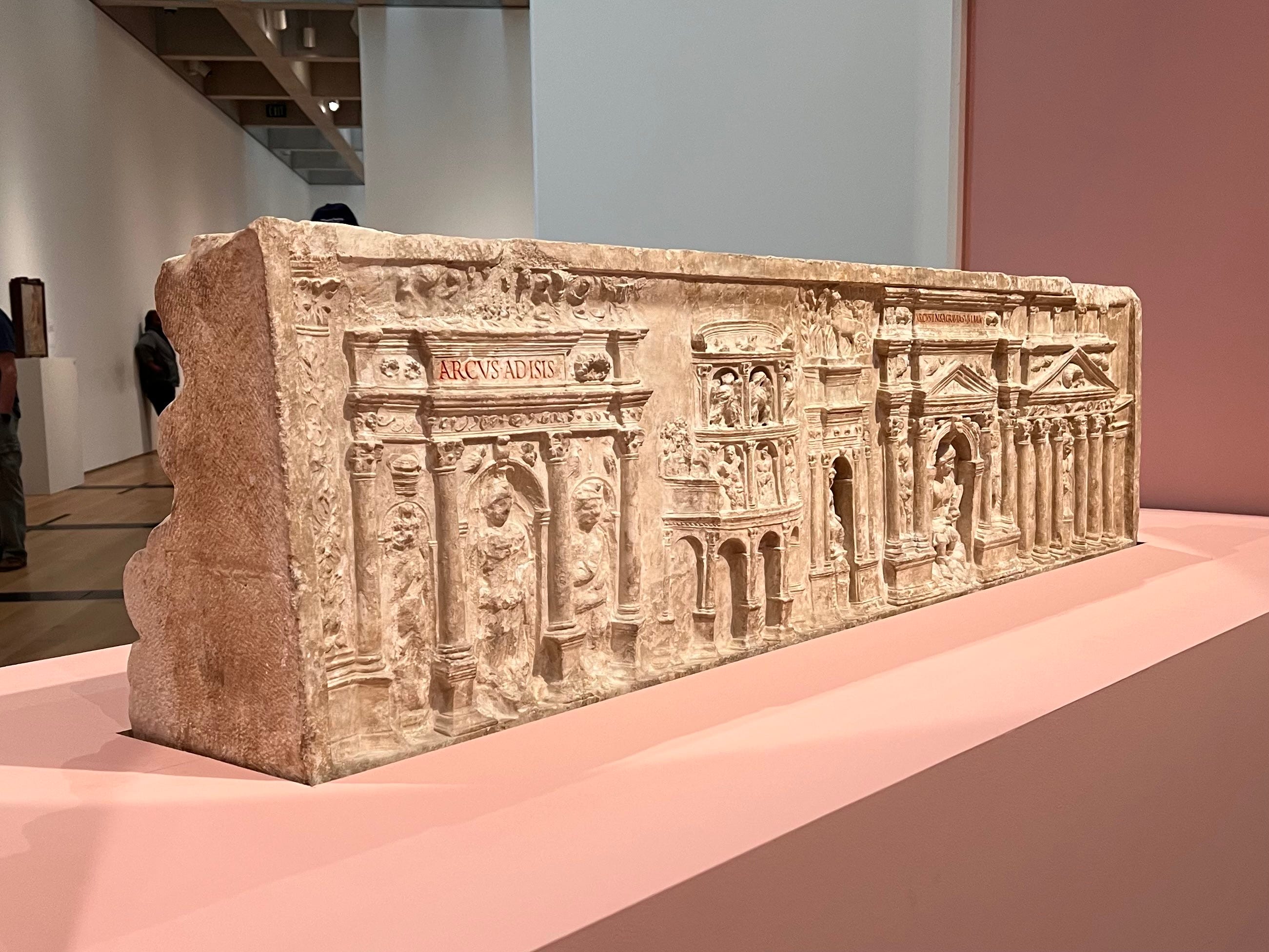
“Ok, so I know I love this exhibit. I saw it in training, and I gushed about it to other folks. I know I want to go back and see it at my own speed. Why can’t I get myself to go?”
This is part of the conversation I had with myself last Thursday. I contemplated the question for a bit, and then I realized the answer.
“OH. This is an inertia moment.”
If you’re not sure what an inertia moment is, it’s because I made up the phrase to help my kid out.
He loves going to his grandparents’ house, for example, but when he’s home, happily playing video games or building LEGO or watching TV, he just doesn’t want to go there. He says it’s “BORING.”
But, when I persist, and get him there anyway, he’s soon asking me, “Mom, when are you going to leave??” He wants his grandparents to himself, without me distracting them with talking. Clearly, he loves being there.
Transitions are the problem. It’s well known in the parenting community I’m part of. Our kiddos just don’t want to change what they’re doing when they’re happy with it, no matter how much they like the other thing.
Heads up about the timing of the transition help a lot. First, a few hours ahead of time to let him know the plan, then maybe 15-30 min before leaving, then 2 minutes before the current activity needs to stop.
But the last couple months, the countdown wasn’t quite enough to ease the transition. After a month or so, I realized I could try explaining what might be going on, and he could perhaps use his improved, 6-year-old reasoning skills to notice what was happening.
And soon, the phrase “inertia moment” was born.
Terminology can be so helpful for understanding something. Name it, and it becomes more concrete. It becomes something we can hold and consider, rather than an amorphous blob that’s hard to track down.
It’s worked to such a degree that now he says, “I know what you’re going to say, Mom. It’s an inertia moment.” YES! You get it, kid. Good noticing.
I’m borrowing “inertia” from physics. It’s the word that describes how an object likes to stay the speed it’s going. Not only “staying still,” as we tend to use it in common language, but also continuing to move the way it’s moving, like how a ball keeps rolling across a smooth floor for a while after you push it.
(It’s friction and maybe gravity that slows down the ball over time. Ask someone who’s more recently studied physics for the details.)
So why didn’t I want to go to the art musuem to see this fabulous show? Because I was doing something else that I was used to. Staying home and playing video games or reading or watching TV. (Clearly my kid and I have some things in common.)
And then, realizing it was an intertia moment gave me the ability to hold the problem and navigate it.
I told myself about why it was important to me. It had art objects that were in my Roman archeology and art textbook. I could go see them in person, something that I’ve always held important about appreciating art.
When I took Impressionism in college, my professor told me that I was the only student she could remember who chose to study an artwork that was in our college’s art collection for their research paper. Everyone else chose to study a picture in a book over visiting the Print & Drawing Study Room and getting up close with a real piece of artwork. What??
So, now I knew the reason to change what I was doing, and then I could take a look at what was keeping me at the speed I was going.
I was worried it would be too crowded for me, with it being the last few days of the show. I was worried they wouldn’t have a ticket for me, despite getting myself there. I had had a long day (long couple weeks) and doing something usual to my routine felt big, big, big.
I went through them one by one. If it was too crowded or they didn’t have a ticket, I could go home, or I could wander around in another part of the museum. If it turned out I wasn’t connecting with the art there, same thing. Just because I started something doesn’t mean I have to keep doing it. (Sort of the opposite position of an inertia moment, now that I think of it.)
And I got myself there. It wasn’t too crowded and they had a ticket for me, and I know now how I most enjoy exhibits, and I gave myself permission to see the show that way.
Having this term, “inertia moment,” helped me ge there. I can name the problem, and overcome it.
Mentioned in this issue: “Relief from the Tomb of Haterii,” 100-110 CE, from Rome, Italy’s (photo at top); inertia and Ancient Splendor: Roman Art in the Time of Trajan (which is now closed, and the next temporary exhibit will be Women Impressionists and the Land!)
No posts
Comments
Nothing yet. Say the first thing.
Sign in to join the conversation.