

Anthony Bourdain had one of those lives that could have gone either way. He was either going to wind up in a gutter somewhere or on top of the world. He somehow ended up with a foot in both places, a globally celebrated food maestro who took his own life in 2018.
Anyone with even passing knowledge of his legend knows the basics: brash, callow kid who wandered into a kitchen, eventually became a top chef, wrote a best-seller exposing the grubby underworld of restaurateuring, and then traveled the globe eating and talking about food for his various TV shows.
Bourdain was anointed the rock star of the culinary world — something people had thought impervious to coolness.
“Tony,” directed by Matt Johnson from a screenplay he co-wrote with Matthew Miller, Todd Bartels and Lou Howe, is the prologue we didn’t know about but needed. It’s the story of a college summer Bourdain spent in 1976 pretending to be a promising writer, but instead slaved away in a seaside kitchen, chasing an indifferent girl and his own deluded self-image.
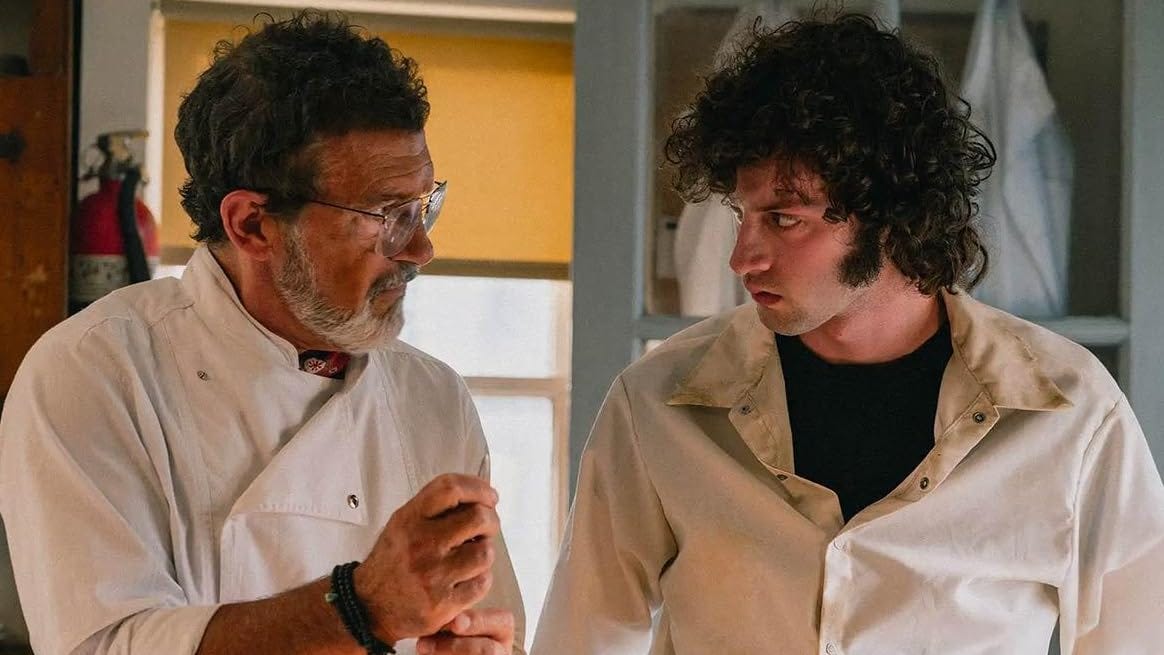
As portrayed by Dominic Sessa in a quietly fabulous performance, young Tony (as he preferred to be called) was a puckish, Holden Caulfield-like twerp who most people took an instant dislike to. He’s an inveterate liar and braggart. The kid, with his bad linguine hairdo and perpetual slouch crying out for a chiropractor, seems desperate to impress everybody he meets, or at least piss them off — anything but be ignored.
The real hat trick Sessa and the filmmakers pull off is actually making us care about this tool.
The secret ingredient that helped turn this sour bouillabaisse of a human into something like a well-rounded meal was another person finally taking his temperature. In this case, a seasoned chef played by Antonio Banderas who shows Tony there’s something more to life than always putting on a front.
The irony is that the place he owns, a beachfront shack in Provincetown called The Flagship, is hardly fine dining. The menu has four entrees on it, fried fish and lobster rolls and the like, that someone correctly dubs one step up from fast food. But chef cares about what he does, filling the shakers with salt he boils down himself from fresh seawater and making from scratch the ketchup people slop over his dishes.
Chef doesn’t have a name, at least one that anybody who works for him knows. It’s a rogues gallery of lowlifes and nobodies, but they live to cook.
Tony only falls in with this group when he gets drunk and makes an ass of himself in the restaurant. He came to town to hook up with Nancy (Emilia Jones), a girl he followed from high school to Vassar College, who flippantly mentioned she’s working a summer job in Provincetown. He lies to everybody, including his parents, telling them he’d won a fellowship to write a novel.
Robbed and penniless with no way to even get home, Tony is gifted a night sleeping on the hammock on chef’s bungalow porch. He follows the man back to the restaurant to apologize and is conscripted to wash dishes. One day turns into two, and then a week, and then Tony is hooked.
The chaotic energy of the kitchen is infectious: the barked orders, the highly questionable hygiene practices, the way the workers bust on each other mercilessly while passing around a vial of cocaine to keep themselves upright and buzzed. Chef pretends not to notice their mischief, though the one thing he’ll not let pass is the Lord’s name taken in vain.
Tony finds himself in a bromance with Sal, a rowdy older lout played by Leo Woodall. A tattooed townie, Sal owns the effortless cool that Tony works studiously at without much success. He’s free with his fists and can talk girls into bed in a matter of minutes, always carving out a sliver of wood from the door jamb to mark his latest conquest.
Things go on from there. Tony’s stilted interactions with Nancy eventually lead to something like a softening — she doesn’t really like this idjit, but also doesn’t know what to make of him, and that intrigues her.
“I like the way I feel when you look at me,” he says, in a rare moment of total honesty.
Eventually chef opens the door a little more and grudgingly allows Tony near the food prep. He shows how to shuck an oyster and speaks in reverent tones about the glory of an old-fashioned clambake. Chef isn’t the sort to tell other people what to do, but he’ll impart wisdom if someone proves themselves open to receiving it.
Sessa was such a knockout in “The Holdovers,” holding his own going toe-to-toe with Paul Giamatti in his very first screen role. This performance seems like his graduation, a mature piece of work playing a very immature youngster. He lets us see the self-loathing behind that sh*t-eating grin, the crushing anxiety Tony’s masking with his bluster and big vocabulary words.
The impression most people immediately had of Anthony Bourdain was that he was effortlessly charismatic. People were just drawn to him and wanted to listen to what he had to say. “Tony” is like the recipe for that man he became, the raw ingredients all jumbled up and ill-portioned— just waiting for a caring hand to shape it all into something sumptuous.
No posts
Comments
Nothing yet. Say the first thing.
Sign in to join the conversation.