
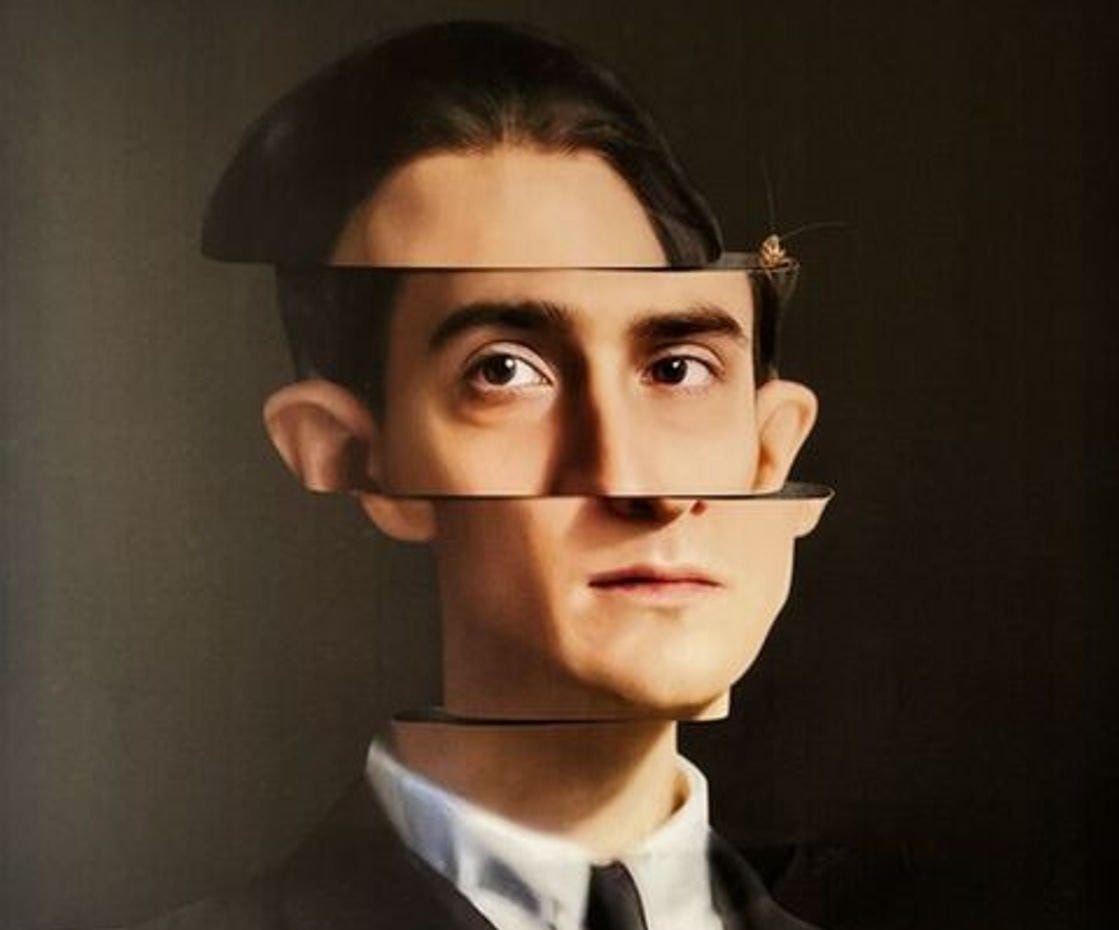

Franz Kafka is one of those Very Important Writers™ we are made to read in high school or college that few people actually seem to relish. (James Joyce shall forever remain their king.) He’s still very studied in academia and revered throughout Europe, and it’s been calculated that for every word he wrote, 10 million have been written about him. His name has become an adjective, Kafkaesque, to describe a state of disjointedness and powerlessness against overly complex bureaucracies.
Having watched “Kafka,” the new biopic from celebrated Polish filmmaker Agnieszka Holland (“Europa Europa”), that description seems apt indeed.
In case you couldn’t tell, I’m not an admirer of Kafka. Perhaps that colored my reaction to “Kafka,” which has a high polish and lofty ambitions. It’s an interesting movie, but curiously flat. I never found myself emotionally connected to the character, and indeed the main takeaway seems to be that he remained something of a remote cipher even to those who knew him.
Idan Weiss plays Kafka in the film, which doesn’t tarry much on his childhood or education, nor his last several years languishing in a sanitarium to address the tuberculosis that would claim his life at age 40. It’s largely focused on his most fruitful time as a writer, after he became a lawyer and through his failed engagement to a woman. (He actually had several near-nuptials, which the screenplay by Marek Epstein skips over.)
Franz was born to well-to-do parents in Prague in what is now the Czech Republic, ethnically German and non-observant Jews. He and his father, Hermann (Peter Kurth), could not have been more unalike — the loud, boisterous, bullying patriarch more concerned with business success than familial harmony, compared to the timid, bookish son who wanted to write more than anything else in life.
The sound design is often dissonant and intrusive, strange clangs and whispers, suggesting that Franz was overly sensitive to noise and distractions, among other challenges. Some have suggested he even had a schizoid personality. Most people simply saw him as reserved, with a dry, often incomprehensible sense of humor.
One of the early scenes shows him giving a reading of his latest work at a literary club, and the story (“In the Penal Colony”) of a man being tortured by a device that writes his crimes on his flesh prompts half the audience to leave — but the half that stays, adores it.
Among them is Max Brod (Sebastian Schwarz), a fellow writer and lifelong friend who encouraged Franz’ creative outlets. Indeed, only a small portion of Kafka’s writings were published during his short lifetime, and he asked Max to burn the rest after he died. Instead he saved them and shared them with the world, making Kafka a literary sensation.
“It was impossible to hate Franz. He had the innocent charm of a martyr,” Max says.
Franz takes a job with an insurance company, rapidly rising through the ranks despite a total indifference to the position. Instead, he spends every spare moment he can writing — always by hand in longform. The film doesn’t go very much into the creative process or the substance of his stories, or how they were inspired by real life experiences.
He gloms onto his fiance, Felice Bauer (Carol Schuler), almost by chance, even describing her ugly features upon first meeting her in a letter to a friend. (Kafka was an obsessive letter writer, often two or three a day.) He spent a few years dithering around with Felice, even writing smitten letters to a friend of hers, Grete Bloch (Gesa Schermuly), before finally calling off the wedding.
He also had an affair with a married woman, Milena Jesenská (Jenovéfa Boková), who reached out to translate his works. The film also depicts a close relationship with a favorite sister, Ottla (Katarina Stark), who quietly stands up for him against their father’s latest rages.
There are some strange moments of inspiration/delusion representing Franz’ inner thoughts, like a recurring daydream that he has webbed fingers. He also seemed to have a penchant for nude calisthenics with large groups of other men, making for some humorous outings. Holland is the rare female filmmaker who seems to genuinely appreciate and even fetishize men’s bodies, perhaps a conscious upending of the traditional ‘male gaze.’
An interesting, though I don’t think entirely successful, choice by Holland is to intersperse modern sections into the movie, centered around museum and tourist explorations of Kafka’s life as somewhat bored guides drone about this or that detail to paying customers. There’s even a laugh-out-loud scene where one brings his group to a pub to supposedly partake of the same vegetarian food Kafka liked, a passed wad of cash from the proprietor signaling the authenticity of this gastronomy.
It’s a creative move, but it ends up feeling like they’re just stopping the movie to explain it to midwit sorts (like me) who don’t fully appreciate Kafka’s brilliance.
I think it entirely likely that someone who is more a devotee of Franz Kafka’s work will be intrigued and engaged by “Kafka.” For me, it’s two-plus hours of storytelling about a man who begins and ends the film as an inscrutable mystery.
No posts
Comments
Nothing yet. Say the first thing.
Sign in to join the conversation.