
As a general audience, we’re not strangers to the appeal of celebrity biopics in cinematic spaces. The allure is practically baked into its formula: center a well-liked or controversial figure in the middle of a story with an interesting upbringing or rise to power (oftentimes both) and use their public familiarity to make a potential boatload of cash. However, for many great biopics that we’ve seen over the years, ranging from historical epics like Lawrence of Arabia (1962) and Amadeus (1984), to contemporary marvels like Goodfellas (1990) and The Wolf of Wall Street (2013), there’s a fair share of mediocrity in the format as well. Recent musical biopics like Bohemian Rhapsody (2018) and Michael (2026) are especially egregious in that their means of existence is less an exploration of the subject’s rise and fall to greatness, but more a glossy public relations attempt at packaging familiarity. Despite the productions’ best respective efforts to bring prestige directors with seasoned careers into the mix, the direct involvement of the subject’s estate is often the final nail in the coffin, airbrushing all of the flaws and unseemly narratives out of the picture. It’s one of the worst ongoing trends in recent cinema, and they keep making money hand over fist from general audiences. Frankly, I’m tired of it.
However, I imagine if Anthony Bourdain, the world-renowned chef, traveler, and author who sadly died of suicide in 2018, would have hated his life to have been turned into a similar display. For someone who famously radiated authenticity, blunt honesty, and charisma, it’s hard to imagine that he’d naturally be okay with having his life’s flaws suspiciously redacted in favor of a puff piece rather than presented in an authentic dissection. A biting, more honest portrayal is exactly what Matt Johnson, the Canadian director whose Nirvanna the Band the Show the Movie (2026) set out to achieve, became a quick contender for best comedy of the decade. Instead of simply playing the hits, Johnson, directing from a script he co-wrote alongside Matthew Miller, Todd Bartels, and Lou Howe, focuses on the summer of 1975 when a 19-year-old Bourdain took a summer job at a Cape Cod restaurant. When I first heard of the premise, I was immediately intrigued and saw through the gimmicks that other biopics employ. Instead of cradle to grave, why not learn how the young man became the chef? It was Aristotle himself who famously said, “Give me a child until he is seven and I will show you the man.” Johnson chose to respond by saying, “give me a young man at 19 and I will show you the chef.”
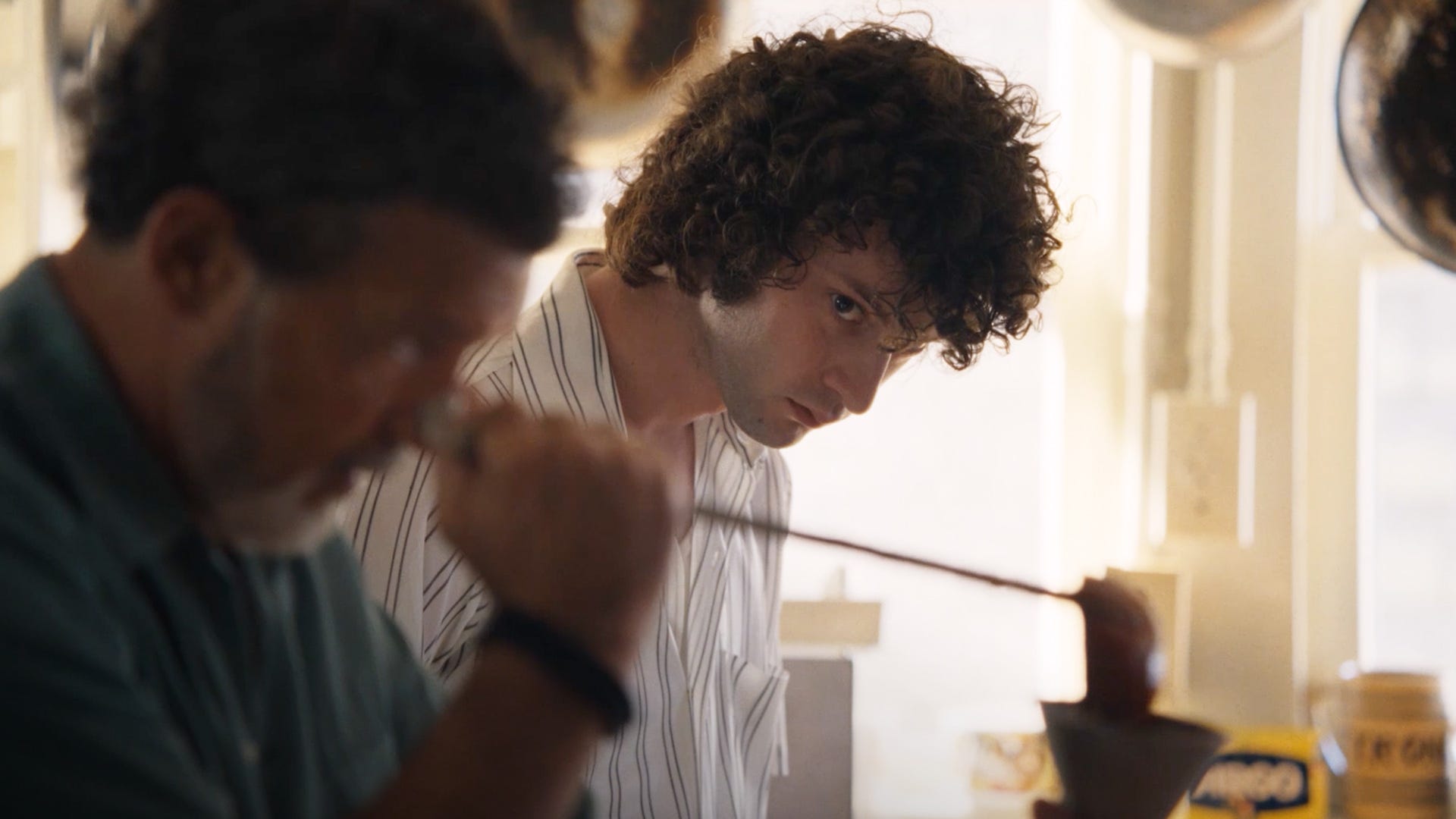
Tony, in its most basic form, is a familiar narrative archetype that many coming-of-age dramas use, anchored tightly to its characters’ flaws, hopes, and the lies they feel they can maneuver their way around. Bourdain (impeccably played by The Holdovers’ Dominic Sessa), then going by Tony (only his mother calls him Anthony), is out of high school and in between jobs as he remains optimistic about obtaining a grant to publish a novel. When he finds out he didn’t receive the grant, however, he takes the next best option for his summer: follow his recently re-acquainted high school crush, (Coda’ s Emilia Jones) to Cape Cod in hopes of winning her affection. After being rejected and drinking himself stupid at a local restaurant, he gets into a fight with the owner and passes out on the street. Without any money to get back to his parents’ home, he asks the only person on the island he can for help: the owner of the restaurant who threw him out. The owner, played by Antonio Banderas, gives him a job as a dishwasher, allowing him to work in exchange for a place to crash.
As an archetype, Tony has familiarity. The lies that stack on top of one another like Jenga blocks and are doomed to eventually be found out become tiresome after a while. However, Tony is at his best when it’s examining Bourdain as a rebel without direction, which Sessa portrays with tremendous aplomb. Through his performance, we rarely see a caricature but rather, an exemplification of what it means to be young, spontaneous, and unassured. Whether he’s navigating house parties with nervous swagger, receiving advice or jeers from a kitchen of cohorts (Leo Woodall and Stavros Halkias, both of whom have never been better), or warming up to his curmudgeonly caretaker, Sessa commands the screen in a performance that dominates a majority of the film. However, the real MVP is Johnson, who emenates personality and direction in a long filmography of fuck-ups attempting to grow up. I can only imagine that Bourdain would be glowing with pride if he could see what he has accomplished.
Feature image credit to A24 via Rotten Tomatoes
No posts
Comments
Nothing yet. Say the first thing.
Sign in to join the conversation.