
SO YOU WANT TO DIRECT A FILM?
Congratulations!
But wait....
Before you cast a single role, plan a single shot, or scout for that “perfect” location, you MUST know the “blueprint” you’re working from!
What TYPE OF SCRIPT are you directing?
This is the main factor that will save you months of confusion, and your answer will instantly tell you what rules you’re playing by, where your biggest risks live, and what you must master to deliver a strong film.
What TYPE OF SCRIPT are you directing?
(1) Are you directing your own script? From the very first word, you get total freedom. The creative gift of living inside the story from the very first word. You protect every heartbeat you imagined. Every nuance. Every quiet moment that only you can see.
But here’s where the real magic happens: when you find the courage to step back. To cut scenes or dialogue you love, because they don’t serve the final story. When you do that, you stop “protecting pages” and start creating a movie that evolves into something even deeper than you wrote.
What TYPE OF SCRIPT are you directing?
(2) Are you directing another writer’s script? Your result depends on your ability to translate someone else’s story into a finished, cinematic experience without losing what made it worth writing in the first place. When you collaborate well with the writer and producers, you gain trust, reduce conflict, and make faster decisions that keep the shoot moving and the story intact, while still stamping the film with your voice.
What TYPE OF SCRIPT are you directing?
(3) Are you directing a television episode or a vertical drama? You’re stepping into an existing universe. Your job is to deliver an episode that looks and feels like the show, while elevating every moment with your personal touch. When you do it right, you protect continuity, keep the producers happy, and leave the series stronger than you found it.
What TYPE OF SCRIPT are you directing?
Whether it’s a short film, feature film, TV series, or vertical drama, the outcome is the same: the director who knows the script type knows where to put their focus, what to prioritize, and how to lead the production with confidence.
That confidence doesn’t come from luck. It comes from the number one skill that creates clear decisions, stronger performances, smarter shot choices, and fewer expensive surprises:
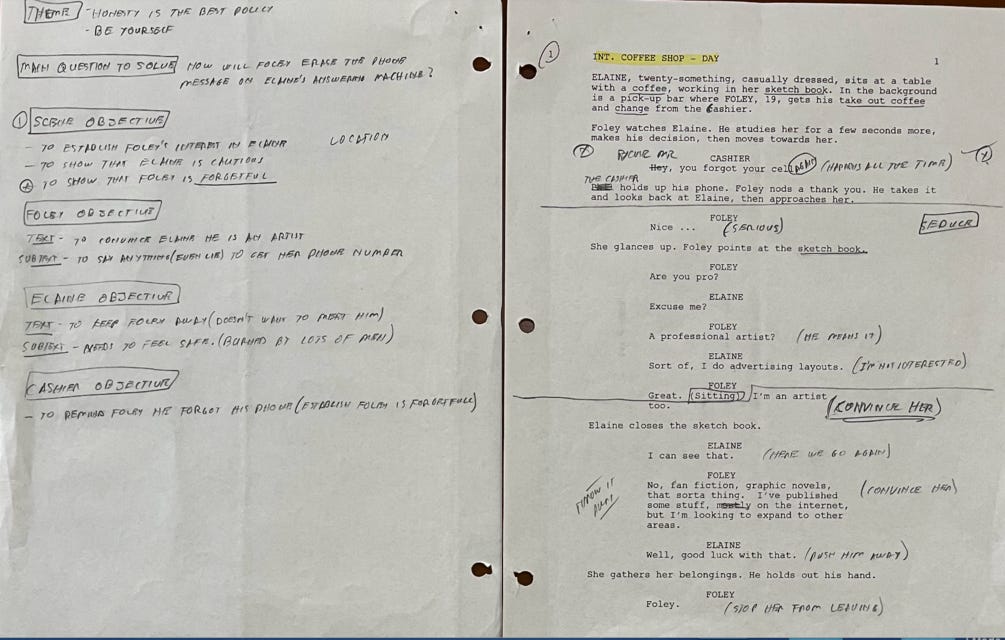
Detailed Script and Scene Analysis!
Because when you truly understand the story inside out, you can build a production plan that holds up, protect the heart of the story, and bring the film to life the way you intended.
“The Importance of Detailed Script and Scene Analysis for Every Director on Every Film, Every Time”.
https://filmdirectingcoach.gumroad.com/l/DetailedScriptAnalysis
TABLE OF CONTENTS
The content presented in this 60-page ebook is based on my personal experiences (over 30 years) as a Television director and feature film 1st Assistant Director, as well as over 20 years of teaching film students and live directing workshops worldwide.
INTRODUCTION (We are on the Clock!)
1. So You Want to Direct a Film?
CHAPTER 1: The Director’s Relationship with the Story
1. The 4 Stages of “Writing” the Final Script
2. 10 Main Scene Category Descriptions
3. The Director’s First Task When Getting a Script
4. The Foundation of all Drama is Conflict
5. The Four (Main) Sources of Dramatic Conflict
CHAPTER 2: From Story Scripts to Shooting Scripts
1. Differences Between “Good Scripts and Bad Scripts”
2. What to Look for on “Your First Reading” of the Script
3. Creating a Shooting Script from the Story Script
CHAPTER 3: Basic Story and Script Analysis
1. The Script: Story Analysis Overview
2. The Script: Your FIRST READING
CHAPTER 4: Detailed Story and Scene Analysis
1. The Script: Detailed STORY Analysis
2. The Script: Detailed SCENE Analysis
3. Text, Subtext, Context, Pretext
CONCLUSION (That’s a Wrap!)
1. My Advice for Filmmakers (Young and Old)
2. As a Filmmaker, You are Also an Artist
3. “Mastering the Art and Craft of Directing”
“The Importance of Detailed Script and Scene Analysis for Every Director on Every Film, Every Time”.
https://filmdirectingcoach.gumroad.com/l/DetailedScriptAnalysis
NOTE: LIMITED TIME ONLY: For the price of a cafe latte in New York or Los Angeles, I am offering this 60-page book for only US$5.00!
No posts
Comments
Nothing yet. Say the first thing.
Sign in to join the conversation.