
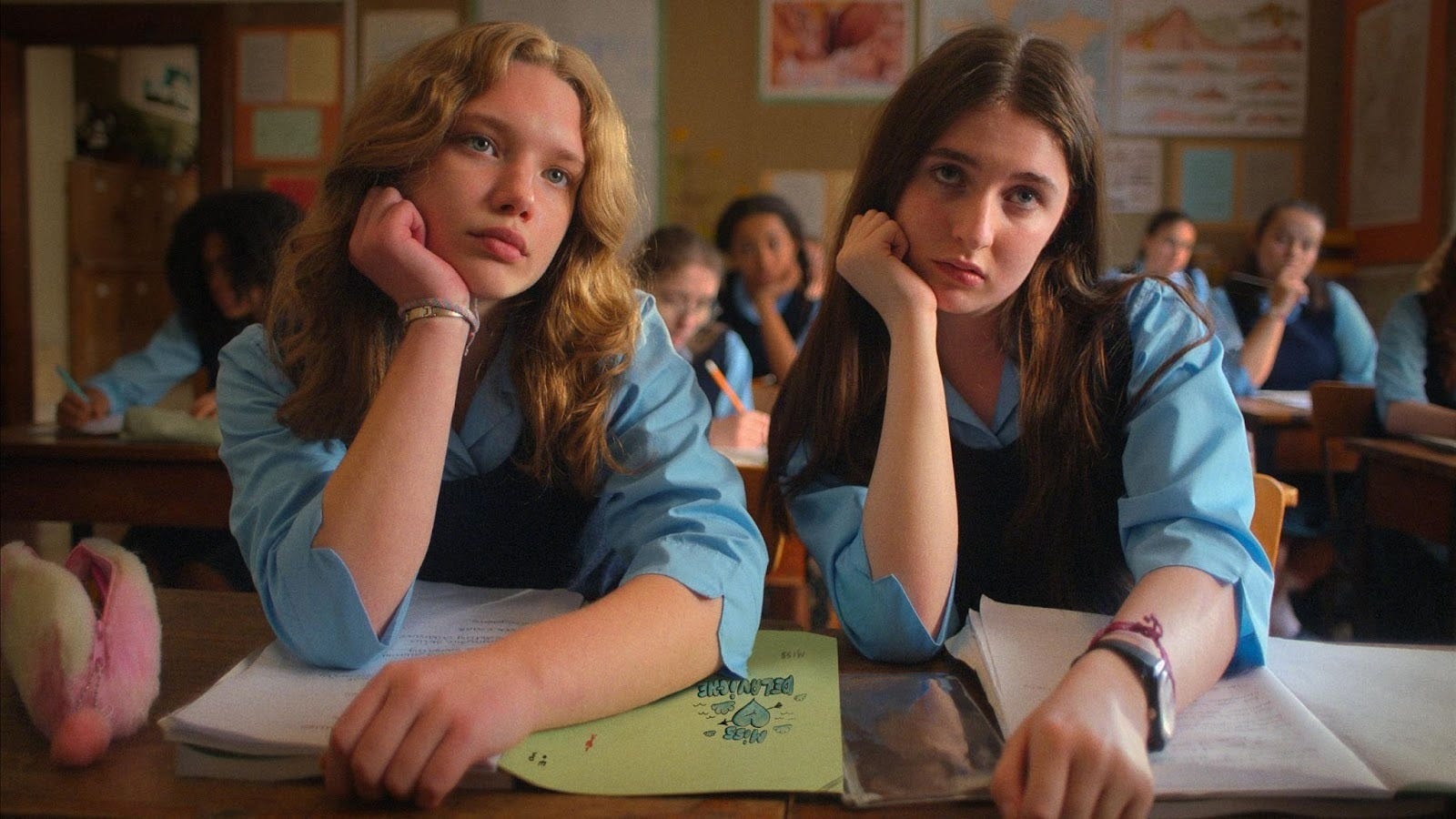
Extra Geography’s greatest attribute is an outstanding sense of place. When we first meet our main duo, the eccentric and inseparable high schoolers Flic (Marnie Duggan) and Minna (Galaxie Clear), we also meet their all-girls boarding school in Yorkshire. The two traverse with leisurely confidence through sprawling greens, ivy-wrapped teacher’s cottages, and storybook dark wood halls that encase linoleum bathrooms, stickered lockers, and well-equipped science labs; half run of the mill highschool, half a fantasy of British fairytales. The two girls are an undeniable unit, often pressed arm-to-arm as if stitched together, as they, in unison, open their notebooks, snap on matching protective goggles, or scrub their teeth in the girl’s lavatory. There is no need to have a heavy-handed expository line about this film being set in the early 2000s: the clothing, hair accessories, and garish bedspreads tell us exactly where we’re meant to be. Flic and Minna’s world exists in a cozy and compact container, they can easily choose to be each other’s everything because their options are delectably limited. The world that these characters play in is deliciously stylized, providing a skillfully actualized introduction to Flic and Minna’s ecosystem that isn’t tropey or retrod.
Minna and Flic’s unit (and cozy schoolground vessel) seem impossible to unsettle, that is until their school decides to combine their summer play program with the neighboring all-boys school. The boys hijack morning mass with a sanctioned, playful collection of dialogue from A Midsummer’s Night Dream, triggering a Beatlemanic response as the crowd of sixteen year olds scream into their hands.
For Minna, the co-ed play seems like a wonderful option for Flic and her annual “summer project”: an extracurricular, self-made, entirely un-academic scheme that the duo utilize to become more holistically well-rounded for university applications. Flic is less certain; they have decided as a unit to hate boys, for one, and she’d rather a more exciting spiritual project, like falling in love with someone. The girls at first gamely agree to a “both and” situation: the play and falling in love.
Because of the limits of their social enclosure, Flic and Minna select their geography teacher as their potential muse — the bespectacled, frumpy, slightly touchy Miss Delavigne (Alice Englert). Extra Geography does not make this a meditation on sexuality, because that isn’t the point of the summer project. The point is to enact falling in love, to force the butterflies, in order to unlock the essential portion of life.
Despite being a fairly clean, and at moments even innocent film, Extra Geography shares more DNA with Superbad than more try-hard attempts (I’m looking at you, Booksmart) in its “falling in love” storyline. Both films portray adolescence as a time of un-detanglable, inarticulate knot of internal desire meeting an exigent need to follow social scripts, to make regimentation and regulation around something as complex and nebulous as love or sex.
But as Flic and Minna’s interests begin to diverge, Extra Geography begins to lag. Where Flic really does hate boys (whether this is a matter of clinging to youthful cootie fears or a burgeoning queer desire is unclear), Minna is open to introducing them into their lives through the play. Where Minna has been cast as Titania, queen of the fairies, Flic has been cast as the humiliating and vague “Tree/Mound”, a telling comparison of their lived experience as Minna enters real flirtations and Flic enters a cycle of social, romantic, and sexual rejections in situations she doesn’t even really want to be in. In turn, when Flic connects more meaningfully with Miss Delavigne, Minna jealously decides that the “falling in love” summer project isn’t interesting. Their push-and-pull, bicker-and-make-up pattern is repeated one too many times, and save for one genuinely surprising moment regarding Flic and Minna’s attempt to fall in love, Extra Geography falls flat in the third act.
What is wonderful and then ultimately frustrating about Extra Geography is that for two-thirds of the film, it knows exactly what it is. It’s confident and clear in tone and story. But in the final third, the film entirely loses the thread — structurally, energetically, and even, most disappointingly, in understanding the core relationship between Flic and Minna.
It’s more notable when the top students fall short, and Extra Geography suffers from the same curse.
No posts
Comments
Nothing yet. Say the first thing.
Sign in to join the conversation.