
There have been many memorable films built around the balance between a person and a dog. What do you think separates the truly great ones from the best?
I think for me, the same thing is true about any film that is an animal-based thing, or the same thing, honestly, with something like The Muppets as well, which is, I think it’s like a Michael Caine quote as well: you’ve got to just treat everyone as if they’re human, and you have to treat everyone as if they’re an actor that you’re working with.
But I think the truth is, you’ve just got to treat the dog the same way you treat any character and give them complete respect and courtesy, and honour them. And if you do that, you’ll get the best out of that character.
but I was always surprised by how underexplored Laika’s story is in film media. What was it about her story that made you think, “This is the film I want to make”?
there are times where I’ll be working on a film, and it’ll take months and months. And I’ll be trying to work out every beat. I’ll be going through every avenue, trying to see what’s the issue with it. And there are times where I’ll hear about something or read about something, or I’ll think of an idea, and it will just flow out straight away.
And for me, that was it with this film, where I had read something about the backstory of this film. It was a true story that the scientist actually did take Laika home to spend time with his family. The film isn’t based on anything beyond that. It’s not based on the actual scientist.
But I heard about that, and just instantly everything formed: the relationship between the father and daughter, Laika’s integration into the story, the scene on the hilltop where they’re talking about the emotions and talking to the animal. And it just all came into such vision.
And I love everything to do with movies. I love Apollo 13, Interstellar, any film you want to talk about space. I’m there for it. But there was something just so small and intimate about the story and so beautiful about Laika’s experience, but just completely tragic, that when I heard about it, I couldn’t help but want to make it.
You're basically taking this tragic story of a figure that became a symbol, and you integrate it into an intimate family story. How did you manage to balance them out without overshadowing each other?
the main truth of it was I felt Laika was almost an observer to what was going on with this family. And so I think they’re both trying to get something out of Laika.
And at the same time, I used to have a little dog that honestly looked like Laika. And when I was eight or nine, I used to say everything I felt to this dog. I would tell him everything I felt about the world. And it was stuff I felt like I couldn’t share with anyone else, but to this dog I could.
And for me, the truth was I never treated Laika as a symbol. I never thought of her as what she became. I always thought of her as this little creature that had never known proper love, that had never known affection, that grew up on the streets of Moscow, and how she was used and ultimately died in such a sad, awful way.
it was sort of what makes her story like the daughter’s story, what makes her story like the dad’s story, and just treating them all as little individual people, rather than trying to ascribe any great symbolism in terms of Laika’s celebrity . And then the same way you’d write any family drama, just letting them all be part of that unit.
it's all set in Moscow in '57. And with a short film, you often have to suggest a much bigger world than you can physically show. How did you approach thinking outside the box to create the scale of the Soviet space program while keeping the story intimate?
There was this element of, I knew how low our budget was. I knew how we weren’t going to be able to film. We didn’t have enough days, basically, to go and film in actual Brutalist areas and stuff like that.
So it was sort of, we filmed in my flat, we filmed in the car park down the street, and we filmed in the field. And then the stuff of the Soviet space program, that was a lot of little bits of stock footage, or little things we filmed where I would be in a warehouse for an hour with a spinning dial, or the cinematographer went up an elevator with a camera that he had to hide, and filmed that shot of the elevator going up.
And I think the truth was, we hadn’t planned for any of that. But when we were in the edit, we realised there is a huge world going on out there. And the more stuff we do to make that world feel real and feel connected, the more powerful the film becomes.
The whole editing was excellent
thanks so much. Olivier Jones is the editor. And he’s just so talented at finding the rhythm of something, and the rhythm of the scene.
And I remember we were editing to music at one point, and it felt so contrived when we were cutting it to these older tracks. And then I just said to him, “Mute the whole thing, cut it without sound, just picture.” Then suddenly we had this incredible geography of scenes and a rhythm that we hadn’t gotten when there was sound.
And it’s the same way that Eddie Hamilton cuts the Mission: Impossible movies. He says, if you can play it without sound, then the film makes sense. And we actually showed it in Birmingham, and there was an issue with the projection, and they didn’t play any of the dialogue. So all you could hear was the music, and it actually still worked.
how did you manage to make the actors feel the connection with the dog that they can't see, without making it feel like a one-man monologue?
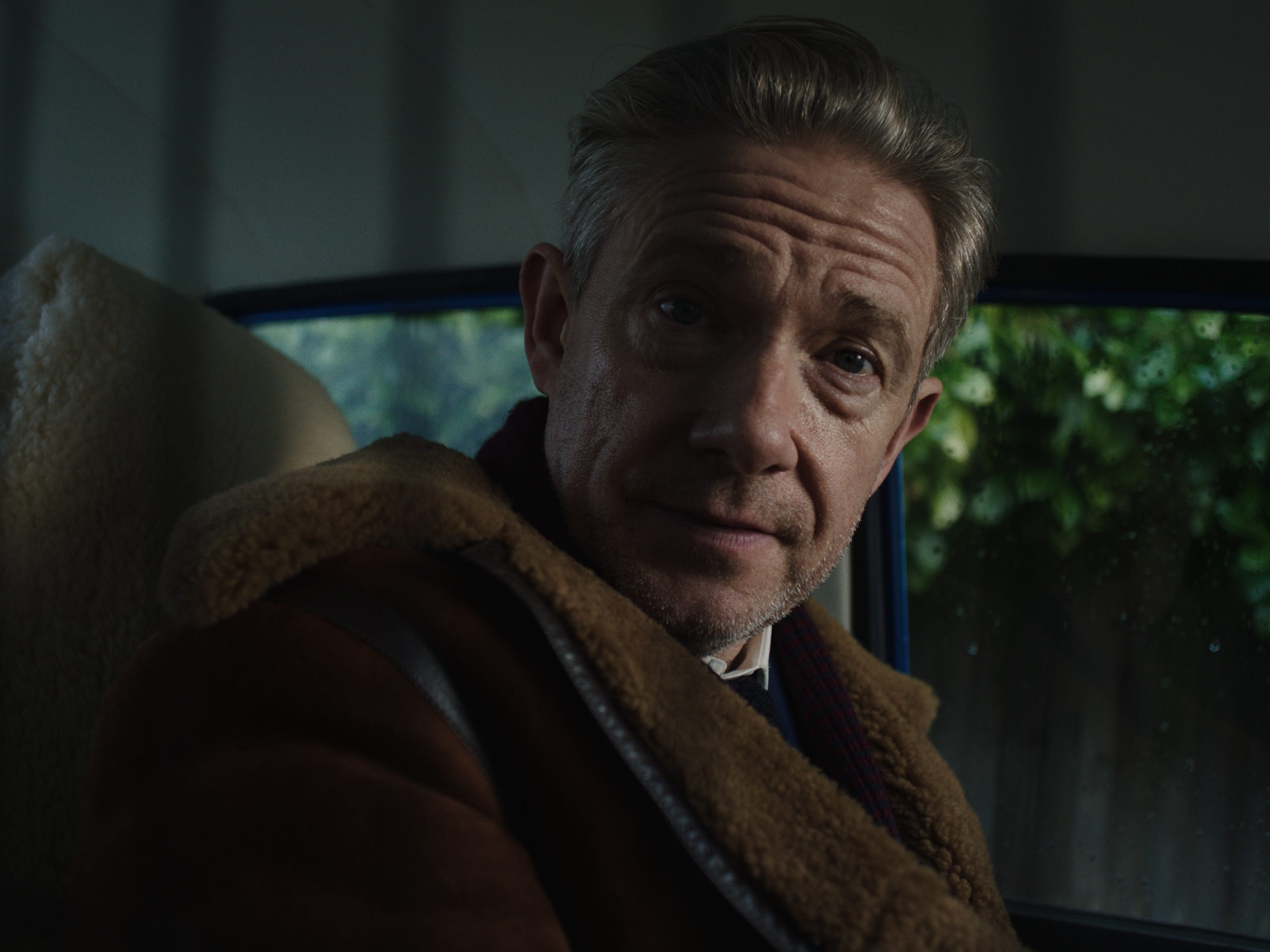
I texted Martin Freeman a day after the film just to say thank you. And he told me that in his memory, there was a dog on the set. And so I think it was just a reality of, like, we just got really great actors. And they performed incredibly well, they did exactly what I needed them to do.
And I honestly just trusted them to go with the scenes. Luckily, they just managed to capture that sense that you’re talking about of talking to the dog. And it was a big thing for me, it shouldn’t feel like a monologue. And it shouldn’t feel like I’m talking to the audience. It should feel like talking to a dog.
Rather than, like, anything else in between, we should feel the presence of Laika.
I think there’s an element of Jake Duncan, who’s a cinematographer. He just has an incredibly responsive camera movement ability. He did all those little tiny motions that make the animal feel alive.
And it really shone in terms of when the actors were there, they could respond to the camera’s movements as if it was another actor. And really, it was another actor. It just happened to be one that we never see.
By the end, did your understanding of her story change while making the film, from what you heard the first time to the last time the camera was cut?
I think, as a director, you kind of have to fall in love with everyone in your film, and you have to kind of understand everything they’re going through. Even if it’s a film where you have a clear villain, you have to have this ability to see why they would do everything.
And for me, when I started, I was thinking of the way you mentioned earlier, as, like, this iconic symbol of space travel, this deeply tragic animal. I thought of her as an animal. And then, as you make the film, and you get so into her mindset, I started just loving her so much, and feeling so sorry for her.
I watched so many clips of her running around these fields, playing, of her being tested. I found the radio interview where she kept barking, that got her the name Little Barker.
I think it’s one of those things, like, what I tried to capture in the film is portraying Laika as someone who was tangible and real, and who was terrified when she died, and someone you can relate to, rather than just a celebrity, and rather than just a symbol of travel, and where you can see a statue of her.
No posts
Comments
Nothing yet. Say the first thing.
Sign in to join the conversation.