

For the reasonable price of just $5 AUD per month or $50 per year, you can be a full subscriber to Filling the Pail with complete access to my extensive archive on a range of topics, as well as access to the unabridged version of my weekly Curios posts.
At time of writing, it has been four days since I emailed the address given on the About page of the Australian Centre for the Public Understanding of Education (ACPUE), asking who they were. So far, I’ve had no response. ACPUE is not just a lone anonymous blogger. It presents us with a supposedly academic—albeit deeply flawed—critique of a report by the Australian Education Research Organisation (AERO) that I wrote about here. If those behind it are indeed academics, then this presents an ethical issue because academics have a duty towards transparency, credit, and accountability, something their institutions presumably insist upon.
Examining ACPUE’s supposedly forthcoming projects, it is clear it is not an impartial actor—the Centre has issues with anything broadly related to what’s become known as the ‘science of learning’. There’s nothing intrinsically wrong with that, but presenting the exercise as a neutral-sounding attempt at ‘public understanding’ seems a little misleading to me. Coupled with evidence of an organised campaign against AERO by Australian education’s old guard (see, for example, here and here) I wanted to know who was behind it.
First, why do I care? I suspect the reason I am a fan of AERO is exactly the same reason its detractors hate it. Notable exceptions aside, Australian education academics have a long history of conducting useless research. They interview pre-service teachers about their attitudes, or they wang on about Foucault. In contrast, AERO provides practical advice teachers can apply in their own classrooms. It records videos to show teachers what this looks like and—full disclaimer—clips from a mathematics lesson I taught last year are in some of those videos. By doing what academics should be doing, AERO poses a threat to their ecosystem.
In the absence of answers, I took to artificial intelligence to try to find out the origins of ACPUE. Initially, I did not make much progress. I found that the ACPUE LinkedIn page was created on 13 August. But then ChatGPT uncovered a nugget of gold. It revealed a LinkedIn post by Rebecca Burtenshaw that included the following:
“…the newly launched Australian Centre for the Public Understanding of Education (founding researchers include people like Robert Hattam who’s always sharing and provoking GREAT discussions) have released a systematic evaluation of AERO’s (2023) report ‘How students learn best: An overview of the learning process and the most effective teaching practices’.”
I replied to this post, asking who the other founding researchers were, but was immediately blocked by Burtenshaw. This means that I cannot provide a link, but I do have a screenshot, if needed.
I had not heard of Hattam before, but it turns out that he’s an Emeritus Professor at Adelaide University. A quick scan of his LinkedIn feed shows him as anything but a neutral commentator interested only in the public understanding of education research. In fact, he seems to have quite a problem with AERO. In replying to lecturer Alison Bedford, who had apparently attended a talk by Hattam about AERO, Hattam states:
“My biggest problem with AERO .. they’re insulting of my whole career as a teacher .. they saunter into our space and claim they have privileged access to THE truth about good teaching. And when I go looking at their evidence it’s bullshit! Imagine pushing dumbed down teaching!”
I posted on LinkedIn about what I had found, tagging Hattam, and he replied. Amusingly, given the above context, he suggested I was being impolite. He did not confirm he is behind ACPUE and he did not answer my questions about who else is involved. But he also did not correct the record and continued to riff on an anti-AERO theme. So, on the available evidence, it seems reasonable to conclude that Hattam is involved with ACPUE. I am happy to retract this claim if Hattam issues a denial.
When examining Hattam’s LinkedIn feed, I noticed something rather odd about his posts, so I ran one of them through Pangram, the most sophisticated AI detection tool available. Pangram appears to be of the view that Hattam’s post is 100% AI generated:
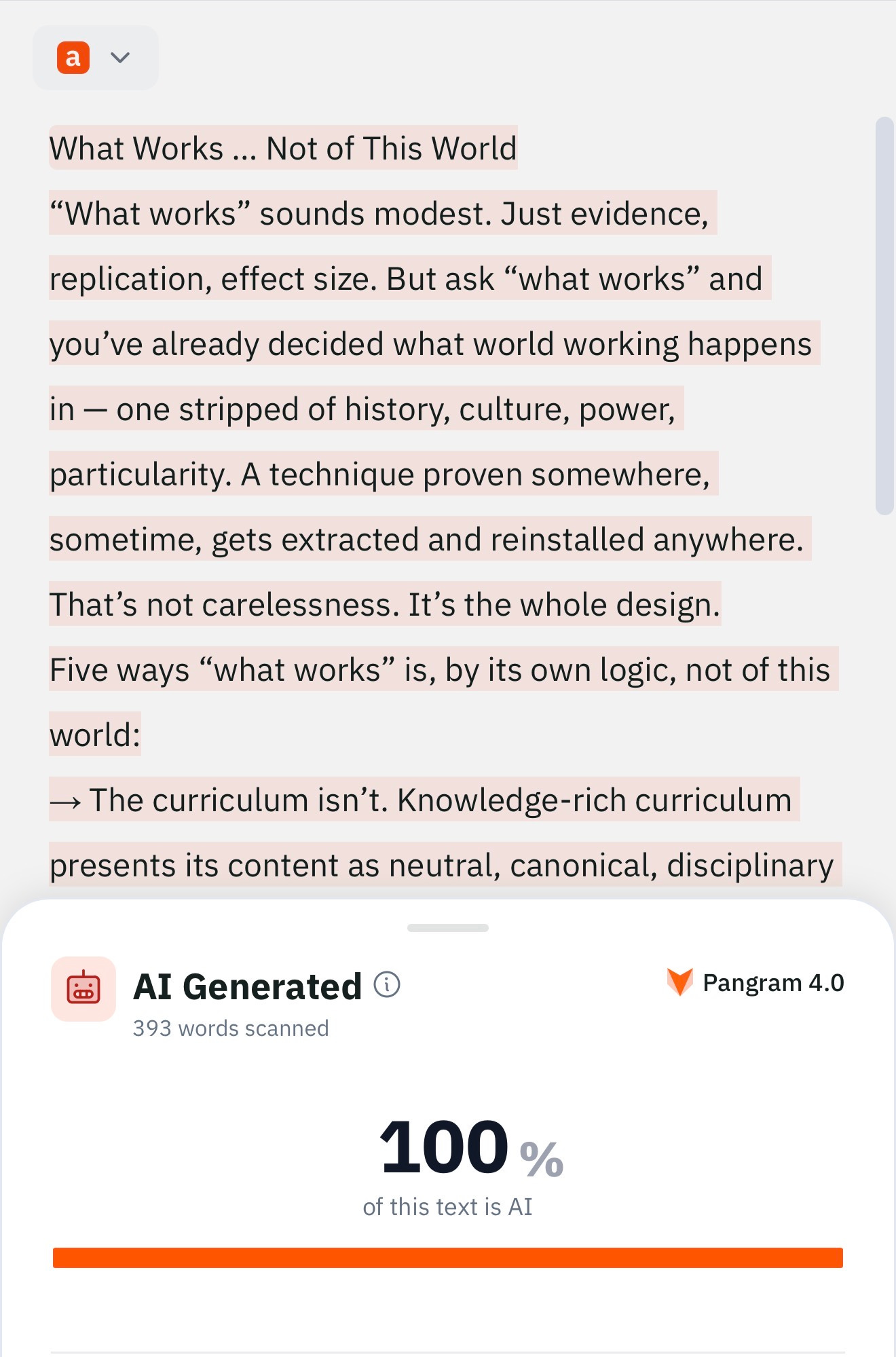
I couldn’t possibly comment on the veracity of Pangram’s assessment; I can only report that this was what it produced. Instead, you should read the post and judge for yourself. And I wouldn’t normally run work through an AI checker but since my last post, I am in pedantry mode.
I went to look up Hattam’s published works and—guess what?—I found an article attacking AERO. Complete with a pretentious quote from Foucault, it seeks to undermine a set of ‘seminal papers’ and therefore has similarities with ACPUE’s attempted takedown of AERO. This paper is co-authored with Wayne Sawyer, Emeritus Professor at the ‘Centre for Public Education Research’ at Western Sydney University. I wonder if Sawyer is involved with ACPUE.
For her part, Burtenshaw seems to be a fairly typical Australian education researcher. Based at Sunshine Coast University, the first article in her public profile is based on a survey of 139 mathematics teachers that asked them what success in mathematics looks like. There’s lots of chin-stroking about the meaning of ‘success’ and concern that too many responses indicate that success meant students being ‘knowers of mathematics’:
“In this domain, success is mostly restricted to knowing mathematics concepts to complete straightforward exercises requiring reproduction of learned facts or procedures – a view reinforced by the domain’s position on the lower end of the Agency-Time Arc. While these indicators of success are important to some degree, they reflect a potentially shortsighted view of mathematics and of the aims of the Australian Curriculum: Mathematics, bearing little relation to students’ lifelong endeavours beyond their temporary time at school.”
Clearly, such research is of no practical value to teachers. It also neatly reflects the way that scepticism about knowledge of facts and procedures is a foundational belief for many researchers—a perverse stance that advocates of the science of learning have been pushing back against.
Finally, someone called Michelle Michael appeared on LinkedIn, responded to my post, engaged in a couple of replies and then blocked me. I can no longer access those posts because I am blocked, but from memory, Michael tried to change the subject, suggest ACPUE was just a small group of critics with a website who did not need to be identified and mock me as a conspiracy theorist.
I always find it interesting when people appear out of the ether and do this. Most of the time, I imagine it means they have been alerted by someone else. As for conspiracies, we have a group of critics who have built a website containing a detailed attack on an organisation and who do not want to be identified. It’s not exactly the alien abduction of Elvis, but it’s also not standard fare.
No posts
Comments
Nothing yet. Say the first thing.
Sign in to join the conversation.