
For the reasonable price of just $5 AUD per month or $50 per year, you can be a full subscriber to Filling the Pail with complete access to my extensive archive on a range of topics, as well as access to the unabridged version of my weekly Curios posts.
In its guidance to schools, the Australian state of Victoria’s government states that mathematics teaching should include ‘explicit teaching of key concepts and skills’. What could be clearer than that? Teachers must explain key concepts and demonstrate key procedures before asking students to apply those concepts or procedures.
Peter Liljedahl would not agree. Liljedahl invented a groovy and increasingly popular method for teaching mathematics known as ‘Building Thinking Classrooms.’ In his book, Building Thinking Classrooms in Mathematics, Liljedahl describes ‘now-you-try-one’ tasks. These are tasks that teachers ask students to complete after a teacher has demonstrated what to do. In other words, these tasks are a form of explicit teaching. According to Liljedahl, this kind of teaching rarely leads to anything good. Students respond by either slacking, stalling, faking, tackling the question but ignoring the teacher demonstration or ‘mimicking’. Mimicking is where students attempt to apply the teacher’s method—in other words, what we would hope students would do in response to explicit teaching—and Liljedahl claims it does not involve thinking:
“Mimicking is very good at teaching students how to replicate routines—the routine for factoring quadratics, adding decimals, dividing fractions, et cetera. So good, in fact, that once students start to have success with mimicking, they don’t want to stop…
…Mimicking is bad because it displaces thinking. Mimicking happens not alongside, but instead of, thinking. Likewise, mimicking is not a precursor to thinking.”
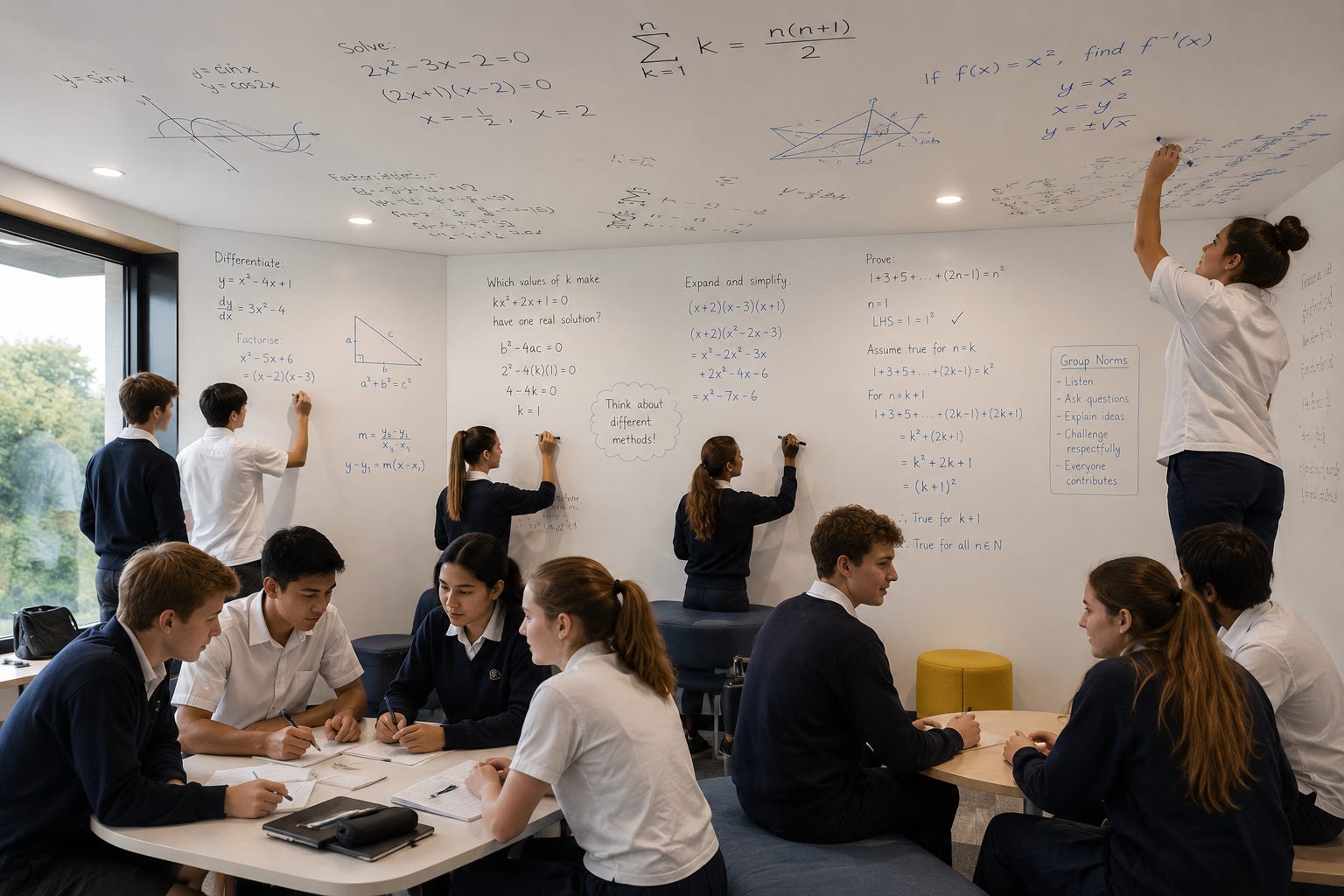
The book goes on to outline Liljedahl’s alternative and highly eccentric approach to maths teaching involving lots of group work, with students writing on the walls or ‘vertical non-permanent surfaces (VNPSs)’ in the approach’s maddening jargon. These are not sensible suggestions for the regular Australian classroom. Attacks on ‘mimicking’ are at odds with decades of rigorous research into the value of worked examples and any use of group work has to contend with the phenomenon of social loafing, where participants in groups do not work as hard as they would individually.
What does any of this have to do with the Mathematics Association of Victoria (MAV)? Last Thursday, I received an email from them. They are bringing Building Thinking Classrooms and Peter Liljedahl to Fitzroy in Melbourne to run, ‘a full-day professional learning experience focused on transforming classroom practice.’
On the event web page, there is a lazy slur targeting, ‘institutional norms established during the industrial-age model of public education’ and a claim that, ‘participants will experience the outcomes of more than 15 years of research.’
Let’s examine that research for a moment.
You might imagine it involved comparing outcomes for students taught using the Building Thinking Classrooms approach with students taught using a different teaching method. That is, after all, the only way to demonstrate it is superior.
I am not aware of any such research. I have looked, but I cannot find it.
Instead, Liljedahl seems to have taken an engineering approach to research—tinkering with classrooms and observing the results. Critically, these results are rarely mathematical outcomes, but instead, observations of student engagement and whether students are ‘thinking’. Remember, this is Liljedahl’s own idiosyncratic definition of thinking and it excludes students attempting to apply a complex strategy a teacher has demonstrated to a new problem—something that, to Liljedahl, can be done without thinking. This is, of course, bonkers.
There is no doubt Liljedahl’s approach has its appeal to a certain kind of mathematics teacher. I can only speculate as to why, but I think it may be to do with how they experienced mathematics themselves and how they would wish mathematics to be. Although inappropriate for teaching mathematics at scale, something like Liljedahl’s approach may be appropriate for a mathematics club or a gifted students’ enrichment program. When students already have a rich fund of relevant knowledge, open-ended tasks are more effective.
Indeed, this is likely to drive a ‘Matthew Effect’ if Building Thinking Classrooms is used in a regular classroom. In other words, the rich will get richer and the poor will get poorer. Students with positive mathematics experiences and lots of knowledge will potentially gain from the open-ended tasks, whereas those without these advantages are more likely to become confused and let their more knowledgeable peers take over, driving a further divergence of performance.
For the reasonable price of just $5 AUD per month or $50 per year, you can be a full subscriber to Filling the Pail with complete access to my extensive archive on a range of topics, as well as access to the unabridged version of my weekly Curios posts.
You may be wondering why it matters that the MAV is so at odds with the Victorian government in promoting Liljedahl’s eccentricities instead of the government’s call for explicit teaching. MAV is a membership body for mathematics teachers and schools and is therefore entitled to take an independent stance. True, but it is also the case that MAV works closely with the Victorian government and receives considerable funding from them. So it is at least a little awkward. If I were Ben Carroll, the education minister, I would be asking some questions.
Because there is one further potential twist to this tale. In a past tour of Australia, it cost nearly $2000 to go and see the Liljedahl show. To be fair, that was for a two-day course hosted at ‘luxury properties’—the web page for those events no longer exists but I recorded the details in one of my Curios posts. The MAV training costs far less—$375 for non-members and $300 for members. I wonder if it is attracting additional funding from other sources and, if so, what those sources are?
I approached the Mathematical Association of Victoria, explaining I would be writing this piece and asking for comment, including on the issue of funding. I received no response.
Update: Post publication, a representative from MAV has reached out to clarify that the Building Thinking Classrooms event does not have external funding to subsidise the registration cost.
No posts
Comments
Nothing yet. Say the first thing.
Sign in to join the conversation.