
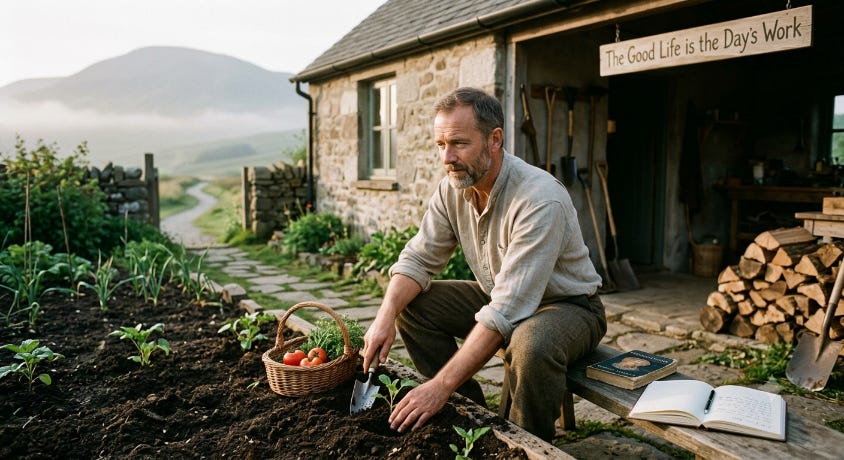
I’ve spent a good deal of time lately thinking, writing, and talking about Stoicism in its many practical guises: the dichotomy of control, the management of emotions, the ethics of relationships, the awareness of mortality. These are the themes that keep coming back, in different forms, whenever the conversation turns to what it might mean to live well. But all of that theorizing eventually has to answer to a much smaller, much more stubborn question: what does a good life actually look like, concretely, on an ordinary day like, say, today?
Because that, in the end, is what it comes down to. Every Stoic idea worth its salt is not a theory to contemplate but a tool to use. And the real test of any philosophy of life isn’t the treatise it produces, but the day it makes possible. To put it as Epictetus did:
“If what I prize is just the interpreting itself, haven’t I ended up as a literary critic rather than a philosopher, with the only difference being that I explicate Chrysippus rather than Homer? So when someone asks me to expound some passage of Chrysippus, I blush at my inability to show him that my actions reflect and are consistent with the words I’m reading.” (Enchiridion 50)
Let’s start with a confusion the Stoics were eager to clear up, and which remains widespread today: the idea that the good life is the same thing as the pleasant life, that is, a life free of difficulty, maximizing comfort and satisfaction.
For the Stoics, the good life, what the Greeks called eudaimonia, does not consist in the accumulation of pleasures or the absence of pain (a la Epicurus). It consists in living in accordance with our higher nature, which for the Stoics is our rational and social nature: living according to reason, in harmony with ourselves, with other human beings, and with the world at large.
This means the eudaimonic life, in the Stoic view, does not depend primarily on external circumstances. One can live well even amid hardship, loss, or illness, because what makes a life good is not what happens to us but how we respond to what happens to us, the quality of character we express, the coherence between what we hold important and what we actually do. Again, Epictetus:
“People are troubled not by things but by their judgments about things. Death, for example, isn’t frightening, or else Socrates would have thought so. No, what frightens people is their judgment about death, that it’s something to fear. So whenever we’re obstructed or troubled or distressed, let’s blame no one but ourselves – that is, our judgments.” (Enchiridion 5a)
It’s a demanding idea, and in a way a consoling one. Demanding, because it strips away the usual excuse of circumstance: we can no longer say “I’ll be happy once I get this or that,” because the good life isn’t deferred to some future condition, it’s available now, in how we choose to live. Consoling, because it means the possibility of living well is never entirely closed off to us, not even in the most adverse situations.
There’s a reason for framing this around a single day rather than a life as a whole, and the reason is deeply Stoic.
The Stoics had a particular relationship with the unit of the day. Marcus Aurelius, Seneca, and Epictetus return constantly to this timescale: not the whole of life, too vast and indeterminate to grasp, but the single, concrete, governable day. Seneca advised settling the accounts of one’s life every evening, as though each day were a life in miniature, with its own beginning and end. Marcus Aurelius prepared himself each morning for what the day would bring, and each evening retraced what had been. As for Epictetus:
“Let not slumber approach your weary eyes before reviewing all that you did during the day. ‘Where did I go wrong? What did I do? What duty did I leave undone?’ After this beginning, run back over your actions, and then reproach yourself for things done badly and rejoice for things done well.” (Discourses 3.10.2-3)
This anchoring to the day is not incidental, it’s the practical recognition of a truth: we don’t live “life” in the abstract, we live a succession of days. And if we don’t know how to live a single day well, the idea of “living life well” remains an empty fantasy. The good life is not some grand project to be realized at an indefinite point in the future: it is what we make of this day, and then the next, and the next after that.
There’s something liberating in this perspective. A whole life can feel crushing, too large, too freighted with expectation, too hard to “make good” in its totality. A day, by contrast, is within reach. We can decide how to meet the people we’ll encounter today, how to use the hours we have today, and how to respond to whatever happens today. A good life, in the end, is nothing more than a sufficient number of well-lived days, one after another.
Let’s try to be concrete. What, in practice, makes a day “well lived” in the Stoic spirit?
A well-lived day begins with a certain preparation: a moment, in the morning, in which we orient ourselves toward what’s coming, reminding ourselves of what matters and what lies outside our control. Not a rigid plan, but an inner disposition. [1. Morning meditation.]
It’s a day in which, faced with whatever happens, we distinguish between what depends on us and what doesn’t, and invest our energy in what is genuinely ours: our choices, actions, and responses, rather than exhausting ourselves over what we cannot control. [2. What, today, is up to me?]
It’s also a day in which, when a difficult emotion arrives, be it irritation, fear, or a sense of being wronged, we don’t react automatically, but allow ourselves that space, however small, between stimulus and response, where reason can re-enter the picture. [3. Own the space between stimulus and reaction.]
Comments
Nothing yet. Say the first thing.
Sign in to join the conversation.