
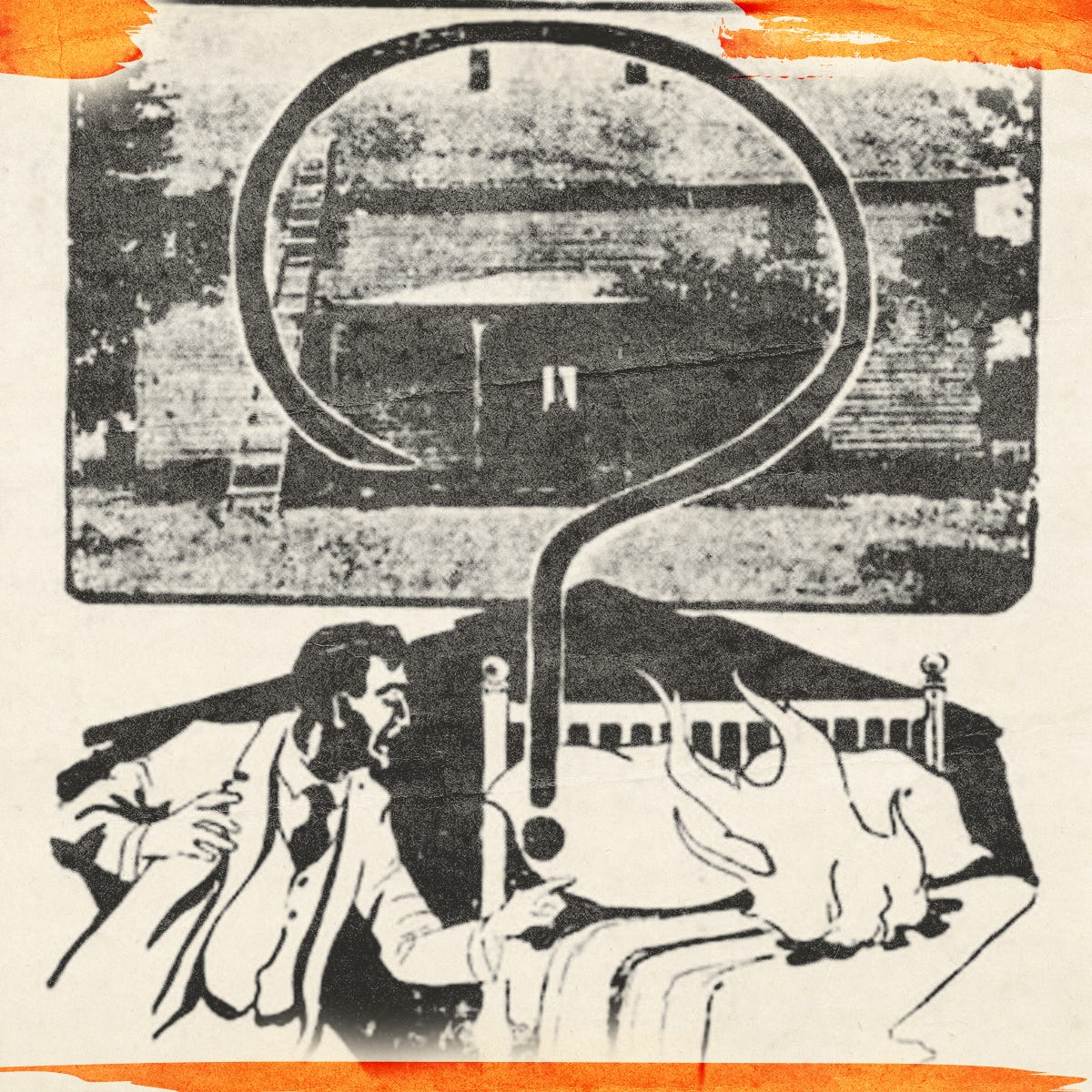
In July of 1922, James Waggoner found himself at the center of a story that set the small town of Norman, Oklahoma ablaze with curiosity.
It all started when his wife opened a wardrobe and a flash of flame sprung out into her face. Soon after that, their roof was on fire. They saved the home, but their night was not over. James washed his face after fighting the roof fire, and the rag burst into flames.
The family was terrified, but they could not alert authorities until morning. Their farmhouse was two miles from Norman, and Mr. Waggoner could not take the chance of leaving his family alone to travel the distance at night.
While they slept, and waited for morning, the bedspread caught on fire.
Each time, there was no source of ignition. The flames leapt from nowhere and either died on their own, or were choked out by efforts from the family.
By the time the police were notified, rugs had burned through, curtains blazed, and a wet rag had caught fire in the kitchen.
Sheriff Bill Newblock sent men to the home to investigate. By then, twelve fires had burned over the course of two days. Details of the event are hard to come by, since, according to the Cleveland County Sheriff’s Office, they don’t have any retained records from that era. We can’t know Newblock’s exact thought process. Since the event didn’t result in any charges being filed, we can’t even be sure records were created at all.
However, contemporary newspaper reporting confirms “heavily armed” men were stationed at the Waggoner farm. An investigation began.
Word in a small town travels quickly. The citizens of Norman and surrounding areas had already heard tales of the strange fires and flocked to the property to see if they could catch sight of one of these paranormal flames. The crowds of visitors left the sheriff and Mr. Waggoner on edge. What if someone used the visitors as a way to slip on to the property, and finish what they had started? The farm was shut down, people were turned away.
Surrounding neighbors, according to the reports, already believed the house was haunted, and attributed these fires to something unnatural.
Sheriff Newblock wasn’t buying the supernatural explanation, and he soon enlisted the help of local chemist, Dr. Edwin DeBarr, to find answers. In the meantime, he suggested to the Waggoners that they were targeted by enemies.
James disagreed. He’s quoted in a number of papers as having said:
If I have any enemies, I don’t know who they are.

Rumor often spreads faster than any fire, natural or unnatural. The Waggoner family and its farm became a flashpoint for intense speculation. Had they set their own house on fire? Were there enemies lurking around the property? Was the entire thing a fabrication? Or was there actually something supernatural, possibly evil, happening?
This speculation was fueled by Newblock’s refusal to divulge any information on the case. He insisted on waiting for word from Dr. DeBarr.
But this brought a complication. Dr. Edwin DeBarr was called away on other more pressing business, and had to leave town. With men stationed at the farmhouse for at least two days, Newblock pivoted and found another expert, this time calling on Dr. I. H. Godlove, a local chemistry professor.
Dr. Godlove immediately declared the case solved and blamed it on volatile “metallic salts” that could burst spontaneously into flame at room temperature.
Locals weren’t convinced.
According to a report in the Durant Daily Democrat on August 17, 1922, the Waggoner farm already had a history. Having stood empty for some time before the Waggoner family moved in, locals believed it to be haunted, claiming all sorts of strange happenings had taken place there.
Waggoner himself claimed that his cornfield burned a year after he moved in, and then two years after that, the barn on the property burned in an unexplained fire.

Initially sent away for overwhelming the family and the stationed deputies, Waggoner announced that anyone who wanted to come to the property would be allowed back, as long as the police were there.
Neighbors and townspeople flowed back to the property, all hoping to catch sight of a flame set by a ghost.
But none came.
As swiftly as the fires had started, they ended. Newblock withdrew his men after three days, and made no comment on the case beyond announcing that they believed the fires to now be over. Not a single fire had been seen while the Sheriff’s detail was present.

A single line in a later follow-up story some months later announces that no evidence of chemicals that could start a fire were found on any of the material taken from the house. Professor Godlove recanted his original statement, and I could find no evidence that Dr. Edwin DeBarr ever completed his report.
A newspaper mention in 1918 confirms that someone by the name of J. L. Waggoner was already farming and selling corn and potatoes in Norman, Oklahoma at that time. A mortgage record from 1920 confirms that James Waggoner purchased farmland in January of 1920 with the help of his wife’s family. 1920 U.S. Census records confirm James Waggoner and his family resided in Cleveland County, Oklahoma, just outside of Norman.
The farmhouse in question is long gone.
Strangely enough, a similar story was claiming headlines in 1922.
In January 1922, two years after James Waggoner and his wife had signed mortgage documents in Norman, a family in Antigonish, Nova Scotia was dealing with a series of fires that seemingly centered around their daughter, Mary Ellen. These strange fires and the resulting claims of them being the result of a poltergeist attached to the girl caught the attention of newspapers around the world.
Six months later, two days of fires allegedly terrorized the Waggoners.
So what is the truth? Could it all be a hoax, inspired by popular headlines of the time? Contemporary reports definitely drew parallels. Or were the chemists right in their initial assumptions, that a natural chemical reaction was to blame?
Or is it possible, that for two days, in 1922 Norman, Oklahoma, a farmer and his family were host to something completely unexplainable?
The Gateway to Oklahoma History
The Brownsville Herald, July 26, 1922
Chickasha Daily Express, July 13, 1922
The Daily Transcript, March 21, 1918
The Durant Daily Democrat, August 17, 1922
The Lexington Leader, July 17, 1922
Monroe Journal, August 1, 1922
The Norman Transcript, July 16, 1922
No posts
Comments
Nothing yet. Say the first thing.
Sign in to join the conversation.