
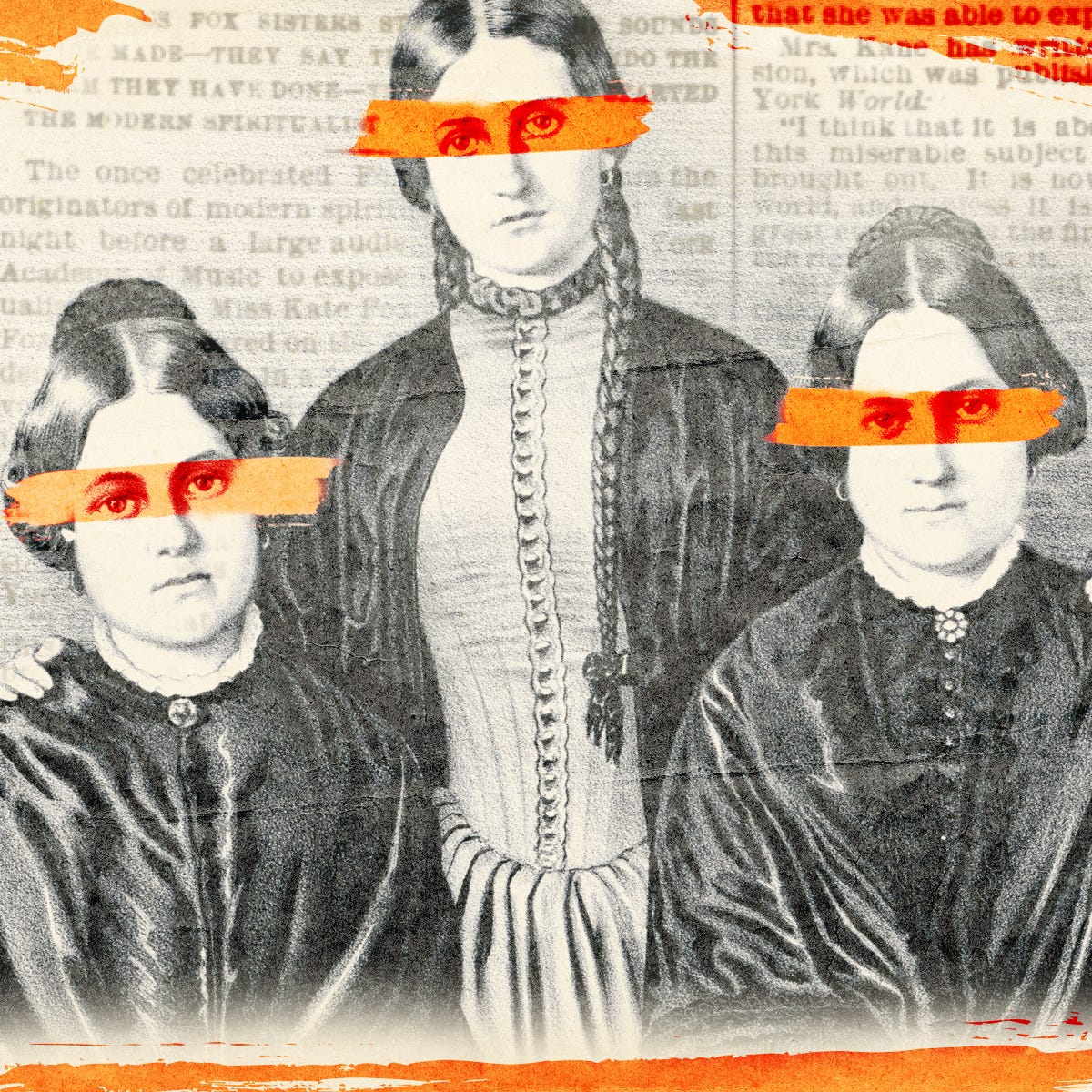
It’s a fraud! Spiritualism is a fraud from the beginning to end! It’s all trick! There’s no truth in it!
It was 1888 in New York City. One of the famed Fox sisters, Margaret (Maggie) Fox Kane, made her declaration on a stage in a crowded auditorium. To thunderous applause, she went into the audience, where she placed her bare foot atop a man’s shoe, and snapped the joints of her big toe. The man felt the raps and acknowledged them, according to the account of the night later written in the New York Herald.
By the newspaper’s own admission, it was a strange night:
There stood a black-robed, sharp-faced widow working her big toe and solemnly declaring that it was in this way she created the excitement that has driven so many persons to suicide or insanity. One moment it was ludicrous, the next it was weird.
Maggie’s younger sister Kate was present in the audience, applauding the confession. This was meant to be, as it was later termed, the “death-blow to Spiritualism.”
But there was a notable absence.
The oldest Fox sister, Leah, was not there.
Before there were séances and messages from the dead, there were two young girls and some noises in a farmhouse.
In March 1848, Maggie and Kate Fox lived with their parents in Hydesville, New York. For several nights, something had disturbed the family after dark. They heard knocks in the walls. Furniture seemed to shift. The sounds moved through the house without revealing their source.
Eventually, these events caught the attention of neighbors, and soon, the Fox home was a flashpoint of debate as neighbors and friends streamed through the home to hear the noises for themselves. This initial flurry of activity was recorded in a book carrying a breezy title: A Report of the Mysterious Noises Heard in the House of Mr. John D. Fox, In Hydesville, Arcadia, Wayne County, Authenticated by the Certificates, and Confirmed by the Statements of the Citizens of that Place and Vicinity.
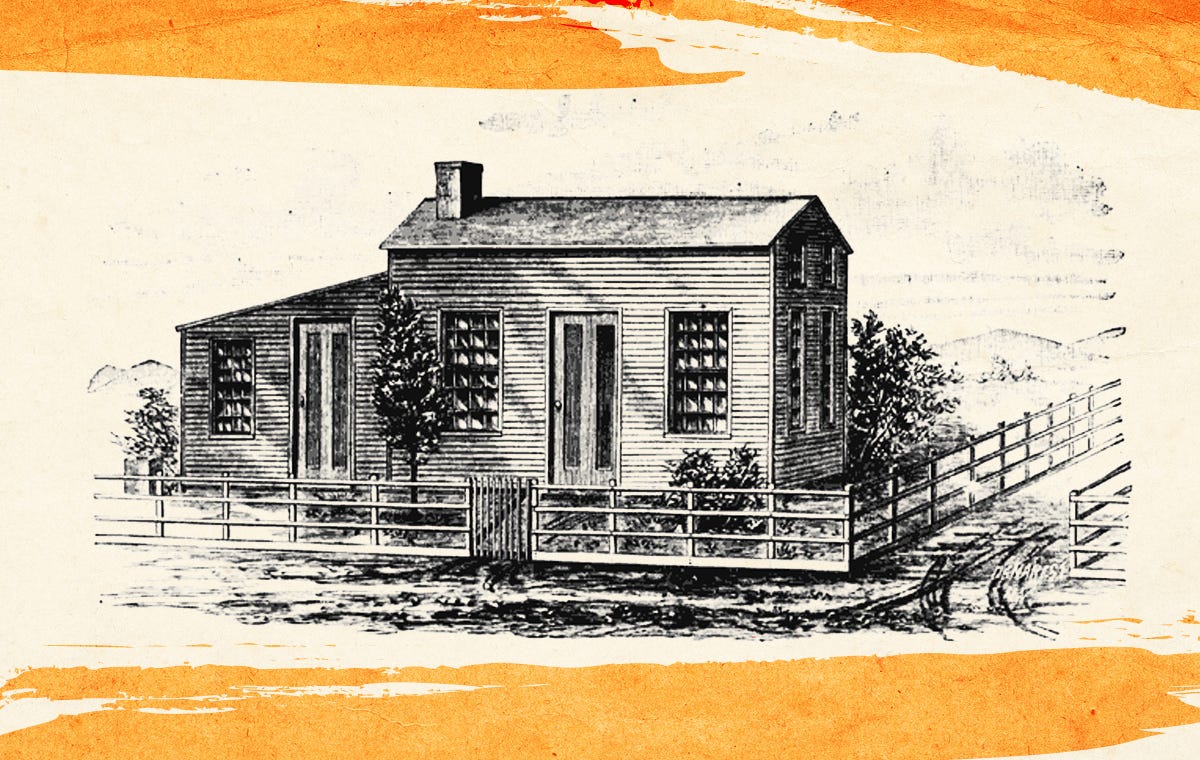
Based on testimony from the sisters’ mother, the Fox family was soon conversing with spirits in the home, all through knocks, taps, and other strange sounds. And more troubling, it seemed centered around her two young daughters. Mrs. Fox recounted watching Maggie one night.
[Maggie] said, “Now do this just as I do. Count one, two, three, four,” striking one hand in the other at the same time. The blows which she made were repeated as before. It appeared to answer her by repeating every blow she made.
Mrs. Fox, through taps and knocks heard that night, had a conversation with what she could not understand. Soon, a neighbor was invited to hear the sounds, and then that neighbor’s husband. More followed, and all of them heard. Soon, through questions answered in taps, the community became convinced that someone had been murdered in the house.
John Fox and some neighbors excavated the basement, searching for any sign of a murder victim, but found none.
Mrs. Fox closed out her testimony on the matter with a statement of disbelief, uncertain of what to make of the strange events.
I am not a believer in haunted houses or supernatural appearances. I am very sorry that there has been so much excitement about it. It has been a great deal of trouble to us. […] I cannot account for these noises; all I know is, that they have been heard repeatedly, as I have stated.
Then, Leah arrived in Hydesville.
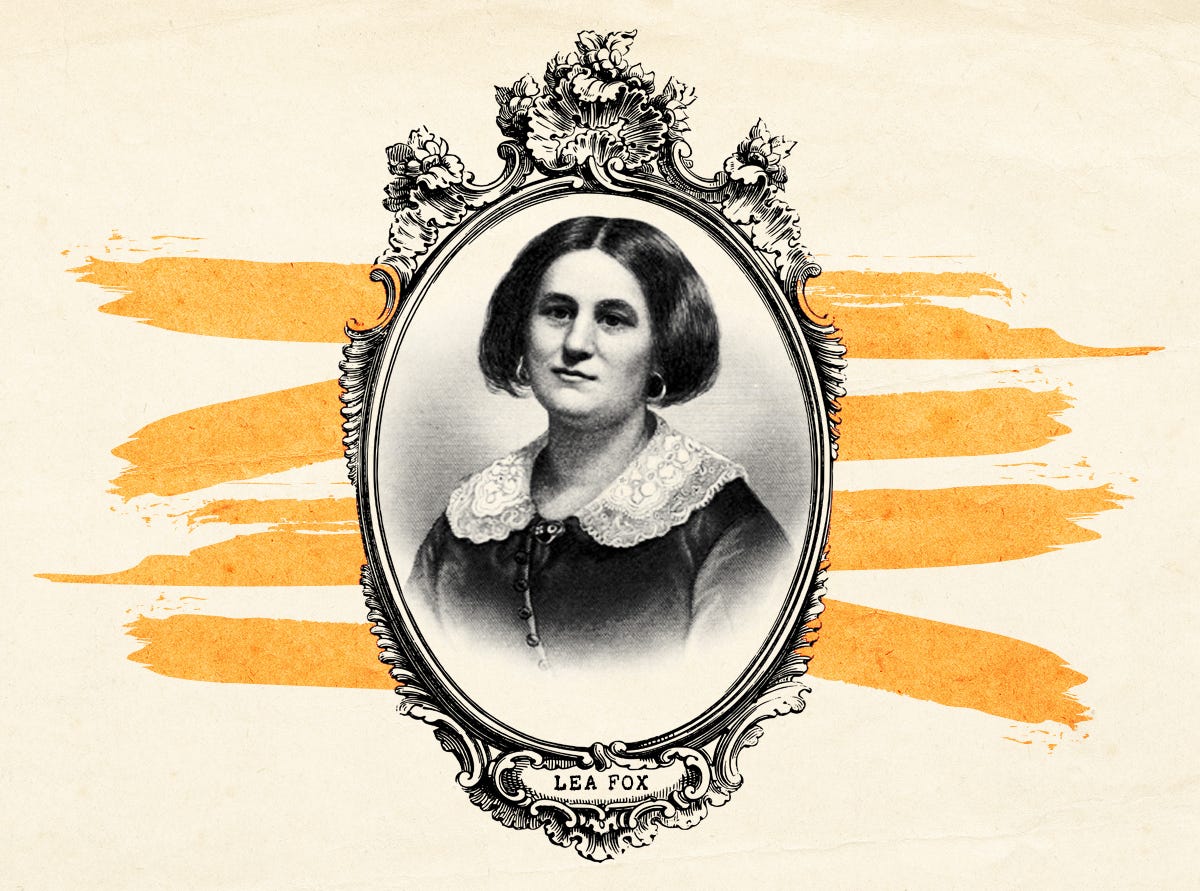
Leah Fox Fish, later Leah Underhill, was not present when the first rappings began in Hydesville. She was two decades older than Maggie and Kate, and living in Rochester.
But when news of the strange happenings in Hydesville reached her, she became a driving force in publicizing the sisters and their abilities, serving as a medium herself and eventually writing a book, The Missing Link in Modern Spiritualism, decades later.
In her book, she describes an initial distaste for holding public rappings. But her actions spoke differently. One year after the initial rappings in Hydesville, the sisters were being paid for manifesting the sounds.
Under Leah’s influence, the rappings became a commodity, with the eldest sister writing in her book decades later that the event had become a “career.”
Maggie and Kate appeared before audiences of believers, investigators, journalists, and prominent citizens. Committees searched furniture, watched the sisters’ hands, controlled their feet, and changed the conditions of the sittings.
Oh, how little did we know of all that was before us! We had just opened the door to the public curiosity and interest; and it was not for us to discriminate who should enter therein. The people came from every direction. We knew not what to do.
Some of the investigations grew contentious, with Leah accusing some skeptics of hostility. During some investigations, such as one where the sisters were made to place their feet upon pillows, the spirits stayed silent. Leah later denied this, claiming in her book that they never failed under observation and were never exposed for fraud.
When rappings failed to manifest under rigorous investigation conditions, she had a ready explanation.
It is true that it sometimes seems that the presence of particular individuals is fatal to any, or any but the feeblest, manifestations. [… Spirits] seem to resent the insulting presence and the unworthy mental condition and attitude of such persons, and ill-disposed to cast such pearls before such swine.
While she claimed that belief in Spiritualism wasn’t necessary, she did say, in rather strong terms, that disbelief in Spiritualism was “fatal” to the success of a sitting.
Through decades of the Spiritualism movement, the Fox sisters continued their sittings, with skeptics often calling them frauds, and believers in the Spiritualism community standing fast behind the figureheads.
But the sisters grew apart, got married, and life continued.
And then, in 1888, the movement truly unraveled.
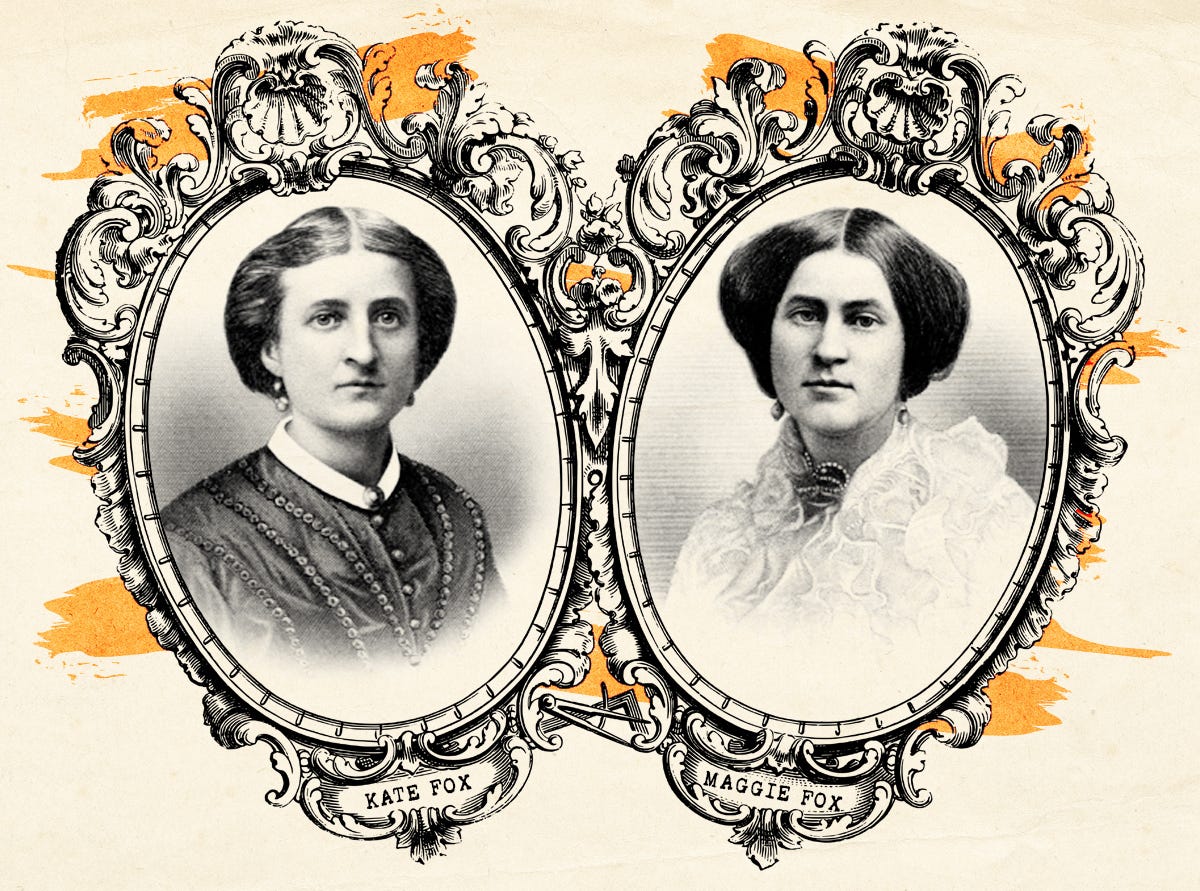
By the mid to late 1880s, skepticism had taken its toll. Kate and Maggie were both having financial difficulties, and both had turned away from the larger Spiritualism movement. Leah had not. While the public exhibitions were less frequent, she fully embraced her position as figurehead and defender of the movement that she insisted the Fox sisters were responsible for starting.
In her published collection of personal writings, letters, and various testimonials, the eldest Fox sister laid out a passionate, sometimes rambling, defense of Spiritualism. But her embrace of the movement looks a bit different when seen alongside later comments from her sisters.
In 1888, Maggie and Kate spoke to author and skeptic Reuben Briggs Davenport for his book, The Death Blow to Spiritualism: Being the True Story of the Fox Sisters. In it, they painted a picture of a domineering older sister who had driven the movement from the start.
Kate Fox spoke of the Spiritualism movement:
If I knew those powerful spiritualists who have done their utmost to harm me in the past could not do so in the future, I would not hesitate to expose it. The worst of them all is my eldest sister, Leah, the wife of Daniel Underhill.
She also painted Leah as the driving force behind a continued deception:
Spiritualism is a humbug from beginning to end. It is the greatest humbug of the century. […] Maggie and I started it as very little children, too young, too innocent, to know what we were doing. Our sister Leah was twenty-three years older than either of us. We got started in the way of deception, and being encouraged in it, we went on, of course.
Kate was not alone in framing Leah as the one pushing the two younger sisters. In fact, Maggie went further in her statement, suggesting it was more than a business-minded encouragement.
I do not exaggerate in any way when I say that I have feared that woman all my life. […] Katie, even to this day, acknowledges some sinister influence about her sister Leah, even if she but chance to meet her in the street. It is a mixture of terrorism and cajolery.
Leah rejected the claims and confessions of fraud made by her sisters, and though she did not directly issue rebuttals, she continued to participate in Spiritualism events. This included a meeting of the Society of Spiritualists in New York, where she read a letter from Spiritualist Oliver Johnson that expressed “sympathy to her because of the recent conduct of her two sisters in the matter of Spiritualism.”
In 1889, after spending the previous year on a mission to dismantle, discredit, and disavow Spiritualism in no uncertain terms, Maggie was ready to reconcile with the movement.
But the movement was not ready to accept her back at the séance table.
Spiritualist publications had outed the fact that Maggie was paid a sum of 1,500 dollars for exclusive coverage of her renouncement before the audience in New York City, where she demonstrated her method of creating the sounds that the Spiritualism movement was built upon.
In covering the recantation of Maggie’s previous confession, the Spiritualist publication The Two Worlds wrote in a December 1889 article titled Another Fox Recantation Scheme:
In her real or pretended first recantation she was evidently inspired with the idea that she should make a grand success and a great fortune. […] But now that the success and the fortune both have failed, she comes back to her former profession, coolly and deliberately trying once more which side will pay best!
And if that left any room for confusion, they continued on to remove any ambiguity.
We want no such characters as mediums between the worlds of mortality and immortality.
The door was closed to Maggie’s return and acceptance into the wider Spiritualism community.
The Fox sisters, dressed in black and sitting around a table, built a quasi-religious movement that spread throughout the Northeast United States and then reached further.
Decades of interrogation, skepticism, support, and séances built a modern mythology around these three women. Then two of them turned on the very movement they built, kicked the supports from the foundations, and showed the world their tricks.
What quite possibly started as two young girls bobbing an apple on a string against the floor to amuse themselves, then grew into a cultural phenomenon that still has echoes in today's society.
As put by Maggie Fox in 1888:
It is wonderful, indeed, how two little children could have made this discovery, and how, by simply obeying the natural thirst for the marvelous, in others, and their inherent superstition, they should have advanced step by step, in the fraud, deluding those who most ardently wished to be deluded.
Did you enjoy this article? Consider supporting 50 States of Strange.
A Report of the Mysterious Noises (1848)
The Missing Link in Modern Spiritualism (1885) by Leah Underhill
The Death-Blow to Spiritualism (1888) by Reuben Briggs Davenport
Another Fox Recantation Scheme. The Two Worlds. December 20, 1889
Society of Spiritualists, New York. Religio-Philosophical Journal. April 13, 1889
Reprint of the New York Herald article in the Richmond Dispatch. October 25, 1888
No posts
Comments
Nothing yet. Say the first thing.
Sign in to join the conversation.