
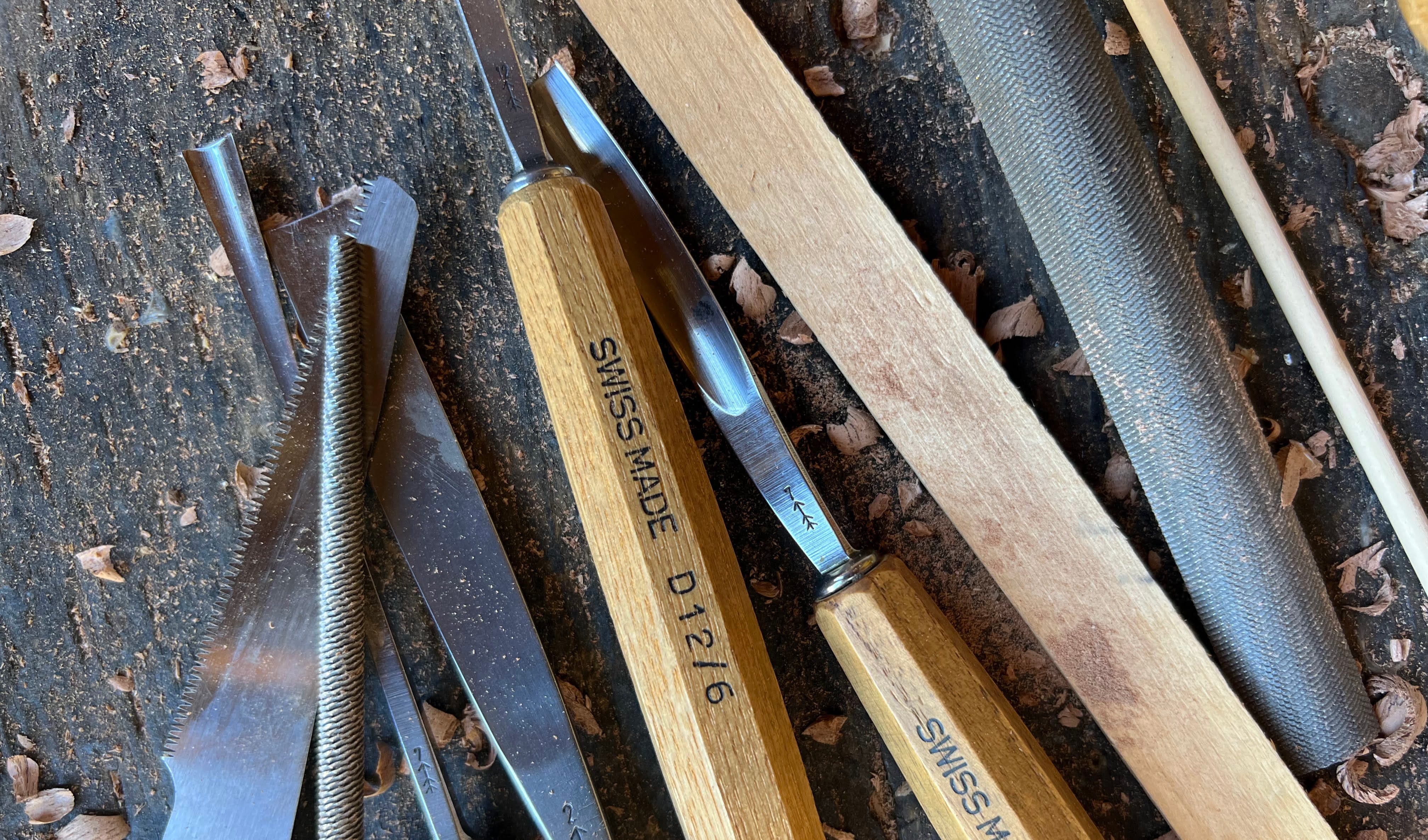
All tools shift work into higher levels of abstraction. At the first level, the practitioner remains close to the material. The knife is in the hand, the pen between the fingers, the saw guided by arm and shoulder. The tool extends the body, amplifying power and precision, but the practitioner is present through every movement and small correction, still in direct contact with the decisions the work requires. At this level, the prosthetic quality of the tool both extends capability and cushions consequence. The running shoe amplifies locomotion but also removes the direct feedback of bare ground.
As tools grow in complexity, they begin to perform more expert versions of the work, with greater precision and reliability than most individual practitioners can sustain. The craftsperson who first understood this was usually someone deep in repetitive, high-tolerance work, someone who through accumulated reps arrived at a meta-level understanding of what the work actually required. The jig, the template, the specialized tool emerged from people who had internalized the work completely enough to see it from outside itself.
A handsaw becomes a Skil saw becomes a miter saw. A hand drill becomes a gear drill becomes a motor drill. A quill becomes a fountain pen. A hand-drawn needle becomes a sewing machine becomes an industrial sewing device. Each step encodes the insight of someone who had done the preceding version long enough and carefully enough to understand what precision actually required. The new tool then performs that understanding reliably, at scale, without requiring the user to develop it themselves.
Tools become coupled into systems that perform large complex work processes. A lumber mill is built from the logic of the handsaw, extended through power and mechanism. Weaving gives way to fast fashion by way of the loom and the industrial sewing machine. Handwriting gives way to letterpress, which gives way to the laser printer. At each step, whole disciplines of expertise become off-the-shelf and included. The person setting type no longer has any relationship to the shape of letters. They choose from a menu of fonts that other humans created long ago, which are now just selections in a dropdown. The fast fashion shop has no knowledge of how to weave or dye fabric, and may have only a loose sense of original design. They are assembling from ready-made materials clothing they have little personal relationship to.
A poster shop can reproduce a perfect copy of a painting through a sophisticated camera run through complex image processing software and output to a large-format printer. They may have deep craft knowledge of those devices and no relationship at all to the act of painting.
The same pattern runs through the digital realm. The typewriter replaced the hand, the word processor replaced the typewriter, the computer with printer replaced both. Spellcheck and voice-to-text further abstracted the act of composition, making it possible for authors who could not reliably spell to produce books. Each generation of the tool embedded the prior generation’s hard-won knowledge into the default behavior of the new one.
What each tool encodes is a narrow but reliable mimic of high craft. The trade is precise control and reliability encoded into the tool itself, eliminating both the need and the ability of the person using it to make certain choices. This is a reduction in the range and expressiveness individual practitioners bring to the work. And the same encoding that produces that reduction releases the person using the tool from a prior layer of required mastery. That released capacity goes somewhere.
If every violinist also had to make their own instrument, the number of expert players would be a fraction of what it is. And yet it was almost certainly craftspeople who were also players who perfected the shape, the wood selection, the varnish, the process, and the tools of lutherie until the instrument could produce the sound it does. The encoded knowledge of generations of instrument makers is now available to any player as a ready-made object. The player who picks up that instrument puts all of the developmental attention that would have gone into making it into playing instead. The highest expressions of performance exist in part because the performer was released from the substrate.
The writer who can reach for ready-made type and paper rather than casting letters and pressing them by hand produces more writing. If every author needed to design their own typeface or build their own press before setting words in print, very few books would exist. The crafts of typography, paper making, and binding accumulated over centuries and eventually became refined enough to disappear into the background of writing. The author picks up a ready-made medium and attends entirely to what they want to say.
This is a genuine trade, not a net loss and not a net gain. There is real loss of craftspersonship, a real reduction in the relationship to the medium that comes with adopting tools that encode generations of prior work. And those same tools open space for makers, builders, and artists who would never have been able to create what they make without prefabricated substrate, pigments, threads, cloth, boards, paper, canvas. Both are true, and they are not commensurable. The virtuoso violinist and the tradition of lutherie that made the instrument possible both represent accumulated human mastery. The decline of one as a widespread practice is not canceled by the flourishing of the other.
We tend to celebrate the output that utilizes the underlying tools and medium, the final artifact that stands as an obvious creative contribution, while barely acknowledging the generations of craft and creativity that went into building the substrate. Perhaps because it has become standardized. Standardization makes a substrate transparent. The canvas, the paper, the violin body, the typeface stop being objects of attention precisely because they have been stabilized and perfected. We see through them to the act that happened on top. The more thoroughly a craft layer is absorbed into substrate, the less visible it becomes as craft, and the less legible as the creative work it actually was. Cultural credit accumulates at the top of the stack, at the layer that is not yet standardized, where individual variation is still visible. What came before is infrastructure. The definition of creativity migrates upward as each layer gets absorbed. The luthier tradition that made virtuoso performance possible becomes background. Stradivarius is mostly a name on instruments rather than a craftsperson whose accumulated knowledge enabled centuries of music.
There is a further loss embedded in the encoding itself. The craftsperson who developed the jig did so because years of doing the work by hand had built a level of understanding that only repetition with consequences can produce. Mistakes were not simply errors to be eliminated. Variation and accident under real conditions, the unexpected result that revealed a material property or an easier path, were the primary site of the insights that eventually became tools. The tool user who inherits the jig has no path to that level of understanding and therefore has a reduced capacity to generate what comes next.
Tools can only encode what was made explicit enough to systematize. The felt, intuitive knowledge that accumulates in a body doing the work, the sense that a joint is true before it has been measured or that the dough has been worked enough, does not transfer into the tool and is not transmitted to the person using it. It gets stranded at every transition. The output measures true. The sense that made “true” legible to the craftsperson is absent.
The encoding that spreads access also narrows expression, and the two move together through the same mechanism. When craft lived in human bodies, the diversity of practitioners maintained a wide range of approaches and aesthetics. Each person solved the problem differently. Tools encode a selection from that range, usually the fastest and most reproducible, and in doing so suppress the approaches that were not chosen. Broader participation in production coincides with a narrowing of what gets produced.
Time is part of this as well. Tools routinely compress the duration of work. But the time that gets compressed was not only inefficiency. It was the duration of contact with the material. The hours the cabinetmaker spent on a joint were the hours during which the wood’s grain, density, and behavior became known to them. The compression of time is also the compression of that relationship. What registers as a productivity gain is also an elimination of the conditions under which the work became legible to the person doing it.
This process does not reverse. The expertise encoded into a tool is not retrievable from it by the tool’s users. They cannot reconstruct what went in by studying what comes out. If the tool disappears, the knowledge is often gone with it or survives only in isolated individuals who are no longer part of any active transmission chain. Each encoding is a one-way door.
The history of tools is this pattern iterating on itself, each cycle producing higher levels of abstraction and deeper removal from first, second, and third order relationships to the work. Generations of craftspeople curated from an ecosystem of tools, selected from the best, refined and honed them, then passed forward not just the tool but a new context in which the tool itself became the new floor. Different kinds of craftspeople brought tools together in sequence to automate work processes. Those processes became industries. Those industries generated the next generation of tools. And the cycle ran again, each time from a higher starting point, each time releasing new capacities at the top of the stack and leaving behind more of the embodied knowledge that had made the previous cycle possible.
Artificial intelligence is the latest and most compressed iteration of this cycle. The tools themselves, the training pipelines, the model architectures, the data infrastructure required to produce a working system, are beyond the comprehension of most people who use them and genuinely difficult to fathom even for the engineers who build them. The encoding has reached a corresponding scale. Every prior layer of abstraction that this pattern describes has been consumed as training material. The model contains compressed within it the output of millions of practitioners across centuries of accumulated discipline. The removal of craft relationship at this layer is proportionally vast.
The objection artists raise, that AI produces work without soul or genuine craft, is not new to this moment. The same critique accompanied photography, the printing press, the electric synthesizer. At each step, practitioners of an existing craft recognized that something real was being removed from the process, because something real was being removed. The abstraction genuinely eliminates a closeness to the work, a relationship to the medium, that the prior practice required and cultivated. The objection is correct, and it is also the objection that has accompanied every tool in this lineage.
AI is also becoming substrate. Practitioners are already developing direct working relationships with it, learning through repetition and consequence what it can and cannot do, how to shape its outputs, where its behavior opens unexpectedly. There will be artists who work with AI the way others worked with oil paint or the electric guitar, who develop through sustained practice a felt understanding of its properties, and who produce from that understanding work that is genuinely new, inventive, and every bit as soulful as work produced closer to the older substrates. The substrate is new, and what follows it will be the same cycle running again from a higher floor.
No posts
Comments
Nothing yet. Say the first thing.
Sign in to join the conversation.