
“Take a good look at these big trees, kids… because they won’t be here by the time you’re my age.”
This is what I heard a father say that to his children while we were walking beneath a grove of giant sequoias in the middle of the Sierras a few weeks ago.
I had been thinking the exact same thing, which surprised me because I hadn’t realized I’d been carrying that thought around until someone else said it out loud.
Sometimes another person says one sentence and suddenly you become aware of an entire conversation you’ve apparently been having with yourself for days.
The interesting part wasn’t whether he was right— none of us know exactly what these forests will look like fifty years from now.
The interesting part was realizing I’d already started narrating the future differently now that I’m raising a daughter.
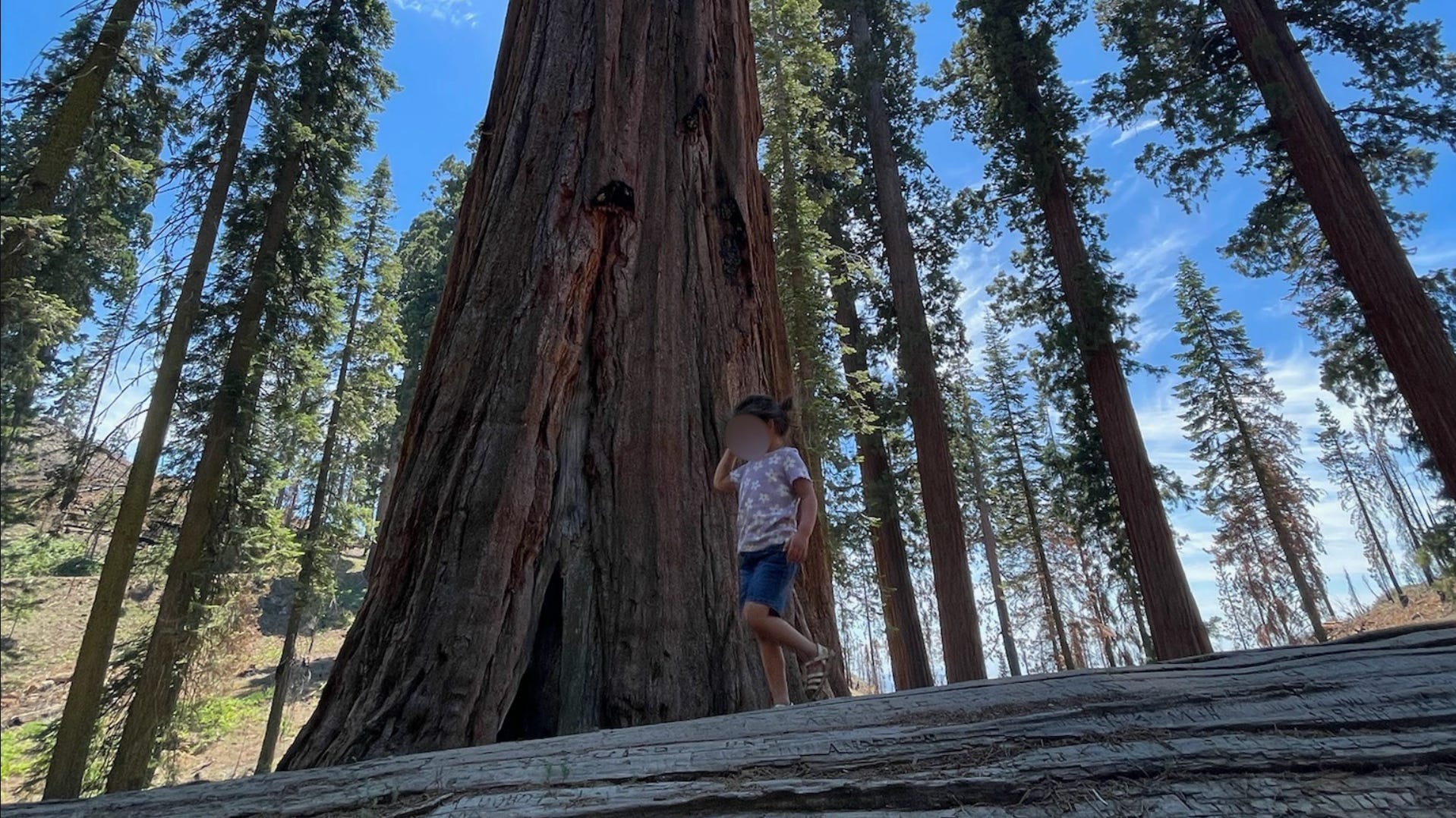
Throughout the trip I’d caught myself pointing things out that probably wouldn’t have crossed my mind ten years ago.
I’d tell her how old the trees were.
I’d explain why we stayed on the trail or found the trail/streams/logs when we got lost.
I’d talk about how many generations had stood in the same places.
And I’d also quietly wonder whether she’d someday bring her own children back.
I wasn’t trying to be dramatic either you guys…. I think I was trying to pay attention?
The drive there probably had something to do with it. We spent hours moving through burned forests, restoration projects, standing dead trees, healthy forests, thinning operations, reservoirs, campgrounds, and small mountain towns that all seemed to tell different parts of the same story.
Every few miles the landscape reminded me that what we casually call “nature” is actually thousands of ecological relationships layered together with thousands of human decisions.
I don’t think that’s unique to forests either. The older I get, the harder it becomes to separate ecology from economics, politics from public health, parenting from community, or technology from psychology.
Everything seems connected to everything else, which is either a sign I’ve completely lost it or a sign we’ve become so specialized that we’ve forgotten reality was never divided into departments in the first place.
That’s probably why the father’s comment stayed with me— It wasn’t really about giant sequoias but about the world we are leaving the generations that come after us.
the future we narrate to our children.
Some people may assume I’m trying to protect my daughter from difficult realities because she’s still little. Others may think I’m telling her too much too soon or covering her with things that children shouldn’t “stress” over.
In reality though… I’m actually trying to protect her from something much more specific— I don’t want her to confuse uncertainty with inevitability.
She knows predators hunt prey because she loves animal documentaries. She knows animals die. She also knows humans are often the biggest predators or causes of ecosystem harm. She is beginning to learn how people fight wars, forests burn, rivers become polluted, and some species have disappeared. (For context, she is only 4 lol)
The point of all of this is to say that over nearing two decades of working around children and families I have one learned one thing to be universally true:
Children are usually capable of holding reality much better than adults assume. What they struggle with is the feeling that nothing they do matters.
That’s why almost every difficult conversation we have ends in the same place in our home. If we talk about pollution, we also talk about the people cleaning rivers. If we talk about wildfires, we talk about firefighters, ecologists, foresters, prescribed burns, and Indigenous communities who spent thousands of years managing these landscapes before we decided suppressing every fire was the answer.
I don’t need her to believe everything will be okay. I need her to believe there are still people who want to participate in what comes next.
Somewhere along the trail I read that giant sequoias rely on the heat of —wanna guess?— wildfires…. yep wildfires themselves are what help open many of their cones and release their seeds.
I already knew forests weren’t as simple as “fire is bad.” I’d spent years reading about prescribed burns, cultural burning, and the unintended consequences of a century of fire suppression.
But learning that one of the largest living organisms on Earth depends, in part, on the very thing most people instinctively think only threatens it made me laugh. Not because it was surprising. Because it was familiar. It felt like another example of something I’ve been noticing for years.
Nature keeps refusing the binaries we insist on imposing onto it.
Fire isn’t good.
Fire isn’t bad.
Neither is rain.
Neither is drought.
Neither is human intervention.
Neither is leaving everything alone.
The question is almost never whether something exists. The question is what kind, under what conditions, in relationship with what other variables, and for how long.
Standing there, I realized I’ve been asking the same question across almost every field I’ve studied. Stress isn’t inherently harmful. Chronic stress without recovery is. Money isn’t inherently corrupting. Neither is poverty inherently virtuous. Technology isn’t automatically progress. Tradition isn’t automatically wisdom. Communities don’t become healthy because conflict disappears. They become healthy because relationships are strong enough to survive it.
Being in nature reminds you that you are one tiny piece of a larger ecosystem too.
stewardship begins before politics.
Politics isn’t separate from ecology. Public policy shapes land management, housing, water, conservation, restoration, research, infrastructure, and whether Indigenous communities regain stewardship over ancestral lands.
Human systems shape ecological systems whether we acknowledge it or not.
What frustrates me is that we usually start the conversation there instead of one step earlier. Before we argue about policies, don’t we have to agree on what we’re actually trying to protect?
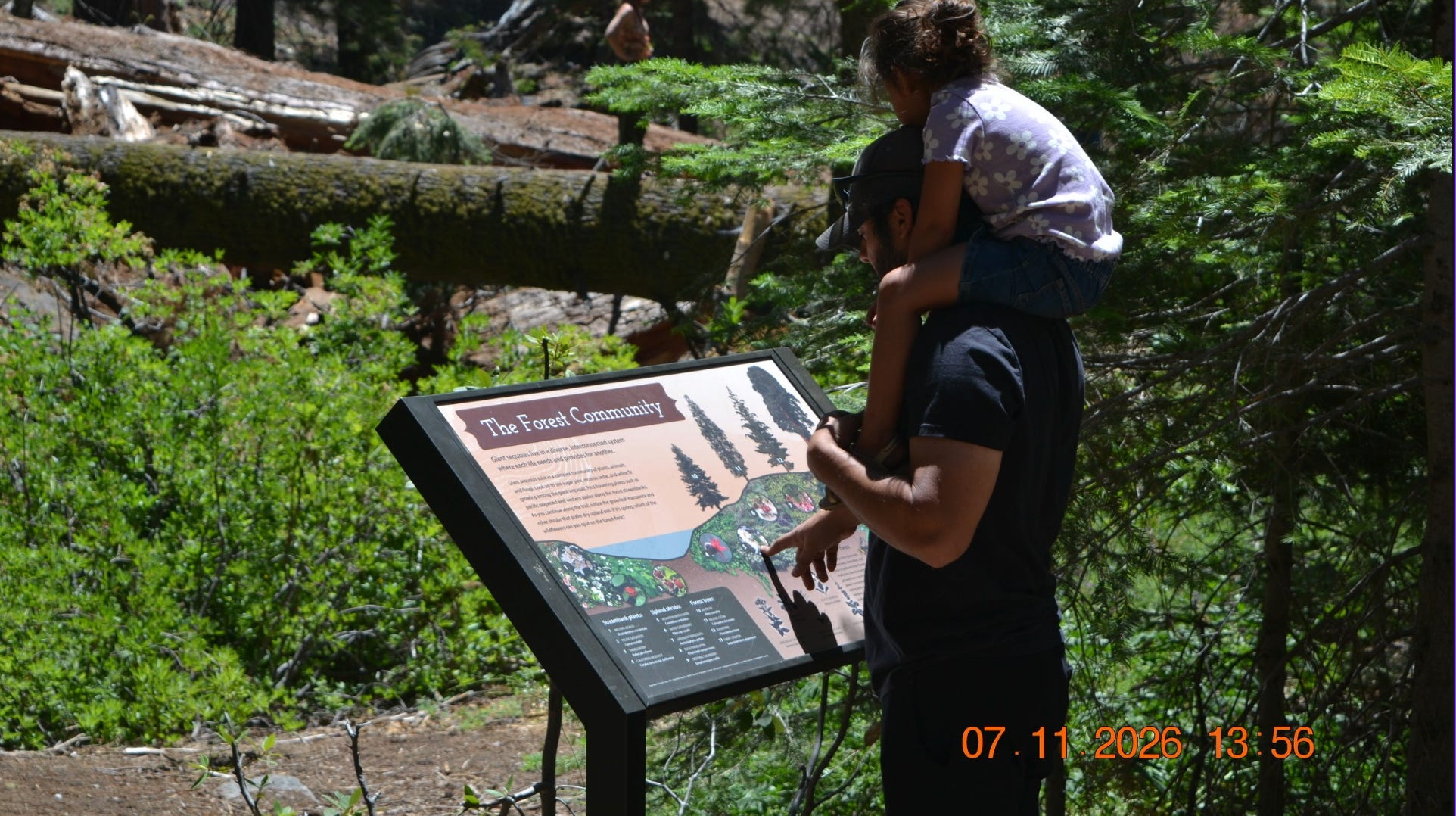
Because standing in that grove, nobody was asking strangers who they voted for. Parents were helping children over roots, pointing out birds, reading the same educational signs, taking family photos for people they’d never met, and quietly hoping their kids would someday get to experience places like this too.
We weren’t united by ideology. We were united by stewardship.
The more I thought about it, the more I realized that wasn’t actually a conversation about giant sequoias. It was a conversation about what parents choose to emphasize when they’re standing in front of something they know their children may not experience in quite the same way.
I also kept thinking about that father after we left—not because of him at all really, but because I realized he probably wasn’t trying to make a statement at all. He was doing what parents have always done.
He was standing between the world as it is and the world his children will inherit, trying to find language for the distance between the two.
I imagine every generation eventually discovers there are things they wish they could promise their children that they simply can’t.
We can’t promise peace.
We can’t promise health.
We can’t promise prosperity, stability, or that every place we loved will remain exactly as we remember it.
And the older I get, the more I think parenting is largely the art of living honestly inside uncertainty. My grandparents probably had versions of that conversation. So did their parents. As did mine.
Every generation eventually finds itself pointing at something and wondering whether it’s disappearing, changing, improving, or becoming something entirely different.
Maybe what feels different isn’t that we’re the first generation to worry about inheritance. Maybe we’re the first generation carrying so many different versions of it at the same time.
I spend a lot of time reading across disciplines, partly because I enjoy it and partly because I don’t think any one field has enough context anymore. Some days I’m reading ecology. The next day it’s developmental psychology, economics, anthropology, public health, history, urban planning, or political science.
They all use different language, different methods, and different measurements, but I keep having the same strange experience. I’ll finish a paper about forests and think, This is describing families. Then I’ll read something about childhood development and think, This is describing democracy.
Somewhere along the way I stopped believing these were separate conversations.
That probably sounds like a stretch until you spend enough time looking at living systems. Forests don’t survive because one tree is healthy. Families don’t survive because one person is resilient. Communities don’t thrive because one policy is perfect.
Everything depends on relationships, diversity, feedback, adaptation, cooperation, disturbance, recovery, and time.
Change one variable and eventually every other variable responds. Sometimes immediately. Sometimes decades later. Sometimes so slowly we convince ourselves nothing is happening until suddenly everything is.
I think that’s why I smiled when I read about the sequoias. Not because I learned that fire can sometimes be beneficial. I’d known that for years. It was because nature had handed me another example of something I’d already been noticing everywhere else.
We love asking whether something is good or bad. Nature almost never answers that question. It answers completely different ones.
Compared to what?
Under what conditions?
In relationship with what?
These are much less satisfying answers if you’re looking for certainty. But they are a hell of a lot more useful if you’re trying to understand reality.
Maybe that’s also why I can’t separate politics from ecology.
Human beings have become one of the dominant ecological forces on the planet. The decisions we make about land use, conservation, restoration, housing, water, agriculture, transportation, education, and research all become ecological decisions too.
Pretending human systems exist separately from natural systems only makes us less capable of seeing the consequences of our own participation.
At the same time, I still think we often begin these conversations in the wrong place. We begin with parties instead of people. We begin with ideologies instead of inheritance. We begin with blame instead of asking what we’re actually trying to preserve.
Standing beneath those trees, I wasn’t wondering who the Republicans were or who the Democrats were. I was watching parents point out birds to their children. I was watching strangers offer to take family photos. I was watching little kids stop to look at pinecones bigger than their heads.
I was watching people from every imaginable background quietly participating in stewardship without ever calling it that.
Maybe that’s what stayed with me most.
Not the father’s sentence.
Not even the trees.
It was realizing that underneath all of our arguments, I suspect most parents are asking remarkably similar questions.
How do I raise a child who tells the truth?
How do I raise a child who contributes more than they consume?
How do I raise someone who notices beauty, protects it, and understands they belong to something larger than themselves?
We may spend the next fifty years disagreeing about legislation, economics, climate models, energy, development, education, and technology… and we probably should because those conversations matter and a lot of fucked up people have done a lot of fucked up things that need to level out.
But I wonder what would happen if we remembered that many of us are still trying to protect the same inheritance, even when we disagree about how to do it.
the stories we teach without realizing
That realization also made me think about what we choose to notice.
I don’t remember my parents spending much time talking about ecosystems when I was growing up, not because they didn’t care, but because their attention was somewhere else.
Every generation seems to inherit a different set of blind spots. Mine inherited unprecedented access to information, and with it came the strange burden of becoming aware of almost everything all at once.
It’s now completely normal to read about drought in one part of the world, war in another, declining birth rates, artificial intelligence, microplastics, pollinator loss, housing shortages, political polarization, and a breakthrough in cancer research before lunch.
Some of that awareness has made us wiser. Some of it has simply made us overwhelmed. I’m still trying to figure out the difference… and I’ve given up trying to figure out how to navigate it.
This is why I keep taking my daughter outside though.
Nature has a way of shrinking the timeline back down to something a human nervous system can actually hold. Not because it distracts us from the world’s problems, but because it reminds us that every living system operates through relationships instead of headlines.
A forest doesn’t regenerate because one thing went right. It regenerates because hundreds of relationships continue functioning well enough that life finds another way forward. Some species disappear while others return. Some disturbances become opportunities. Others become tipping points.
It’s never just one cause, and it’s almost never just one solution.
I’ve noticed that I parent the same way. I don’t really teach isolated facts. I don’t sit my daughter down for lessons about ecology or economics or psychology because those subjects don’t actually exist in isolation outside of a classroom.
Instead, we have hundreds of tiny conversations that gradually build a way of seeing the world. We talk about why we return a shopping cart, why we thank people whose jobs often go unnoticed, why we leave flowers for the bees, why we wave at our neighbors, why we stay on the trail even when no one is watching, why we compost, why we vote, why we read history, and why we apologize when we’re wrong.
Fun story really quick?
My daughter (4) came home from school a few weeks back and shared that a friend was trying to kill a bee and she tried stopping her and telling her why they are so good for the earth and another friend came in and backed her up but the girl still stomped on it. She wasn't devastated, she wasn't angry.. she was just disappointed and shocked. Mind you, these are a bunch of preschoolers, but this is what I’m focused on: educated awareness and advocacy that is intuitive not shoved down a throat. I also like to think that girl went home and asked these questions or may reconsider doing that again in the future?
Okay back to the article.
None of those conversations are really about the individual behavior. They’re about relationships. They’re about understanding that every action becomes part of a system whether we intended it to or not.
That’s probably why I struggle with the way so many conversations unfold now.
We seem increasingly convinced that every issue has one cause, one villain, and one solution. If we could just identify the right person to blame or the right policy to pass or the right technology to invent, everything else would fall into place. But almost nothing I’ve studied has worked that way.
Living systems are almost always more complicated than our politics and much less interested in our certainty.
That doesn’t mean truth doesn’t exist. It doesn’t mean every perspective is equally valid or that evidence suddenly stops mattering. It simply means reality usually asks more of us than choosing a side. It asks us to understand context, feedback loops, unintended consequences, tradeoffs, history, timing, and relationships. It asks us to become comfortable saying, “I don’t know yet,” while still taking responsibility for what we do know.
I don’t know what that father believes politically.
I don’t know whether we’d agree about climate change, forest management, public lands, energy policy, education, taxes, or any of the hundreds of issues people use to sort each other into opposing camps.
Maybe we’d agree on almost nothing.
Maybe we’d agree on almost everything.
Standing there, it genuinely didn’t matter. What mattered was that we were both trying to raise children who would inherit something worth belonging to.
what we are all leaving behind.
I keep coming back to the word stewardship because I think we’ve quietly replaced it with ownership. We talk about owning homes, owning land, owning resources, owning success, even owning our lives.
Nature has never seemed particularly interested in ownership. It operates through participation. You don’t own a watershed you’re drinking from. You participate in it. You don’t own a forest that has been growing for two thousand years. You become one brief relationship within a much longer story.
Maybe that is why stewardship feels like such an old-fashioned word now— it asks us to think less about what belongs to us and more about what we are temporarily responsible for before it belongs to someone else.
Children have always inherited uncertainty.
What changes from one generation to the next is not uncertainty itself, but the form it takes and the stories adults tell about it.
We do not prepare children by pretending difficult realities do not exist, but we also do not prepare them by convincing them collapse is inevitable.
We prepare them by helping them understand that they belong to living systems, and that living systems have always depended on participation, adaptation, reciprocity, and care.
Long before children inherit money, they inherit neighborhoods, institutions, languages, rivers, forests, stories, technologies, habits, and ways of seeing the world. They inherit the relationships previous generations built, protected, damaged, or neglected. In many ways, that is their greatest inheritance.
And maybe that is what I hope my daughter remembers long after she has forgotten the statistics, the names of the trees, or even the trip itself.
I hope she remembers that belonging always comes with responsibility, that complexity is not something to fear, and that the healthiest systems she will ever encounter—whether forests, families, neighborhoods, or civilizations—will almost always be the ones that learned how to care for relationships instead of merely winning arguments.
My hope is also not that she grows up believing the future is guaranteed to be bright. My hope is that she grows up believing the future is still something human beings participate in creating.
Because whether we are restoring forests, raising children, rebuilding communities, or simply helping a stranger on a hiking trail, stewardship has never depended on certainty. It has always depended on showing up anyway.
That, more than anything else, feels like the inheritance worth fighting for.
final notes
The father’s sentence stayed with me long after we left the grove, but it also left me with another question I couldn’t stop thinking about.
How do we actually have these conversations with children?
Not in theory. Not in a way that protects them from reality or burdens them with problems they were never meant to carry. How do we tell the truth while raising children who still believe they belong to the future they’re inheriting?
That question became the next piece I wrote.
Free subscribers receive this essay and my reflections on parenting, systems, ecology, community, and what it means to become wise ancestors rather than simply wealthy ones.
Paid subscribers also receive Talking to Children About an Uncertain World: Teaching Stewardship Instead of Helplessness—a practical Fieldkeeper guide exploring childhood development, age-appropriate conversations from infancy through adolescence, and how each of the Five Elements (Owl, Monkey, Lion, Whale, and Elephant) may experience uncertainty differently, with guidance for supporting each one.
If we’re going to leave our children a different world, I think we also need to leave them different conversations.
teaching stewardship instead of helplessness: a toolkit for raising children in an uncertain world
In this piece, we reflected on the moment another father’s words made me realize I’d already begun quietly narrating the future to my own daughter. It became less a story about giant sequoias than a meditation on stewardship, inheritance, and the question so many parents now carry:
This toolkit is my attempt to answer that question.
Many parents today feel caught between two equally uncomfortable choices. We either shield children from reality until they’re old enough to stumble into it alone, or we hand them a version of the world so heavy that they begin carrying problems no child was ever meant to solve. I don’t think either approach serves them particularly well.
Children don’t need adults who promise everything will be okay. They also don’t need adults who quietly convince them the future is already lost. They need adults willing to tell the truth while continually reminding them that human beings have always participated in shaping what comes next.
This toolkit isn’t about protecting children from reality. It’s about helping them build a relationship with reality that leads to participation instead of helplessness.
Part One invites you to examine your own relationship with uncertainty before bringing children into the conversation. Children don’t simply learn from what we say—they learn from what we repeatedly notice, fear, grieve, celebrate, and believe about the future.
Part Two explores how these conversations can evolve from infancy through adolescence, offering age-appropriate approaches rooted in child development rather than fear. The goal isn’t to memorize scripts, but to understand what children are capable of hearing, carrying, and participating in at different stages of life.
Part Three introduces the Five Elemental Archetypes—an original Fieldkeeper framework for understanding how different children naturally process uncertainty. Rather than labeling children, the archetypes offer another lens for recognizing how different nervous systems metabolize the same information and how we can adapt our conversations accordingly.
Part Four brings everything together through a practical family reflection. Instead of asking what your child should believe, it asks what kind of relationship you hope your family will develop with the realities you face together. Stewardship isn’t formed through one perfect conversation. It’s built through hundreds of ordinary moments that gradually become the culture of a family.
This isn’t a script to memorize but a way of thinking that will continue changing as your children, your understanding, and the world itself continue to change.
Read it slowly.
Return to it often.
Comments
Nothing yet. Say the first thing.
Sign in to join the conversation.