
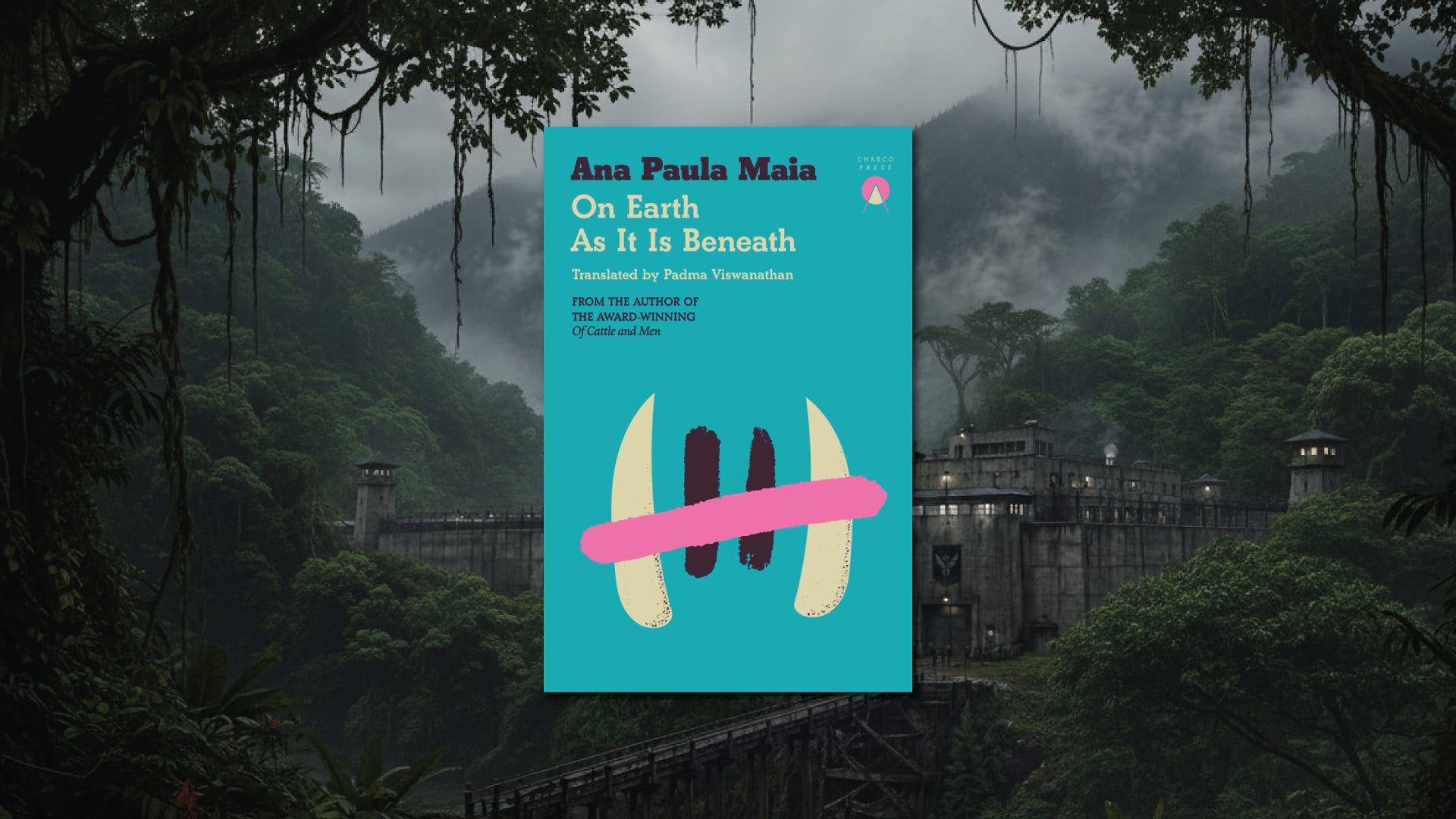
This is not a review. See why.
Context
Deep in the jungles of Brazil is a penal colony surrounded by high walls, and it forms the setting for the bulk of this disturbing novella. The colony was designed as an experiment in rehabilitating violent criminals, mainly murderers, but the experiment failed, and it’s scheduled to be shut down. This proves to be too much for the warden, Melquiades, who begins a horrific practice: Periodically, he allows two prisoners to try to run—and hunts them with a rifle. None have yet escaped. Most of the guards refused to be party to this and quit, leaving only one, Taborda. When the novella opens, only a few inmates are left under their supervision. We also learn early on that a visit from a government official is long overdue. Escape attempts, the eventual arrival of the official, and Melquiades’s continued descent into madness provide the basis for the bulk of the novella’s action.
Ideas (Overall evaluation: shallow)
Violence begets violence
Cowardice and neglect can enable horrors
Violence begets violence
We learn more about inmate Bronco Gil’s backstory than any other character’s. His father had raped his mother, and then learned of his existence and took him in several years later. His father was a contract killer, and Bronco Gil joined the family business at a young age. Eventually he’s caught by the police and sent to jail, then to the penal colony. There he hunts boars to obtain food for the colony, and ends the novella by killing again before going to work in a slaughterhouse. His life is a never-ending cycle of violence, from his conception to the last page. It’s hardly groundbreaking to point out that violence can inspire retaliatory violence, or that a person used to seeing violence used to “solve” problems will be more inclined to consider violence as a solution to his own problems. Nevertheless, this is the pattern we see throughout the novella: One act of violence leads to more.
The novella does not explore the role of choice in this pattern. Bronco Gil did not have to join the family business, but we get next to nothing about his thought process when he volunteers to do so, younger than his father had expected. Once a pattern of behavior becomes habituated and part of a person’s character, it is easy to act on autopilot and continue to act in the same way; indeed, this is what most people do most of the time. However, it is astounding that nobody at the penal colony even considers another way, even if they choose not to act on it. People are not doomed to repeat their past mistakes. Further, the fact that Bronco Gil’s initial choice is given next to no explanation is a shocking omission; he was making a life-altering decision, and surely he had reasons for doing so. But they are missing from the novella.
There’s another, more symbolic way in which violence seems to lead to more violence in the book, and it’s hinted at by the title. The penal colony is not on any random site but one that was used to bury slaves. As under the ground people who were trapped faced their deaths, so above imprisoned people now face theirs. The symmetry is marred, however, by a glaring piece of context: The slaves were victims, whereas the inmates are perpetrators. Further, the penal colony has become dystopic due to the actions of two individuals (the warden and the guard who enables him); it is not part of a broader system that treated an entire race as subhuman.
Cowardice and neglect can enable horrors
The guard who stayed, Taborda, was a subject of morbid curiosity for me. How could he justify continuing to work there after Melquiades turned the place from an unpleasant but legitimate arm of the justice system into a nightmare? Why didn’t he leave and report the horror he’d witnessed? Unfortunately, we never learn. We learn only that he is a coward, and that had he not been, many lives may have been spared. It is not only Taborda who enables Melquiades, though; the book’s cover claims it examines the effect of institutional neglect. We see this mostly by the long overdue visit from the official that finally comes, with the only explanation being that he was busy. Had the penal colony had more supervision, perhaps deaths could have been avoided. Many people in the surrounding area had also heard that nobody ever came out of the penal colony, but nobody asked too many questions. As the dead slaves were buried, so the fate of dozens of murderers is also pushed under the rug. It’s hardly a deep exploration of the point, but the basic question “What could make such an atrocity possible?” does at least have an answer in the novella: cowardice, apathy, and neglect.
The Vibe
Reading this book was miserable. The penal colony is described as being hot and smelly. The violence is described in gory detail. The few glimpses we get into the characters’ psychology are all ghastly. Had it not been so short, I likely would not have finished it.
Conclusion
The premise was intriguing as a dystopian-adjacent work, but On Earth As It Is Beneath is psychologically shallow, deterministic, and simply miserable in its content. Unless one is deeply interested in depictions of prison systems, I would not recommend it.
Comments
Nothing yet. Say the first thing.
Sign in to join the conversation.