
This is not a review. See why.
Context
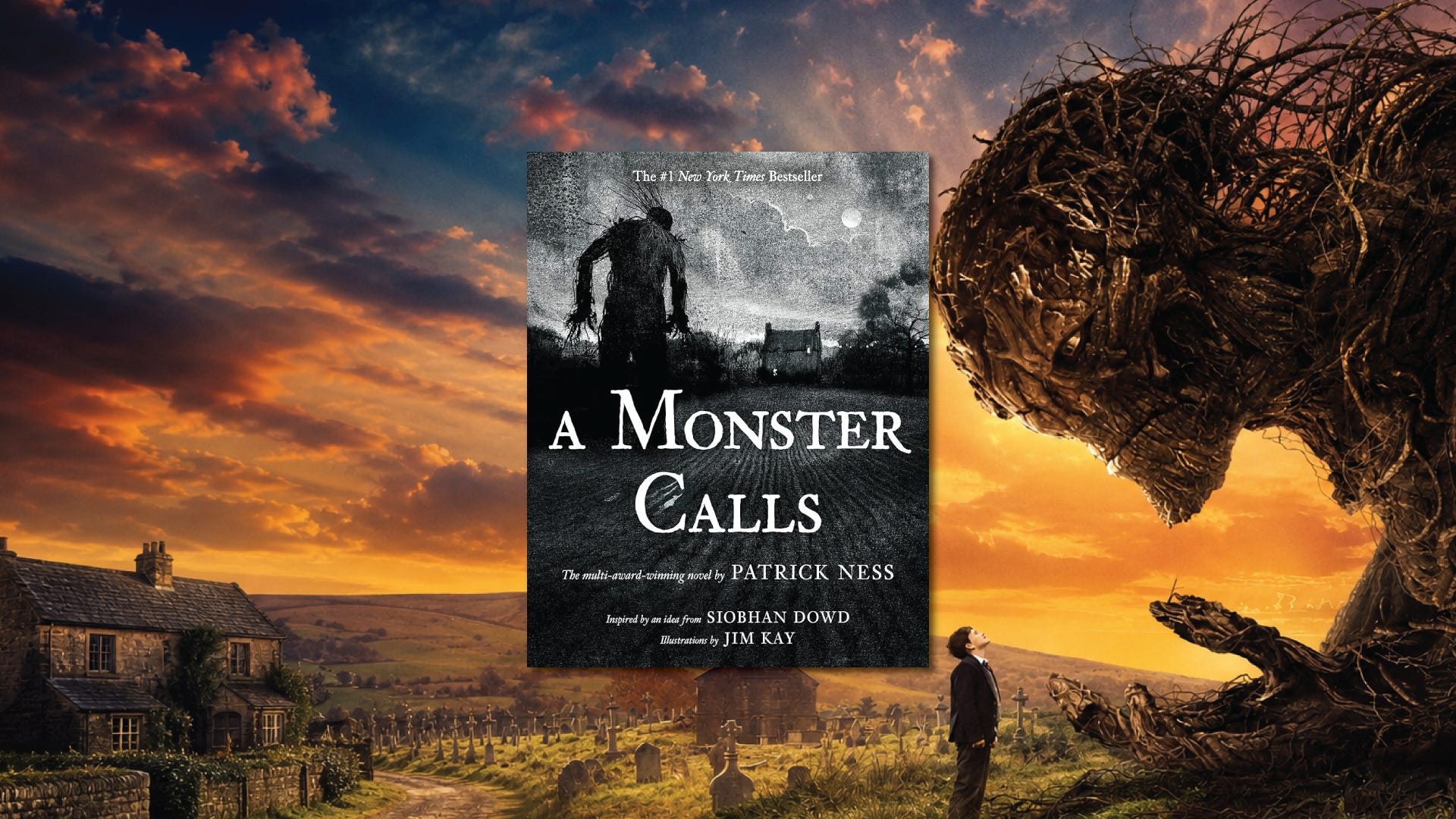
Thirteen-year-old Conor is living a nightmare: His mother is dying of cancer. Further, his father lives in another country, he doesn’t get along with his grandmother, and he’s no longer speaking to his best friend. To top it all off, he’s having actual nightmares. And then the monster comes. The monster, a giant creature that forms from the yew tree Conor can see from his window, comes to tell him three stories, after which Conor will tell the tree his own story. The tales and the process of coming up with his own story help Conor to realize some important truths and begin to process his grief.
A Note on Symbolism: The yew tree is often planted in graveyards (as the tree in the novella is) and associated with death, in part because many parts of the tree are poisonous to mammals. However, the Celts regarded it as a symbol of immortality and rebirth (perhaps the reason early Christians planted it in their graveyards) because the trees can live thousands of years and develop new roots from their branches when they touch the ground. The symbolism persists into modern times, too; for example, in the Harry Potter series, Voldemort’s wand is made of yew—Voldemort being a bringer of death and a seeker of immortality. In modern times, scientists have learned how to develop anti-cancer drugs from compounds found in yew leaves and bark, a fact mentioned in the novella.1
Key Ideas (Overall: good)
Our actions, not our desires, make our characters
Being honest about feelings we deem bad is the only way to free ourselves from them
Pain is isolating if not shared
Our actions, not our desires, make our characters
In the monster’s stories, the situation is always more complex than it first appears. In the first one, a prince tries to save his kingdom by committing a murder and blaming it on the queen, who is a witch. As Conor eventually realizes, the prince wanted to do what he thought was right—to make a difficult decision that would benefit the rest of the kingdom. But murder is not right, whatever the reason. The prince’s desire does not make him the savior he wants to be. This is one example of a few from the monster’s tales and Conor’s life, all coming down to the same point: “You do not write your life with words, the monster said. You write it with actions. What you think is not important. It is only important what you do” (134).
What we think naturally influences how we feel, but we get to control how we handle our thoughts (more on that in the next section) and, importantly, whether we act on them. Our lifestyles, relationships, careers, and health all depend on our actions—wishing that things were different isn’t enough to make them so. The novella also acknowledges the complexity possible in a person’s mind; you can wish two opposing things for the same situation. I want to highlight, though, that it isn’t always the case that our thoughts, feelings, and actions need to be in conflict with each other. In times of emotional turmoil, you may sometimes need to take the reins and push yourself to act in a way you know to be right even when you don’t feel like it, and doing so can even be an act of courage. But this stoic self-discipline needn’t be the norm. Aristotle argued that having one’s knowledge, emotions, and actions aligned was the ideal, but if that wasn’t achievable, it’s still morally praiseworthy to act rightly even when one does not feel like it.2 And as the monster in the novella points out, it is our actions that ultimately decide the course of our lives.
Being honest about feelings we deem bad is the only way to free ourselves from them
On the journey of self-acceptance, one of the hardest steps can be learning to acknowledge and accept all of one’s feelings, even when some of them seem “wrong.” This does not mean always acting on those feelings or always expressing those feelings to others. It means full honesty with oneself. As Conor learns, if you are not honest with yourself about these feelings and where they come from, they will trap you in a web of shame and guilt, which can drive further unpleasant emotions and destructive behaviors. The monster explains,
Your mind will believe comforting lies while also knowing the painful truths that make those lies necessary. And your mind will punish you for believing both.
“But how do you fight it?” Conor asked, his voice rough. “How do you fight all the different stuff inside?”
By speaking the truth. (134)
The novella illustrates this in a way that’s seamlessly integrated with Conor’s journey through dramatic and moving scenes that linger with a reader (details would be spoilers, so I won’t say more).
Pain is isolating if not shared
Conor feels totally alone as he goes through the anguish of his mother’s failed treatments and the added responsibility of taking care of himself when she can’t. His best friend told everyone else at school about his mom being sick without his permission, so he stopped speaking to her. Well-meaning adults try to cut Conor slack, but this makes him feel totally invisible; he feels like what he does doesn’t matter because nobody will criticize him or respond either way. The only person who engages with him is his bully. Conor ends up acting out in a desperate attempt to be seen and taken seriously.
Emotional pain can make one feel totally alone in the world, like nobody else could ever understand what you’re going through. And the pain of losing a parent at a young age is obviously not something everybody has experienced. But people don’t have to have perfect knowledge of your feelings to be supportive and let you know you’re not alone. I know this from personal experience; last year I went through something that few of my friends could relate to—yet nearly all of them made me feel heard, seen, and supported, whether by cheering me up, listening to me, or just sitting with me. In the novella, Conor eventually finds a way to connect with his grandmother over their shared pain. He discovers that by opening up, we may be able to relate to people who initially seem totally different from us.
The Vibe
The writing walks a careful balance of being clear and vivid without making it unbelievable that a thirteen-year-old boy could be thinking and saying the things that Conor thinks and says. Because he’s going through such a difficult time, obviously the main emotional notes are grief, sadness, and anger. Yet there is also hope in what Conor learns from the monster. It won’t be easy, but he won’t be trapped forever.
Conclusion
A Monster Calls deserves praise for tackling a child’s grief in a way that’s accessible and impactful for older children and teens as well as a worthwhile read for adults. An intriguing exploration of grief, emotional complexity, the importance of stories, and self-honesty, this novella is short but powerful.
Acknowledgement: This book was recommended to me by my friend, author of fiction and nonfiction Tim White. You can check out his work at timwhitewriting.com
For example: “But with the things that come about as a result of the virtues, just because they themselves are a certain way it is not the case that one does them justly or temperately, but only if the one doing them also does them being a certain way: if one does them first of all knowingly, and next, having chosen them and chosen them for their own sake, and third, being in a stable condition and not able to be moved all the way out of it”; Aristotle, Nicomachean Ethics, translated by Joe Sachs (Indianapolis; Focus Publishing, 2002), 26.
Comments
Nothing yet. Say the first thing.
Sign in to join the conversation.