
This week we’re taking our last trip of the summer and heading to Maine for the entire week. I am so excited! Last year was my first time going to the lakeside resort where my husband spent many childhood summers, and it is so special…the perfect way to end the summer. I’m planning on taking the week off from the newsletter while I’m gone, with the exception of two This American Lit posts that will go out on Monday and Friday.
If you are a paid subscriber and not subscribed to This American Lit, you can do that by going to fictionmatters.substack.com/account and toggling “on” posts from This American Lit. On your account settings page, you can also get the RSS feed link to get FictionMatters and This American Lit podcast episodes (like the Approaches to Reading The Custom of the Country episode releasing on Monday) in your favorite podcast player. These are now two separate podcast feeds so if you want to get TAL episodes, be sure to doublecheck your account!
Readers, wish me luck and reading time during my lakeside getaway. I’ll see you next week!

This week I read…
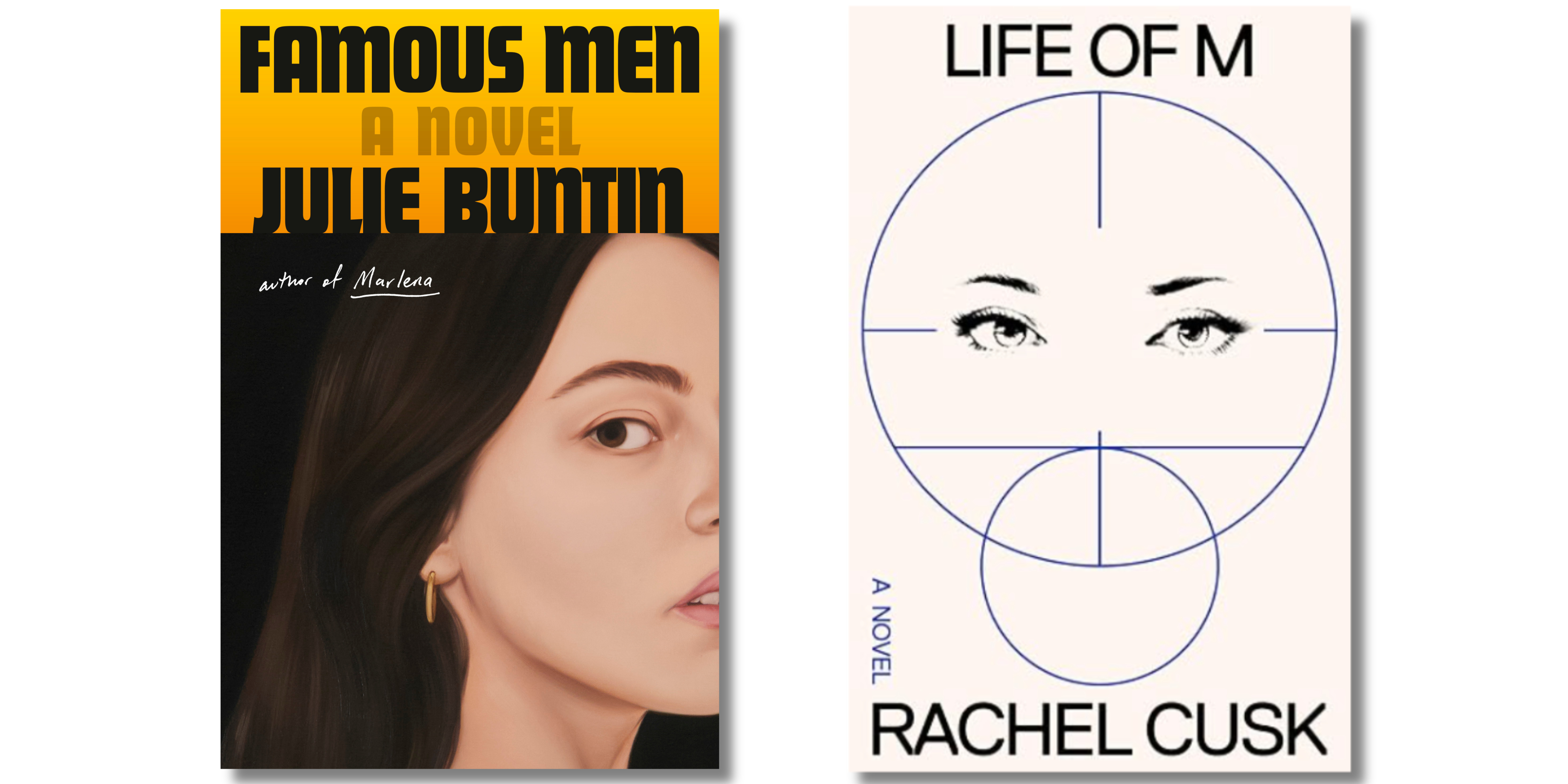
Famous Men by Julie Buntin. Why, oh, why is this wonderful book not receiving more attention? The story is narrated by Wilhelmina Miles (Will for short) who grows up with a single mom in the small town of Greening, Michigan. Will is naturally drawn to the world of language and falls in love with poetry—particularly the poetry of local legend Nathaniel Fellows—while wiling away the time reading in the library of the elite boarding school where her mom works in the cafeteria. We get a lot of Will’s small town backstory—the friends who abandoned her, the boys who gossiped about her, the poetry she inhaled—before she eventually makes her way to NYC and directly into the orbit of Nathaniel himself. Enrolled at a small NYC college, Will talks her way into Nathanial’s MFA poetry seminar as his off-the-books assistant. Now in his 60s, Nathaniel is a renowned figure in the world of letters having published poetry collections, novels, and a memoir that served as inspiration for a film. Will will do anything to remain close, learn from him, and bask in his aura…and while you can imagine correctly where that will lead in the grand scheme of things, this is a novel of context and details where every small decision Will, or, more accurately Buntin, makes.
I think this book is truly brilliant. The story is relatively simple and you could easily hear the premise and think you’ve read similar tales before. But the layers, the depth, and the context Buntin provides here turn this into something very special and profoundly necessary. She’s able to explore this grey space where the relationship that develops between Will and Nathaniel is simultaneously nuanced and black-and-white. She also builds out Will’s world (ignoring Nathaniel’s writing advice to cut all backstory) so we see the way men, the male gaze, economic necessity, loneliness, on and on, have gone into forming her conception of herself and, therefore, led her straight to a man like Nathaniel. The book also brilliantly examines the way male storytelling styles have colonized fiction broadly, and the way men can take up an undue portion of an individual woman’s story. Finally, Buntin’s writing is just so, so good. It is never showy or overstuffed, but it’s the kind of prose that makes you light up with recognition of a thought your feeling you’ve had, but have never been able to articulate. I alternated between print and audio for this one and the wonderful actress Mara Wilson does a lovely job of bringing Will to life. Clearly, I loved this book, and I really hope more readers pick it up. It’s well-worth your time. Bookshop | Libro.fm
Life of M by Rachel Cusk. I will admit to having imposter syndrome when it comes to reviewing this novel because the only other Cusk book I’ve read is A Life’s Work and she is one of those authors who seems always to be reviewed in the context of her body of work. But I’m sharing my thoughts anyways just in case you too are relatively new to Cusk and considering picking up this very buzzy fall release. The novel is narrated by an unnamed writer who meets the actress M at a bookstore. The writer does not know who M is when they meet, but that is a rare thing in the life of M. M is very, very famous and has been since childhood when she costarred in a movie where her role was much to mature, perhaps even provocative, for a child of eleven to be playing. Nothing really happens in this book. The narrator and M meet for coffee, the narrator reflects on her husband’s recent health crisis, the narrator tells us anecdotes about M’s confrontation with a former partner. Rather than filling out a plot or developing a robust character, the relationship between the narrator and M serves as a useful vehicle to explore the nature of identity and the power of art to shape reality. The questions the book is asking are quite interesting and I enjoyed considering how fame at such a young age would warp someone’s sense of self—and then asking whether that is quite so different from a regular person’s experience of identity after all. I like philosophical novels and books that make me ask big questions, and Life of M is certainly fits the bill.
Much has been said and will continue to be said about the rumor that Natalie Portman is the inspiration for M, and that Portman is not thrilled with Cusk’s portrayal. On the one hand, this book clearly isn’t about Portman because it isn’t about anybody. There’s really no rounded out character to explore here. M remains an idea throughout the novel, sometimes frustratingly so even as M-the-idea serves a fascinating role in furthering the questions of identity Cusk wants to pose. On the other hand, the inspiration is clearly Natalie Portman! There are enough details that echo the career trajectory of Portman that Cusk clearly knows people will make the connection, and she chose to write and keep those details. Is it a marketing ploy? Is it mean-spirited? I honestly don’t know! But what this choice does do is force readers to become complicit in the construction of M/pseudo-Natalie. We notice the similarities, we make the connections, we fill in what we know or have suspected or have heard about this celebrity. This active speculation brings the reader into Cusk’s dialectic on fame and identity in an admittedly intriguing way.
Overall, I liked this book quite a bit and recommend it as a short book that demands the readers involvement and attention. While this isn’t a book I loved and adore, I found Cusk to be an exceptional guide into some themes I really enjoyed exploring, and that is a wonderful reading experience in my book. I must also say, however, that the last sentence is so baffling that it makes the entire book slightly less successful. I have no idea what this sentence is doing there and while it’s very possible that my lack of understanding makes me the dummy, I just don’t think I should leave a book feeling like one very odd choice unraveled my understanding. If you read this, please come talk to me about it! Bookshop | Libro.fm
Now I’m reading…
I’m almost done with The Bear Hunter’s Daughters: A Tale of Seven Sisters by Anneli Jordahl which is our FictionMatters Book Club selection. It’s been a wild ride and I’m enjoying reading something that feels totally itself.
New on my TBR…
I received an early copy of Serious Music by Percival Everett (#galleybrag), and I think I might pick it up soon.
💬 Tell me about your week in books! What did you finish, what are you reading now, and what have you added to your TBR?

The biggest books this autumn. (The Guardian)
The best reviewed books of the week. (Lit Hub)
7 graphic novels that build stories from fragments. (Electric Lit)
Did smartphones kill reading? (Lit Hub)
The best recent translated fiction. (The Guardian)
A definitive rating of Tana French novels. (Electric Lit)
Traci Thomas talked with Martha Adams about translated literature and the conversation is (unsurprisingly) delightful!

The new Rachel Cusk novel is already creating quite the stir and it hasn’t even released yet! In this NYT review (gift link), Alexandra Jacobs asks how Cusk’s novel answers the question, can celebrities be people too? The Guardian’s review explicitly posed the Natalie Portman question, as well. This Vulture article tracked all the overlaps between Cusk’s M and Natalie Portman—you can see hear what I mean when I say there’s no way Cusk didn’t understand that people would make this connection, whatever her intensions.
A couple weeks ago we started getting a physical copy of the Sunday New York Times and I am thrilled with this development. It was kind of shocking to hear my almost-five-year-old ask “what’s a newspaper?!” and I’m glad she will know about this historical artifact in a real way. I’ve enjoyed reading the time sensitive news on Sunday and then slowly making my way through what interests me in the rest of the paper and the supplementals. There are four main perks I’ve discovered so far: 1) I read articles I wouldn’t click on, but end up getting a lot out of; 2) When I read a physical article, I’m more likely to read the entire thing without skimming; 3) Louise sees us reading something physical rather than looking at our phones; and 4) you get unlimited gift links with a Sunday delivery subscription, which is quite useful for this newsletter.
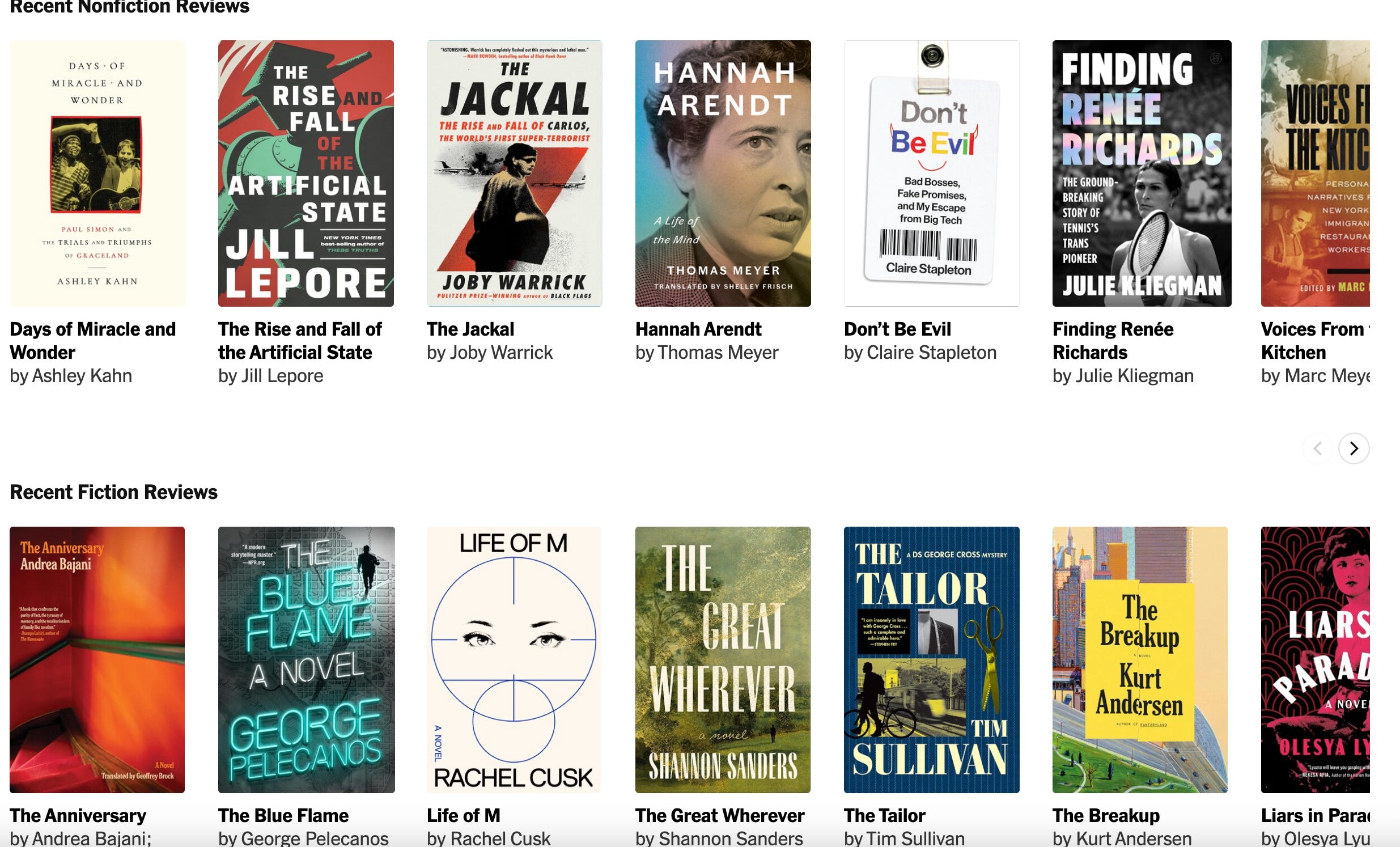
Okay, speaking of the NYT…the Book Review appears to have changed their homepage and I don’t like it one bit. While I can see the benefit of scrolling through book covers to find reviews, I like seeing the headlines and bylines that accompany those reviews. To me, it looks like a very nice, very fancy blog now instead of THE Book Review. I’d love to know more about this change, what inspired it and if it signals anything about the direction the Book Review is headed.

For questions, comments, or suggestions, please don’t hesitate to reach out by emailing fictionmattersbooks@gmail.com or responding directly to this newsletter. I love hearing from you!
This email may contain affiliate links. If you make a purchase through the links above, I may earn a small commission at no additional cost to you.
If you enjoyed today’s newsletter, please forward it to a book-loving friend. That’s a great way to spread bookish cheer and support the newsletter!
Happy reading!

Comments
Nothing yet. Say the first thing.
Sign in to join the conversation.