
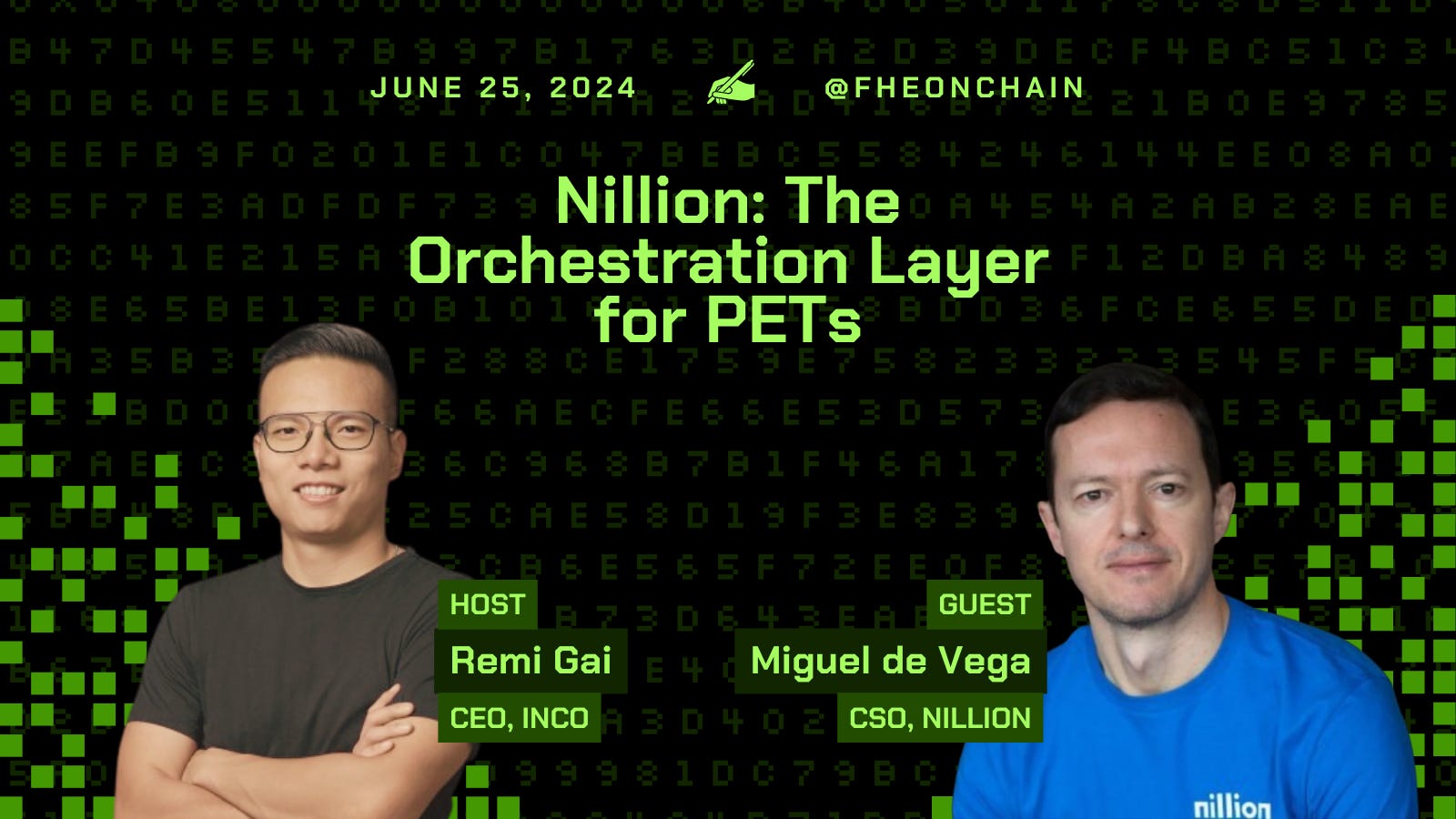
This week, we got the chance to speak with the CSO of Nillion Network, Miguel de Vega. With 25 years of experience in distributed systems, Miguel has been in this game for a long time and is making big waves with Nillion.
This interview was one of our most interesting yet, so make sure to check it out. It is nearly an hour, jam-packed with dense topics broken down by one of the foremost experts in this space. If you haven’t taken the time to listen to it, make some time.
Let’s get into it!
Full video ⬇️
Introduction to Nillion 53 seconds →
Nillion is building a decentralized network of blind computers. The main function of this decentralized network is to compute highly sensitive data.
Traditionally, data is not encrypted end-to-end, only during storage and transmission. Nillion is building a network in which data is encrypted during storage, transmission, and processing.
Blockchains decentralize transactions whereas Nillion wants to decentralize computation.
Why is FHE considered a type of MPC 2 minutes 35 seconds →
FHE in its most simple form is all about computing on top of encrypted data. FHE is usually organized in a client-server architecture. The client sends encrypted data to the server, and the server computes and returns the answer.
With MPC, the architecture more closely resembles a decentralized network. By running only part of the full computation, an MPC network protects the security of the data.
There is a version of FHE, which Inco uses, where MPC is leveraged during decryption. Functionally this means that no one party can fully decrypt the data, as no single one of them have the full private key. In this scheme, FHE protects the data during computation, and MPC protects it during decryption.
Yao’s Millionaire Problem 4 minutes 40 seconds →
This conceptual problem is famous for being a test of secure computation. It describes two friends, both millionaires, who want to see who has more money without revealing to each other how much each has.
One way of solving this is with a client-server FHE architecture. In this scenario both millionaires are clients and send their net worth as a ciphertext to the server which computes the data, returning a response to both clients. The problem with this solution is that both have the decryption key.
Another way of solving this issue is with a blockchain, still using FHE. Everyone can now compute the result, rather than just one server. In this scenario, the decryption key could be protected through MPC.
The last scenario is pure MPC, where both millionaires provide some of their data, collaboratively compute, and then get a result. This is true only in theory as most of the time the computation is outsourced to a server.
The functional difference between MPC and FHE is that FHE computing is done through one server, whereas MPC computing is spread through many nodes.
Tradeoffs between MPC and FHE 9 minutes 9 seconds →
There are three ways to look at this: communication, bandwidth, and computational complexity. Simply put: how many messages need to be sent, how much information must be sent per message, and how complex the computation for that message is.
The three ways of building MPC, FHE, garbled secrets, and linear secret sharing all score differently when measured in the above format.
FHE scores the worst in computational complexity, garbled secrets scores the worst in bandwidth complexity, and linear secret sharing scores the worst in communication complexity.
The fact that each version has a different tradeoff, makes using all of them together the natural conclusion.
FHE must be protected against the nodes deviating from their purpose. Verifiable FHE solves this.
Nillion’s Orchestration Layer 13 minutes 50 seconds →
Nillion’s thesis is that there is no silver bullet in PETs (privacy enhancing technologies) and that all schemes must be organized to get the best result. The goal is to aggregate all PETs and create a framework that allows for new ones to be onboarded into the orchestration layer with ease.
Because of how different these schemes are the space is highly fragmented, making the developer experience very complicated and esoteric. For instance, moving data from secret shares to ciphertext is very complicated.
Nillion’s orchestration layer is all about removing the barriers for developers and breaking down the silos that currently constrain creativity and progress in the PETs space.
Additionally, creating value coordination through this fragmented ecosystem will help create an environment that incentivizes active development.
What happens under the hood? 18 minutes 4 seconds →
The end goal (level four) is to create a development environment in which the developer does not need to know anything about PETs, and can simply use unique data types, integers, and fixed point arithmetics to build their privacy-enhancing applications. The compiler would pick the best combination of PETs to execute the developer’s vision.
Level one of this vision is to create a library for each PET.
Level two is when these are orchestrated through another language such that you can switch between libraries seamlessly.
Level three is when each type (MPC, FHE, etc) is bundled such that depending on the use case, TFHE or BGV FHE is used.
MPC vs FHE (onchain) 22 minutes 22 seconds →
In an FHE blockchain setting, you have global states, and consensus is needed on the value of that state. In an MPC blockchain setting, it is slightly more flexible. MPC has different subnets (clusters) that can operate independently. Consensus is only needed in one cluster, not all the clusters, all the time.
Removing nodes in MPC networks is not like removing a node in a blockchain network, and must be done with more care to keep all the data whole.
Size of Networks 27 minutes 34 seconds →
2-party networks all the way up to <100.
Different clusters of nodes can have different hardware requirements. For instance, an FHE cluster would need much different software than a linear secret-sharing cluster.
Networks can be repurposed to support existing systems and blockchains. For instance, Nillion could be leveraged to secure decryption on the FHE-based L1 built by Inco.
Nillion Today 31 minutes 50 seconds →
Signatures is a huge use case. Voting is also a big one, for DAOs specifically.
Some more are private trading, encrypted order books, health analytics, supporting research, supply chains, AML, and biometric identification.
Personalized AI is a huge use case that Nillion is interested in. PETs are extremely important here as you cannot have an AI that knows everything about you that is not 100% secure.
Wavelets 35 minutes 30 seconds →
Wavelets cheapen computing as they are the approximate version of the original operation, but simpler.
An issue with this efficiency-enhancing method is that for certain use cases like smart contracts, when implementing wavelets you lose enough definition in the data to render it useless. Accordingly, this technique works very well for LLM solutions.
MPC-ML vs FHE-ML 41 minutes 43 seconds →
Given that ML is already computationally heavy, with MPC you avoid the computation bottleneck that occurs when using FHE. Additionally, with MPC you suffer from an increased number of nodes.
On the other hand, FHE doesn’t require pre-processing which can amount to gigabytes.
Path for scaling Nillion 45 minutes 57 seconds →
The first step is incorporating more and more PETs.
For those that want FHE computations, it will be about scaling hardware.
For linear secret sharing, we cannot change the speed of light, so not much to do here.
What’s next? 47 minutes 55 seconds →
Check out the Nillion SDK at Nillion.com. You can develop in Python or Java.
Miguel wants to highlight the fact that for more intelligent answers from LLMs, we must give them more time to compute. As LLM answers become more intelligent, the data shared will become more sensitive. This is why we need PETs to secure LLM data in the future.
Confidential LLMs are a few years away still.
The conversation with Miguel de Vega, CSO of Nillion Network, gave us invaluable insights into the world of Fully Homomorphic Encryption (FHE) and Multi-Party Computation (MPC). Through this discussion, we explored how Nillion is revolutionizing secure computing with its unique orchestration layer and its approach to privacy-enhancing technologies (PETs).
Miguel's expertise and the innovations at Nillion shed light on the potential of PETs in decentralization and confidentiality. With the Nillion network, data is encrypted not only during storage and transmission but also during processing, providing a level of security that is rare in today's technology landscape.
The conversation emphasized that there is no one-size-fits-all solution in PETs. Nillion's orchestration layer aims to bring together various cryptographic techniques to create a unified framework for developers. This approach not only streamlines the development process but also opens the door to new use cases in AI, blockchain, and more.
If you haven't listened to the interview yet, we highly recommend you do. It's filled with valuable information and interesting discussions that highlight the future of secure computing. Keep an eye on Nillion as they continue to break new ground in this exciting field.
No posts
Comments
Nothing yet. Say the first thing.
Sign in to join the conversation.